⚡ ShopSideK Verdict
The best dropshipping Shopify app for most new merchants is FFOrder — it offers manual quality checks on every package, 7–9 day US/EU shipping, a dedicated 1-on-1 account manager, and a free $15 signup coupon. Unlike CJDropshipping, FFOrder scales with you from first sale to branded private-label products without switching apps. For custom branding and premium unboxing, Zendrop is the strongest choice. For high-volume automation across multiple suppliers, AutoDS is the enterprise pick.
FFOrder Dropshipping
1.7M+ products from 40,000+ factories with manual quality inspection on every package. Dedicated 1-on-1 account manager via WhatsApp. Scales seamlessly into private labeling, custom packaging, and factory-direct wholesale pricing — no app switch needed.
💰 Free to install · You pay per order · Free sourcing requests
Exclusive ShopSideK Perk: $15 Signup Coupon
Zendrop
Custom-branded thank-you cards, packaging, and invoices ship with your products. Transforms a generic dropshipped package into a professional unboxing experience that builds your brand identity and drives repeat purchases.
💰 Free plan available · Paid from $49/mo for branding features
Start Branding Free →AutoDS
Central automation hub for high-volume stores. Automates fulfillment across AliExpress, Amazon, and CJ. Multi-supplier routing prevents stock-outs during peak seasons by auto-switching to backup suppliers.
💰 Trial available · Paid from $26.90/mo
Automate Your Store →Also Featured in This Playbook
If you’ve searched for the best dropshipping Shopify apps, you’ve likely scrolled through endless lists of dozens of tools. They’re overwhelming, often biased, and leave you with more questions than answers. The truth is, the perfect app for a brand shipping 500 orders a day is the wrong choice for a founder searching for their very first sale.
Forget the generic lists. This is a playbook.
We’re taking a different approach by giving you the exact app stack you need for the three distinct phases of a dropshipping business: starting, growing, and scaling. This guide provides a clear action plan to help you select the right tools for your budget, goals, and current challenges.
Not sure how the dropshipping model itself works yet? Before choosing your apps, it’s worth getting the full picture with our complete guide to dropshipping on Shopify—it covers the entire business model from setup to first sale.
Find Your Stage: The 3 Phases of a Dropshipping Business
Choosing a dropship Shopify app isn’t a one-time decision—it’s an evolution. The features you need when you’re hunting for your first product are fundamentally different from the automation required to manage thousands of orders. Using a high-powered automation suite from day one is like buying a semi-truck to go grocery shopping; it’s expensive, complicated, and completely unnecessary.
This playbook is built around finding the right dropshipping Shopify apps for your specific growth phase.
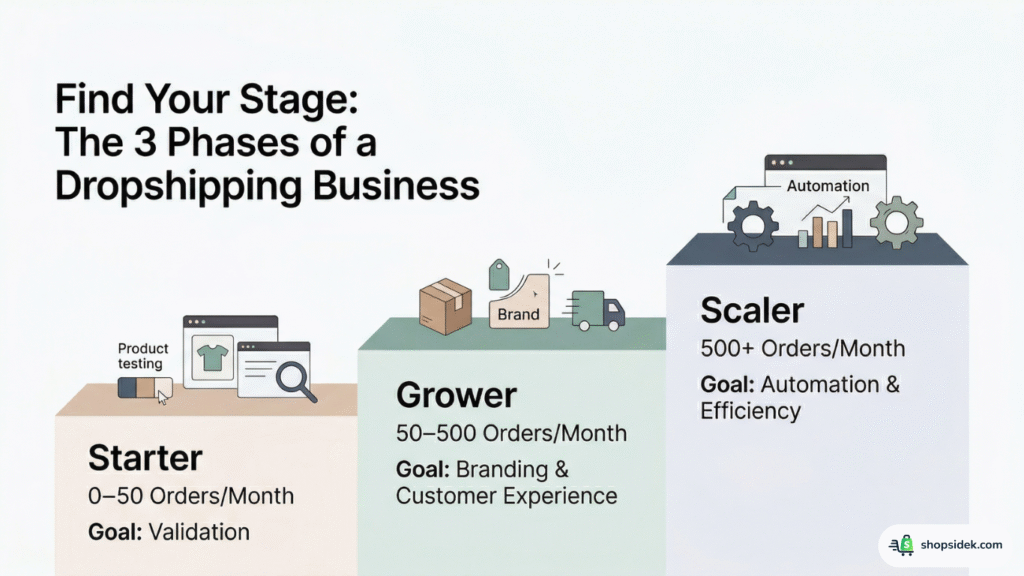
Phase 1: The Starter (0–50 Orders/Month)
Your primary goal is validation. At this stage, everything is about finding a potentially winning product and confirming that real customers will buy it. Your focus should be on keeping costs and risks as low as possible while you test your ideas in the market.
Phase 2: The Grower (50–500 Orders/Month)
You’ve found a product that sells, and you have consistent orders. Your goal now shifts to building a real brand and improving the customer experience. This means finding suppliers with faster shipping, adding custom branding to your packaging, and encouraging repeat purchases.
Phase 3: The Scaler (500+ Orders/Month)
Your business is now a high-volume operation. The main goal is maximizing profit through advanced automation and operational efficiency. You need to prevent stock-outs, manage multiple suppliers seamlessly, and get crystal-clear data on your profit margins as you scale.
The Starter Playbook: Your First Winning Product
Welcome to Phase 1. At this stage, your mission is simple: validate a product idea without breaking the bank. Forget complex automation or expensive subscription fees. Every dollar and hour should go toward answering one question: “Will people buy this?”
Your dropshipping Shopify apps should be lean, powerful, and focused on sourcing products and building instant credibility.
💡To keep your overhead at zero while you validate, it’s also worth exploring our full roundup of the 18 best free Shopify apps for new stores—many of which pair perfectly with the starter stack below.
Starter Dropshipping Shopify Apps: FFOrder & Judge.me
This two-part stack gives you everything you need to find a product, get it on your store, and make it look trustworthy from day one—all for free.
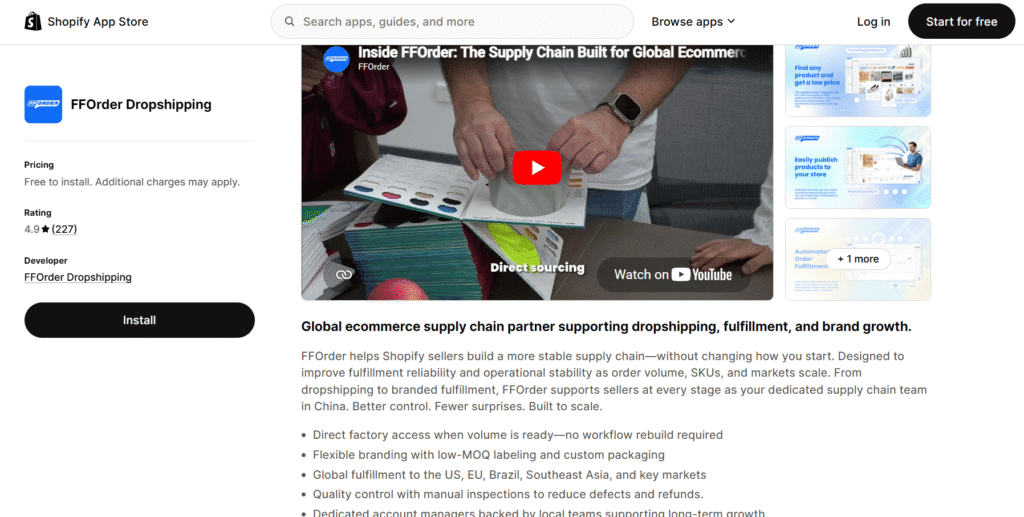
✅ FFOrder Dropshipping: The ultimate free sourcing partner for beginners. It connects you to a massive catalog of 1.7 million+ winning products and 40,000+ Chinese factories. What makes FFOrder the absolute best choice for beginners is their manual quality checks—their warehouse team hand-inspects every package before it ships, which prevents customer complaints and refund requests.
They also offer a free Sourcing Request service: if you find a product on AliExpress or an advertiser’s store, just submit the link and their team will negotiate direct factory-level pricing for you. They provide fast shipping to the US/EU in 7-9 business days (10–15 business days globally) with tracking numbers automatically synced within 24 hours.
Shopify App Store Rating: 4.9 stars (230+ reviews)
🎁Special Deal: $15 Signup Coupon (ShopSideK Exclusive)
Why FFOrder Beats CJDropshipping for Beginners
While CJDropshipping has historically been a popular free tool, FFOrder provides critical upgrades that directly solve the most frustrating beginner pain points. As highlighted in our FFOrder dropshipping review, these features give new stores a massive competitive edge. Here is a direct comparison:
| Feature | CJDropshipping | FFOrder Dropshipping |
|---|---|---|
| Entry Cost | Free to install | Free to install (plus $15 signup coupon) |
| Quality Control (QC) | Basic automated scan; high rate of defective products | Manual inspection by warehouse staff on every package |
| US/EU Shipping Times | 10–20+ days (frequent delays during holidays) | Fast shipping in 7-9 business days |
| Customer Support | Ticket-based support; long queues and slow replies | Dedicated 1-on-1 account manager via WhatsApp/WeChat |
| Custom Branding | High MOQ required for custom boxes/bags | Low-MOQ private labels, custom cards, and poly mailers |
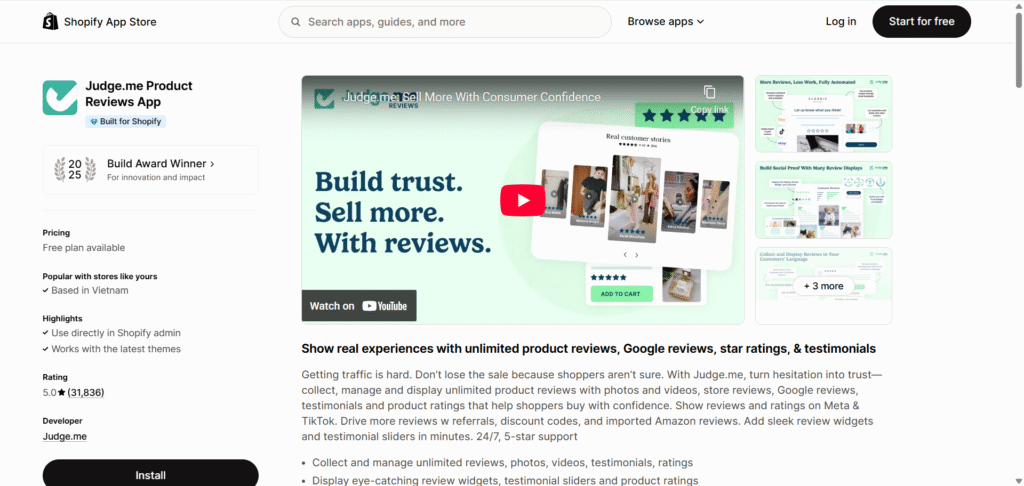
✅ Judge.me Product Reviews: A new store with zero reviews feels empty and untrustworthy. Judge.me solves this instantly. Its free-forever plan allows you to import existing product reviews, including photos, from sources like AliExpress. This social proof is one of the most powerful tools for securing your first sales.
Shopify App Store Rating: 5.0 stars (37,360+ reviews)
💡Judge.me is just one of many options. If you want to explore the full range of review apps—including specialized tools for visual brands and dropshippers—read our best Shopify product review apps post.
Your Action Plan: Finding and Importing Your First Product
Follow these three steps to go from an empty store to a product page ready for customers.
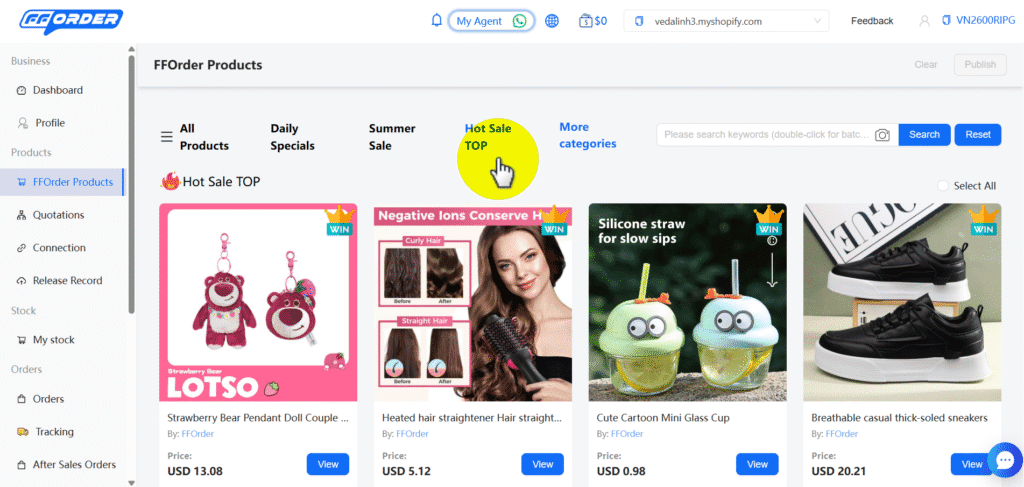
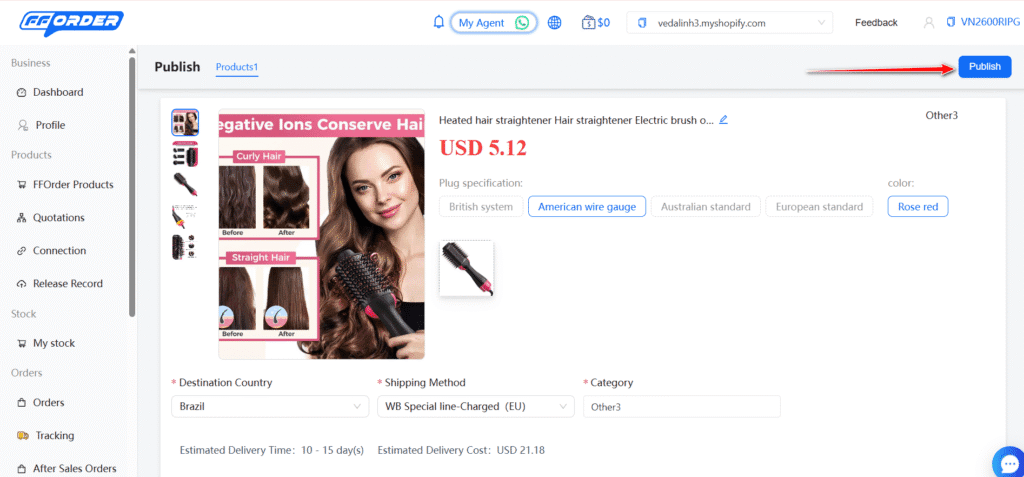
1. Discover a Hot Product in FFOrder: Once connected to your Shopify store, navigate to the “Hot Sale TOP” section in the FFOrder Products dashboard. This area shows you what’s currently popular, giving you a data-driven starting point instead of relying on guesswork.
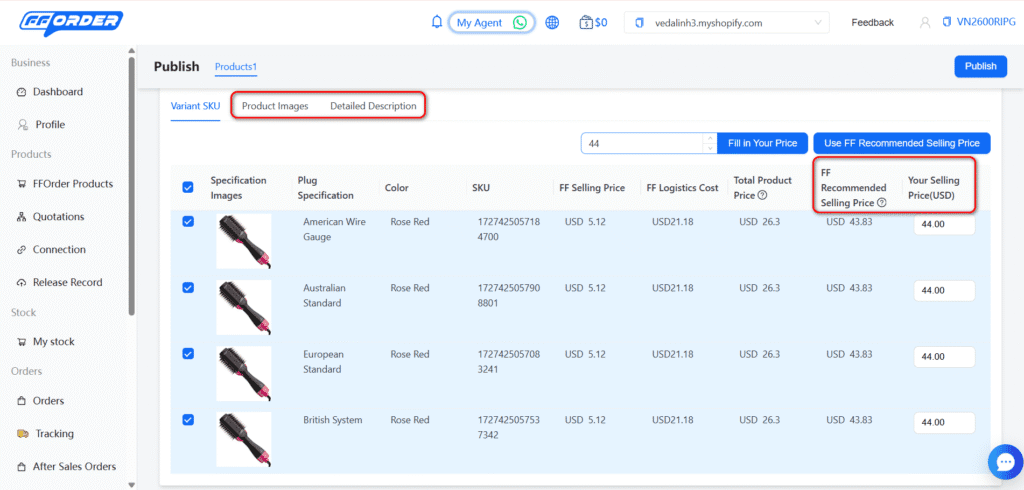
2. List the Product to Your Store: When you find a product you like, simply click the “Publish” button. FFOrder allows you to edit the product title, description, and pricing before pushing it directly to your Shopify store with one click.
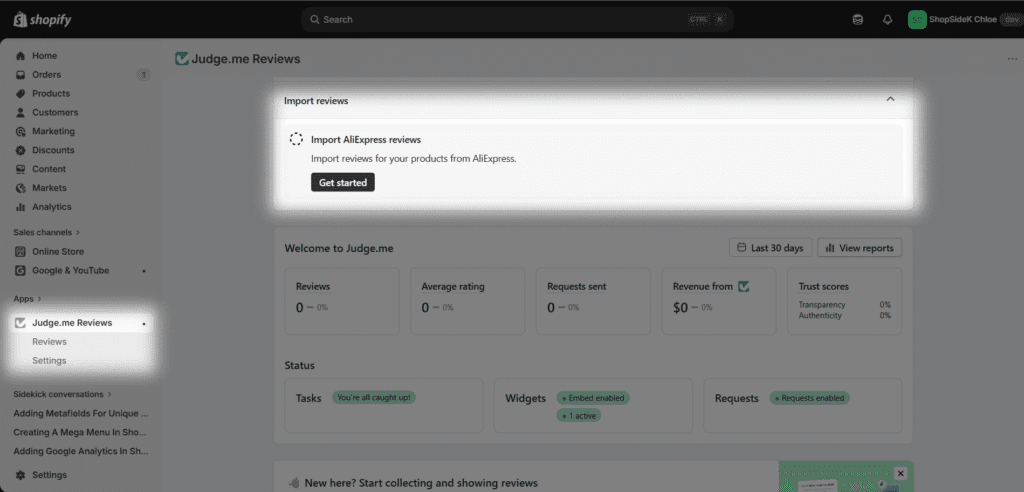
3. Build Instant Social Proof with Judge.me: With the product now live, open the Judge.me app. Use its review importer to find the original product on AliExpress and pull in existing customer reviews. My advice is to prioritize importing reviews that include real customer photos for maximum credibility.
Limitations & Mistakes to Avoid
The starter stack is designed for validation, not for building a premium brand. Be aware of its limitations and common beginner mistakes.
Limitations: While FFOrder is a massive upgrade over generic Chinese suppliers, global shipping to remote countries (like Brazil or certain parts of Latin America) can still take 10–15 business days. However, for major markets like the US and EU, you can consistently expect fast shipping to the US/EU in 7-9 business days.
Mistake to Avoid: Skipping the Sample Order. This is the single biggest mistake new dropshippers make. You must order a sample of your product and have it shipped to yourself before you sell it. Here’s why:
- You Verify Product Quality: What you see in supplier photos isn’t always what you get. A sample lets you feel the quality firsthand.
- You See the Real Packaging: Does it arrive in a branded box or a crumpled plastic bag? The unboxing experience is part of your brand.
- You Experience Actual Shipping Times: This is non-negotiable. Keep in mind, you can’t promise a 10-day delivery if your own sample takes 25 days to arrive.
The Growth Playbook: Building a Real Brand
You’ve validated your product and have a steady stream of orders. Congratulations—you’ve moved from being a starter to a grower. Your mission now shifts from simply making sales to creating a memorable customer experience that earns loyalty and repeat business. This means tackling the biggest weakness of the starter phase: slow shipping and generic packaging.
At this stage, you graduate from mass-market sourcing platforms to more curated solutions that offer faster shipping and branding features.
💡If you’re still building out your Shopify store’s foundation, our complete Shopify business playbook covers everything from account setup to your first marketing campaign.
Growth Dropshipping Shopify Apps: FFOrder, Zendrop, & Omnisend
These Shopify dropshipping apps are designed to professionalize your entire operation, from fulfillment to marketing.
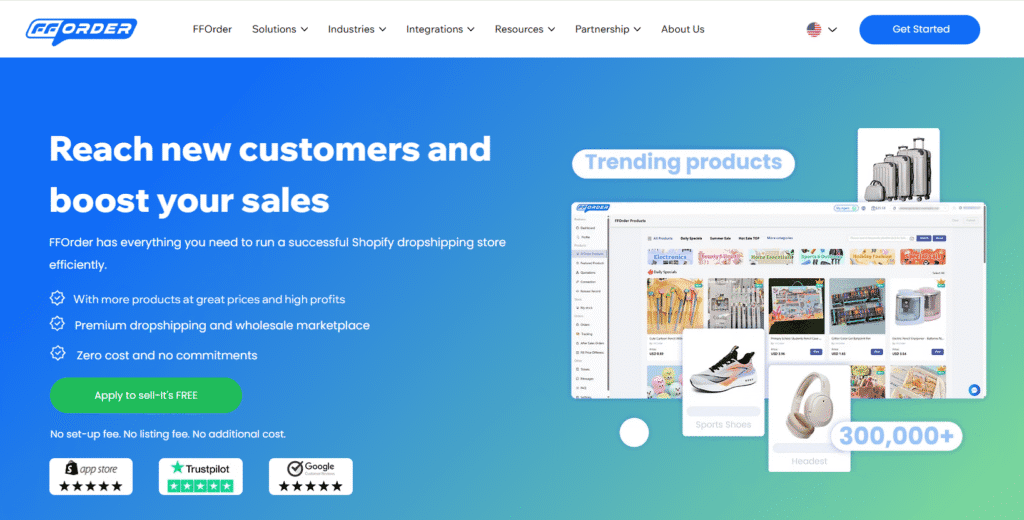
✅ For Sourcing & Scaling: FFOrder Dropshipping
If you started with FFOrder in Phase 1, you have a massive advantage in Phase 2: you don’t have to switch apps or rebuild your workflow to scale. Once you reach consistent orders, you can contact your dedicated 1-on-1 account manager to unlock private labeling, custom neck tags, logo stickers, and branded eco-packaging with extremely low MOQ.
FFOrder also grants you direct factory access, letting you buy inventory at true wholesale prices and stock them in their 13,000㎡ warehouses for automated 24h dispatch, instantly boosting your profit margins.
✅ For Custom Branding: Zendrop
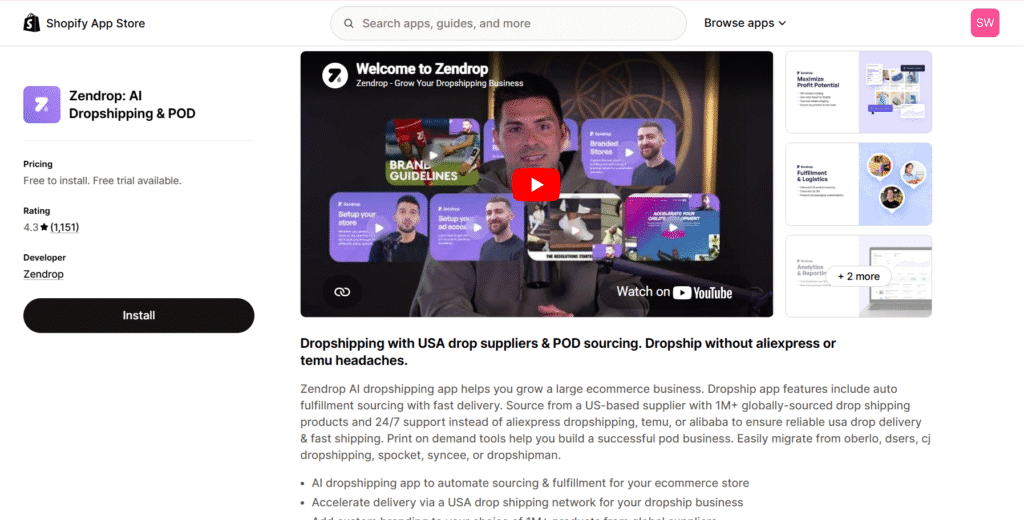
While Zendrop offers a wide range of products and access to faster shipping options, its standout feature is custom branding. You can create custom-branded thank-you cards, packaging, and invoices that ship with your products. This transforms a generic dropshipped package into a professional unboxing experience that builds your brand identity.
Shopify App Store Rating: 4.3 stars (1,140+ reviews)
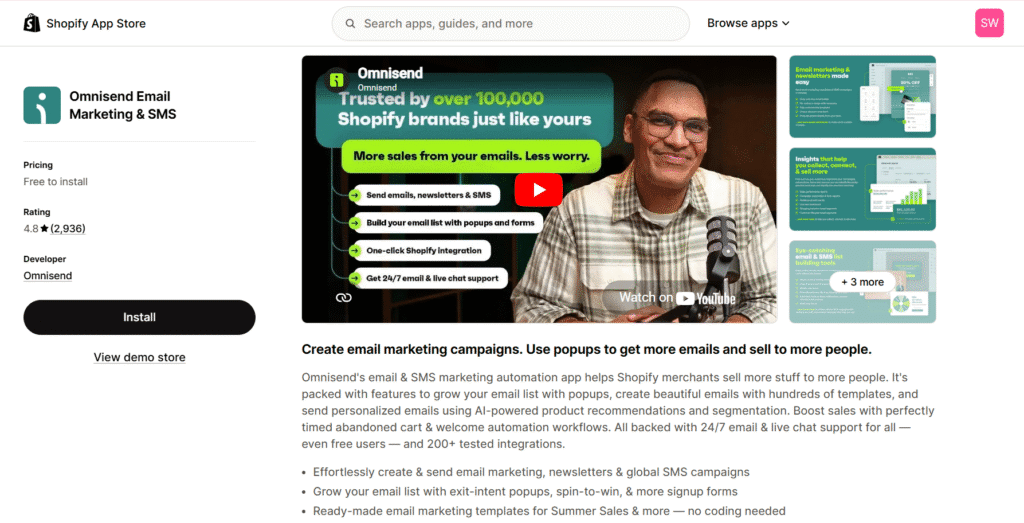
✅ For Marketing Automation: Omnisend
As you grow, you can’t manually email every customer. Omnisend automates the crucial communication that drives sales and loyalty. Set up “set-and-forget” email flows to recover abandoned carts, welcome new subscribers, and send post-purchase follow-ups to encourage a second purchase. According to Omnisend, their users earned an average of $79 for every dollar spent on the platform in 2025.
Shopify App Store Rating: 4.8 stars (2,930+ reviews)
💡If you want to go deeper on email marketing strategy beyond just your dropshipping stack, read our full guide to the best email marketing apps for Shopify.
Your Action Plan: Vetting a Faster Supplier
In my opinion, upgrading your supplier is the most important step in the growth phase. Here’s how to do it professionally.
- Contact Your Dedicated VIP Agent: Ask your FFOrder account manager to optimize your shipping routes to guarantee fast shipping to your target market. You can also discuss options for custom tags, insert cards, and custom packaging.
- Order Samples to Verify Everything: Just like in the starter phase, ordering a sample is non-negotiable. But now, you’re evaluating more than just the product. Scrutinize the shipping speed, the quality of the packaging, and the tracking information provided.
- Ask the Right Questions: A professional supplier is a partner in your business. Before committing to them, you should understand their policies. Use our checklist to ask about return policies, liability for lost packages, and options for custom packaging.
📑Resource Drop: Download our free Supplier Vetting Checklist PDF to get the 10 essential questions you must ask any new dropshipping supplier.
Limitations & Key Considerations
Moving to a premium supplier network involves important trade-offs you need to know.
Limitations: Scaling your brand requires close communication. While FFOrder automates shipping and tracking, customizing your branding requires you to coordinate with your VIP agent to approve sample designs for neck tags and packaging inserts before they go live on customer orders.
The Strategic Trade-Off: While overseas shipping remains fast and quality is guaranteed via manual inspections, you are investing a small amount in custom branding elements (like logo stickers and insert cards) to elevate the unboxing experience. This minimal branding investment pays for itself through a higher repeat purchase rate and increased customer lifetime value.
Ready to graduate from testing products to building a real brand? The right platform makes all the difference. Start your Shopify store today and integrate with a premium supplier for a professional customer experience.
The Scale Playbook: Automating for Maximum Profit
Your business has serious momentum. With hundreds of orders flowing in each month, your focus shifts from brand building to operational excellence. Every wasted minute and every untracked dollar represents a significant drain on your profitability. The mission now is to automate processes, remove bottlenecks, and gain a crystal-clear understanding of your finances to maximize your bottom line.
At this stage, you need an enterprise-grade “mission control” for your entire operation.
Scale Dropshipping Shopify Apps: AutoDS, Duoplane, & TrueProfit
This stack is for serious business owners who need to manage complexity, automate fulfillment, and make decisions based on precise financial data.
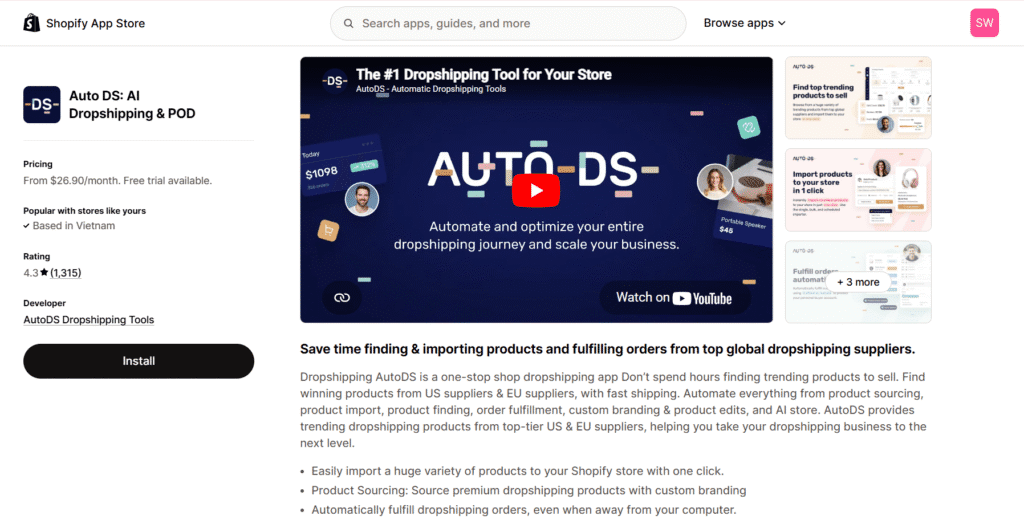
✅ For Broad Supplier Automation: AutoDS
AutoDS acts as a central hub for automating your entire dropshipping workflow across a wide network of public suppliers like AliExpress, Amazon, and CJdropshipping. It handles order fulfillment, price and stock monitoring, and provides advanced product-finding tools, freeing you up to focus on marketing and growth.
Shopify App Store Rating: 4.4 stars (1,310+ reviews)
✅ For Advanced/Private Supplier Integration: Duoplane
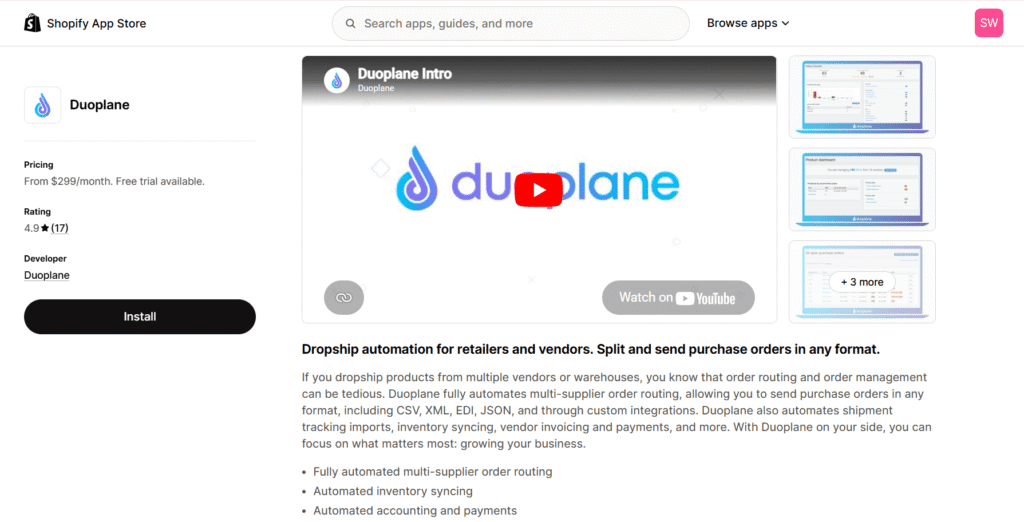
If you’ve established relationships with your own private suppliers, distributors, or even have your own warehouse, Duoplane is the next step up. It’s a more advanced (and expensive) solution designed for deep integration with specific vendors, automating complex inventory routing and order splitting. It’s the choice for high-volume retailers who have outgrown public marketplaces.
Shopify App Store Rating: 4.9 stars (17 reviews)
✅ For Financial Clarity: TrueProfit
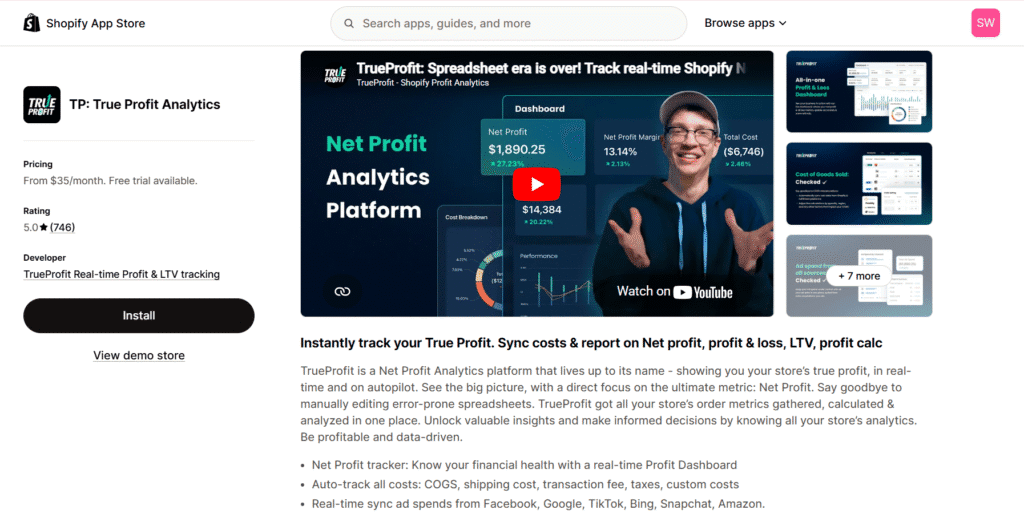
At scale, spreadsheets are a liability. TrueProfit is a dedicated profit analytics dashboard that gives you a real-time, accurate view of your business’s financial health. It automatically pulls in data from your ad accounts (Meta, Google, TikTok), COGS from your suppliers, and transaction fees to give you a true net profit calculation. Understanding these numbers is essential for optimizing ad spend and maximizing your margins.
Shopify App Store Rating: 5.0 stars (740+ reviews)
💡 Not quite at TrueProfit scale yet? Our free Shopify Profit Margin Calculator is a great starting point to understand your margins and break-even points at any stage of growth—no paid subscription required.
Your Action Plan: Preventing Stock-Outs with Automation
During peak sales seasons like Black Friday, your best-selling product going out of stock can cost you thousands in lost revenue. Advanced automation prevents this.
The key concept is multi-supplier routing. A platform like AutoDS or Duoplane allows you to map a single product to multiple suppliers. If your primary supplier runs out of inventory, the system automatically reroutes new orders to your designated backup supplier without any manual intervention. This creates operational resilience, ensuring your sales momentum is never halted by a single supplier’s inventory issues. In practice, it’s a critical strategy for protecting revenue when demand is at its highest.
Limitations & Choosing Your Path
These powerful tools come with significant commitments of both time and money. It’s crucial to understand that they are not for everyone.
The primary limitation is cost. These are premium, enterprise-level solutions. Duoplane’s plans, for example, start at $299 per month and go up from there. This level of investment is only justifiable when you are managing a high volume of orders where manual processing is costing you more in time and errors. For any business in the Starter or Grower phase, these tools are simply overkill. Choose this path only when the complexity of your operation has become the main obstacle to your next level of growth.
Conclusion: Stop Searching for One “Best” App. Build Your Stack.
The search for the “best” dropshipping apps for Shopify is a trap. As your business evolves, your needs will change, and your tools must evolve too. The key to success isn’t finding one perfect app, but building the right stack for your current challenge.
Start by validating your product with low-cost, quality-controlled tools like FFOrder. As you grow, leverage FFOrder’s private labeling and factory-direct pricing to scale your brand without having to switch apps or rebuild your entire fulfillment workflow. When you reach high volume, invest in powerful automation hubs like AutoDS to maximize your operational efficiency and profit margins.
You have the complete guide. The next step is to execute. Sign up for Shopify, choose your starter stack, and launch your dropshipping business today.

FAQs About Top Shopify Apps For Dropshipping
Is dropshipping still profitable in 2026?
Yes, absolutely—but the model has matured. The way I see it, the era of simply finding a cheap product on AliExpress and running ads to a generic store is over. Today, profitability in dropshipping depends on building a real brand, providing a great customer experience, and marketing effectively.
Success now comes from faster shipping, quality products, and a professional brand identity, which is why graduating through the stages in this playbook is so critical.
How do I handle returns with a Shopify dropshipping app?
This is a crucial question that highlights the importance of your supplier relationship. The app is just the technology that connects you; the actual return policy is set by your supplier.
Before you sell a single item, you must understand their process: Do they accept returns for buyer’s remorse? Who pays for return shipping? Do they offer a replacement for damaged goods? This is why the supplier vetting process in the “Grower” stage is so important. A clear, fair return policy is a key part of customer service.
What is Print-on-Demand (POD) and is it dropshipping?
Print-on-demand is a popular form of dropshipping where you sell products with custom designs (like t-shirts, mugs, or posters). When a customer places an order, the product is printed and shipped directly to them by a third-party partner. You never handle any inventory, making it a dropshipping model.
Leading POD apps like Printful and Printify integrate directly with Shopify, allowing you to easily create and sell custom products without any upfront investment in stock.