Last updated: November 16, 2026. You can open and click through both demo pages for free, with no signup.
A Christmas ornament or seasonal pillow cover product page sells something nobody buys one of: a tree takes a dozen ornaments, a sofa two or three pillows. The pages that sell answer three questions before the price: how many make a set, will they suit my tree or sofa, and what happens when glass breaks or a seam fails. Hangwell sells mouth-blown glass ornaments in a box of 6, 12 or 24, a finish picked for every slot. Turnstitch sells embroidered pillow covers as a mix of six seasonal designs, the discount growing with each cover. After the breakdowns: what US rules say about guarantees, warranties and fabric labels.
Key takeaways: 7 rules for a holiday décor product page
- Sell the set a home actually uses. Hangwell loads twelve ornaments at $84, Turnstitch three covers at $81.60.
- Let the shopper fill the set. A finish per slot or a season per row makes the order the shopper’s own arrangement.
- Show the product on the shopper’s kind of home. Eight trees for one ornament and five sofa fabrics for six covers settle the “will it suit mine” question.
- Sell the storage with the décor. A tray that is the box and a bag for six folded covers answer December 26.
- Price the breakage. Hangwell’s promise table lists every way glass can fail and what each costs the buyer.
- Strike only prices you charge. Never a number set above the single price.
- Write a promise as terms, then name it. “A new cover any time in two years” is a written warranty, so the page needs its title and its terms.
The two examples at a glance
| Hangwell (glass ornaments) | Turnstitch (pillow covers) | |
|---|---|---|
| Product | Mouth-blown 80 mm glass balls, six finishes, a 12-cell tray that stores them | 18 × 18 in linen-cotton covers, six embroidered seasonal designs, covers only |
| Kaching offer type | Build a box: 6, 12 or 24, a finish per slot | Mix & match across six designs: 2, 3, 4 or more |
| Prices | $45 · $84 · $156 | $32 · $57.60 · $81.60 · $102.40 (up to $153.60 for six) |
| Crossed-out price | Ornaments × $8.50: $51 · $102 · $204 | Covers × $42: $42 · $84 · $126 · $168 |
| Selected on load | Box of 12, three Chalk, three Ember, two Fir, two Pewter, two Brass | Three covers: Fir Sprig, Snowfall, Heartline |
| Widget extra | Brass hooks ($9 value) free from twelve | A linen keeping bag ($14 value) free from four covers |
| Cart reward | Free shipping from $80 | Two cedar blocks ($8 value) free from $95 |
| Live example | Hangwell template (T43) | Turnstitch template (T60) |
Example 1: Hangwell, a Christmas ornament product page sold by the box
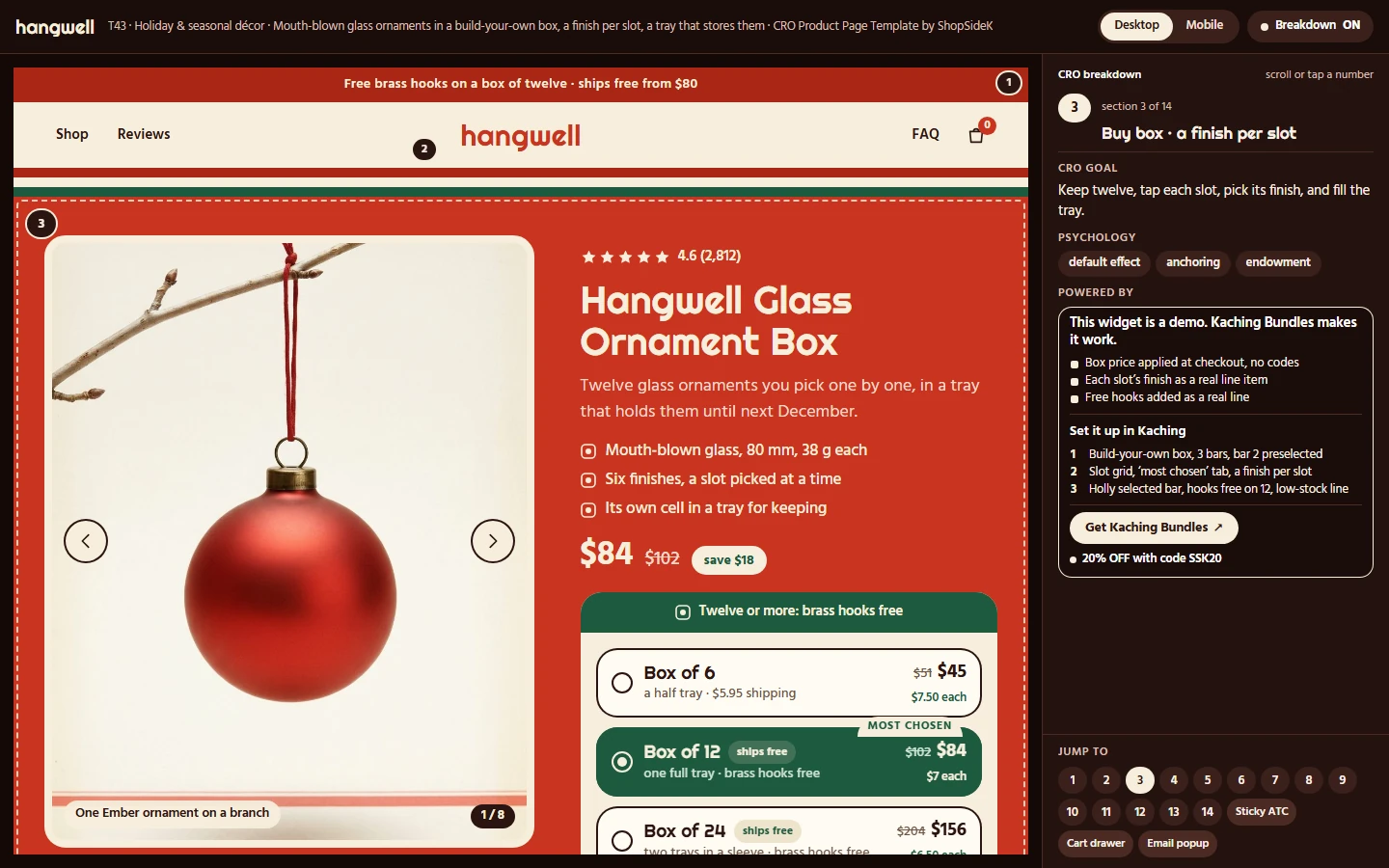
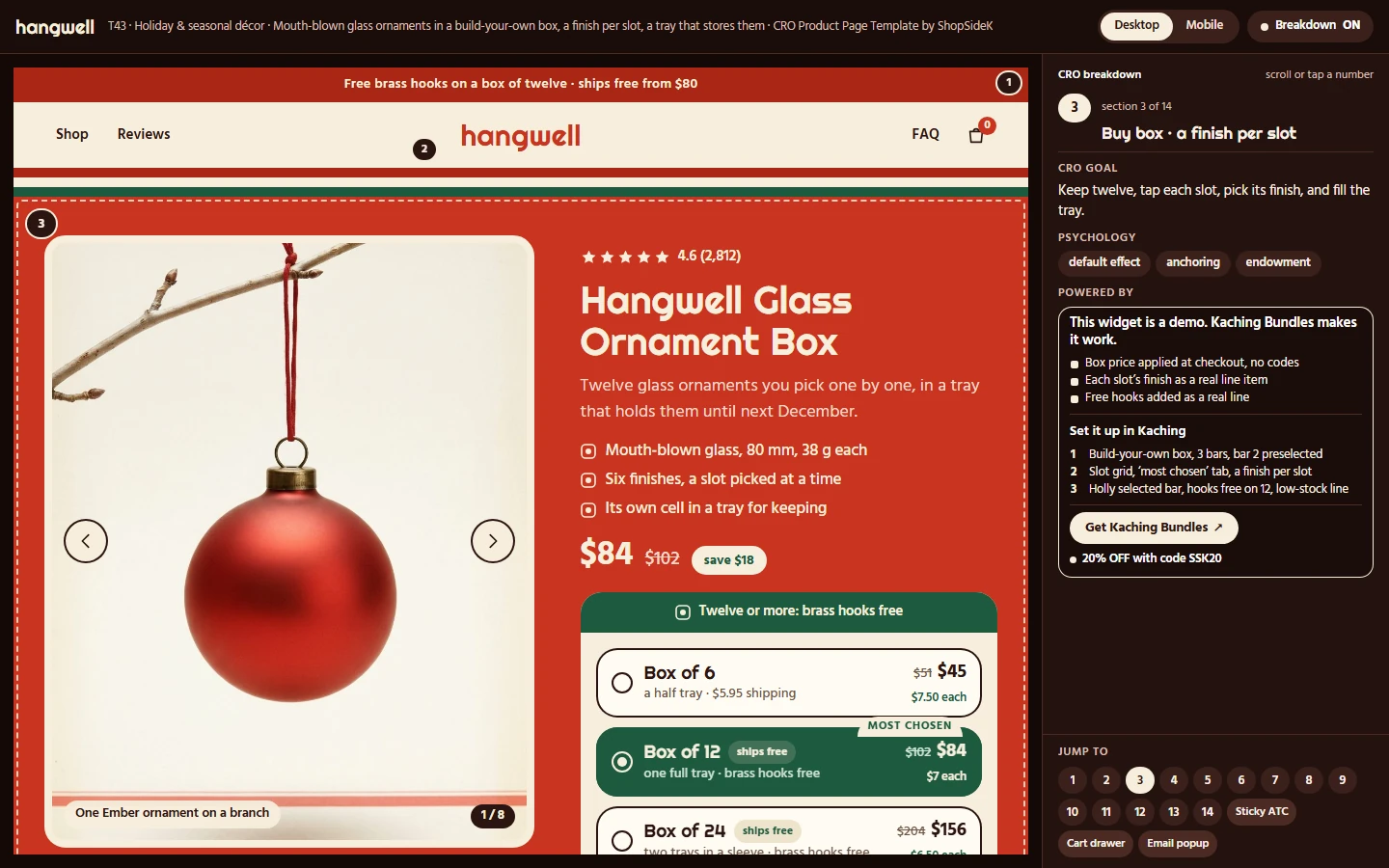
Hangwell sells one ornament at one price in six finishes: three matte (Chalk, Ember, Fir), two mercury (Pewter and Brass, silvered inside the glass) and one clear crackle (Frost). Each ball is mouth-blown, 80 mm and about 38 g, with a brass-tone cap and a waxed cotton cord. The box is a molded-pulp tray of twelve cells with a hinged lid, so the packaging is where the ornaments live from January to November. The template has no seasonal switch; it is a Christmas page all year.
The offer: a box of 6, 12 or 24, a finish for every slot
| Bar | Price | Crossed-out price | Per ornament | Extra |
|---|---|---|---|---|
| Box of 6 (“a half tray”) | $45 | $51 | $7.50 | $5.95 shipping |
| Box of 12 (preselected, “most chosen”) | $84 | $102 | $7 | Ships free; brass hooks, a card of 50 ($9 value) |
| Box of 24 (“two trays in a sleeve”) | $156 | $204 | $6.50 | Ships free; brass hooks |
Under the bars sits a slot grid in rows of six: tap a slot, then a finish; “Fill the rest” sets every empty slot to the last finish, and “Start over” clears it. The button, “Fill the box · $84,” works only when every slot is full, and the grid loads with “the Hangwell mix”: three Chalk, three Ember, two Fir, two Pewter and two Brass.
The strike is the box size times $8.50, so the stamp reads $6, $18 or $48 saved, and the hooks’ $9 is never added to it. There is no timer, only a stock line, covered under “One thing not to copy.”
The sections that do the persuading
- One finish, eight trees. A slow ticker shows the same Chalk ball on a flocked six-footer, a branch in a jug, a dorm’s wire tree and five more.
- Six, up close. A drag row says what each finish does in a room; Pewter “throws the room back at you, upside down.”
- The lid card. The card in every box turns over: twelve numbered cells on the front, the put-away steps on the back.
- Twelve, in three rounds. On scroll, a pinned tray empties, 12, 8, 4, 0: matte low and deep, mercury between, Chalk in the gaps.
- Already wrapped. A ribbon, a blank card and a gift receipt with no prices.
- Every December it costs less. A slider divides $84 by twelve ornaments and the Decembers they hang, against a $1.50 plastic ball replaced every third year, and states the result: glass wins from the thirteenth December.
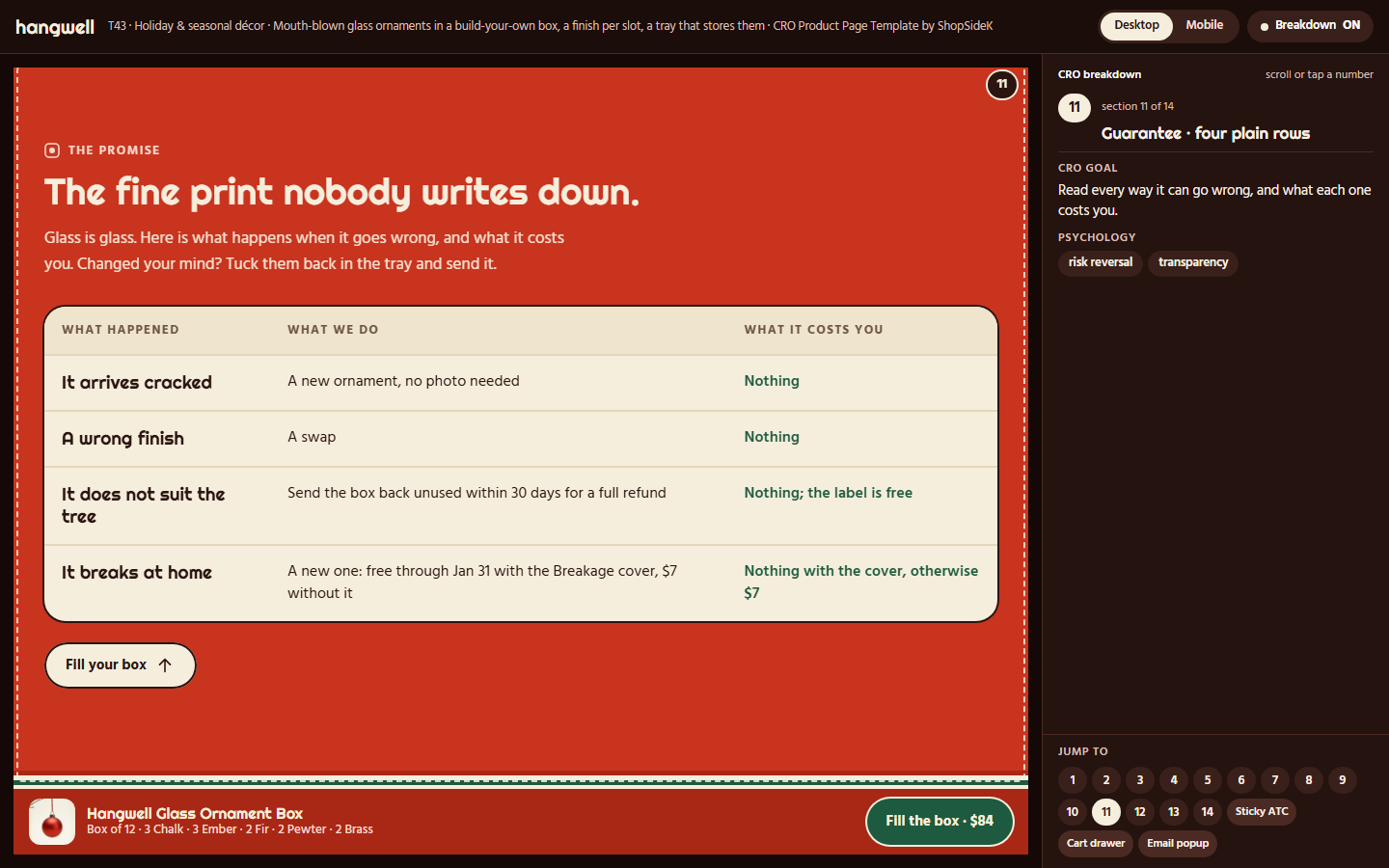
The promise is a plain table: a cracked arrival gets a new ornament, no photo needed; a wrong finish, a swap; a box that doesn’t suit the tree goes back unused within 30 days for a full refund; an ornament broken at home costs $7, or nothing through January 31 with the Breakage cover. The last row names the case the buyer pays for, and the price.
The cart: free shipping at $80, and a cover for the glass
The Kaching Cart drawer runs one free-shipping bar at $80 of products under a static line, “Ground orders by Dec 14 arrive by Dec 24,” with the hooks as a $0 line. “Goes with it” offers an empty 12-cell tray ($14) “for the ornaments you already own” and twelve spare caps and cords ($6), and a switch adds the Breakage cover ($2.95), which never counts toward the bar. A box of six reads “Add $35 for free shipping”; twelve ship free on their own.
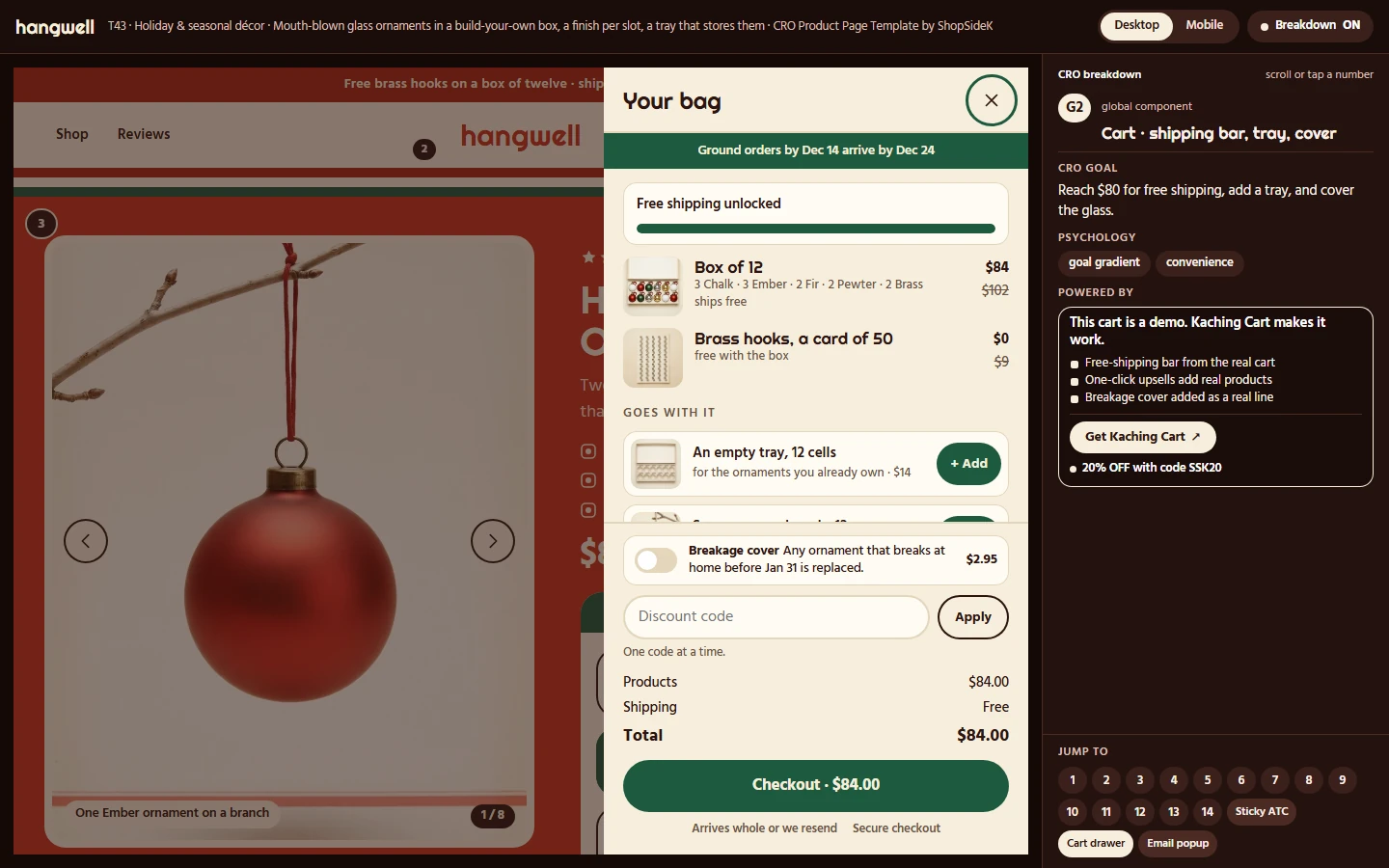
Change one number on a live store. In Kaching Cart a discount code lowers the total a tier counts, and the demo counts before the code. With the spin wheel’s HANG10, the box of twelve counts as $75.60, so an $80 tier would charge it shipping and break “a box of twelve ships free”; a $75 tier keeps the promise. On the demo’s assumed costs (an ornament landed at $1.80 with its cap and cord), all 48 first-order combinations keep at least 50% gross margin; the worst, the box of twelve with HANG10 at $75.60, keeps 50.3%. The ship-by date is a demo value; for setting a real one, see Christmas product page examples.
One thing not to copy
“Only 76 Brass ornaments left in this batch” sits under the bars on every visit, and the count never moves, because the demo has no inventory behind it. On a live store, read the number from inventory and show it only when it is low, or leave the line out.
Rebuild the offer in Kaching
- A build-a-box deal on one product with box sizes of 6, 12 and 24 at fixed prices of $45, $84 and $156, the box of 12 loading selected under a “most chosen” badge.
- “Let customers choose different variants for each item,” so every slot takes its own finish, with default finishes set for the box of twelve.
- The hooks as the free gift on the bars for 12 and 24, and a “ships free” label on both.
- In Kaching Cart, a free-shipping tier (at $75 rather than $80), an add-on list for the tray and cords, the Breakage cover as a toggle and the ship-by announcement.
Kaching lists build-a-box bundles and a progress bar among its features (Kaching Bundles on the Shopify App Store), and documents free gifts on a deal (Kaching help: bundle types), a variant picker for each item (Kaching help: variant dropdowns), default variants per bar (Kaching help: default variants) and cart tiers that count after codes (Kaching help: free shipping progress bar). Not in its public help articles: the slot grid’s “Fill the rest” button, a stock line and the setting that loads a bar selected. Check those in your own deal editor, and compare other box layouts in the Kaching build-your-own box templates.
Example 2: Turnstitch, a pillow cover product page that mixes the seasons
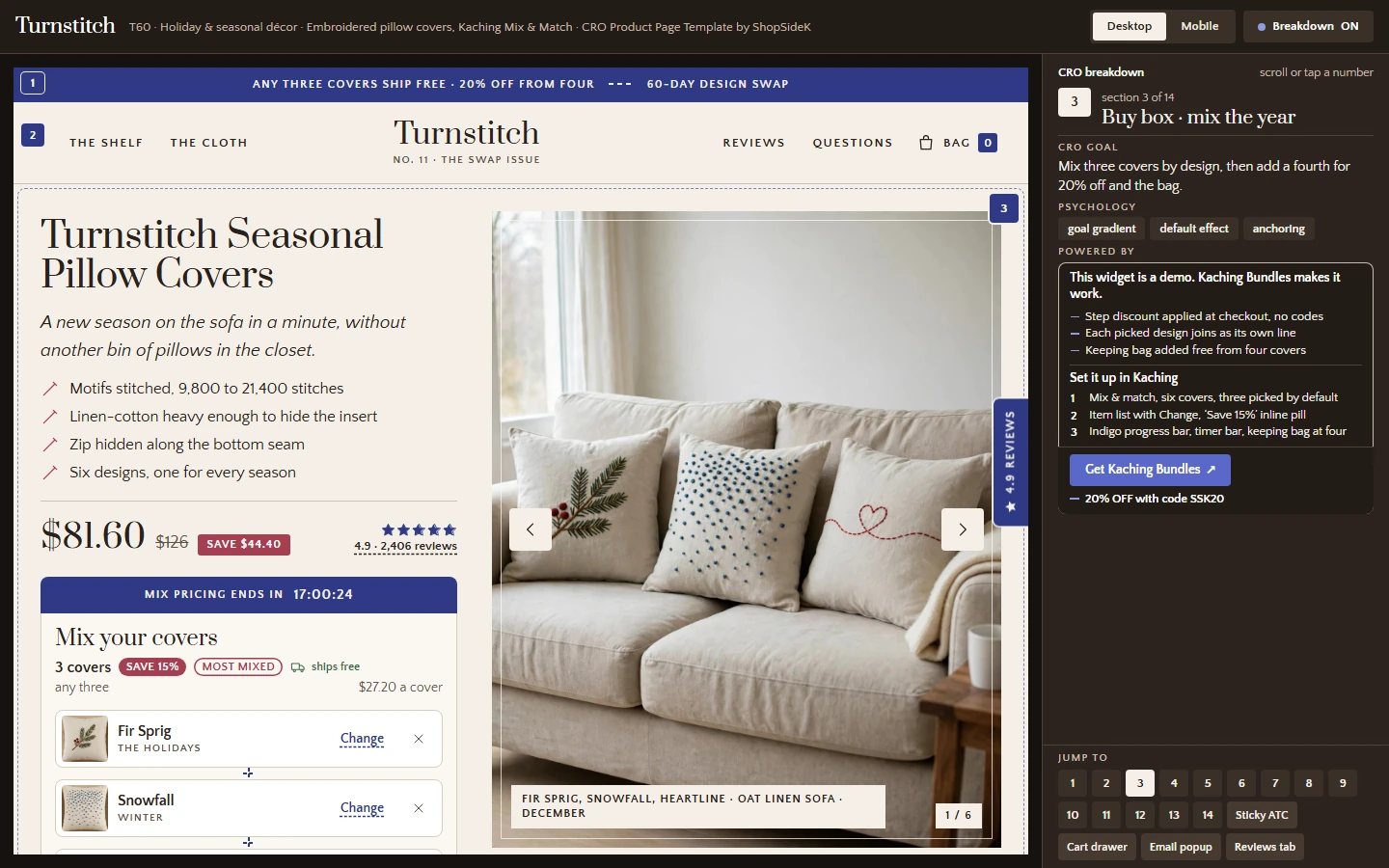
Turnstitch sells 18 × 18 in covers in an oat cloth of 55% linen and 45% cotton at 300 g/m², each with one embroidered motif: Fir Sprig for the holidays, Snowfall for winter, Heartline for Valentine’s, then Tulip Row, Lemon Branch and Acorn Cap for spring, summer and fall. A zip hides along the bottom seam, and the covers come without inserts, so only the covers change. The promise: “A new season on the sofa in a minute, without another bin of pillows in the closet.” It has no seasonal switch either.
The offer: mix any designs, save more with each cover
| Covers | Price | Crossed-out price | Per cover | Extra |
|---|---|---|---|---|
| 1 | $32 | $42 | $32 | $5.95 shipping |
| 2 (“Save 10%”) | $57.60 | $84 | $28.80 | $5.95 shipping |
| 3 (preselected, “Save 15%”, “Most mixed”) | $81.60 | $126 | $27.20 | Ships free |
| 4 to 6 (“Save 20%”) | $102.40 to $153.60 | $168 to $252 | $25.60 | Ships free; a linen keeping bag ($14 value) |
The percentages are off the $32 single price. The widget is a list: three rows load, Fir Sprig, Snowfall and Heartline, the holidays through February, each with a “Change” link that opens a 3 × 2 grid of designs. “+ Add a cover” brings in the next design, repeats are allowed, and the mix stops at six.
A progress bar names the next step (“Add 1 more: the keeping bag, free”), and the bag, in the same cloth and sized for six folded covers, stays locked until the fourth. An indigo bar reads “Mix pricing ends in” and counts down to midnight, then restarts while prices stay put; the demo keeps it to show where a timer fits. A live store points it at a real end date, as Black Friday product page examples explains, or drops it.
The sections that do the persuading
- One shelf. Season chips grow two stacks: four seasons of two whole pillows take “48 in of shelf,” the covers “6 in, one bag,” and a button loads one design per season into the mix.
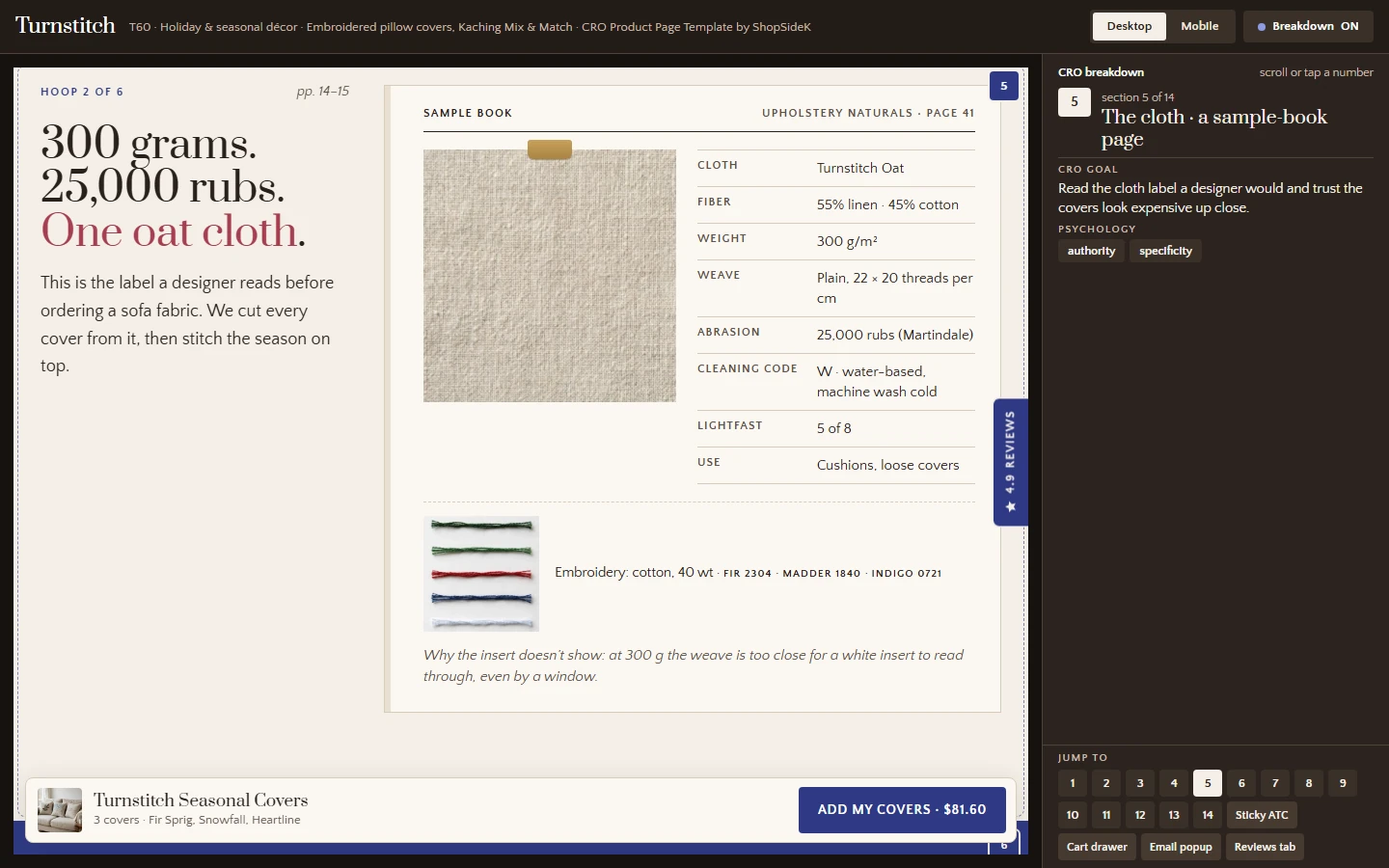
- The sample-book page. The cloth’s upholstery label: fiber, weight, weave, abrasion (“25,000 rubs (Martindale)”), cleaning code W and lightfastness “5 of 8.”
- One size up. A drag handle splits one photograph of the same cover with an 18 in and a 20 in insert, and a button adds the 20 in insert to the bag.
- Fold. Push. Zip. Chop. A zipper pull walks five frames of one swap, “about a minute at the sofa.”
- Six side by side. A table gives each design’s season, threads, stitch count (9,800 to 21,400) and feel.
- Five sofas. Five sofa-fabric cards turn over to the stylist’s three picks and one to skip, and load the three into the mix.
The promise is a finder: four chips, one answer each. “The color fights my sofa” gets another design within 60 days, used covers included; “A thread pulled” and “The zip quit” get a new cover any time in two years; “It came out smaller” offers a refund within 60 days. The rules section below covers what that two-year promise requires.
The cart: inserts in a slider and a gift at $95
The drawer opens on a free-gift bar: two cedar blocks ($8 value) at $95 of products, so three covers read “Add $13.40 more for two cedar blocks, free.” A slider offers a 20 in insert ($18), a 22 in insert ($21) and a 12 × 20 in lumbar cover ($26), and a switch adds shipping protection ($2.95). Three covers and the 20 in insert reach $99.60; four covers clear it alone.
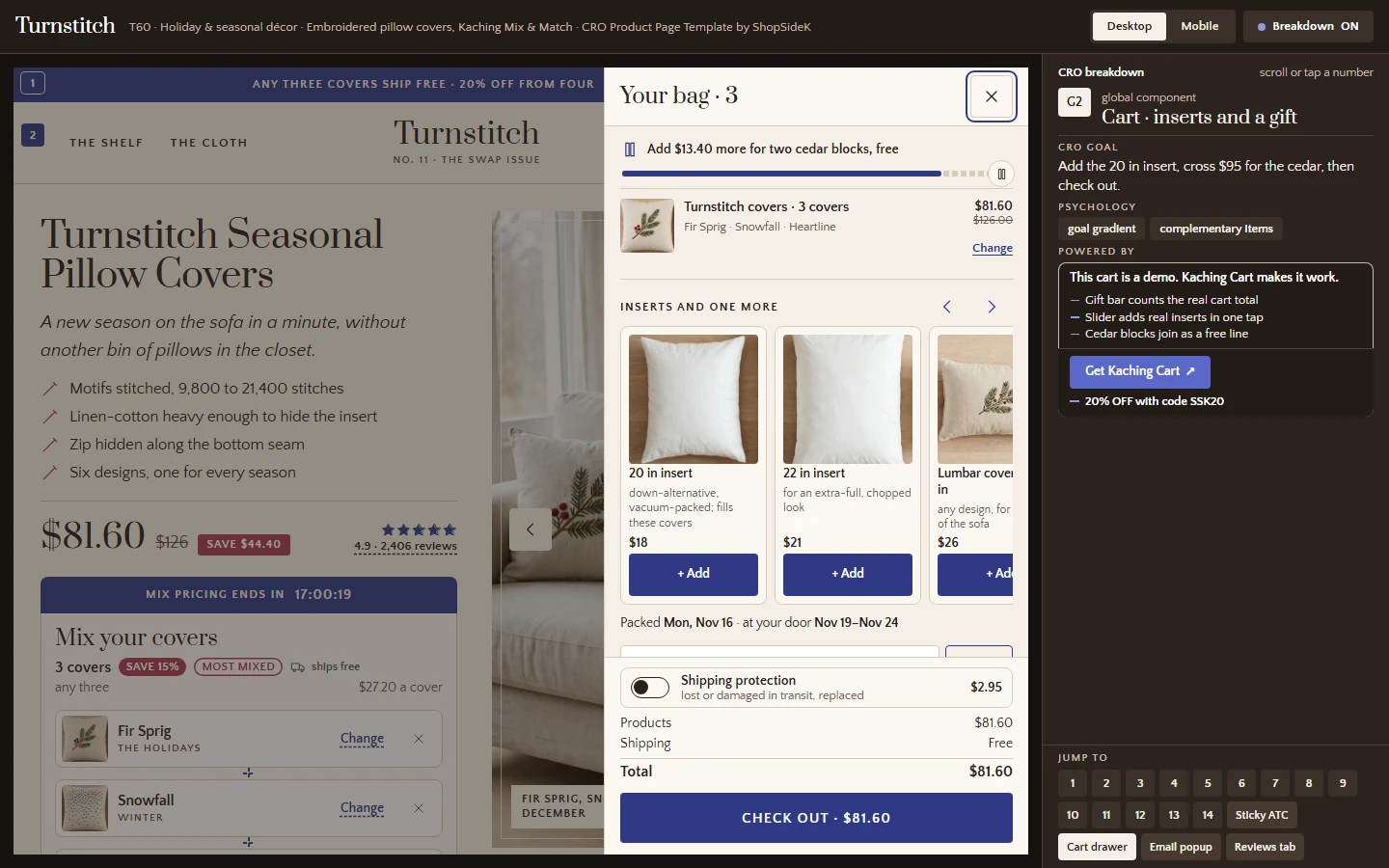
Codes lower the counted total here too. With the popup’s TURN10, three covers and the insert count as $89.64 and four covers as $92.16, both short of $95, so an $89 tier keeps the promise. On the demo’s assumed costs (a cover landed and packed at $6.70), all 120 first-order combinations keep at least 50%; the worst, four covers, a 20 in insert and TURN10 at $108.36, keeps 50.3%.
One thing not to copy
Every cover carries a compare-at price of $42, so one cover shows $32 struck at $42, and Kaching multiplies the strike by the covers. Three covers read $81.60 struck at $126 with “SAVE $44.40” beside the price, while the widget’s pill says “Save 15%”: measured from the $32 the cover sells for, they save $14.40. On a live store, strike only a price the cover really sold at, or set the compare-at to $32 so strike, stamp and pill all say 15%. The rule behind it is in Black Friday product page examples.
Rebuild the offer in Kaching
- A mix-and-match deal over the six cover products with discounts by item count: 10% at two, 15% at three, 20% at four and more, three covers loading selected under a “Most mixed” badge.
- An item list with a change control on every row, a progress bar and a savings line.
- The keeping bag as a free gift unlocked at four items.
- In Kaching Cart, a free-gift tier for the cedar blocks (at $89 rather than $95), an upsell slider for the inserts and lumbar cover, and a shipping-protection toggle.
Kaching lists mix-and-match bundles among its bundle types (Kaching Bundles on the Shopify App Store), and its help on collection breaks names mix-and-match deals as the case for discounts that apply when products are added from different pages (Kaching help: collection breaks). Its cart listing covers an upsell slider and toggles such as shipping protection (Kaching Cart on the Shopify App Store). Not in the public help articles: the countdown bar, a gift that unlocks at a set item count and the setting that loads three rows selected. Check them in your editor, and compare more lists in the Kaching mix & match templates.
What a décor page can promise: guarantees, warranties and fabric labels
Both pages promise what happens after the sale. US rules treat those promises as advertising, and some as written warranties with their own requirements. This is general information, not legal advice.
Satisfaction guarantees and written warranties
- “Money back” means a full refund on request. The FTC’s guides say a seller should use “Satisfaction Guarantee,” “Money Back Guarantee” or similar terms only if it “refunds the full purchase price of the advertised product at the purchaser’s request,” and should disclose any material limits or conditions clearly (16 CFR 239.3 (Cornell LII)). Hangwell states its condition where the promise is made: the box goes back unused, within 30 days, on a free label.
- A promise about defects for a set time is a written warranty. “A new cover, free, any time in the first two years” for a pulled thread or a failed zip is that kind of promise. Under the Magnuson-Moss Warranty Act, a written warranty on a product costing more than $10 must be titled either “full” or “limited” (15 U.S.C. 2303 (Cornell LII)). The FTC’s guide adds that the five tests for “full” must all be met, otherwise the warranty is “limited” (FTC: Businessperson’s Guide to Federal Warranty Law).
- Above $15, the terms go in one document, next to the product. That document says who is covered, which parts, what the warrantor will do, for how long and how to claim (16 CFR 701.3 (Cornell LII)). For sales that need no store visit, the seller shows the full text, or where to read it and how to get a free copy, “on the page containing the description of the warranted product, or on the page facing that page” (16 CFR 702.3 (Cornell LII)). A “Warranty” link in the buy box does that job.
- A cover sold for extra is a service contract. The FTC’s interpretation says an agreement “which calls for some consideration in addition to the purchase price of the consumer product” is a service contract, not a warranty, and notes that some such agreements are regulated by states as insurance (16 CFR 700.11 (Cornell LII)). Hangwell’s $2.95 Breakage cover fits that description, so write its terms out, and ask the app or provider behind a paid protection switch which state rules it follows.
Neither demo titles its promises or links a warranty document; a store copying them would add “Limited warranty” and link the terms.
Labels for a fabric cover
- Pillow covers fall under the Textile Act. The Textile Rules list cushions, and slip covers and other covers for furniture, among covered products (16 CFR 303.45 (Cornell LII)), so the online fiber and origin rules in clothing product page examples apply. Turnstitch lists “55% linen · 45% cotton” but never says where the covers are made; a live store adds “Imported” or “Made in USA.”
- Lab numbers need the lab report. “25,000 rubs” and “lightfast 5 of 8” are test results, and the FTC expects a basis for objective claims before they run (FTC Policy Statement Regarding Advertising Substantiation). Keep the mill’s certificate, or drop the number.
Lights, batteries and California’s Proposition 65 warnings, which glowing décor raises, are covered in home decor product page examples.
How to build a holiday décor offer in Kaching
- Pick the deal by how the set is chosen. One product in many finishes suits a build-a-box deal; separate designs from a collection suit mix and match. See fixed vs mix and match bundles on Shopify and how to choose products to bundle on Shopify.
- Set the compare-at to a price you’ve charged. Kaching strikes the compare-at price times the items in the bar, or the normal price when there is no compare-at (Kaching help: crossed-out price). An inflated compare-at inflates every bar.
- Preload a set that looks finished. Default finishes or designs show a full tray or styled sofa, not an empty grid.
- Put the storage gift where the order is biggest. Hooks from twelve ornaments and the keeping bag from four covers reward the size that fills the tray or the shelf; see free gift vs discount on Shopify.
- Set cart tiers on the total after codes, and decide whether codes stack. Kaching Cart counts the total after discount codes (Kaching help: free shipping progress bar), and its bundle discounts are product discounts that combine with a second product discount only on Shopify Plus; elsewhere, a code meant to stack is set up as an “Amount off order” discount (Kaching help: combine a Kaching discount with a Shopify discount). Both demos let their welcome code stack:
| Order | Revenue | Gross margin |
|---|---|---|
| Hangwell: box of 12, list price | $84 | 54.6% |
| Hangwell: box of 12, 10% code | $75.60 | 50.3% |
| Turnstitch: three covers, list price | $81.60 | 59.8% |
| Turnstitch: four covers, a 20 in insert, 10% code | $108.36 | 50.3% |
Costs are each demo’s assumptions: product, gifts, packing, shipping, card fees and a reserve for returns and breakage. Test your own numbers in the Shopify discount break-even calculator; which codes combine is in how Shopify bundle discounts stack.
Holiday décor product page checklist
- The set a tree or a sofa takes, preselected and preloaded, with the smallest set as the anchor.
- A finish, color or design picker for every item in the set.
- Photos on several kinds of trees or sofas, not one styled room.
- Storage as part of the product: a tray, a box or a bag.
- Every way the product can fail, with what the buyer pays in each case.
- Promises about defects titled “full” or “limited,” with the terms linked from the buy box.
- Fiber content and country of origin for anything made of fabric.
- Compare-at prices the item really sold at, and stock lines from real inventory.
- Cart thresholds set on the total after codes.
FAQ
What should a Christmas ornament product page include?
Size, weight and material, every finish in one photo, how many per box, how they hang, photos on several kinds of tree, how they ship and store, and what happens if one arrives cracked or breaks at home.
What should a pillow cover product page include?
The cover size and the insert size it suits, whether inserts are included, fiber content and country of origin, care, the closure, photos on several sofa fabrics, every bundle price, and a swap window long enough to try it at home.
Should Christmas ornaments be sold one at a time or by the box?
By the box, with the shopper choosing the finishes. Hangwell sells boxes of 6, 12 and 24 at $45, $84 and $156 and loads the box of twelve, because twelve fills one tray, ships free and earns the free hooks.
Should pillow covers be sold with inserts?
Covers only keeps the price low and reuses inserts buyers own, if the page says so near the price. Turnstitch says “covers only,” recommends an insert one size up and sells a 20 in insert for $18 in the cart.
Does a money-back guarantee have to be a full refund?
Yes. The FTC’s guides say “Money Back Guarantee,” “Satisfaction Guarantee” and similar terms should be used only if the seller refunds the full purchase price at the buyer’s request, and any conditions, such as returning the item unused within 30 days, must be disclosed clearly.
Do I have to call my product guarantee a limited warranty?
If it promises to fix or replace a defect for a stated time on a product costing more than $10, the Magnuson-Moss Warranty Act requires the title “full” or “limited,” and “full” only when all of the FTC’s tests are met. Above $15, the terms go in one document that buyers can read before ordering.
Will a welcome code stop a box from shipping free in Kaching Cart?
It can. Kaching Cart counts the total after discount codes, so an $84 box with a 10% code counts as $75.60 and misses an $80 free-shipping tier. Set the tier at $75, or at the lowest total your preselected bar reaches with the code.
More product page examples
Hangwell and Turnstitch both come from the ShopSideK library of Shopify product page templates, each with a free section-by-section breakdown. Browse the holiday and seasonal décor templates for the niche’s other pages.
Flameless candles with a Christmas version and the 2026 shipping deadlines are in Christmas product page examples; a garland and candle sets, with the battery and Proposition 65 rules, in home decor product page examples.
Sources
- 16 CFR 239.3, satisfaction guarantees and similar representations in advertising (Cornell LII)
- 15 U.S.C. 2303, designation of written warranties (Cornell LII)
- FTC: Businessperson’s Guide to Federal Warranty Law
- 16 CFR 701.3, written warranty terms (Cornell LII)
- 16 CFR 702.3, pre-sale availability of written warranty terms (Cornell LII)
- 16 CFR 700.11, written warranty, service contract and insurance distinguished (Cornell LII)
- 16 CFR 303.45, coverage and exclusions from the Textile Act (Cornell LII)
- FTC Policy Statement Regarding Advertising Substantiation (1984)
- Kaching Bundles on the Shopify App Store
- Kaching Cart on the Shopify App Store
- Kaching help: different bundle types
- Kaching help: customize your bundle variant dropdowns
- Kaching help: set default variants in your bundles
- Kaching help: change the crossed-out price in your bundle
- Kaching help: collection breaks for volume discounts across product pages
- Kaching help: free shipping progress bar in Kaching Cart
- Kaching help: combine a Kaching discount with a Shopify discount