Last updated: October 30, 2026. You can open and click through both pages for free; no account needed.
A clothing product page has to answer “will this fit me?” before it can sell anything else. The two Shopify examples below answer it on the page itself: every item in a multi-pack keeps its own size and color, every photo says what size the person in it wears, and a free swap takes the risk out of guessing wrong. Only then do they sell the second, third or fifth piece.
Fit is also the main reason apparel orders come back. In a Coresight Research survey of 100 decision-makers at US apparel brands and retailers, the average return rate for online apparel orders was 24.4%, and size or fit was the top return reason, named by 53% of respondents (Coresight Research, April 2023).
Below are two working pages, Plainweight (a heavyweight T-shirt) and Amble (anti-chafe slip shorts), each with exact prices, the sections that do the fit work, the cart, and the Kaching Bundles settings behind the offer.
Key takeaways: 7 rules for a clothing product page
- Give every item in a multi-pack its own size and color. A clothing two-pack works when the pieces can differ: two colors for one person, or two sizes for two people.
- Caption the size the model wears. “6′0″ · usually L · wears L” next to a photo answers the fit question faster than any adjective.
- Put every size you sell on a body. One cut on eight people, XS to 4XL, settles “will boxy look like a tent on me?”
- Lead the size chart with the measurement that decides fit. For slip shorts that is the hips, plus one rule for shoppers between sizes.
- Turn quality claims into tests the shopper runs. Weighing your own tee beats the word “premium”.
- Make the swap cheaper than the worry. A free size swap that ships the new size first removes the cost of picking wrong.
- Strike only a price you have charged. If one item normally sells for $28, measure the pack savings from $28.
The two examples at a glance
| Plainweight (T-shirt) | Amble (slip shorts) | |
|---|---|---|
| Product | Unisex heavyweight boxy crew tee, 220 GSM cotton | Anti-chafe slip shorts worn under dresses, nylon and elastane knit |
| Sizes and colors | XS–4XL, six colors | XS–3XL, six shades (five skin tones and black) |
| Kaching offer | Quantity Break with a size and a color per tee: 1, 2 or 4 tees | Quantity Break built as a pack, with a shade and a size per pair: 1, 3 or 5 pairs |
| Bar prices | $34 · $62 · $112 | $28 · $68 · $99 |
| Price per item | $34 · $31 · $28 | $28 · $22.67 · $19.80 |
| Preselected bar | Two tees (Black M and Bone M) | Pack of 3 |
| Main fit tools | A size caption on every photo, one cut on eight bodies | A hips-first size chart, a shade finder under three lights |
| Promise | Free size or color swap for 60 days; the new tee ships first | Free swap with a label both ways for 30 days |
| Cart rewards | Free shipping from $60, a free tote from $130 | Free shipping from $50 |
| Order in the walkthrough | $34 → $62 → $80 | $28 → $68 → $84 |
| Live example | Plainweight template (T21) | Amble template (T04) |
Example 1: Plainweight, a T-shirt product page with a size and color per tee
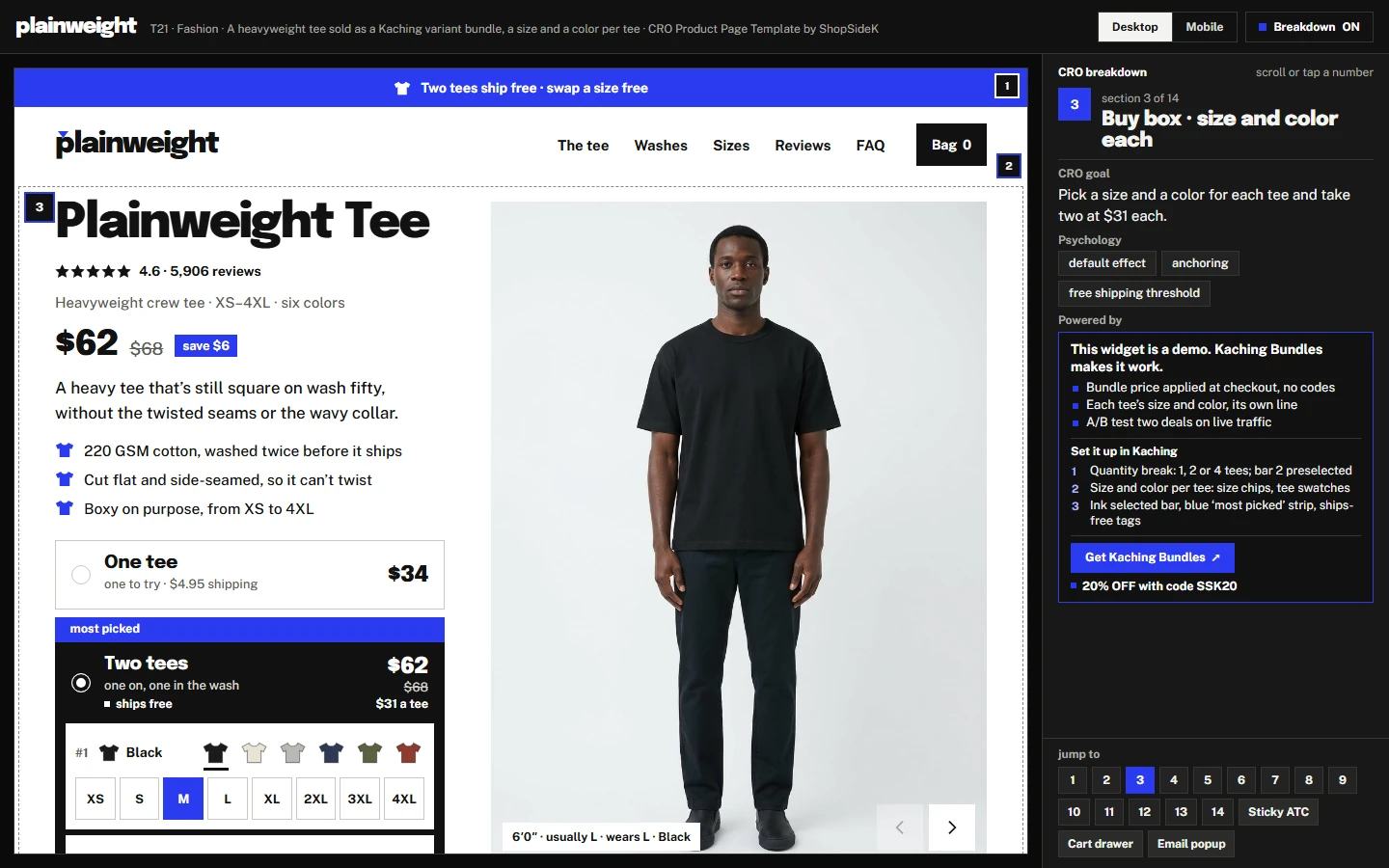
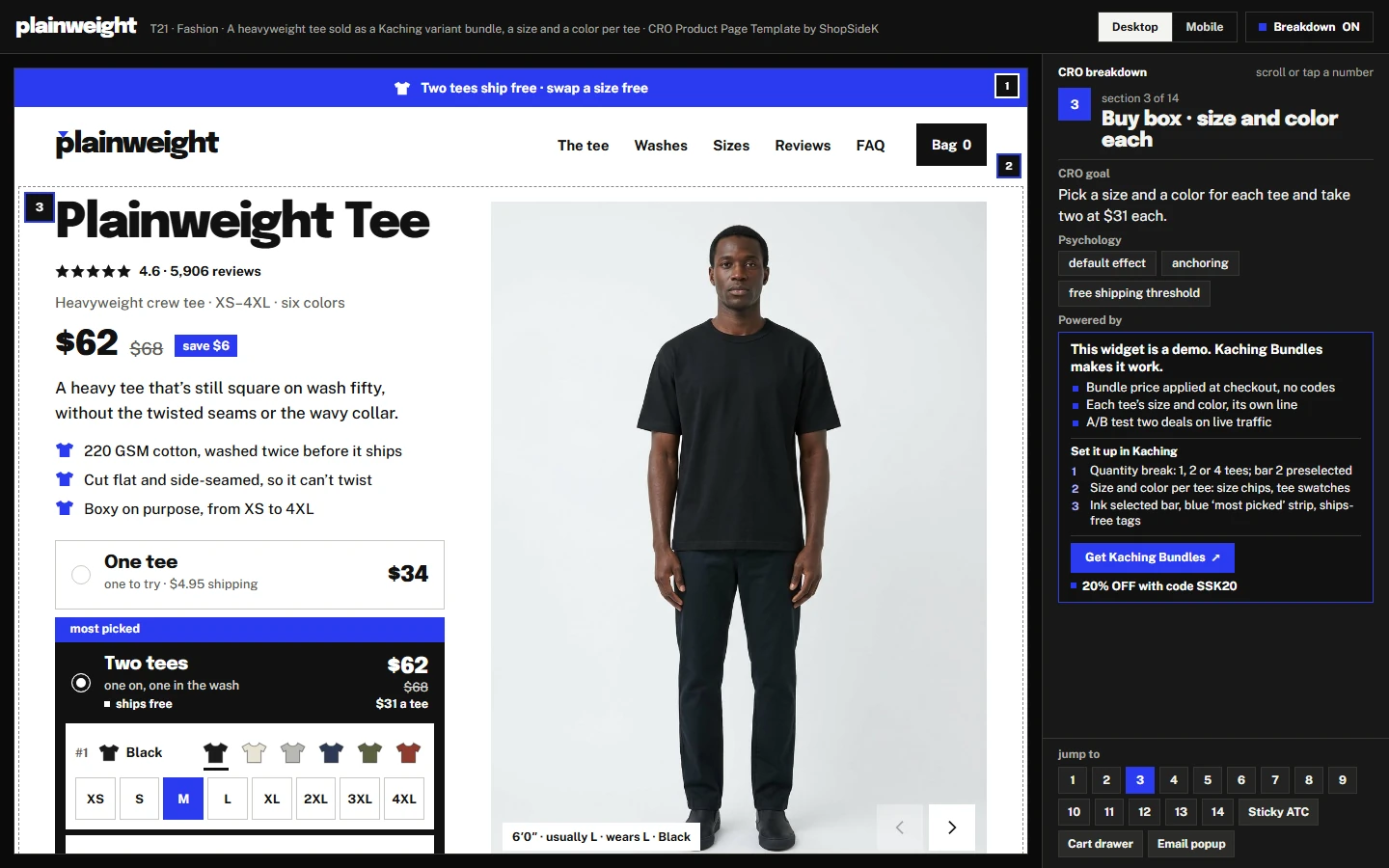
A plain tee may be the hardest thing to sell online: no print, no logo, and every shop has one. Plainweight’s page never calls its tee premium or perfect. It sells a 220 GSM cotton tee with numbers the shopper can check, and it sells two at once by letting each tee be its own size and color.
The offer: one, two or four tees
| Bundle bar | Price | Crossed-out price | Per tee | Shipping |
|---|---|---|---|---|
| One tee (“one to try”) | $34 | none | $34 | $4.95 |
| Two tees (“one on, one in the wash”), preselected | $62 | $68 | $31 | Free |
| Four tees (“a drawer that never runs out”) | $112 | $136 | $28 | Free |
The selected bar opens one row per tee, each with eight size options and six color swatches shaped like a flat tee. The two-tee bar loads as Black · M and Bone · M, so the shopper sees two different shirts in the bundle before touching anything. In the demo, moving up to four tees keeps both picks and adds two new rows. A single line under the bars says what the order saves (“You save $6”, or “$24” on four tees), and the crossed-out price is always the quantity × $34, the price of one tee. The bar names say what each bundle is for, never a percent.
Fit, answered before the shopper asks
- A size caption on every photo. Each gallery photo carries a chip with the wearer’s height, usual size, size worn and color, for example “5′1″ · usually XS · wears XS · Black”. The thumbnails are labeled with the size worn or the color shown, from XS to 4XL.
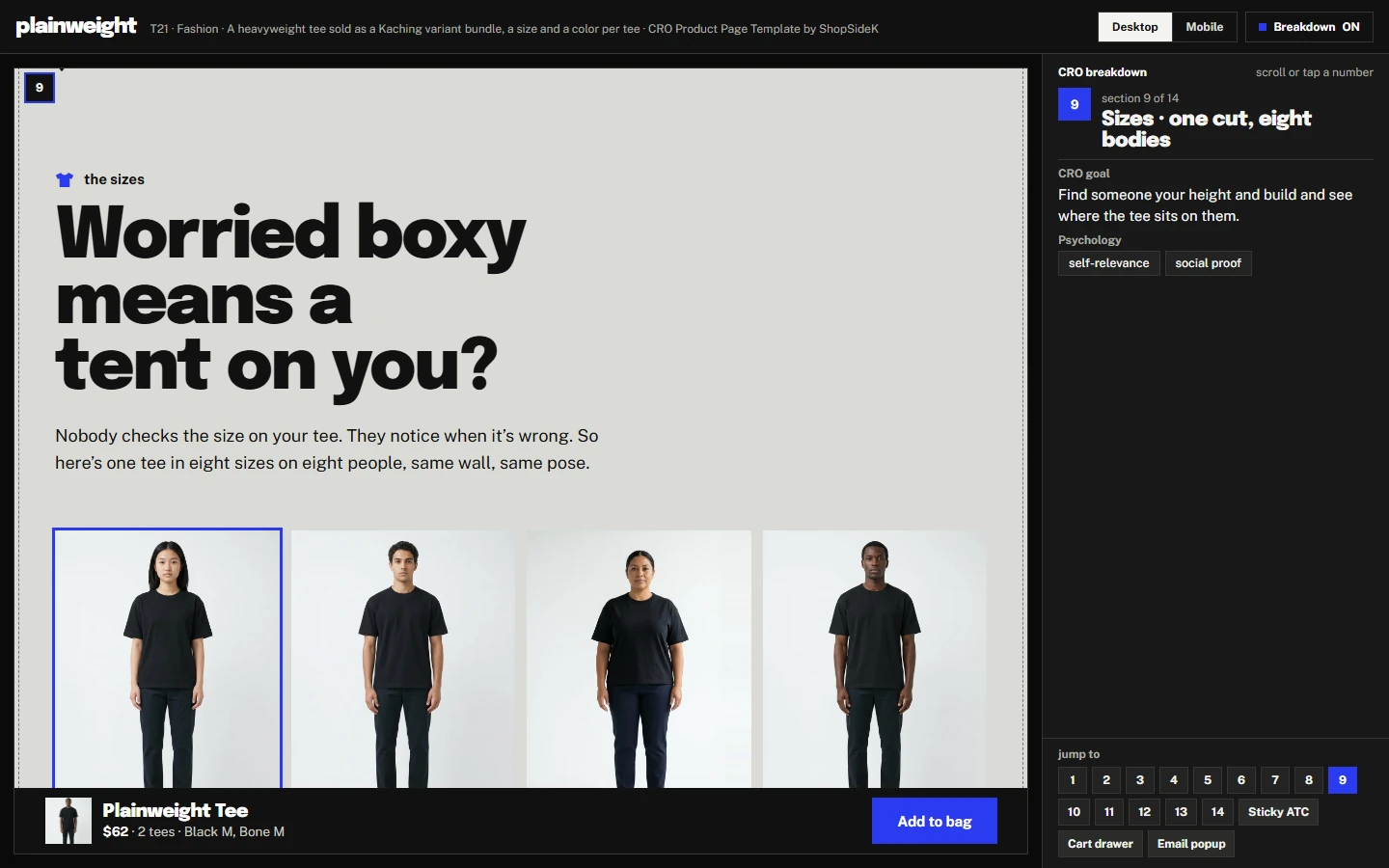
- One cut on eight bodies. The “Worried boxy means a tent on you?” section shows the same black tee on eight people, XS to 4XL, against the same wall. Tapping a size adds one line on where the tee sits on that person; for the 3XL it stops at the hip, not halfway down the thigh.
- Arms up. Three frames (a reach to a top shelf, a bend to tie a shoe, standing) show the hem and collar staying put.
- Reviews with fit lines. Every review card shows the buyer’s height, usual size, the size they kept, the color and roughly how many washes. One 5′2″ buyer explains that the M was long on her, so she swapped to an S.
Proof the shopper can run
- Weigh yours. A size M weighs 248 g. The shopper types the weight of their own favorite tee and gets an instant answer: at 150 g, “A lightweight, about 150 GSM: 98 g lighter than ours.”
- The tee, part by part. Six parts (collar, shoulders, side seams, hem, cotton, neck label) open one at a time, each comparing “a thin tee” with this one. The side seams, for example, are cut flat and sewn up both sides, so they stay at your sides instead of twisting to the front.
- Wash it fifty times. A button runs the page’s wash test. At wash 50 the tee has lost 1.9% of its length, its collar is 3 mm wider and a side seam has moved 0.6 cm, against 6.8%, 19 mm and 4.1 cm for a thin tee. The method sits under the numbers: ten size-M tees of each kind, washed warm at 40°C and measured flat every ten washes.
The cart: from $62 to $80
Two tees clear the $60 free-shipping line. The cart’s reward bar then points at a second milestone, a free canvas tote ($16 value) at $130, and one recommended card offers “the other plain thing”: three pairs of crew socks for $18. One tap takes the order from $62 to $80. On four tees ($112), the same $18 card closes the gap to the tote exactly.

That $130 milestone came out of the margin math, not out of a round number. Every size costs the shopper $34, but in the demo’s assumed costs a 2XL–4XL tee costs $9.30 to make against $8.50 for XS–XL, and the email popup offers 10% off a first order. With the tote at $130, the worst modeled order (two large-size tees with the 10% code) still keeps 51.7% gross margin. If you price every size the same, model your margin on the biggest sizes.
The popup earns its place too: its first step asks “Which size do you wear?” before the email field, so restock and new-color emails can go out by size.
One thing not to copy
The “$34 a tee · $8.50 to make · $12 kept” section draws the price breakdown on the tee itself, down to what the shop keeps. It only works for a brand that makes its own product. If you resell another brand’s tees or dropship, “to make” is someone else’s wholesale price, and the drawing reads like your margin sheet.
Rebuild the offer in Kaching
- A Quantity Break deal on the tee: 1, 2 or 4 tees at fixed bundle prices, bar 2 preselected.
- “Let customers choose different variants for each item” turned on, with a size and a color per tee and image swatches for the colors.
- A “most picked” badge on bar 2, a free-shipping label and a price per tee on bars 2 and 3.
For how to space the bars and their prices, see how to set profitable Shopify quantity breaks.
Example 2: Amble, slip shorts sold as a build-your-own pack
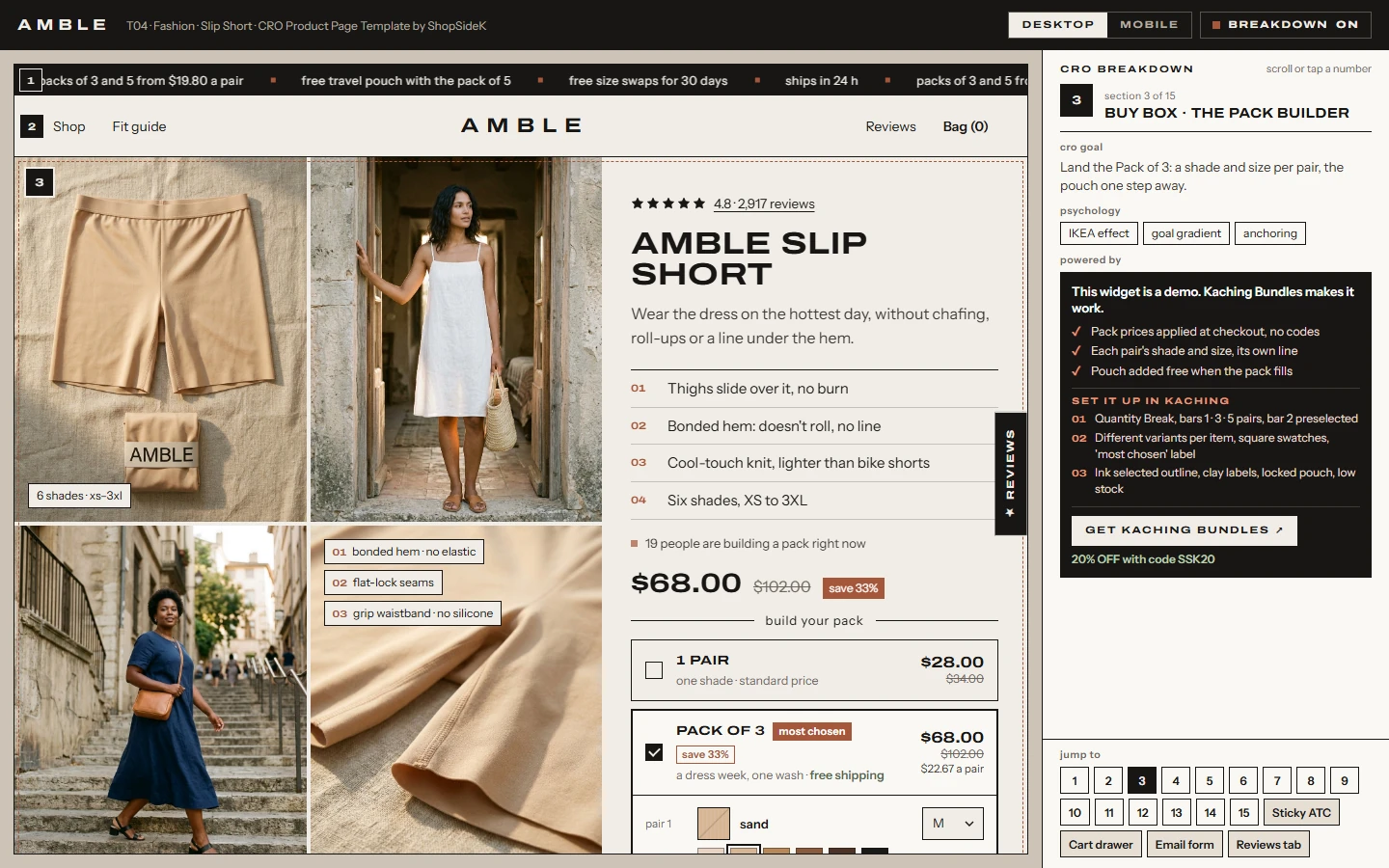
Amble sells anti-chafe slip shorts worn under dresses. A shopper wants her own skin shade for light fabrics, black for dark ones, and enough pairs to rotate between washes, so the page builds the pack one pair at a time.
The offer: one, three or five pairs
| Bundle bar | Price | Crossed-out price on the page | Per pair | Extras |
|---|---|---|---|---|
| 1 pair | $28 | $34 | $28 | |
| Pack of 3 (“a dress week, one wash”), preselected | $68 | $102 | $22.67 | Free shipping |
| Pack of 5 (“a pair for every weekday”) | $99 | $170 | $19.80 | Free shipping and a free linen travel pouch ($12 value) |
Each pair in the selected pack gets six shade swatches and a size dropdown. In the demo, the Pack of 5 opens with three pairs filled and two empty slots marked “choose shade”, and the add-to-cart button asks for the missing shades until the pack is full. The travel pouch sits in a row under the bars, greyed out with a lock until the shopper picks the Pack of 5.
Fit and shade, answered on the page
- A hips-first size chart. “Measure your hips, not your waist.” One table lists XS to 3XL by hip measurement in inches and centimeters, with the usual US dress size beside each, and one rule for shoppers between two sizes: take the size your hips say, because the waistband gives. The buy box links straight to it.
- A shade finder under three lights. The light booth shows five skin-tone shades on real arms under daylight (5,500 K), office light (4,000 K) and golden hour (2,700 K). The shopper taps the arm closest to hers, and that shade goes onto pair 1 of her pack. The rule under it: one in your shade for light fabrics, one black for dark ones.
- Reviews from people like her. Customer photos open into reviews that show each reviewer’s size, usual dress size and height.

Proof the shopper can see
- Spot the shorts. Four outfits, from a white linen sundress to a black satin slip dress. The shopper votes “shorts” or “no shorts” on each, then the caption reveals the shorts were there every time, with the shade, the size and how many hours they were worn.
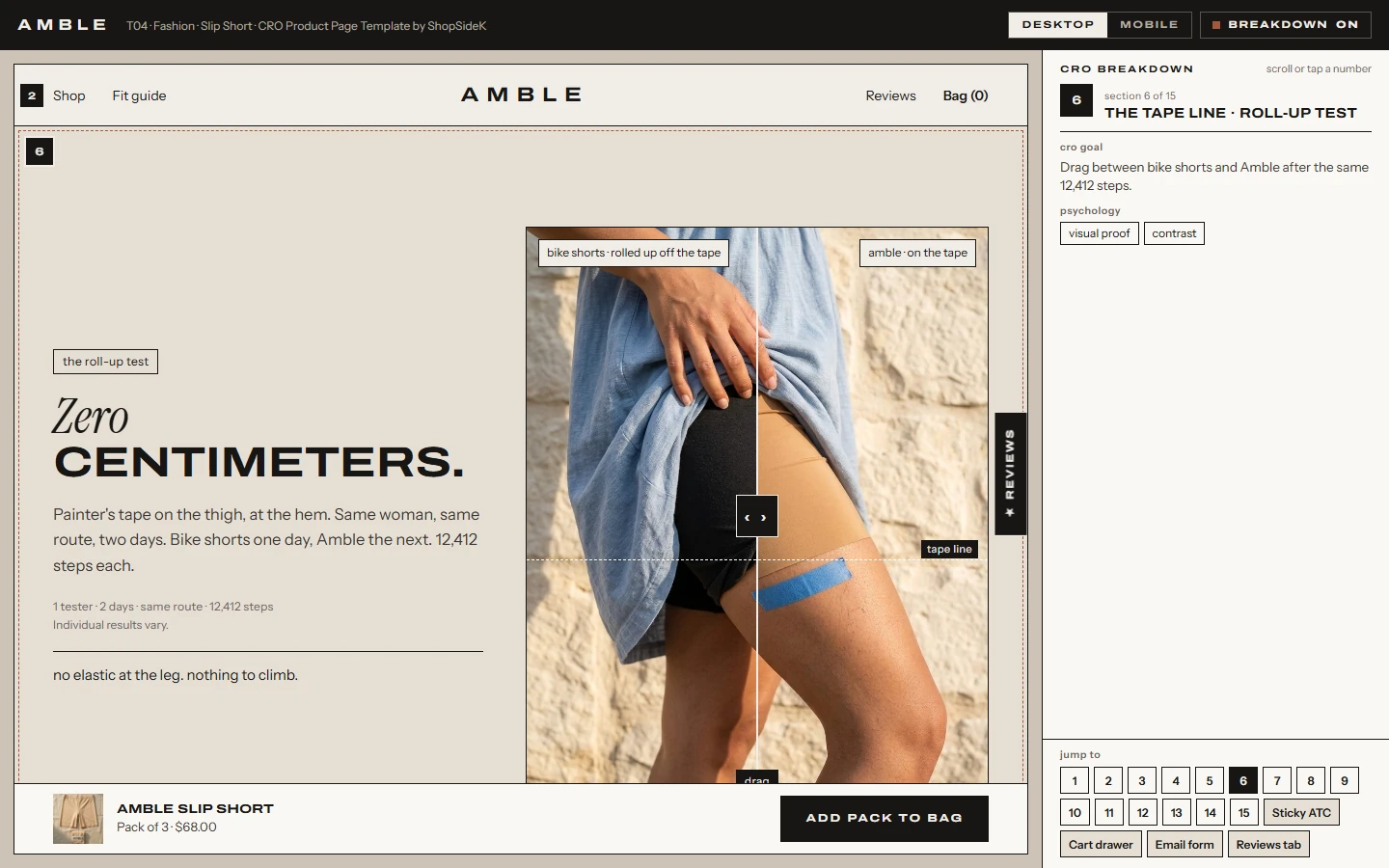
- The tape line. One tester, the same route on two days, 12,412 steps each, with painter’s tape at the hem: the bike shorts rolled up off the tape, the slip shorts stayed on it. The caption says “Individual results vary.”
- The slide test. A drawn tilt board shows how long each surface grips skin: skin on skin holds past 40°, cotton jersey lets go at 27°, the shorts’ knit at 14°.
The cart: from $68 to $84
Both packs clear the $50 free-shipping line on their own. Instead of a single upsell, the cart shows a short “wear it with” list: a No-Line Brief for $16 and a Slip Cami for $32, plus a $6 mesh wash bag as a tick-box add-on. Adding the brief to a Pack of 3 takes the order from $68 to $84. An email form embedded in the footer offers 10% off a first pack; in the demo’s assumed costs, even a Pack of 5 with that code keeps 66.7% gross margin.
One thing not to copy
The single pair shows $28 with $34 crossed out, under the words “standard price”. If $28 is what one pair normally sells for, $34 is not a price shoppers ever paid, and US guidance on former-price comparisons treats an inflated “was” price as deceptive (16 CFR 233.1). Strike against $28 instead. The packs still win: three pairs at $68 save $16 (19%) against three single pairs at $28, and five pairs at $99 save $41 (29%).
Rebuild the offer in Kaching
- A Quantity Break deal with bars of 1, 3 and 5 pairs, bar 2 preselected.
- Different variants per item for shade and size, square shade swatches, a “most chosen” label on bar 2.
- A free gift locked until the Pack of 5, and a low-stock line only if the stock count is real. The demo’s “only 23 packs of 5 left” and “19 people are building a pack” lines are sample text.
For whether a pack like this should be fixed or mix and match, see fixed vs mix and match bundles on Shopify.
What a US clothing listing has to say: fiber, origin and care
In the US, an online clothing listing must say where the item was made, and it must give the fiber content whenever the copy names or implies a fiber. Care instructions are required on the garment’s label. This is general information, not legal advice.
- Country of origin. When a textile product is advertised in a mail order catalog or mail order promotional material, its description must clearly state that it was made in the USA, imported, or both, and the statement must match the label (16 CFR 303.34). The FTC’s business guide states that this disclosure applies to internet advertising as well (FTC: Threading Your Way Through the Labeling Requirements Under the Textile and Wool Acts).
- Fiber content. According to the same FTC guide, a written ad that mentions or implies a fiber must also give the fiber content from the label, and written advertising includes the internet. Percentages are not required in the ad. A tee page that says “heavyweight cotton” is mentioning a fiber.
- Care. Garments need care instructions on a permanent label under the FTC’s Care Labeling Rule (16 CFR Part 423). No rule we found requires them on the product page, but shoppers who are about to wash a $34 tee warm will look for them.
How the two demos measure up:
- Plainweight lists its fiber content (a 100% cotton body, a 95% cotton and 5% elastane collar rib) and its care line (“Wash warm, tumble low, no bleach”), but its page does not say where the tee is made. A real store selling it would need “Imported” or “Made in USA” in the description.
- Amble lists its fiber content (78% recycled nylon, 22% elastane), its care (“Wash cold, hang dry”) and its origin (“Designed in Portland. Made in Portugal.”).
How to set up a per-item size and color bundle in Kaching
- Keep sizes and colors on one product, at one price. Both demos charge the same for every size and color, so the bundle price never changes when a shopper swaps a size.
- Create a Quantity Break deal with fixed bundle prices. Use one bar per pack size, and preselect the bar most shoppers should land on (Kaching help: bundle types).
- Turn on per-item choices. In the deal editor, switch on “Let customers choose different variants for each item”, then add swatches as colors, custom images or product images, in a circle, rounded or square shape (Kaching help: customize bundle variant dropdowns).
- Name each bar by its use. “One on, one in the wash” and “a pair for every weekday” give the shopper a reason to move up a bar.
- Run a test order. Check that each item lands in the cart as its own line with its own size and color, and that switching bars keeps the shopper’s earlier picks.
- Model the worst order on your largest sizes. Stack any first-order code on the biggest pack in the most expensive sizes, then set cart thresholds so that order still pays. See how Shopify bundle discounts stack and the Shopify discount break-even calculator.
Clothing product page checklist
- Height, usual size and size worn on every model photo.
- Every size you sell shown on a body, or at least the smallest and the largest.
- A size chart led by the measurement that decides fit, with a rule for between sizes.
- A separate size and color for each item in a multi-pack, and bars named by their use.
- A swap or return promise in plain steps, close to the add-to-cart button.
- Fiber content, care and, for US shoppers, a “Made in USA” or “Imported” line.
- Reviews that show the reviewer’s height, usual size and the size they kept.
- A crossed-out price only if the item has actually sold at that price.
- Live counters and stock lines only if they count something real.
- One cart add-on that belongs with the order and closes the gap to the next reward.
- An email step that asks for the shopper’s size, so restock emails match it.
FAQ
What should a clothing product page include?
Size help on the page itself (a size caption on photos, a size chart and a between-sizes rule), photos of the item on different bodies, fiber content and care, the country of origin for US shoppers, reviews that mention fit, a clear swap or return promise, and the price of every option before checkout.
How do I show sizing on a Shopify clothing product page?
Write the model’s height and the size they wear on each photo, show the garment on several sizes, and put a size chart one tap from the size picker. Lead the chart with the one measurement that decides fit, such as chest for a tee or hips for slip shorts, and add a rule for shoppers between two sizes.
Can a Shopify bundle let customers pick a different size for each item?
Yes. In Kaching Bundles, the “Let customers choose different variants for each item” setting gives every item in a deal its own size, color or other option, so a two-tee bundle can be a Black M and a Bone L. Test an order to confirm each item reaches the cart with its own variant.
Do I have to list fabric content and country of origin on a product page?
In the US, an online textile listing must say whether the item is made in the USA, imported, or both. If the copy mentions or implies a fiber, it must also give the fiber content from the label. Care instructions belong on a permanent label on the garment.
Should a clothing store offer free size swaps?
A free swap turns a wrong-size order into an exchange instead of a refund, but it has a cost, so price it in. Plainweight’s demo sets aside $1.20 per tee for swaps, assuming about one tee in eleven gets swapped, and ships the new size before the first one comes back.
How many items should a clothing multi-pack have?
Match the pack to how people use the item. Plainweight sells one, two or four tees because people wear one while the other is in the wash. Amble sells one, three or five pairs: a week of dresses with one wash, or a pair for every weekday.
What is a good example of a T-shirt product page?
Plainweight’s demo page is a working example: a size caption on every photo, eight sizes shown on eight people, a weight and wash test the shopper can run, and a two-tee bundle where each tee gets its own size and color.
More product page examples
Plainweight and Amble are part of the ShopSideK library of Shopify product page templates, each with a free CRO breakdown of every section. For more clothing pages, browse the fashion and apparel product page templates.
Other posts in this series: Black Friday product page examples, Christmas product page examples, New Year product page examples, a Valentine’s Day product page example and supplement product page examples.
Sources
- Coresight Research: The true cost of apparel returns (April 4, 2023)
- 16 CFR 303.34, country of origin in mail order advertising of textile products (Cornell LII)
- FTC: Threading Your Way Through the Labeling Requirements Under the Textile and Wool Acts
- 16 CFR Part 423, Care Labeling of Textile Wearing Apparel and Certain Piece Goods (Cornell LII)
- 16 CFR 233.1, Former price comparisons (Cornell LII)
- Kaching help: customize your bundle variant dropdowns
- Kaching help: different bundle types