Last updated: October 30, 2026. Both example pages are live, free to click through and need no account.
A beauty device product page has to settle two doubts before it can sell: will this thing hurt my face or do nothing for it, and is it worth more than a jar of serum. The two Shopify examples below settle them in opposite ways. Unpeach, a dermaplaning wand, takes the fear out of a first pass with a blade and sells its refill heads by the Sunday. Redrest, an LED face mask, prints every number a skeptic would check and sells a second mask to whoever borrows the first.
Device pages also carry a risk that skincare pages mostly don’t: one careless word, such as “FDA registered” or “clears acne,” can claim something the product was never cleared for. So after the two breakdowns, this post covers what the FDA and the FTC say about device claims, with links to the primary sources.
- Unpeach: a $49 sonic dermaplaning wand, with a scratch card over three kits of wand and refill heads.
- Redrest: a $79 silicone LED face mask, sold as one, two or three masks with a free neck and chest wrap on three.
Key takeaways: 7 rules for a beauty device product page
- Answer the fear before the features. A first-time buyer worries about nicks, noise or heat long before she compares specs, so show the device doing its job safely, in a way she can replay.
- Print the numbers a skeptic checks. Wavelengths, LED count, measured output, session length and surface heat are what separate a device from a toy, so put every figure on the page.
- Size the bundle in uses, not units. “4-month kit · 16 Sundays” tells the buyer how long the order lasts; “wand + 12 heads” makes her do the math.
- Sell the second unit to the person who borrows it. A device that touches the face is personal, so a two-pack named “one for whoever’s next” reads as a fix, not an upsell.
- Make the return window longer than the results take. If your device needs eight to twelve weeks to show a change, a 30-day window asks people to judge it before it can work.
- Claim only what your clearance or your test covers. “FDA-cleared” needs a clearance for that use, and “testers saw” needs a real test behind it.
- Count every discount layer before launch. A scratch reveal, a popup code and a free gift can each look small and still stack into a margin you can’t keep.
The two examples at a glance
| Unpeach | Redrest | |
|---|---|---|
| Product | Sonic dermaplaning wand with snap-on PetalGuard heads | Soft silicone LED face mask, 152 LEDs, four light modes |
| Price of one | $49 | $79 |
| Kaching offer type | Bundle Upsell: the wand, the wand + 12 heads, the wand + 24 heads | Quantity Break: 1, 2 or 3 masks |
| Preselected bundle | 4-month kit, $64 ($54.40 after the scratch reveal) | Two masks, $138 |
| Extra discount layer | Scratch card revealing 15% off every kit | None |
| Free gift | Chrome travel case on the 6-month kit | Neck and chest wrap on three masks |
| Popup offer | 10% off a first kit | $10 off a first order |
| Return window | 60 nights, return label in the box | 120 nights, used is fine |
| Main proof | Peach test, sound check, two-cheek foundation test | Measured specs, fit drawing, blind-graded tester panel |
| Worst modeled order margin | 66.1% | 52.1% |
| Live example | Unpeach template (T05) | Redrest template (T22) |
Example 1: Unpeach, a dermaplaning page that sells the first Sunday
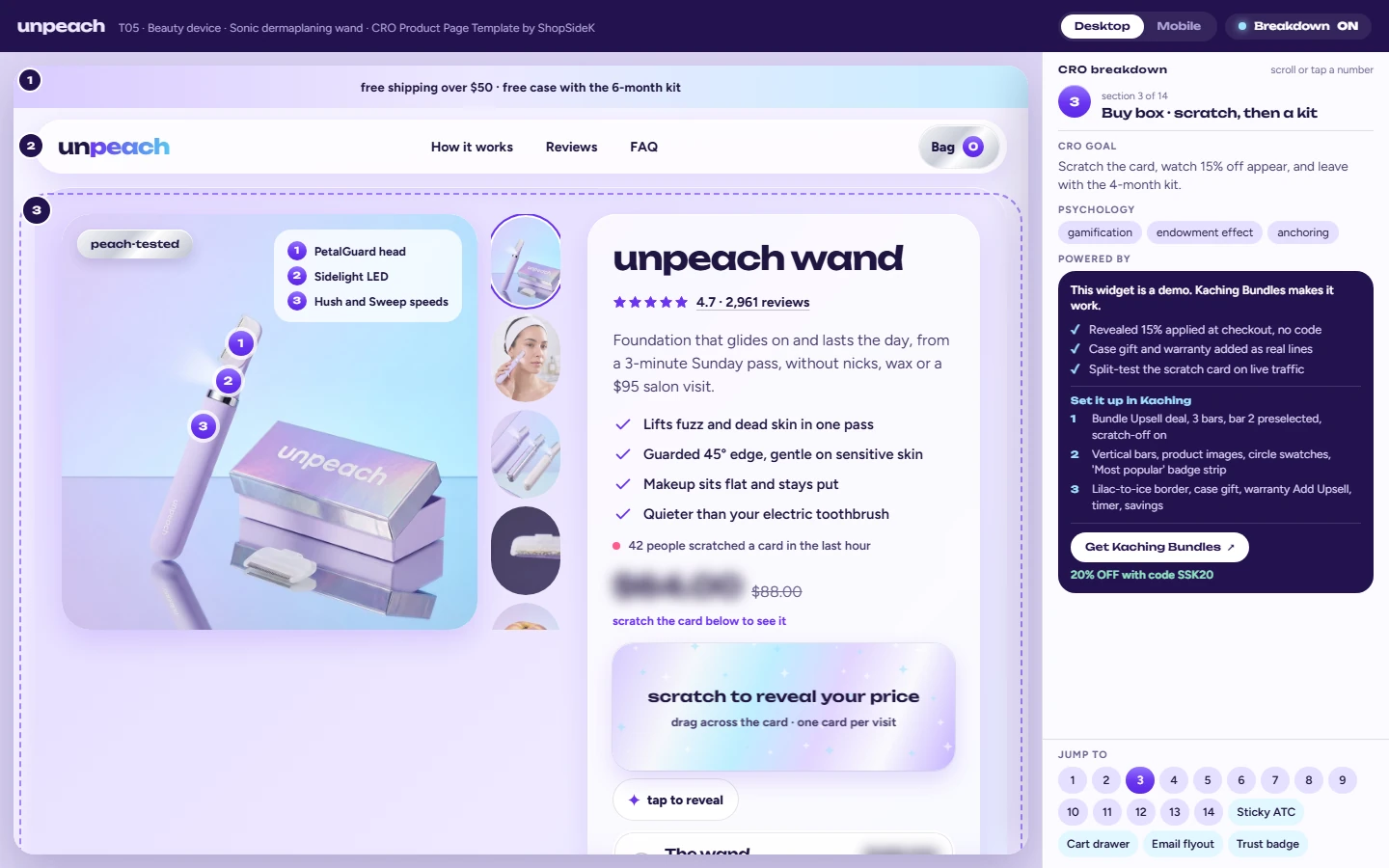
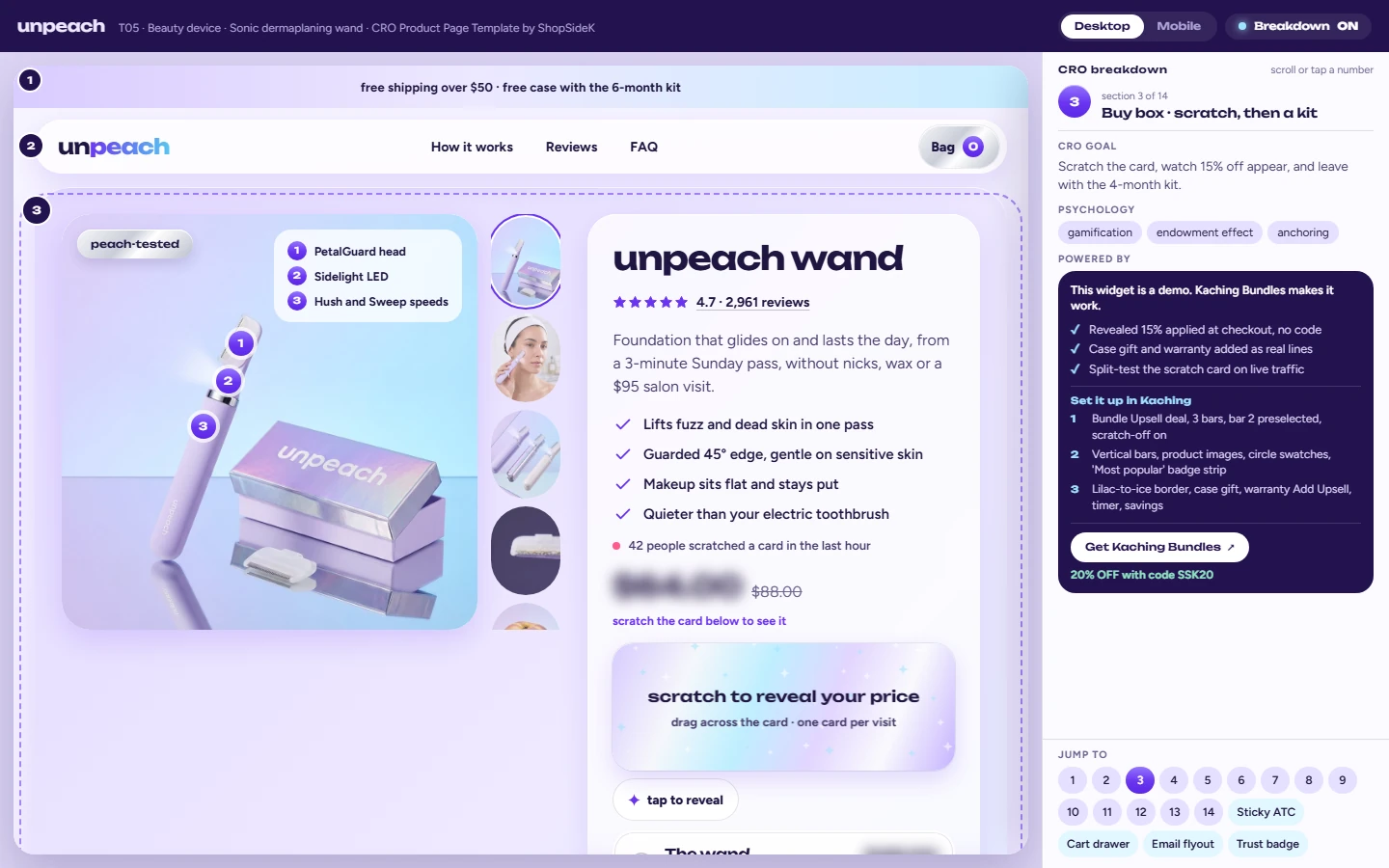
The person on this page has usually wanted to try dermaplaning for a while and keeps putting it off because the tool is a blade near her face. Unpeach spends its first screens on that fear, then sells the heads she will need afterward: one fresh head a week, so the kits are counted in Sundays.
The offer: a scratch card over three kits
The buy box opens with a holographic card, “scratch to reveal your price,” above three kit bars whose prices are blurred until the card is scratched or tapped. Every card reveals the same 15% off every bar, so no shopper pays more than another for the same kit.
| Kit | What’s inside | Price | Crossed-out price | After the 15% reveal | Heads (Sundays) |
|---|---|---|---|---|---|
| The wand | Wand with 4 heads, cable, cap, pouch | $49 | $64 | $41.65 | 4 |
| 4-month kit (preselected) | Wand + a 12-head refill | $64 | $88 | $54.40 | 16 |
| 6-month kit | Wand + two 12-head refills + a free chrome travel case ($18 value) | $79 | $112 | $67.15 | 28 |
Nobody is forced to play: the add-to-cart button reads “Reveal my price · add my kit” and does both in one tap. After the reveal, a savings line appears (“You save $33.60 on this kit” on the 4-month kit), the chosen finish (Lilac, Chrome or Pearl) follows her from bar to bar, and every bar offers a two-year wand warranty for $6.
Two demo details need a note. The $64 struck on the single wand is the wand’s catalog price, which Kaching strikes automatically; on a live store, show that strike only if the wand really sells at $64, or hide it. And the “people scratched a card in the last hour” chip is sample text: show a count like that only if something actually measures it.
The sections that do the persuading
- What one pass lifts. A macro photo of a used head after one stroke from ear to chin, labeled vellus hair, dead skin and yesterday’s sunscreen, followed by an honest limit: one pass won’t remove a dark chin hair.
- The peach test. The shopper taps three strokes across a peach, and the counter ends on “3 strokes · 0 nicks · 0 juice.” Peach skin is thinner than a face, which is the point.
- Hear it first. Hold a button to hear both speeds next to an electric toothbrush: 38 dB on Hush, 44 dB on Sweep, 61 dB for the toothbrush, measured 15 cm away.
- The stroke map. A face map fills in zone by zone with the speed and the number of strokes for each area, and greys out brows, lids, breakouts and moles.
- The two-cheek race. Thirty testers planed one cheek only and wore the same foundation for ten hours; the page runs two clocks that stop at 6 h 10 min and 9 h 40 min, with “Average times across 30 testers. Individual results vary.”
- Reviews and FAQ. The carousel keeps a four-star review about chin hairs the wand didn’t touch, and the FAQ opens on the question everyone asks: no, it doesn’t grow back thicker.
- The guarantee. Sixty nights, a return label already in the box, and the used heads don’t count against the refund.

The cart: from $54.40 to $76.40
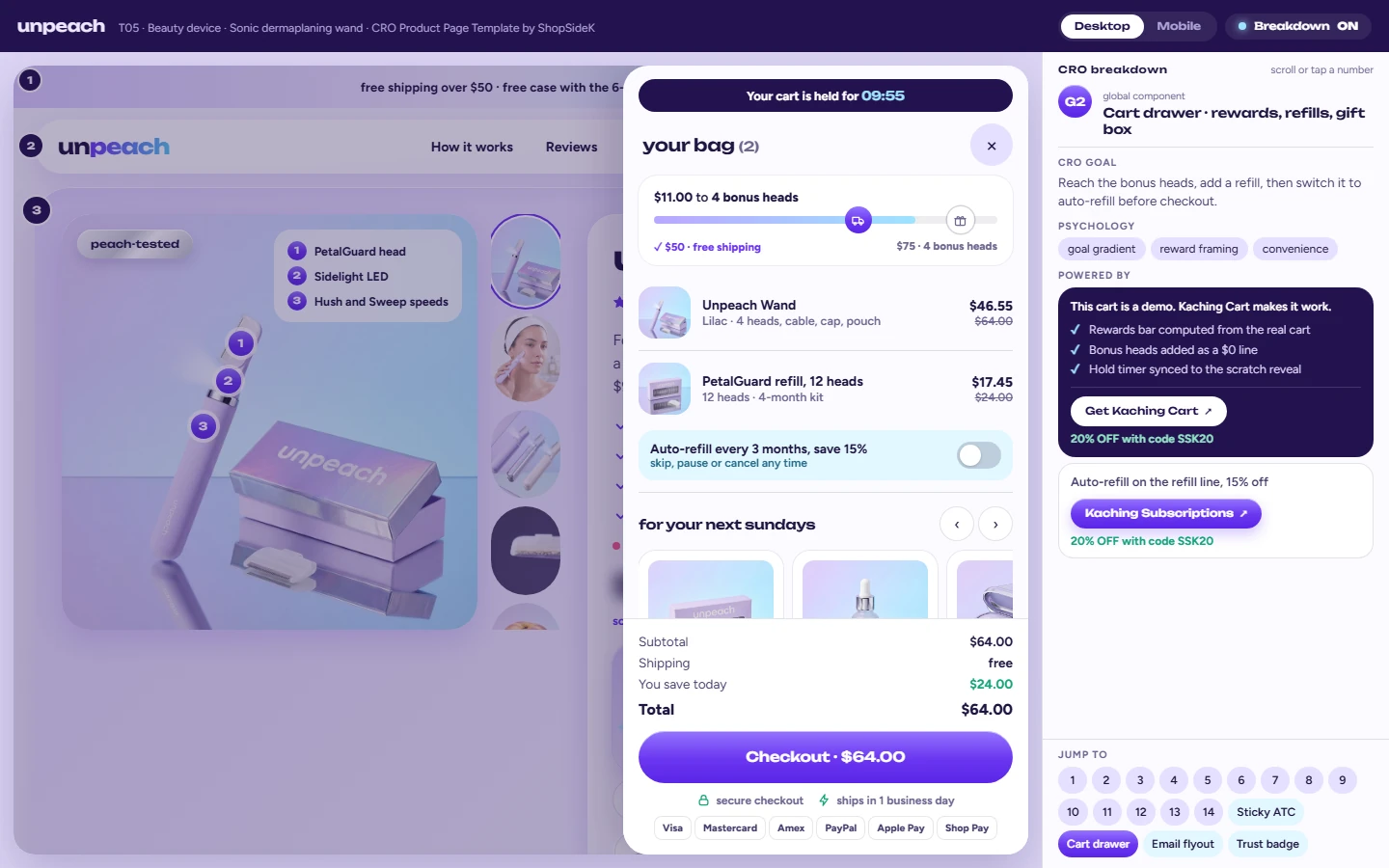
The revealed 4-month kit ($54.40) already clears the $50 free-shipping line, and the cart’s rewards bar points to the next milestone: four bonus heads, worth $8, at $75. One of the add-on cards is an after-plane calm serum at $22, which lands the order at $76.40 and unlocks the bonus heads. On the refill line, a toggle offers an auto-refill of 12 heads every three months at 15% off ($20.40), with skip, pause and cancel spelled out next to it.
One thing not to copy
After the reveal, a line says “your 15% is held for” a 15-minute countdown, and the cart adds its own 10-minute hold. When the widget’s clock reaches zero, the line changes to “hold ended · scratch price kept for this visit.” That is kind to the shopper, but it turns the countdown into decoration. Either let a hold expire as it says, or leave the timer off.
Rebuild the offer in Kaching
- A Bundle Upsell deal with three bars (the wand, wand + refill, wand + two refills + the case as a free gift), bar 2 preselected.
- A scratch card on top that reveals 15% on every bar, and the warranty as an Add Upsell on each bar; confirm the scratch-off option appears in your own Kaching editor before you design around it.
- Vertical bars with product images, circle finish swatches, a savings line after the reveal.
More scratch-card layouts are in the Kaching scratch-off templates.
Example 2: Redrest, an LED mask page that prints its numbers
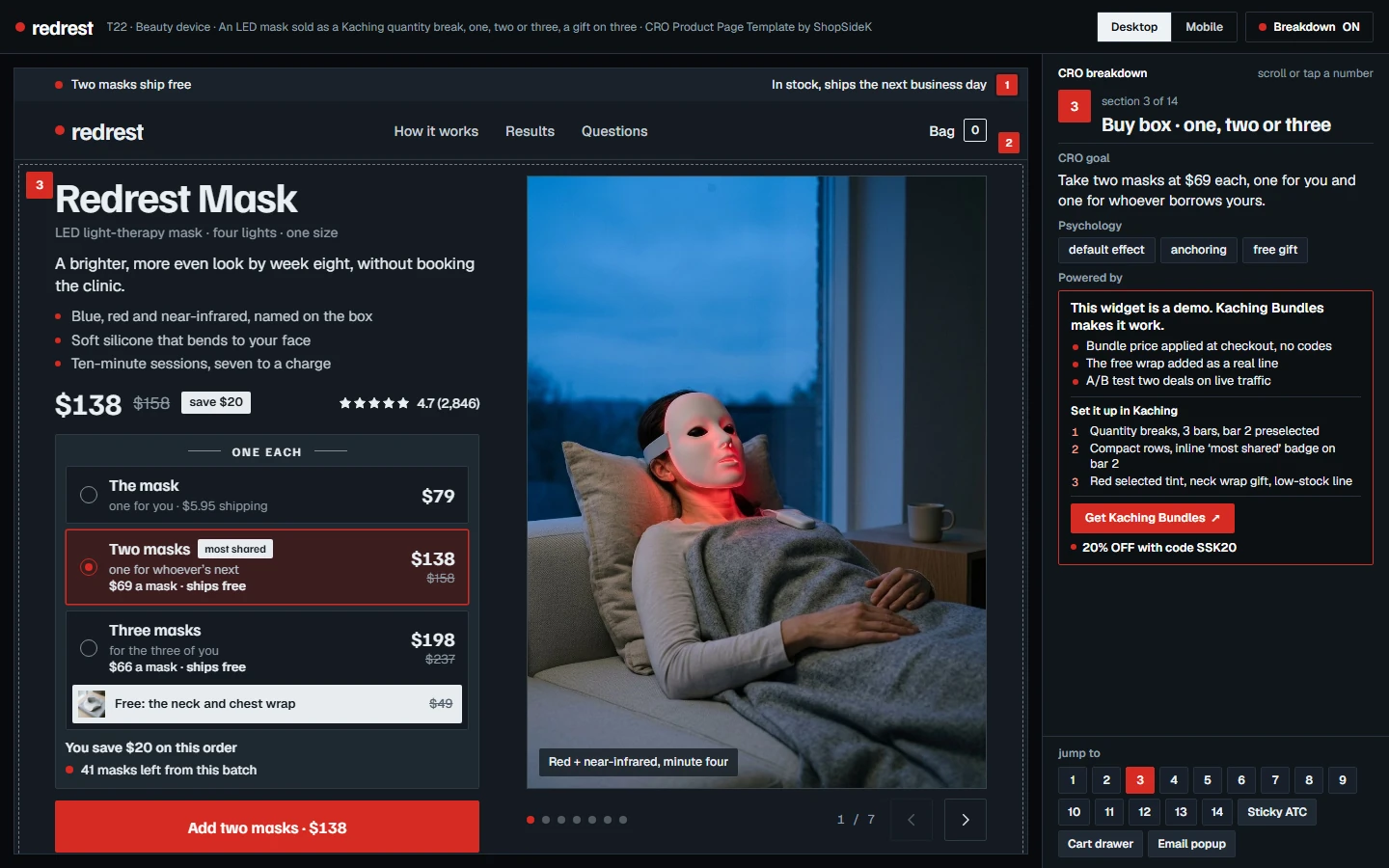
LED mask shoppers have usually seen a dozen masks that promise “7 colors” and nothing else. Redrest’s answer is to behave like a spec sheet with good manners: it names its wavelengths, says how its output was measured and shows what a blind grader did and didn’t see on its testers. The offer then turns the one person who borrows the mask into the reason for a second one.
The offer: one, two or three masks
| Bundle | Price | Crossed-out price | Per mask | Shipping | Gift |
|---|---|---|---|---|---|
| The mask | $79 | none | $79 | $5.95 | none |
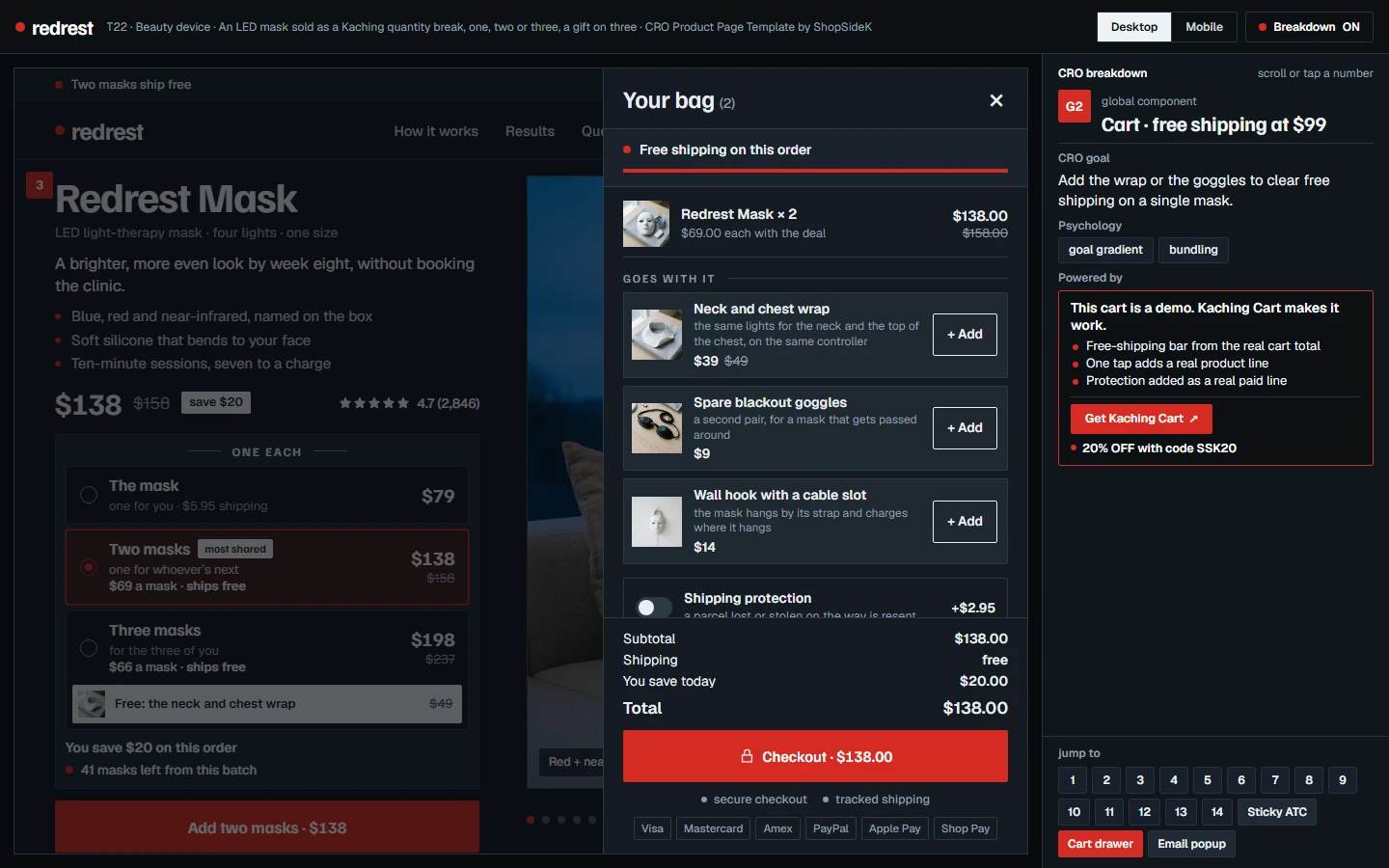
| Two masks (preselected, “most shared”) | $138 | $158 | $69 | free | none |
| Three masks | $198 | $237 | $66 | free | Neck and chest wrap |
Each struck price is the quantity × $79, which is what Kaching computes for a quantity break. The subtitles name the people, not the percent: “one for you,” “one for whoever’s next,” “for the three of you.” A single line under the bars states the saving in dollars (“You save $20 on this order”). The demo’s only urgency is a stock line, “41 masks left from this batch,” which is a static demo number; a live store should show a line like that only if it counts real stock.
The sections that do the persuading
- Four lights, fanned. Cards for Blue (415 nm, 24 LEDs), Red (633 nm, 64), Near-infrared (830 nm, 64) and Red + near-infrared together. The near-infrared card adds a small test: you can’t see that light, but a phone camera can.
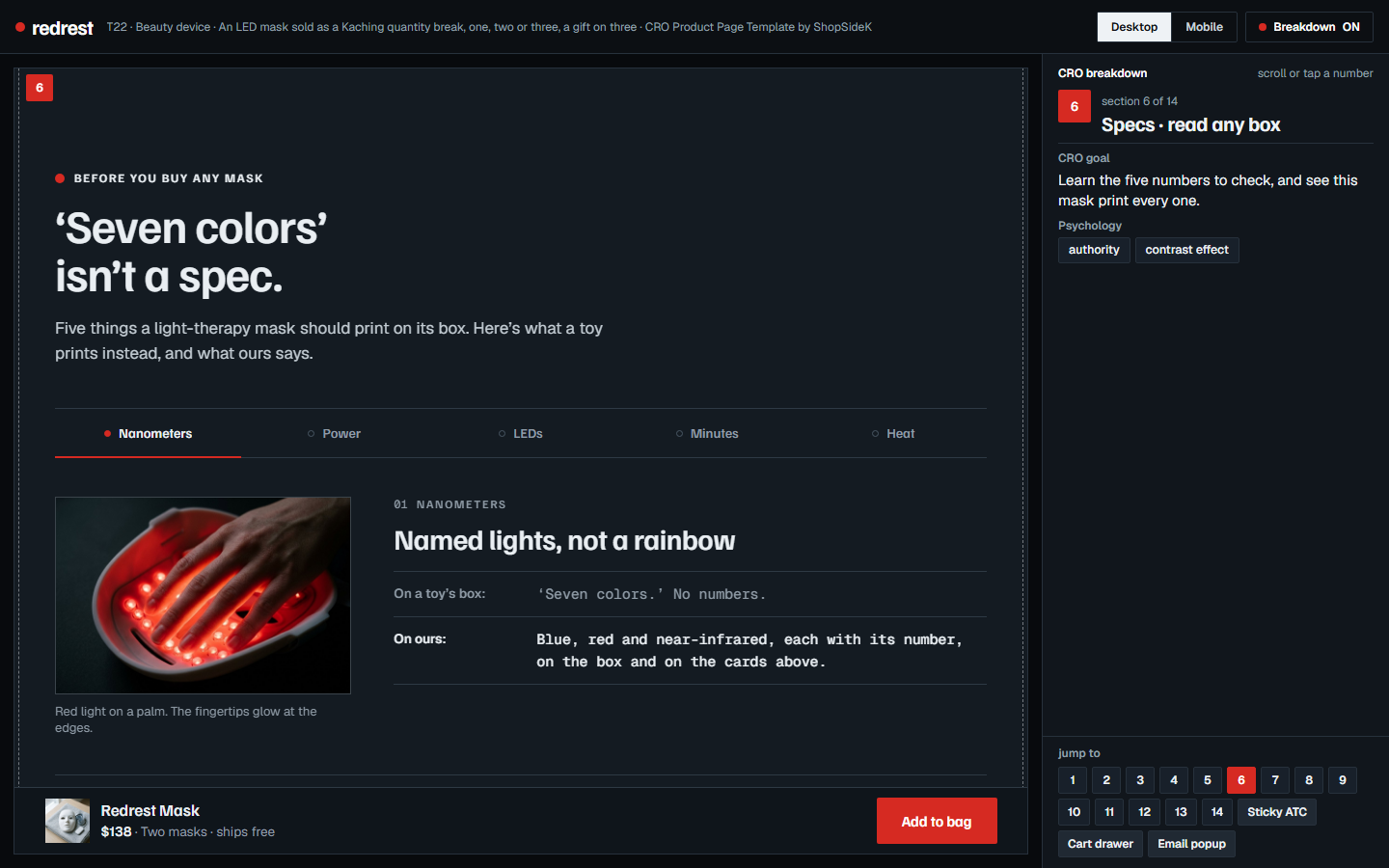
- Read any mask’s box. Five things to check on any mask’s packaging, each set against a vague label: wavelengths in nanometers, power measured at the skin side on every batch (14, 30, 26 and 56 mW/cm² by mode), the LED count, a ten-minute session that switches itself off, and about 38 °C at the silicone with no UV.
- Soft enough to follow your cheekbones. A drawing shows the soft silicone holding the LEDs about 4 mm from the skin, against 15–20 mm at the cheekbone on two hard-shell masks measured on the same head form.
- Six of the forty-six. A use test with 46 adults aged 27 to 66 across skin-tone groups I to VI, five nights a week for eight weeks, photographed on day 0 and day 56 and graded by an esthetician who didn’t know which photo was which. The page shows six testers, each with what the grader saw and what hadn’t changed yet, and no averages or percentages anywhere.
- Your nights. Weekday chips turn the routine into a plan: five nights a week for four weeks, then three.
- The promise. One hundred and twenty nights, used is fine, with the shopper’s own return-by date worked out on the page, plus a two-year warranty.
The cart: shipping solved on load
Because the two-mask bundle is preselected, the cart opens with free shipping already reached ($99 and up). Instead of a carousel it shows a short “goes with it” list matched to a shared mask: spare blackout goggles for $9 (“a second pair, for a mask that gets passed around”) and a wall hook with a cable slot for $14. A shopper who picks one mask sees “$20.00 to free shipping,” and the neck and chest wrap at $39 clears it. The popup offers $10 off a first order rather than 10%, a choice explained in the setup section below.
One thing not to copy
On the three-mask bar, the free neck and chest wrap is struck at $49, while the cart sells the same wrap as an add-on for $39. A shopper who opens the cart can see that the gift was valued above the price anyone pays for it. Value a free gift at the price you actually sell it for.
Rebuild the offer in Kaching
- A Quantity Break on the mask: 1, 2 and 3 at fixed bundle prices of $79, $138 and $198, bar 2 preselected.
- Compact rows, an inline “most shared” badge, the price per mask and a “ships free” tag on bars 2 and 3.
- The wrap as a free gift product on bar 3, a savings summary, and a stock line only if it counts real stock.
For how to set the bar prices, see how to set profitable Shopify quantity breaks and how deep quantity break discounts should go.
What a beauty device page can claim: FDA terms and proof
Skincare copy is mostly about how skin looks. Device copy slides easily into what a device does to the body, and in the US that is regulated territory. The points below summarize what the FDA and the FTC publish. This is general information, not legal advice; check your own product with a regulatory adviser.
- “FDA registered” is not an endorsement. The FDA says a registration and listing entry “does not denote approval, clearance, or authorization” of a facility or its devices, and that it does not issue registration certificates to device facilities (FDA: “FDA registered” or “FDA certified” devices). A “registered” badge suggests a review that never happened.
- Treatment words describe a medical device. Under section 201(h) of the Federal Food, Drug, and Cosmetic Act, a device is a product intended to diagnose, cure, mitigate, treat or prevent disease, or to affect the structure or a function of the body (FDA: how to determine if your product is a medical device). For example, the FDA lists over-the-counter light-based devices intended to treat mild to moderate acne as Class II devices that go through a 510(k) premarket notification (FDA product classification, code OLP).
- “Cleared” means cleared for something specific. A 510(k) notifies the FDA before a device is marketed so the agency can judge whether it is equivalent to a device already on the market (FDA: 510(k) clearances). If your device has a clearance, name the use it was cleared for and keep the record handy; the same FDA page links to the searchable 510(k) database.
- Every measurable claim needs support before it runs. The FTC expects advertisers to have “a reasonable basis for advertising claims before they are disseminated,” and a claim that cites a level of support, such as “tested on 30 people,” must have at least that level behind it (FTC Policy Statement Regarding Advertising Substantiation).
How the two demos handle this: Redrest’s copy stays with how skin looks (“a rested, even look,” “the look of fine lines”) and never names acne, wrinkles as a condition or collagen, and it carries no FDA line at all. Careful wording lowers the risk, but it does not settle whether a real mask needs a clearance. Unpeach’s “three and a half more hours of foundation” and Redrest’s tester panel show what the support behind a claim looks like on the page: who was tested, how, for how long, and what didn’t change. In both demos those tests are invented, so a live store would need to run its own.
How to build a beauty device offer in Kaching
- Choose the deal by what the device needs next. A device with consumables (heads, gels, cartridges) fits a Bundle Upsell of device plus refills; a device with nothing to refill fits a Quantity Break for the rest of the household (Kaching help: bundle types).
- Name the bars after time or people. “16 Sundays” and “one for whoever’s next” do more work than “save 27%.”
- Offer the cover where the doubt is. A warranty as an Add Upsell on each deal bar answers “what if the motor dies” at the moment of choosing (Kaching help: add an upsell to your deal bar).
- Put repeat orders in the cart, not the widget. Unpeach offers its auto-refill on the refill line in the cart, so the first purchase stays simple.
- Price the worst order before adding a layer. On the demos’ assumed costs, Unpeach’s deepest stack (the 6-month kit, scratched, plus the 10% popup code) still keeps 66.1% gross margin; with card fees and a 6% return rate added, the worst order on each kit lands between 61.3% and 62.5%. Redrest’s worst order (three masks, the free wrap and the popup code) keeps 52.1% with a $10 code; a 10% code would have dropped it to 49.4%, which is why the popup offers dollars. Run your own numbers in the Shopify discount break-even calculator, and see how Shopify bundle discounts stack.
- Hide any strike you can’t stand behind. If the crossed-out price isn’t one you really charge, remove it from the deal bars (Kaching help: remove the compare-at price).
Beauty device product page checklist
- The first fear named and answered with something the shopper can replay: a test, a sound, a demo clip.
- Every spec a skeptic checks, with units: wavelength, output, LED count, minutes, heat, noise.
- A how-to section that says where not to use the device.
- Bundles named in uses or people, with the preselected bar the one most buyers need.
- A crossed-out price only where the item really sells at that price.
- Gift values that match what you charge for the same item.
- A warranty offered at the moment of choosing, not buried in the footer.
- A return window longer than the time results take.
- Tester results that show who, how long, how graded and what didn’t change.
- No “FDA registered” badge, and “FDA-cleared” only with a clearance for that use.
- Urgency only when it is real: a stock line that counts, a hold that expires.
- Every discount layer priced together before launch.
FAQ
What should a beauty device product page include?
A plain answer to the first fear (pain, nicks, heat or noise), the specs a skeptic checks with their units, a short how-to with the areas to avoid, results from a described test, bundles sized in uses, a warranty and a return window longer than results take.
Can I put “FDA registered” on my LED mask product page?
It is risky. The FDA says registration and listing does not mean approval, clearance or authorization, and that it issues no registration certificates for device facilities, so the badge suggests a review that never took place.
What does “FDA-cleared” mean for an at-home beauty device?
It means the device went through a 510(k) premarket notification and the FDA accepted it for a specific intended use. Name that use on the page, and don’t extend it to claims the clearance doesn’t cover.
How should I bundle a beauty device with its refills?
Build kits that pair the device with the refills for a set period and name them by that period, such as a 4-month kit with 16 heads for one head a week. Preselect the kit most buyers need, and offer ongoing refills as a subscription in the cart.
Should I sell an LED face mask as a two-pack?
It can work, because a mask is personal and others in the home tend to borrow it. Name the second unit for that person, show the price per mask, and make the two-pack the first bundle that ships free.
How long should the return window be for a beauty device?
Longer than the results take. Redrest’s page says a brighter look tends to show by week eight and treats twelve weeks as the fair test, so its 120-night window runs past it with a month to spare; Unpeach’s 60 nights cover eight weekly uses.
Is a scratch-off discount worth adding to a device page?
It can turn hesitation into a small win, but keep it fair and priced in: reveal the same discount to everyone, never block buying behind the scratch, and check the margin with every other code stacked on top.
More product page examples
Unpeach and Redrest are part of the ShopSideK library of Shopify product page templates, each with a free section-by-section CRO breakdown. For more device pages, browse the beauty device product page templates, or compare offers in the Kaching quantity break templates.
For the claims side of beauty, see also skincare product page examples and supplement product page examples.
Sources
- FDA: Are there “FDA registered” or “FDA certified” medical devices? How do I know what is FDA approved?
- FDA: How to determine if your product is a medical device
- FDA product classification database: product code OLP, over-the-counter light-based device for acne
- FDA: 510(k) clearances
- FTC Policy Statement Regarding Advertising Substantiation (1984)
- Kaching help: different bundle types
- Kaching help: add an upsell to your deal bar
- Kaching help: remove the compare-at price from a bundle deal