Last updated: October 30, 2026. Both pages are free, clickable demos with a breakdown of every section. No signup.
A skincare product page sells a habit, not a jar: the shopper wants to know how long it takes, whether it will sting, what goes on before and after it, and how much to buy. The two Shopify examples below answer those questions in two different ways. Pellis Lab, a body lotion for rough, bumpy arms and thighs, ties its bundle to a 12-week plan and gives the extra bottles away. Fourdrop, a vitamin C serum, sells the whole morning routine, cleanser, serum and cream, with all three ticked when the page loads.
After the two breakdowns comes the part most skincare page examples leave out: which claims keep a skincare product a cosmetic under US rules, and which ones turn it into a drug.
Key takeaways: 7 rules for a skincare product page
- Sell the routine the product lives in. Show the step before and the step after, and let the shopper add them in one tap, because nobody uses a serum or an acid lotion on its own.
- Size the bundle to the time the product needs. If results take 12 weeks and one bottle lasts four, the 3-bottle option is the honest default, and free bottles can carry the discount.
- Answer the sting question before checkout. Say what the first week feels like, which strength to start on and when to step down.
- Let shoppers rule themselves out. A two-question check that sends lookalike conditions to a doctor costs a few sales and earns the rest.
- Show proof a shopper can judge. Same person, same light, a stated method and “individual results vary” beat a wall of five-star quotes.
- Describe how skin looks and feels, not what the product treats. Under FDA rules, claims to treat a condition or change how skin works can make a skincare product a drug.
- Give a subscription a real reason. Freshness or a fixed protocol justifies a refill schedule; offer it as a choice, not a hidden default.
The two examples at a glance
| Pellis Lab | Fourdrop | |
|---|---|---|
| Product | Leave-on body lotion with AHA and urea, 10% each, 200 ml | Vitamin C serum, L-ascorbic acid at 10%, 15% or 20%, 15 ml |
| What the page sells | A 12-week plan for rough, bumpy arms and thighs | A three-minute morning routine |
| Kaching offer type | Buy X Get Y: buy 1, buy 2 get 1 free, buy 3 get 3 free | Bundle Upsell, frequently bought together: serum + cleanser + cream |
| Selected on load | Buy 2, get 1 free (3 bottles) | All three products ticked |
| Prices | $38 · $76 · $114 | $38 · $54 · $59 · $75, by what is ticked |
| Subscription | Offered in the cart: auto-refill at 15% off | Opt-in checkbox in the widget: 15% off every 8, 10 or 12 weeks |
| Add-ons | SPF 30 body mist $16, elbow and knee balm $14 | Cotton headband $6 |
| Scarcity signal | A low-stock line | A ship-today cut-off at 2 pm |
| Order in the walkthrough | $76 → $90, which unlocks a free travel size | $75 → $87, with a free travel cream already in the bag |
| Live example | Pellis Lab template (T02) | Fourdrop template (T19) |
Example 1: Pellis Lab, a body lotion page that sells a 12-week plan
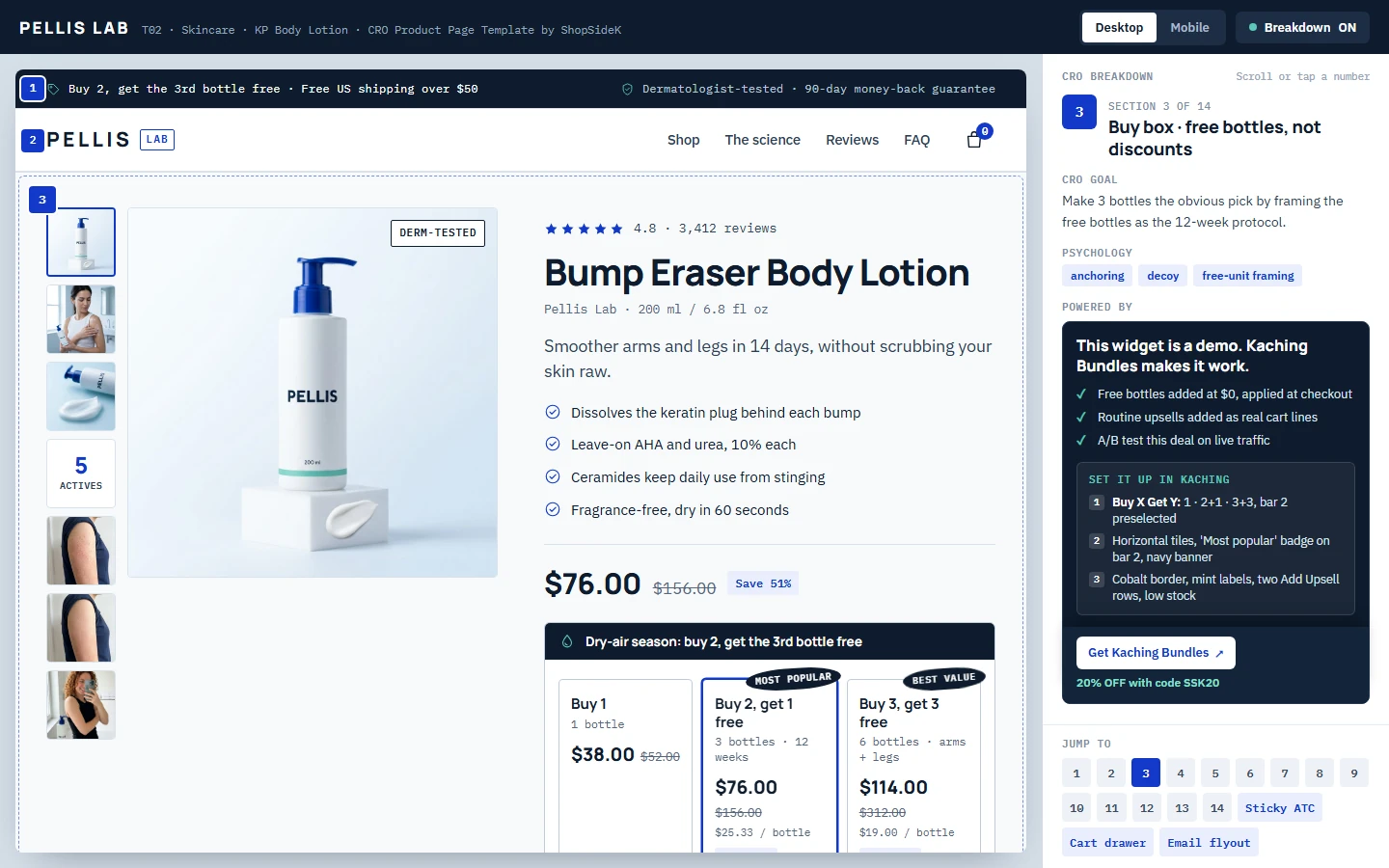
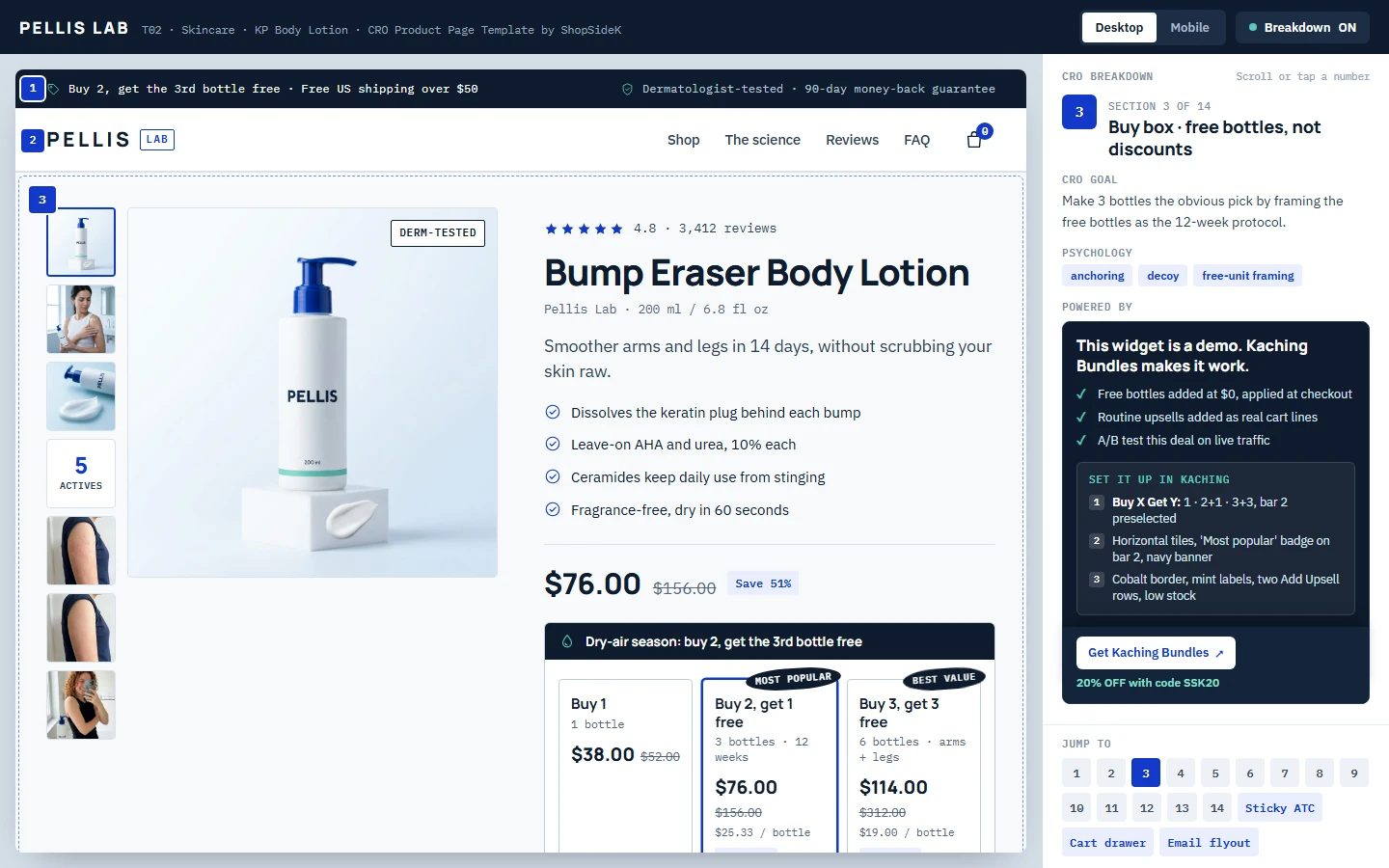
Pellis Lab sells a fragrance-free leave-on lotion for keratosis pilaris, the rough “chicken skin” bumps on upper arms and thighs. Its shopper has usually tried scrubs and loofahs already. The page’s answer is a plan: one bottle covers one body zone for four weeks, the plan runs 12 weeks, so the free bottles are what make the plan affordable.
The offer: free bottles instead of a deeper discount
| Tile | Price | Bottles | Per bottle | What it covers |
|---|---|---|---|---|
| Buy 1 | $38 | 1 | $38 | 4 weeks on one zone |
| Buy 2, get 1 free (preselected) | $76 | 3 | $25.33 | 12 weeks on one zone |
| Buy 3, get 3 free | $114 | 6 | $19.00 | 12 weeks on arms and legs |
Two routine rows sit under the tiles, both unticked: a Daily SPF 30 Body Mist ($16) and an Elbow & Knee Repair Balm with 20% urea ($14). The 3-bottle and 6-bottle tiles ship free, and the bottles come free in the cart at $0, so the shopper sees exactly what they pay for.
The demo strikes every tile at $52 a bottle, a sample compare-at price set on the product, and shows “Only 37 three-bottle sets left at this price” as sample text. A live store should strike only a price it has actually charged, and show a stock line only when it counts real stock.
The sections that do the persuading
- A grit scale for proof. Testers matched the feel of their arm to sandpaper swatches at day 0, 14, 28 and 56, and the page steps through the grits with photos for arms and thighs. The method sits in a footnote, next to “individual results vary.”
- The plug diagram. A tappable cross-section of one bump shows why scrubbing fails and what each ingredient does, so an acid lotion feels logical rather than harsh.
- KP or not. Two taps sort rough bumps from strawberry legs, folliculitis and eczema, and the last two are sent to a doctor or a dermatologist instead of the buy box.
- A protocol that picks the bundle. The shopper chooses zones and skin type, the page writes out how to apply it and how many bottles 12 weeks need, and one button selects the matching tile.
- The sun rule. A night reminder and a morning reminder on a drawn phone lock screen explain that acids raise sun sensitivity, then offer the SPF mist as the morning step.
- A 90-day guarantee. It runs longer than the 12-week plan and refunds every bottle, opened or empty, with nothing to send back.

The cart: from $76 to $90
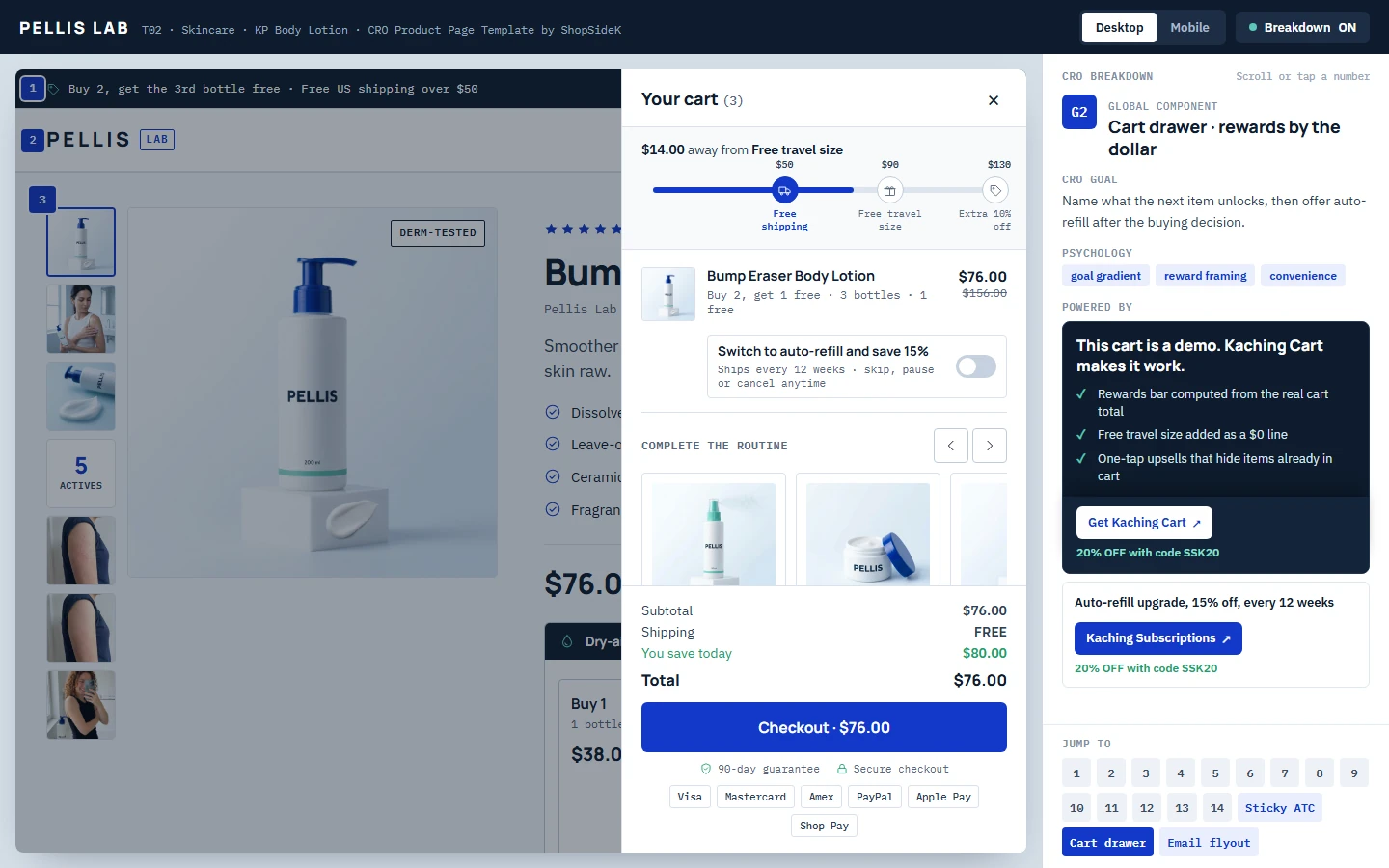
The cart drawer, built with Kaching Cart, has three milestones: free US shipping at $50, a free 50 ml travel size ($14 value) at $90 and an extra 10% off at $130. The preselected 3-bottle set lands at $76, so the slider’s balm ($14) is exactly what reaches the travel size. A last line in the drawer offers to switch the set to auto-refill every 12 weeks at 15% off, which brings $76 down to $64.60.
One thing not to copy
The protocol is written on a dermatologist’s prescription pad, with “Rx”, “Sig” and “Disp” lines and a signature. In the demo it works as a story device: it turns advice into a bottle count. On a live store, a prescription format around a named skin condition presents a cosmetic as a treatment, which is how a product drifts into drug territory under FDA rules (see the claims section below). Keep the plan and the bottle math, write them in the brand’s own voice, and keep the expert’s tie to the brand stated, as the demo does with “Pellis Lab advisor.”
Rebuild the offer in Kaching
- A Buy X Get Y deal with three bars, 1, 2+1 and 3+3, bar 2 preselected.
- Horizontal tiles, a “Most popular” badge, two unticked upsell rows for the mist and the balm.
- Kaching Cart rewards at $50, $90 and $130, an upsell slider and the auto-refill offer.
For when a buy-X-get-Y deal earns more than a straight discount, see the economics of BOGO offers on Shopify.
Example 2: Fourdrop, a vitamin C serum page that sells the morning
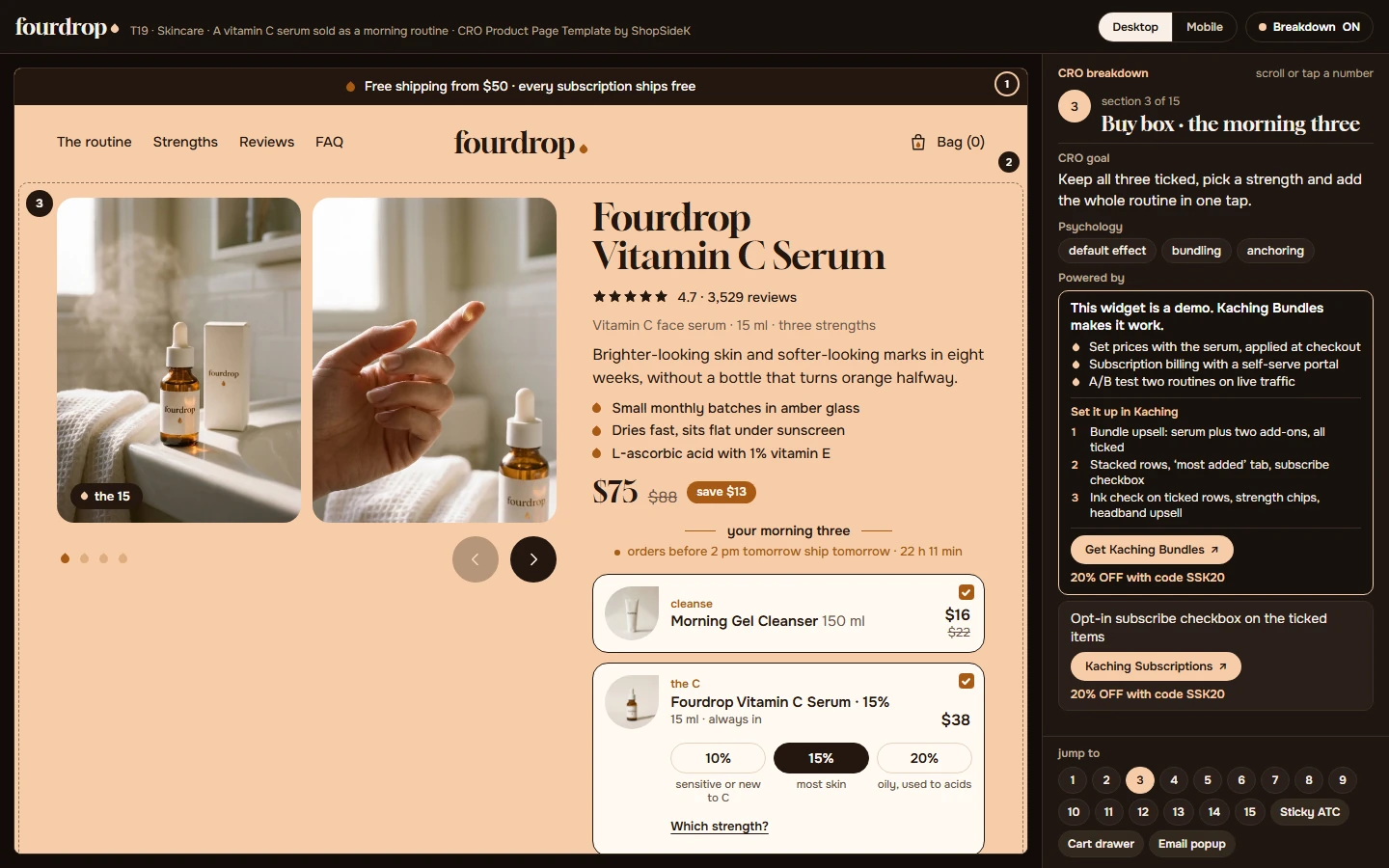
Fourdrop sells one serum at three strengths, all at $38, in a small 15 ml amber bottle: four drops a morning is about 75 mornings, and an opened bottle stays straw-colored for about 90 days in a cabinet. The page treats the bottle size and the date on the box as its main selling points, because the classic fear with vitamin C is a bottle that turns orange before it’s finished.
The offer: the routine, ticked on load
| What is ticked | One-time price | Crossed-out total | Subscribed price |
|---|---|---|---|
| The serum alone | $38 | none | $32.30 |
| Serum + Morning Gel Cleanser | $54 | $60 | $45.90 |
| Serum + Daily Cream | $59 | $66 | $50.15 |
| All three (on load) | $75 | $88 | $63.75 |
The cleanser costs $16 with the serum instead of $22, and the cream $21 instead of $28, so the struck total is the three products’ own prices added up. The serum row is locked “always in” and carries the strength chips. Under the rows, an unticked “Subscribe & save” checkbox switches every price to 15% off, with deliveries every 8, 10 or 12 weeks; 10 is the default, because ten weeks is about one bottle. One-time orders ship free from $50, and every subscription ships free.
The sections that do the persuading
- The morning loop. Four steps in a ring, thinnest to thickest, show where the serum goes: after the cleanser, before the cream, with sunscreen always last.
- Three doubts, three photos. How far does a bottle go, will it turn orange, will it sting: each gets one photo and a plain answer, including “if it stings past a minute, drop to the 10.”
- Strength by skin. A table sends sensitive or new users to 10%, most skin to 15% and oily skin used to acids to 20%, with what the first week feels like at each.
- Week zero, week eight. One face in the same window light, a drag slider, “individual results vary” and a line that the skin’s own color is the same in both photos.
- A dated batch log. Small monthly batches, each box printed with its bottling day, and nothing shipped more than 30 days after it.
- A three-part guarantee. A refund within 60 days even on a half-used bottle, the other strength sent free if the first one is wrong, and a replacement for any bottle that arrives darker than straw.

The only scarcity line on the page is a dispatch cut-off: “orders before 2 pm ship today,” with a weekend version that says Monday. It is a real daily deadline, which is the kind of countdown worth copying.
The cart: open it on a reward already earned
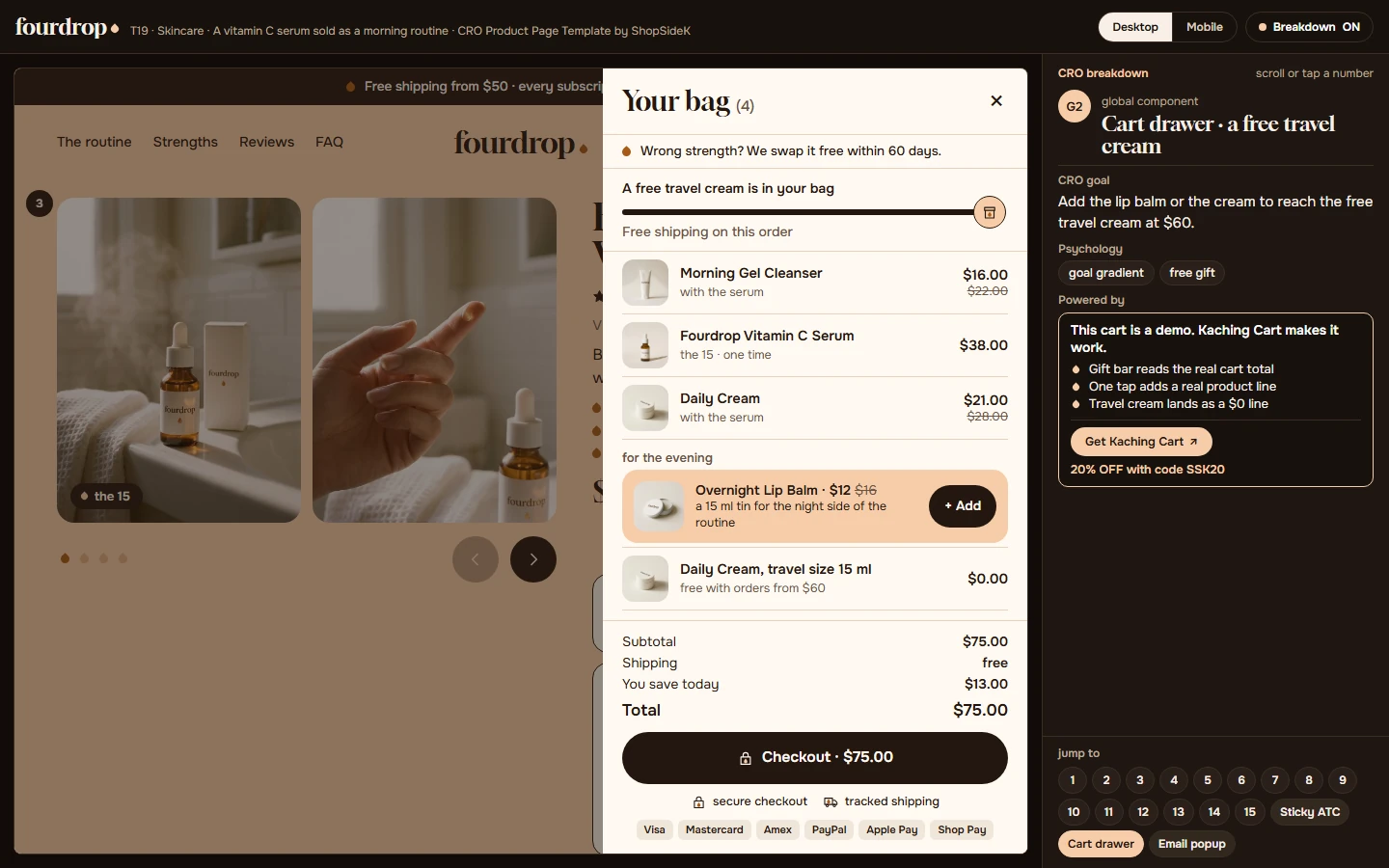
The cart drawer’s free-gift bar adds a 15 ml travel Daily Cream from $60, and the routine already costs $75, so the drawer opens with “A free travel cream is in your bag.” Its top line is the strength promise: “Wrong strength? We swap it free within 60 days.” One card offers an Overnight Lip Balm for the evening ($12), which takes the order from $75 to $87.
One thing not to copy
The batch log re-dates itself from today’s date every time the page loads, so the demo never looks stale. A real store can only show batches it actually bottled, on the days it bottled them: a log that writes its own dates would turn the page’s strongest trust signal into a false claim.
Rebuild the offer in Kaching
- A Bundle Upsell on the serum, with the cleanser and cream at set prices, both selected by default.
- Kaching Subscriptions turned on for the deal: 8-, 10- and 12-week plans at 15% off.
- A strength option on the serum and one upsell for the headband.
The demo’s opt-in subscribe checkbox, the checkbox rows and the timer to a fixed 2 pm cut-off are layout choices that have not all been confirmed in the Kaching editor, so check each one in the app before you promise it to a client. For how a routine bundle differs from a cart add-on, see Shopify bundles vs upsells.
Cosmetic or drug: what a US skincare product page can claim
The FDA decides whether a skincare product is a cosmetic, a drug or both by its intended use, and it reads intended use from the claims a brand makes on labels, in ads, on the internet and in other promotion, as well as from how consumers perceive the product (FDA: Is It a Cosmetic, a Drug, or Both?). A product page is promotion, so its bullets count. A drug is a product intended to diagnose, cure, mitigate, treat or prevent disease, or to affect the structure or any function of the body; a cosmetic is for cleansing, beautifying, promoting attractiveness or altering the appearance. A product with drug claims needs an approved application or must follow an OTC drug monograph. This is general information, not legal advice.
The two demos sit on either side of that line, which makes them useful to compare. Fourdrop keeps to looks (“brighter-looking skin and softer-looking marks”) and its footer says it is a cosmetic, not meant to treat or prevent any skin condition. Pellis Lab names keratosis pilaris as the job it was made for, and one bullet says it “dissolves the keratin plug behind each bump.”
| Claim on a product page | How FDA’s framework reads it | The safer direction |
|---|---|---|
| Names a condition as what it treats (“treats keratosis pilaris”) | Treating a condition is a drug use | Describe look and feel: “smoother-feeling arms,” “rough, bumpy-looking skin” |
| Changes how skin works (“regenerates cells,” “reduces melanin”) | FDA lists cell-regeneration and pigment-production claims among its drug examples | “Softer-looking marks,” “more even-looking skin,” and say the skin’s own color doesn’t change |
| Sun protection or an SPF number | Sunscreens are regulated as drugs and carry a Drug Facts label; moisturizers and makeup with sun-protection claims are both cosmetics and drugs | Sell a compliant sunscreen as its own product; keep sun claims off the cosmetic |
| A results number (“92% of testers,” “61% fewer visible bumps”) | The FTC expects a reasonable basis for objective claims before they run | Keep the study write-up behind it, or cut the number |
| An expert on the page | A connection between the endorser and the brand must be disclosed clearly | State the tie, as Pellis Lab does with “Pellis Lab advisor” |
Sources for the table: FDA on sunscreen, the FTC Policy Statement Regarding Advertising Substantiation and 16 CFR 255.5 on material connections.
Two more rules touch a skincare page directly:
- Acids and the sun. FDA’s guidance for cosmetics containing alpha hydroxy acids, issued in January 2005 and not legally binding, recommends a “Sunburn Alert” on leave-on AHA products used where skin meets the sun: the AHA may raise sun sensitivity, so use sunscreen, cover up and limit sun exposure while using it and for a week after (FDA guidance on AHA labeling). Pellis Lab’s lock-screen section turns that warning into the routine’s morning step.
- MoCRA, the 2022 cosmetics law. Since December 29, 2024, a cosmetic’s label must give a domestic address, a domestic phone number or electronic contact information, such as a website, where people can report adverse events (21 U.S.C. 364e). The brand must report serious adverse events to FDA within 15 business days (21 U.S.C. 364a) and keep records showing the product’s safety is adequately substantiated; certain small businesses are exempt from the facility registration, product listing and manufacturing-practice requirements (FDA: MoCRA). A visible contact route on the product page makes the label’s promise easy to keep.
How to build a skincare routine bundle in Kaching
- Pick the deal from the routine. Use Buy X Get Y when the routine is more of the same product over time, and a Bundle Upsell when it is different products with a set price on each (Kaching help: bundle types).
- Match the quantities to the timeline. Work out how long one unit lasts and how long results take, then make the middle option cover that time.
- Add the steps around the product as upsells. The sunscreen after an acid, the cream after a serum: one row each, with a line saying why (Kaching help: add an upsell to your deal bar).
- Offer the subscription where its reason is. Fourdrop puts it in the widget because freshness is the reason; Pellis Lab offers it in the cart once the plan is chosen (Kaching help: subscriptions for bundles). For pricing tiers and plans, see subscription plans per quantity tier.
- Price the worst order before launch. On the demos’ assumed costs, the lowest margin was 50.7% for Pellis Lab (six bottles switched to auto-refill) and 63.9% for Fourdrop (the serum alone, subscribed, with the welcome code). Run your own numbers in the Shopify discount break-even calculator.
Skincare product page checklist
- The routine around the product, with the steps before and after it one tap away.
- Bundle sizes that match how long a unit lasts and how long results take.
- What the first week feels like, which strength to start with and when to step down.
- A quick check that sends lookalike conditions to a doctor.
- Before-and-after photos in the same light, with the method and “individual results vary.”
- Claims about how skin looks and feels, not conditions treated or skin functions changed.
- For AHA products, the sun warning and the sunscreen step.
- Any sunscreen sold with its Drug Facts label, as its own product.
- A visible contact route for complaints and adverse event reports.
- A guarantee that lasts longer than the time results take.
- One scarcity line at most, and only one that is true, such as a daily ship cut-off.
- A subscription offered with its reason and its cancel terms.
FAQ
What should a skincare product page include?
The routine the product belongs to, how long it takes, how much to buy for that time, what the first week feels like, who should not use it, before-and-after proof with its method, the full ingredient list, a guarantee and a clear way to contact the brand.
Can a skincare product page say it treats keratosis pilaris or eczema?
Not if the product is sold as a cosmetic. FDA treats a claim to treat a condition as a drug claim, and drugs need an approved application or must follow an OTC monograph. Describe how skin looks and feels instead, and have the final wording reviewed.
Is a vitamin C serum a cosmetic or a drug?
It depends on what the page claims. “Brighter-looking skin” and “softer-looking marks” describe appearance, the cosmetic side. Claims that it reduces melanin production or regenerates cells match FDA’s own examples of drug claims.
Should a skincare store sell routine bundles?
Yes, when the products are used together. Fourdrop ticks cleanser, serum and cream on load and lets the shopper untick what they already own; Pellis Lab adds the sunscreen and the balm as optional rows under its bottle tiles.
Should skincare be sold by subscription?
When the product runs out on a schedule or loses freshness, yes, as a clear option with its cancel terms shown. Fourdrop’s 10-week default matches one bottle; Pellis Lab offers auto-refill in the cart once a 12-week plan is chosen.
Do AHA skincare products need a sun warning?
FDA’s 2005 guidance, which is not binding, recommends a “Sunburn Alert” on leave-on AHA cosmetics used on sun-exposed skin, advising sunscreen and limited sun exposure during use and for a week after.
Can I show before-and-after photos on a skincare page?
Yes, if they are real and representative: the same person, light and framing, the time between them, the routine used and “individual results vary.” Any number you put next to them needs a study behind it.
More product page examples
Pellis Lab and Fourdrop are two of the demos in the ShopSideK library of Shopify product page templates, each opening with a free section-by-section CRO breakdown. For more pages in this niche, browse the skincare product page templates, or compare offers on the Kaching Buy X Get Y templates and the Kaching frequently bought together templates.
Related breakdowns: supplement product page examples and clothing product page examples.
Sources
- FDA: Is It a Cosmetic, a Drug, or Both? (Or Is It Soap?)
- FDA: Sunscreen, how to help protect your skin from the sun
- FDA: Guidance for industry, labeling for cosmetics containing alpha hydroxy acids (January 2005)
- FDA: Modernization of Cosmetics Regulation Act of 2022 (MoCRA)
- 21 U.S.C. 364a, adverse events (Cornell LII)
- 21 U.S.C. 364e, labeling (Cornell LII)
- FTC Policy Statement Regarding Advertising Substantiation (1984)
- 16 CFR 255.5, disclosure of material connections (Cornell LII)
- Kaching help: different bundle types
- Kaching help: add an upsell to your deal bar
- Kaching help: how to sell subscriptions for bundles