Last updated: October 30, 2026. Both example pages are live demos anyone can click through, free and without an account.
A kitchen product page sells into a room that is already full: the shopper owns pans, a pepper mill and a drawer that barely closes. The pages that work answer three kitchen questions before the price: how many pieces the cook actually uses, where each piece goes when dinner is over, and what the surface will look like after a hundred meals. The two Shopify examples below, a nesting cookware set and a pair of electric grinders, answer all three with set prices, a color for every piece and claims they can show.
Below, each example gets the same treatment: the offer ladder with exact prices, the sections that do the persuading and why, the cart, one thing not to copy and the Kaching Bundles settings behind the widget. A section near the end covers what a cookware page may say about its coating under US rules.
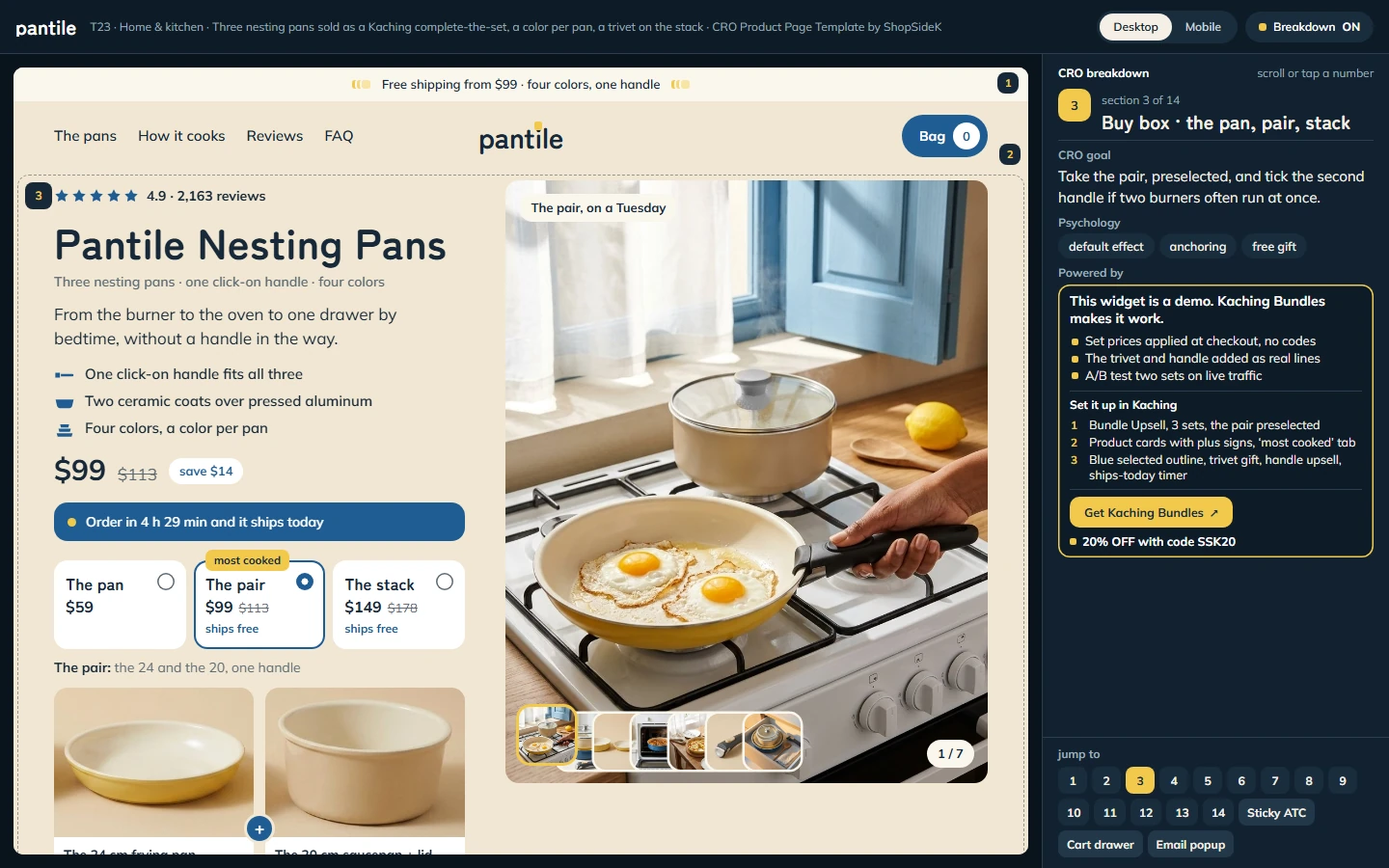
- Pantile, three ceramic-coated nesting pans sold as the pan, the pair or the stack, built on a Kaching complete-the-set bundle.
- Sparehand (everyday version), a rechargeable salt and pepper grinder sold as one, a pair or two pairs, built on Kaching quantity breaks.
Key takeaways: 7 rules for a kitchen product page
- Preselect the number a kitchen actually uses. Salt and pepper come in twos and most dinners use two pans, so both pages load with the pair selected, not the single piece.
- Give every piece its own color. A swatch row for each pan or grinder lets one order hold a black-and-white pair for the stove and a pink-and-grey pair to give.
- List size, capacity and weight for every piece. Kitchens are measured in burners and drawers, so a set page should read like a packing list, not a mood board.
- Show the test, not the adjective. A twenty-week wear log or a measured round against the old tool says more than “durable” or “premium” ever will.
- Put the product inside a real cook. A week of dinners or a smash burger walked through step by step lets the shopper rehearse using it.
- Upsell the piece the set is missing. A second handle for two burners at once, or one dock that charges both grinders, completes the order instead of padding it.
- Name the coating’s materials, not its chemistry. Say what the surface is made of and show how it wears; leave “non-toxic” and “PFAS-free” out unless you can document them under the rules below.
The two examples at a glance
| Pantile (cookware set) | Sparehand, everyday version (kitchen gadget) | |
|---|---|---|
| Product | Three ceramic-coated aluminum pans that nest into one stack, one click-on handle that fits all three | Rechargeable one-handed grinder: tip it to grind, stand it up to stop |
| Kaching offer type | Bundle Upsell (complete the set): the pan, the pair, the stack | Quantity Break: 1, 2 or 4 grinders |
| Prices | $59 · $99 · $149 | $36 · $59 · $99 |
| Crossed-out price | The pieces’ own prices added up: none · $113 · $178 | Quantity × the $36 single price: none · $72 · $144 |
| Preselected | The pair (the 24 cm frying pan, the 20 cm saucepan, the handle) | The pair (salt and pepper) |
| Top-bar gift | A cork trivet ($18 value) with the stack | A refill duo ($14 value) with two pairs |
| One add-on in the widget or cart | A second handle, $12 | A twin charging dock, $15 |
| Urgency | A timer to the real 2 pm dispatch cut-off | A low-stock line (see “One thing not to copy”) |
| Live example | Pantile template (T23) | Sparehand everyday version (T06) |
Example 1: Pantile, a cookware page that sells the set as one drawer
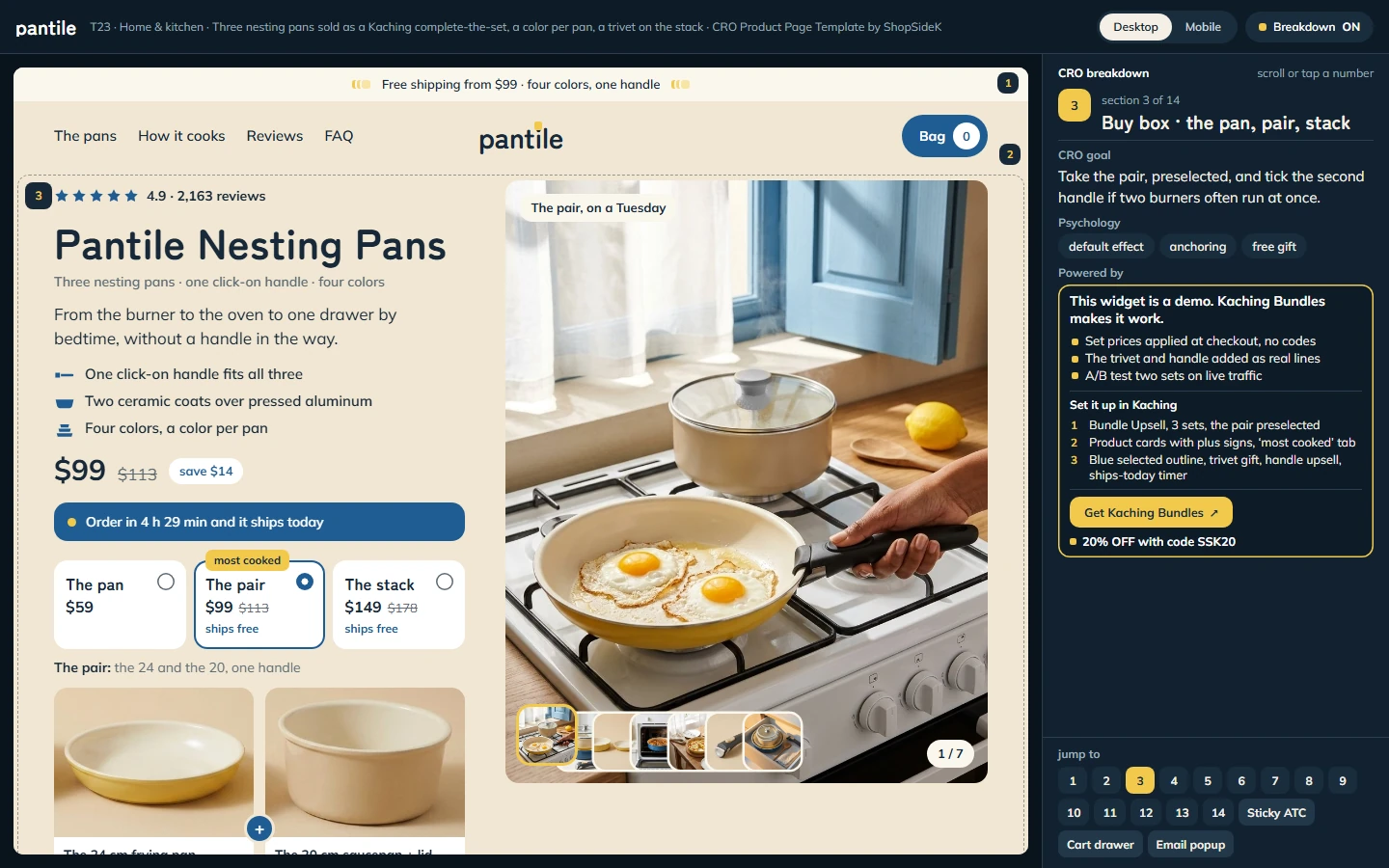
Pantile sells three pans that stack 29 × 14 cm with no fixed handles: a 24 cm frying pan, a 20 cm saucepan and a 28 cm sauté pan, plus one charcoal handle that clicks onto any of them. The page’s promise is a whole kitchen routine in one line: from the burner to the oven to one drawer by bedtime, without a handle in the way.
The offer: the pan, the pair or the stack
| Set | What’s in it | Price | Crossed-out price | Extra |
|---|---|---|---|---|
| The pan | The 24 cm frying pan and the handle | $59 | none | Shipping $7.95 |
| The pair (preselected, “most cooked”) | + the 20 cm saucepan with its lid | $99 | $113 | Ships free; “You save $14 on this set” |
| The stack | + the 28 cm sauté pan with its lid | $149 | $178 | Ships free + a cork trivet ($18 value) |
Each set takes a fixed dollar amount off every piece: in the pair, the 24 drops from $45 to $40, the handle from $14 to $12 and the 20 from $54 to $47. In the stack the four pieces land at $38, $11, $45 and $55. The crossed-out number is simply what the same pieces cost bought one by one, which is what Kaching shows for a Bundle Upsell, so it stays honest as long as each piece really sells on its own at that price. Each pan picks its own color from four (Harbor, Lemon, Sand, Sardine), and the pair loads as a Lemon 24 next to a Sand 20.
One add-on sits under the set cards on every bar: a second handle for $12 (struck $14), “for two burners at once”. The only urgency on the page is a bar above the sets, “Order in 4 h 29 min and it ships today”, which counts to a real 2 pm dispatch cut-off and switches to “ships Monday” over the weekend.
The sections that do the persuading
- Five places, one pan. Five rows (burner, oven, table, fridge, dishwasher) open one at a time, and a single photo shows the pan in that place with the handle on or off. The oven row carries the hard number: to 230 °C / 450 °F with the handle off.
- What’s in the stack. A drag row of seven pieces, each with its size, capacity and weight: the 28 holds 3.6 L, the 20 holds 1.8 L, the 24 weighs 0.9 kg. Nothing about the set is left to a guess.
- Your knob, marked. The shopper picks a stove (gas, coil, glass-top, induction) and the top number on the knob, and the page marks where medium sits for eggs, everyday cooking and water. Ceramic coatings last longer at medium, so the care advice arrives as a tool instead of a warning.
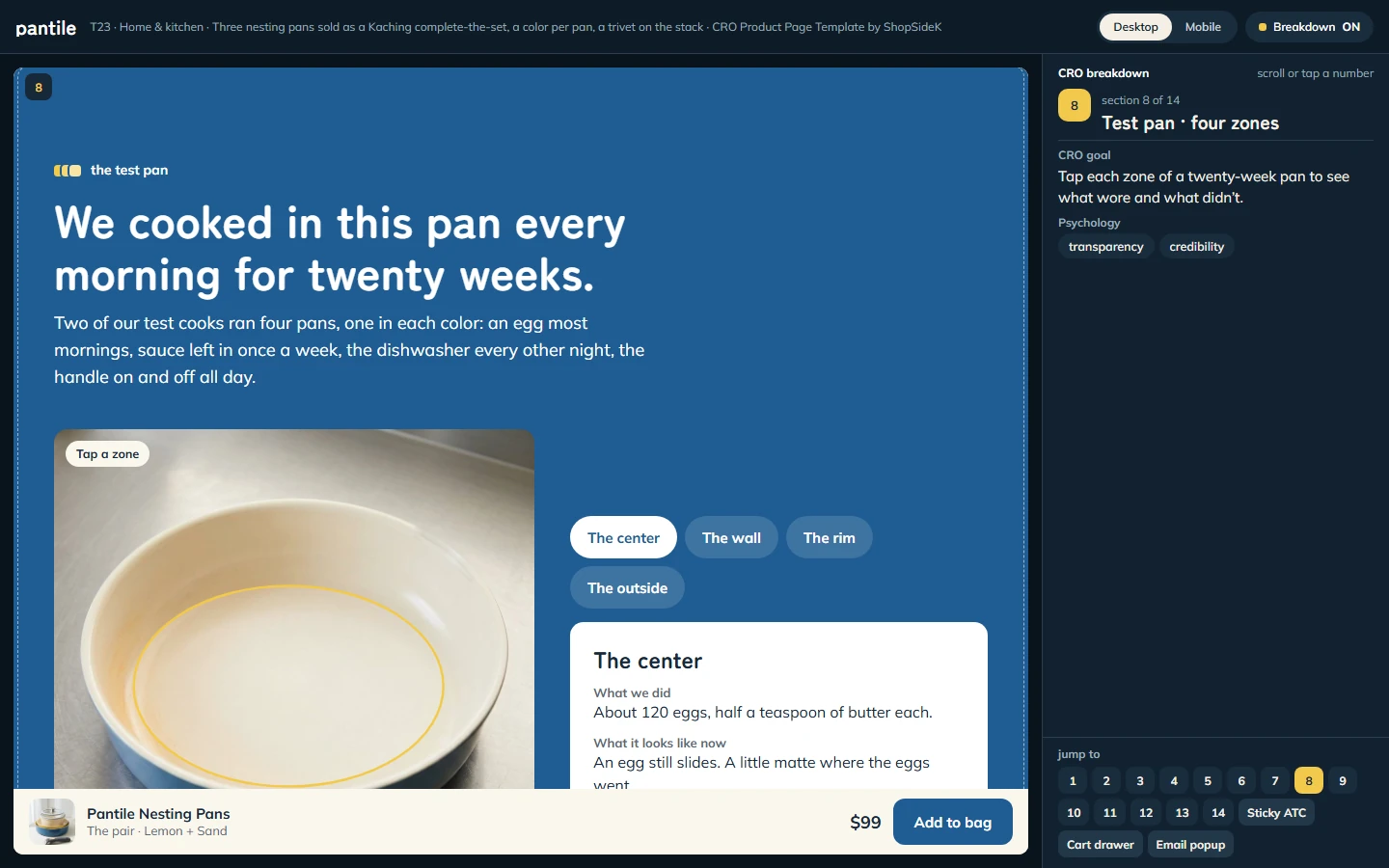
- The test pan, zone by zone. Two test cooks used four pans for twenty weeks. Tap the center, the wall, the rim or the outside of one pan to read what was done (about 120 eggs, tomato sauce left in twenty times, the handle clicked on about 2,800 times) and what it looks like now, ending on “Your kitchen isn’t our test kitchen.”
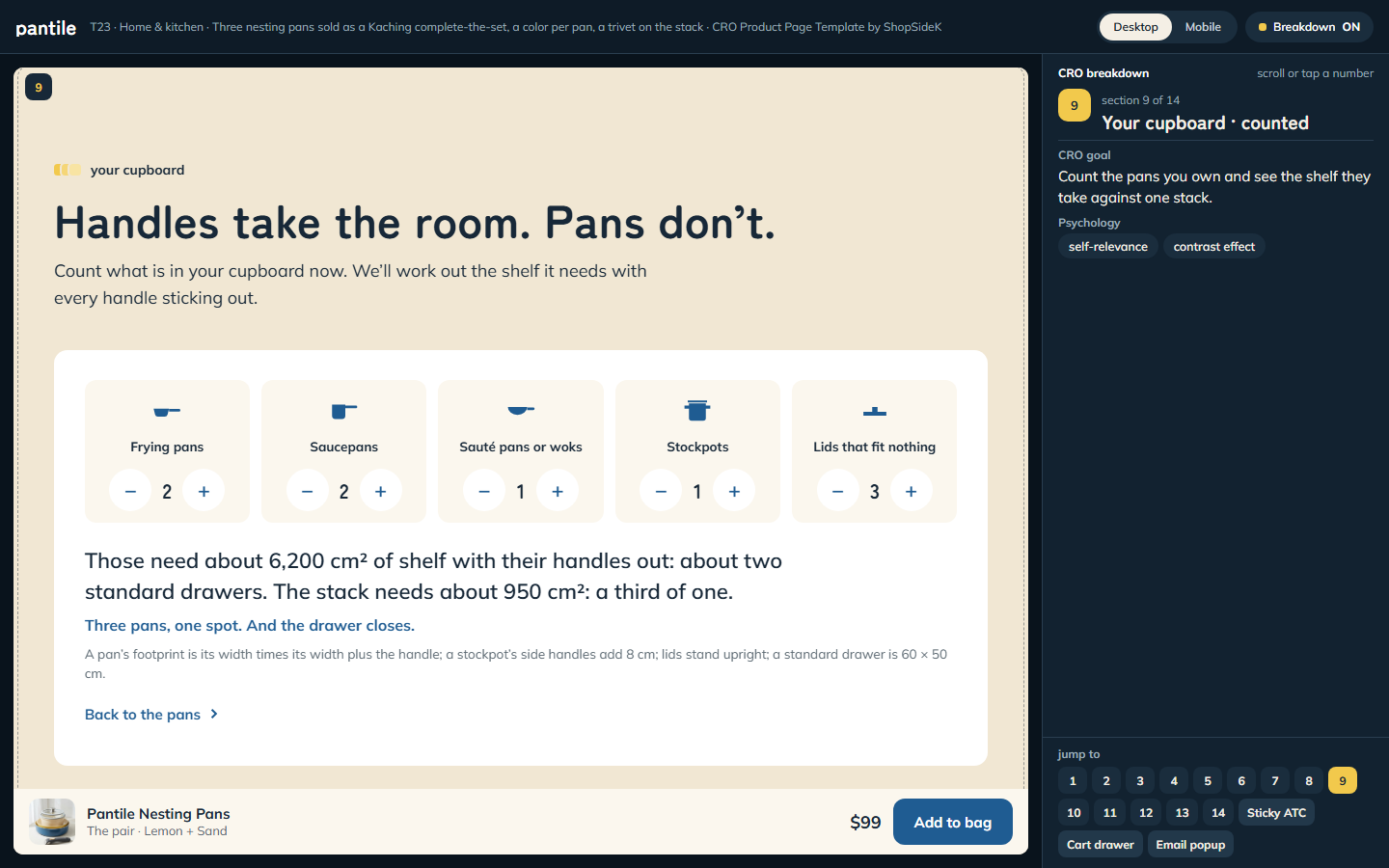
- Your cupboard, counted. Steppers count the pans the shopper owns now, and the page works out the shelf they take with handles sticking out. The default count needs about 6,200 cm², roughly two standard drawers; the stack needs about 950 cm².
- A week off three pans. A plain table of seven dinners shows which pans each one uses and when two burners run at once, which is exactly when the second handle earns its $12.
- Two promises. 100 nights to cook in it and still return it, three years on the coating and the handle for life.
The cart: from $99 to $125, with the towel
The cart drawer, built with Kaching Cart, opens on a free-gift bar: a linen tea towel ($16 value) from $120, with a muted line under it for free shipping from $99. Below it, a slider titled “goes in the stack” offers a flat glass lid for the 24 ($15), two olive-wood spatulas ($14) and a splatter screen ($16), plus a $6 housewarming box toggle. The pair at $99 opens $21 short of the towel; the second handle and the spatulas take it to $125, and the towel lands as a free line.

On the demo’s assumed costs, its worst modeled order (the stack with the wheel’s $20-off code, the trivet, the towel and free shipping) still keeps 51.4% gross margin, and the preselected pair keeps 61.6% at list price.
One thing not to copy
The cupboard calculator works only because Pantile’s whole argument is nesting: three pans in the space of one. A conventional pan set with fixed handles has no shelf story to compute, so the same tool would only remind the shopper how much room your set takes. Use a calculator only when the number it returns is your best argument.
Rebuild the offer in Kaching
- A Bundle Upsell deal with three bars, the 24 + handle, + the 20, + the 28, a fixed dollar amount off each item, bar 2 preselected.
- A color swatch row for each pan, a “most cooked” badge and the cork trivet as a free gift on bar 3.
- One Add Upsell on every bar (the second handle), a savings line, and a timer set to your real dispatch cut-off.
For how to decide which pieces belong in a set, see how to choose products to bundle on Shopify.
Example 2: Sparehand, the everyday page for a kitchen gadget sold in pairs
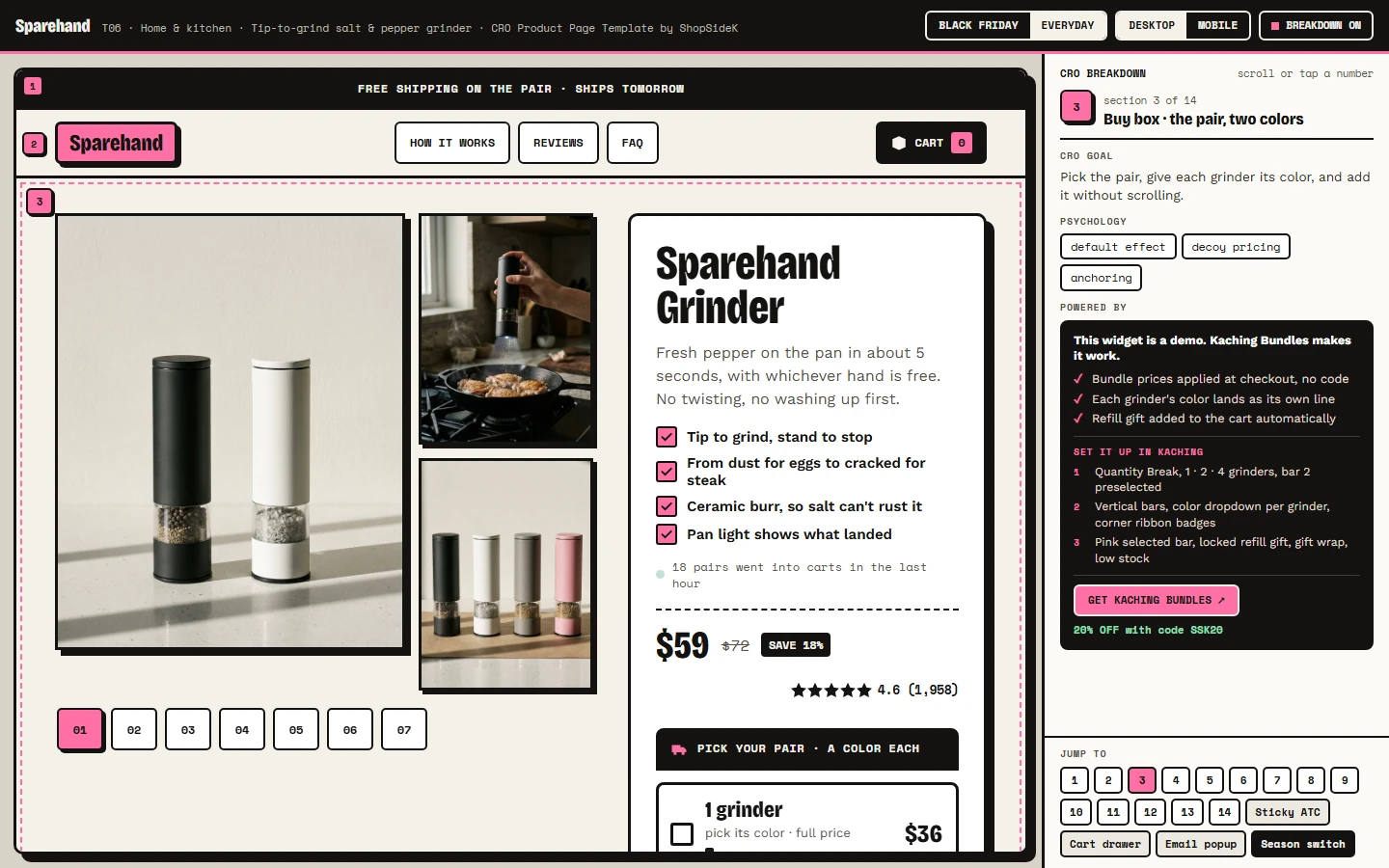
Sparehand sells a rechargeable grinder with a ceramic burr that grinds when it’s tipped and stops when it’s stood up, so it works with one hand. The demo opens in a seasonal sale skin by default; the link in this section opens the everyday version, which is the page the product carries for the other eleven months of the year.
The offer: one, a pair or two pairs
| Bar | Price | Crossed-out price | Per grinder | Extra |
|---|---|---|---|---|
| 1 grinder | $36 | none | $36 | |
| The pair (preselected) | $59 | $72 | $29.50 | Free shipping; “You save $13 on this order” |
| Two pairs | $99 | $144 | $24.75 | Free shipping + a refill duo ($14 value) |
The single grinder at full price makes the pair read as the obvious choice, and two pairs carry the line “one for the stove, one to give”. Under the selected bar, each grinder gets its own dropdown with a square swatch in four finishes (Pepper, Salt, Smoke, Peppercorn), so the default pair arrives as one black and one white. A $4 gift-wrap box with a 40-character note sits in the widget for the people buying two pairs to give one away.
The sections that do the persuading
- Hands full. An overhead photo of two hands caked in breadcrumbs at a breading station, with a ticker that repeats “twist” 38 times: the number of twists a twist mill needs for a teaspoon, in the demo’s own measurement. The enemy is the old tool, never the cook.
- Two lanes, one hand. A smash burger stepped through in five stages, left hand and right hand side by side. In every step one hand is busy, and the free one does the seasoning.
- Six piles. The same peppercorns ground on each of the six settings, from dust to cracked. Pick a dish (scrambled eggs, cacio e pepe, steak crust) and the page rings the pile it wants.
- Measured rounds and the shopper’s own tin. Five measured rounds against a twist mill and a best-by date typed from the pre-ground pepper in the shopper’s cupboard turn “fresher” into numbers the shopper produced.
- Three numbers for a gadget. Two years on the motor, burr and battery; 60 days to return it used; $0, because the return label is already in the box.
The cart: one dock for two grinders
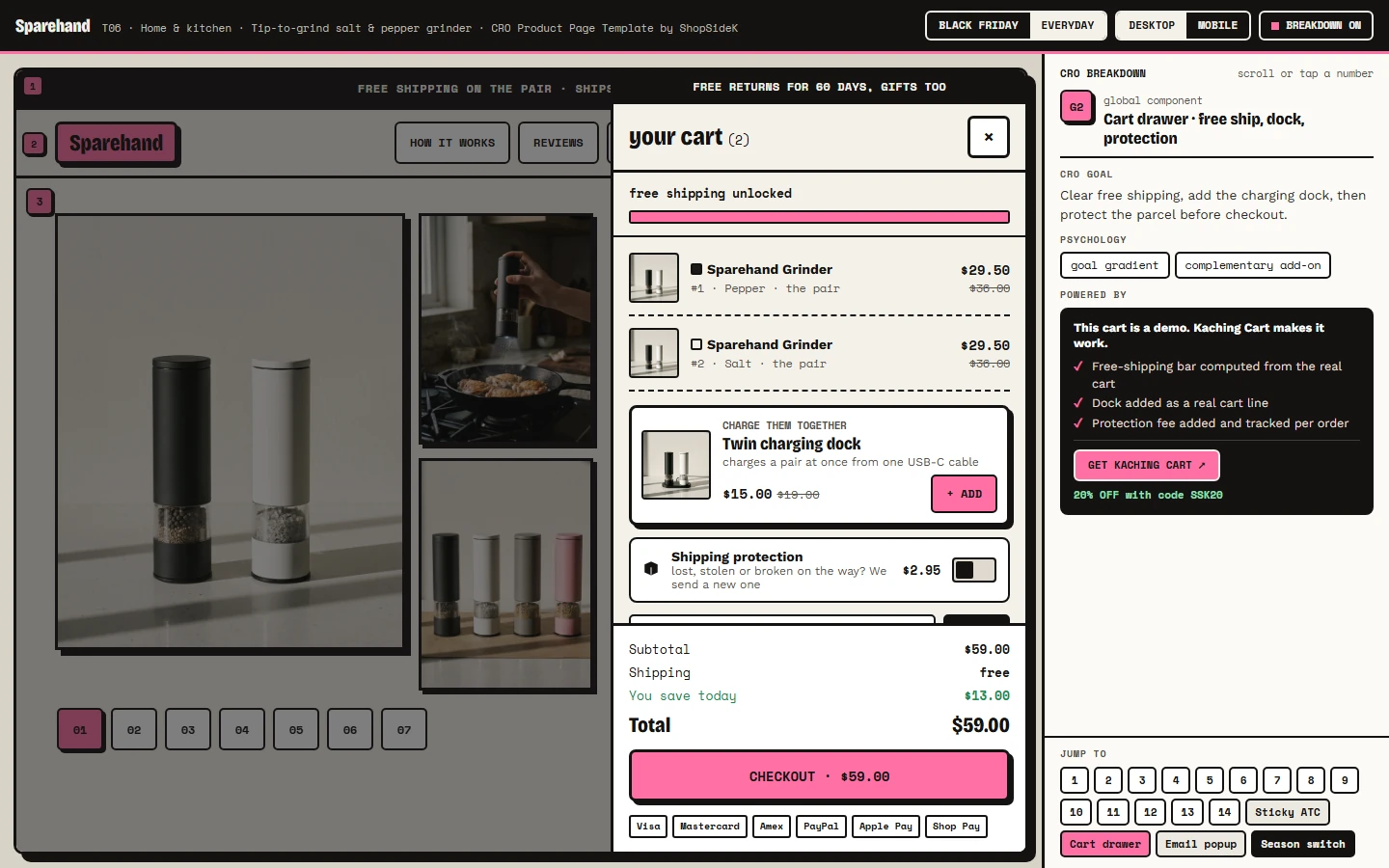
The pair clears the cart’s $45 free-shipping line on its own, and the drawer’s top line reads “Free returns for 60 days, gifts too.” The single recommended card is a twin charging dock ($15, struck $19) that charges both grinders from one cable, taking the pair from $59 to $74. Shipping protection ($2.95) is an optional toggle, off by default. On the demo’s assumed costs, the everyday worst case (two pairs, gift wrap and the popup’s 10% code) still keeps 60.4% gross margin.
One thing not to copy
Under the bars, the demo prints “only 23 pairs left at this price”. On a demo that line is sample text. On a real store, a low-stock line has to come from your live inventory count, and “at this price” promises the price will change, so only write it when a price change is actually scheduled.
Rebuild the offer in Kaching
- A Quantity Break deal with bars of 1, 2 and 4 grinders at fixed prices, bar 2 preselected.
- A color dropdown with square swatches for each grinder, a refill duo as the free gift on bar 3.
- A savings line under the bars, and the charging dock as the single cart upsell in Kaching Cart.
For setting quantity-break prices that still make money, see how to set profitable Shopify quantity breaks.
What a cookware page can say about its coating
Coating claims are where kitchen pages get into trouble, because the words shoppers search for (“non-toxic”, “PFAS-free”, “PFOA-free”) are the ones regulators read most closely. Here is what the US rules say and how the Pantile demo stays inside them. This is general information, not legal advice.
- “Non-toxic” covers people and the planet. The FTC’s Green Guides warn that shoppers may read a non-toxic claim as covering both human health and the environment, so the claim needs evidence for both or a clear qualification (16 CFR 260.10).
- A true “free of” claim can still mislead. Under the Green Guides, a free-of claim can be deceptive if the product contains another substance with the same or similar environmental risk, or if the substance was never associated with that kind of product (16 CFR 260.9).
- California: disclose listed chemicals online, and no partial “free of” claims. Under California’s AB 1200, a cookware maker that intentionally adds a chemical from the state’s designated list to the handle or to any surface that touches food must name it on the product’s website, and an exempt product must still carry the required statement on its online listing (California Attorney General enforcement advisory, October 17, 2023). Since January 1, 2023 on the website, and January 1, 2024 on the package, a maker may not claim the cookware is free of a specific chemical from a listed group or class unless no chemical from that group is intentionally added (Cal. Health & Safety Code § 109013). A “PFOA-free” badge on a pan whose coating contains other intentionally added PFAS is the case this rule targets.
- Minnesota: no intentionally added PFAS in cookware. Since January 1, 2025, Minnesota law bars selling cookware that contains intentionally added PFAS (Minn. Stat. § 116.943, subd. 5).
How the demo handles it: Pantile names the materials (“two ceramic coats over pressed aluminum”, a stainless induction plate), gives temperature limits as plain numbers, shows wear in a dated test and never prints “non-toxic”, “PFAS-free”, “PTFE-free” or a certification seal. If your real coating supports a free-of claim, keep the supplier’s documentation, and check the current text of each state’s law before you print a badge.
How to build a kitchen bundle in Kaching
- Choose the deal type by what’s in the box. Different pieces that complete each other (pans, lids, a handle) belong in a Bundle Upsell with a discount on each item; more of the same product belongs in a Quantity Break (Kaching help: bundle types).
- Let each piece pick its color. Turn on “Let customers choose different variants for each item” and add color swatches, so a pair can hold two finishes (Kaching help: customize your bundle variant dropdowns).
- Put the gift on the top bar only. A trivet with the stack or a refill duo with two pairs gives the largest set a reason that isn’t a deeper percent. For why a gift can beat a bigger cut, see free gift vs discount on Shopify.
- Add one upsell that finishes the job. A second handle or a charging dock as a single Add Upsell or cart card (Kaching help: add an upsell to your deal bar), not a carousel of unrelated gadgets. For where each kind of offer belongs, see Shopify bundle vs upsell.
- Price the worst order before you publish. Stack the set price, the gift, free shipping and any popup code. Pantile’s worst modeled order keeps 51.4% and Sparehand’s everyday worst keeps 60.4%; check yours in the Shopify discount break-even calculator and decide which codes may combine with set prices (how Shopify bundle discounts stack).
Kitchen product page checklist
- The pair or the set a kitchen really uses, preselected.
- A color for every piece in the bundle, chosen in the widget.
- Size, capacity and weight for every piece, plus what the whole set measures stacked or stored.
- Heat limits as plain numbers: oven temperature, lids, induction.
- A wear test you actually ran, with dates and what changed, instead of “durable”.
- One section that walks through a real cook or a real week of dinners.
- One add-on that completes the set, offered once.
- A crossed-out price that equals the pieces’ real separate prices.
- Coating copy limited to materials and shown results; no “non-toxic” or “free of” badge without documentation.
- California online listings: the AB 1200 chemical disclosure if a listed chemical is intentionally added.
- A dispatch timer only if it counts to your real cut-off; a stock line only if it reads your live inventory.
- Returns that allow cooking in it, stated in nights or days.
FAQ
What should a kitchen product page include?
Every piece’s size, capacity and weight, heat limits as numbers, how the product is cleaned and stored, a demonstration or test you ran, reviews with photos from real kitchens, a clear returns window that allows use, and the price of every set before checkout.
Should cookware be sold as a set or one pan at a time?
Offer both, with the set that matches most dinners preselected. Pantile sells one pan with the handle at $59, the two-pan pair at $99 and the three-pan stack at $149, and loads the pair, the first set that ships free.
Can I call my cookware non-toxic or PFAS-free?
Only with evidence. The FTC’s Green Guides treat “non-toxic” as a claim about people and the environment, and a “free of” claim can mislead even when true. In California, cookware may not claim to be free of one chemical from a listed group if another chemical from that group is intentionally added.
What does California’s AB 1200 require on an online cookware listing?
If a chemical on the state’s designated list is intentionally added to the handle or a food-contact surface, the maker must list it on the product’s website, and the required statement must also appear on the online listing. Since 2023, “free of” claims on the website are restricted for chemicals in listed groups.
Is cookware with PFAS banned in Minnesota?
Yes. Since January 1, 2025, Minnesota law prohibits selling cookware that contains intentionally added PFAS, under Minnesota Statutes section 116.943.
How do I let shoppers pick a different color for each pan in a bundle?
In Kaching Bundles, turn on “Let customers choose different variants for each item” on the deal and add color swatches. Each piece in the selected bar then gets its own swatch row; in the Pantile demo, every pan reaches the cart as its own line with its color. Run a test order to confirm the same in your store.
What is a good upsell on a kitchen product page?
The piece the set can’t work without in a common situation: a second handle for cooking on two burners at once, a charging dock for two grinders, or a lid for the one pan that ships without one. Offer it once, next to the set, at a small price.
More product page examples
Pantile and Sparehand both sit in the ShopSideK library of Shopify product page templates, each with a free breakdown of every section. For more pages in this niche, browse the home and kitchen product page templates, or compare other offers built on the Kaching complete-the-look templates.
The Black Friday version of the grinder page is in Black Friday product page examples. Another everyday breakdown: clothing product page examples.
Sources
- 16 CFR 260.9, Free-of claims (Cornell LII)
- 16 CFR 260.10, Non-toxic claims (Cornell LII)
- California Attorney General: enforcement advisory on AB 1200, food packaging and cookware (October 17, 2023)
- California Health and Safety Code § 109013 (California Legislative Information)
- Minnesota Statutes § 116.943, products containing PFAS (Office of the Revisor of Statutes)
- Kaching help: different bundle types
- Kaching help: customize your bundle variant dropdowns
- Kaching help: add an upsell to your deal bar