Last updated: October 30, 2026. Both pages are live demos you can click through for free, with no sign-up.
People rarely buy home decor for its own sake. They buy it for a spot: a mantel, a stair rail, a window, the shelf behind the sofa. A home decor product page sells best when it starts from that spot and answers three questions before the buy button: how many do I need for it, will the pieces match, and how will it look from where I actually sit. The two Shopify examples below answer those questions in opposite ways, and the contrast is the useful part.
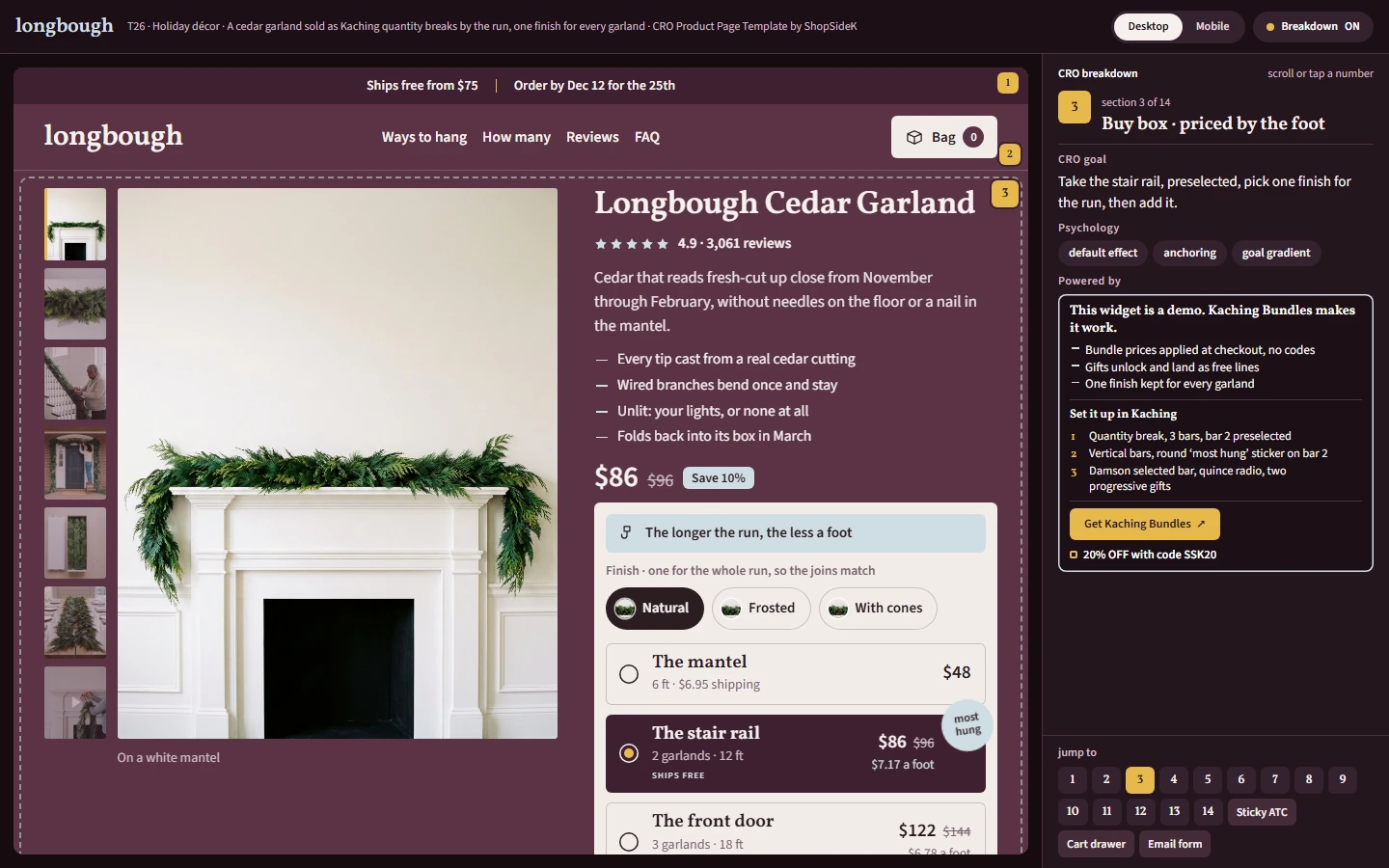
- Longbough sells an artificial cedar garland by the run, with bundles named after the place each length dresses and one finish locked for the whole run.
- Little Fib sells flameless real-wax candle trios by the set, with a different wax color allowed for every set in the order.
Each example below has the exact prices, the sections that do the selling, the cart and the Kaching Bundles settings behind the offer, followed by the safety facts a decor page has to get right.
Key takeaways: 7 rules for a home decor product page
- Name each bundle after the spot it dresses. “The mantel”, “The stair rail” and “The front door” answer “how many do I need?” before the shopper has to ask.
- Price by the unit people measure. Garland is measured in feet and candles in sets, so the bars say “$7.17 a foot” or “$34 / set” instead of a quantity count.
- Lock the variant when pieces join; free it when they scatter. Lengths that hook together must share one finish. Sets that go to different rooms can each take their own color.
- Put a calculator where the doubt lives. A one-sentence measuring tool turns “will two be enough?” into a number of runs, ties and hooks.
- Show the product from where people will see it. A garland is judged from the bottom stair and a candle from the sofa, so photograph and count from those places.
- Sell the whole season, not just the first evening. Show when the piece goes up, how long it stays and where it lives the rest of the year.
- State materials, batteries and limits plainly. “Covered porch, not open rain”, “six AAs in the box” and “unlit” prevent returns better than adjectives do.
The two examples at a glance
| Longbough | Little Fib (everyday version) | |
|---|---|---|
| Product | Unlit artificial cedar and pine garland, 6 ft a run, about 10 in wide | Three real-wax LED pillars (4, 5 and 6 in) with a remote and a daily timer |
| What a shopper measures | Feet of mantel, rail or door frame | Shelves, sills and rooms |
| Kaching offer type | Quantity Break: 1, 2 or 3 runs | Quantity Break with a variant per item: 1, 2 or 3 sets |
| Prices | $48 · $86 · $122 | $39 · $68 · $93 |
| Variant rule | One finish for every run in the order | A wax color for each set |
| Free gifts in the widget | Clear hooks from 12 ft, a storage bag from 18 ft | None; spare AAs as a $7 add-on |
| Urgency in the widget | None | One low-stock line |
| Order in the walkthrough | $86 → $125 | $68 → $86 |
| Live example | Longbough template (T26) | Little Fib template (T09), everyday view |
Example 1: Longbough, a garland page that sells by the foot
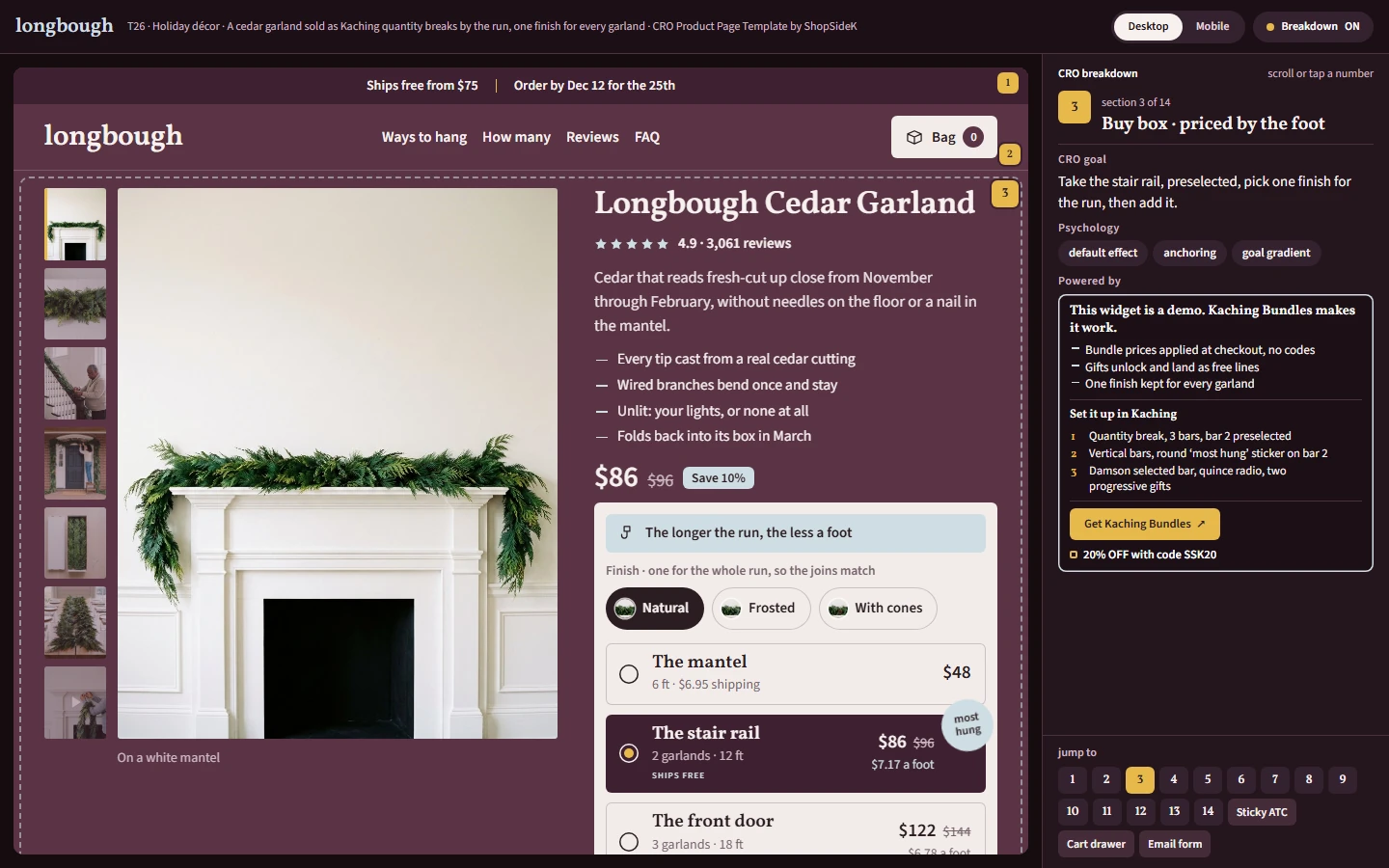
Longbough’s garland comes in 6-foot runs with a wire loop at each end, so longer spots take two or three runs hooked together. The page never asks the shopper to work out a quantity. It asks where the garland is going.
The offer: three runs named by place
| Bar | Length | Price | Crossed-out price | Per foot | Free in the widget | Shipping |
|---|---|---|---|---|---|---|
| The mantel | 6 ft | $48 | none | $8.00 | nothing | $6.95 |
| The stair rail (preselected, “most hung”) | 12 ft | $86 | $96 | $7.17 | 12 clear hooks ($8 value) | free |
| The front door | 18 ft | $122 | $144 | $6.78 | the hooks plus a canvas storage bag ($18 value) | free |
The struck price is the run count times the single-run $48, so the saving reads as $10 on the stair rail and $22 on the front door, with “Save 10%” and “Save 15%” next to the price. Free shipping starts at $75, which the stair rail clears on its own. The gifts are the two things a longer run needs: hooks to hold a door frame, and a bag big enough to store three folded runs.
Above the bars sits one row of finish chips, Natural, Frosted or With cones, labeled “one for the whole run, so the joins match.” All three finishes cost the same, and switching bars keeps the finish. The Frosted chip comes with an honest aside: the white tips can leave a little on dark wool in the first week.
The sections that do the selling
- Five ways to hang it. A photo collage shows the same 6 ft on a stair rail, up and over a door, swagged across a mantel, laid down a table and tucked along a shelf. Each tile lists the finish, the number of runs and the ties or hooks it took.
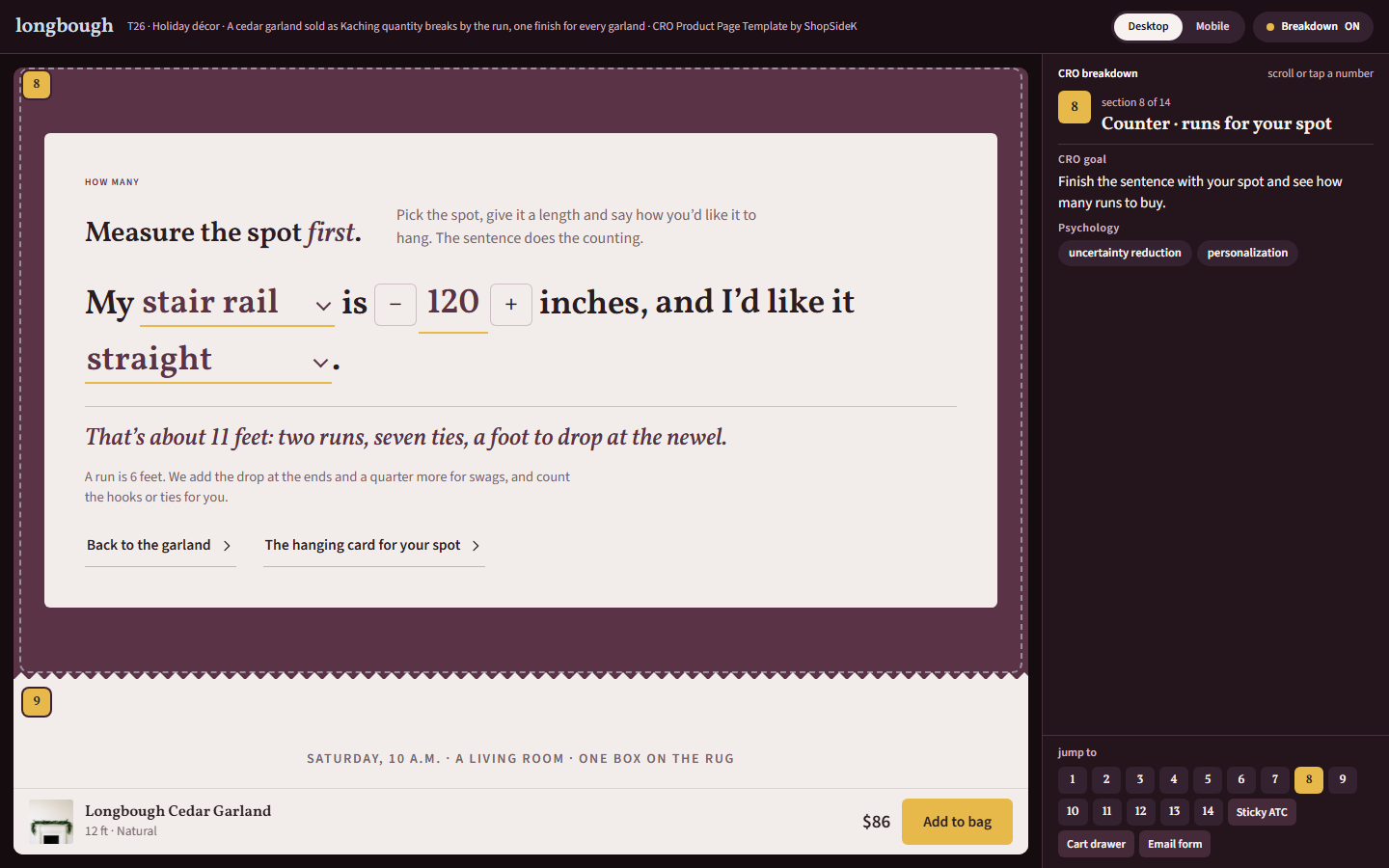
- A sentence that counts for you. “Measure the spot first” asks the shopper to finish a sentence: my stair rail is 120 inches and I’d like it straight. The answer comes back as “about 11 feet: two runs, seven ties, a foot to drop at the newel.”
- Counts from the bottom stair. “35 a foot · 3 layers · 0 wire”: 35 tips a foot, three needle layers and no bare wire visible from below, with the method stated under the numbers (“counted on ten runs from this season’s batch”).
- How a tip is made. A draggable bench photo walks from a real cedar cutting to a silicone mold, a poured tip, a hand-wired branch and a finished run.
- The first hour, as a script. A short scene admits the garland arrives flat, then shows the fix: ten minutes of fluffing a run, three hooks under the mantel lip, lights last if at all.
- Up in November, still up in February. Five dated rows take the garland from the Saturday after Thanksgiving to its box in late February, with the minutes each step takes. The page sells a winter of use, not one holiday.
- Three Decembers, or a new one. A branch that won’t hold its shape in its first three seasons gets a replacement, returns are open for 60 days even after hanging, and a run still flat after fluffing is replaced the same day. The return label cost ($6.95) is stated, not hidden.
The email form fits the same idea. It sits at the bottom of the page instead of popping up, and its first step asks which spot the shopper is dressing first before it asks for an email. The offer is $10 off a first order of $75 or more, plus a hanging card for that spot.
The cart: from $86 to $125
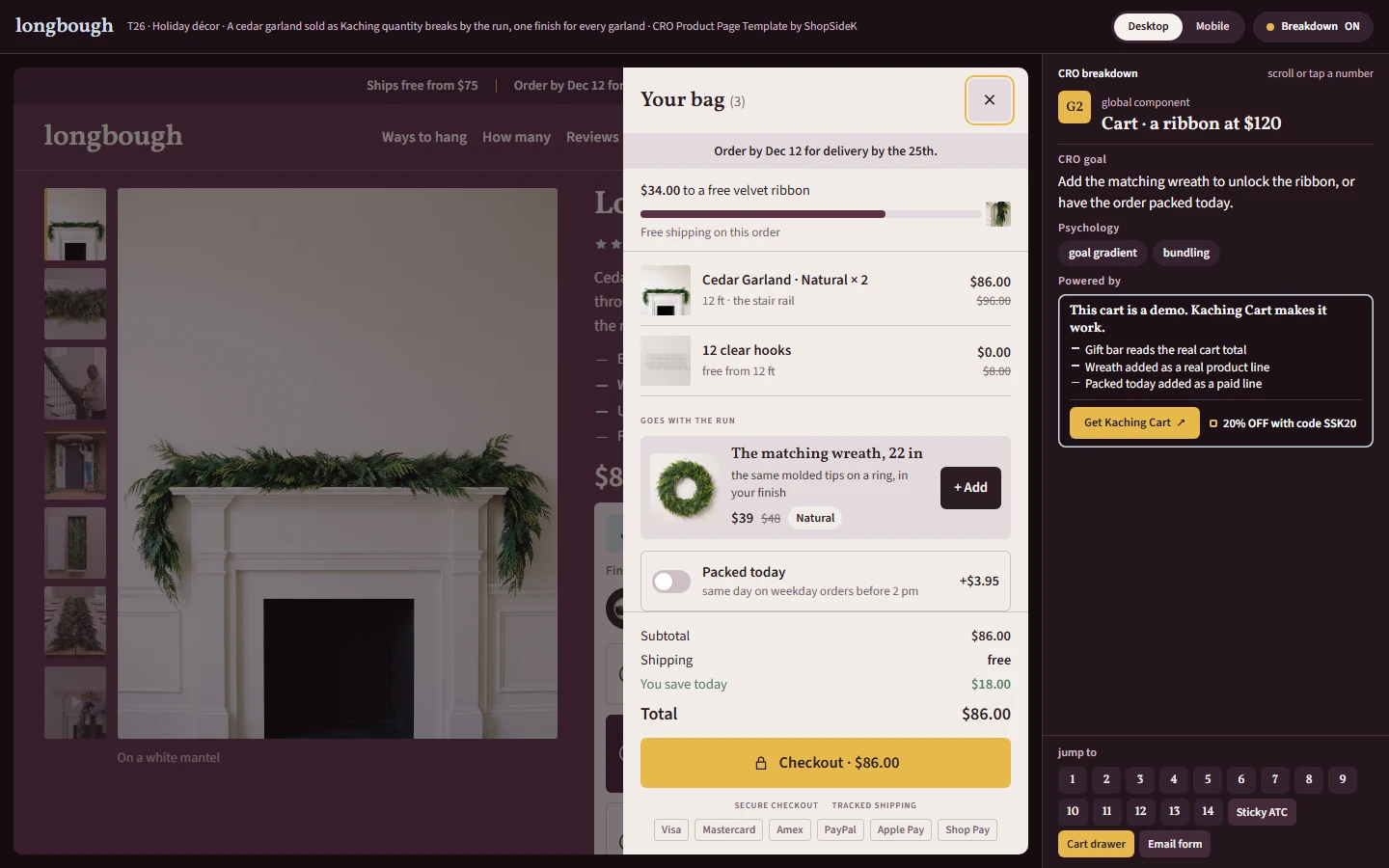
The cart drawer has one reward, a 4-yard damson velvet ribbon ($12 value) from $120, and one recommended card: the matching 22-inch wreath for $39, struck at $48, in whatever finish the run uses. The stair rail alone sits $34 short of the ribbon. Adding the wreath takes the order from $86 to $125, so the ribbon goes in free. A “Packed today” toggle ($3.95) ships weekday orders placed before 2 pm the same day. Every add-on in this drawer finishes the look of the spot the shopper already chose.
One thing not to copy
The demo prints a fixed sample date, “Order by Dec 12 for the 25th”, in the announcement bar, the buy-box delivery timeline and the cart. On a live store, work that date out from your own packing and carrier times and remove it once it passes. A December cut-off still showing in January tells shoppers nobody is watching the store, on a page that otherwise sells the garland through February.
Rebuild the offer in Kaching
- A Quantity Break deal with bars of 1, 2 and 3 garlands at fixed prices, bar 2 preselected, and the per-foot price written into each bar’s text.
- Vertical bars, a “most hung” badge on bar 2, one shared finish choice for every item in the bar.
- Free gifts on bars 2 and 3 (the hooks, then the bag); free shipping from $75 set in the store.
Kaching’s help center explains the deal types (Kaching help: bundle types), and our guide to setting profitable Shopify quantity breaks covers how far apart the bars should sit.
Example 2: Little Fib, a candle page that sells a color for every room
Little Fib sells real-wax pillars lit by an LED, in trios of three heights, with a remote and a timer that lights them at the same hour every evening. The template has a Christmas layer, but this breakdown uses its everyday version, the page as it reads the rest of the year. Use the link below to open it.
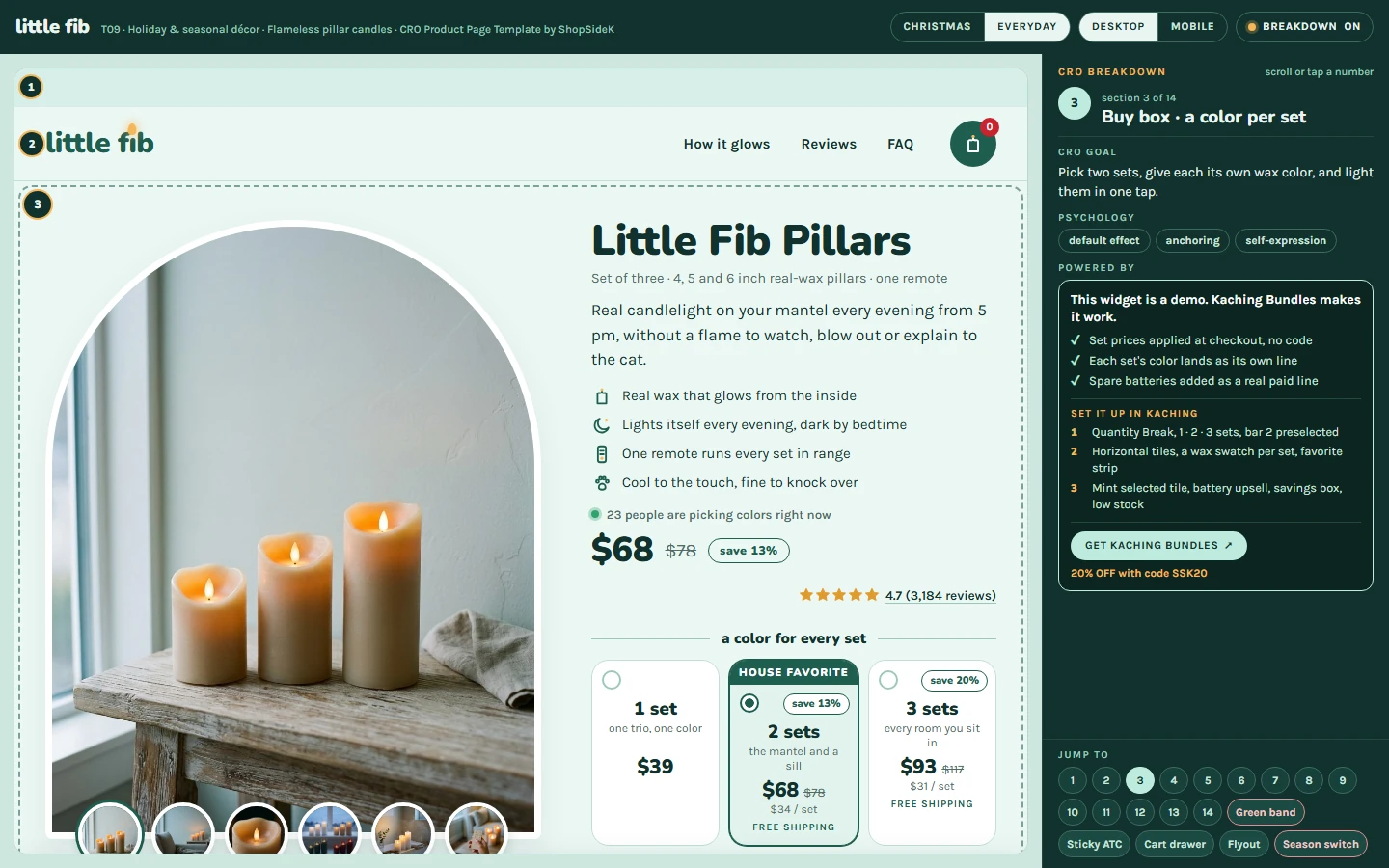
The offer: sets, each in its own wax
| Bar | Price | Crossed-out price | Per set | Saving shown | Shipping |
|---|---|---|---|---|---|
| 1 set (“one trio, one color”) | $39 | none | $39 | none | $5.95 |
| 2 sets (“the mantel and a sill”, preselected, “house favorite”) | $68 | $78 | $34 | save 13%, “You save $10” | free |
| 3 sets (“every room you sit in”) | $93 | $117 | $31 | save 20%, “You save $24” | free |
The struck price is the set count times $39. The important switch is the one Longbough leaves off: every set in the bar gets its own row of wax swatches, Snow, Oat, Juniper or Cranberry, so one order can put Cranberry on the mantel and Snow on the bath tray without a second checkout. Picking a color for the first set jumps the gallery to a photo of all four colors lit on a sill. The price never changes with the color.
Under the bars sit three small extras: a “12 spare AAs · $7” checkbox (struck at $10, with “the first six are in the box”), a mint savings box, and one low-stock line. That line, “Only 31 Cranberry sets left in this pour”, is sample text in the demo; show one only when it comes from a live inventory count.
The sections that do the selling
- The flame, admitted. The page says outright that the flame is the one fake thing, and lets shoppers see from how close it stops fooling the eye.
- Lit when you get home. A timer section turns the remote into a routine: on at five, off at eleven, no matches.
- A table of places that ban candles. Rentals, dorms, hotels, offices and care homes each get the rule as it’s usually written and the spot where a set can go instead. It finds buyers who were never allowed a real candle.
- The sill after a winter. Two photos of the same white window sill: one after a season of tealights, with a soot shadow up the frame, wax in the corners and a singed curtain hem; one after a season of pillars, with a little dust. It makes the safety case without a single statistic.
- Reviews from rooms. A photo carousel of buyers’ rooms, including a renter whose landlord walked past without noticing and a four-star review that calls the credit-card-sized remote easy to lose.
- Questions with one answer each. A search field with suggested questions answers the practical worries: about 450 hours per pillar on two AAs, a remote that reaches about 5 m, a switch on every base, and real wax that softens in a hot July window.
The cart: from $68 to $86
The drawer has two milestones: free shipping at $50 and a free six-pack of tealights ($14 value) at $80. The preselected two sets clear the first and stop $12 short of the second. A slider of three add-ons follows, all things that sit next to a trio: a travertine tray that holds one set ($18), a pair of flameless tapers on the same remote ($22) and a spare remote ($8). Adding the tray takes the order from $68 to $86 and unlocks the tealights. A $4 gift box sits as a toggle below.
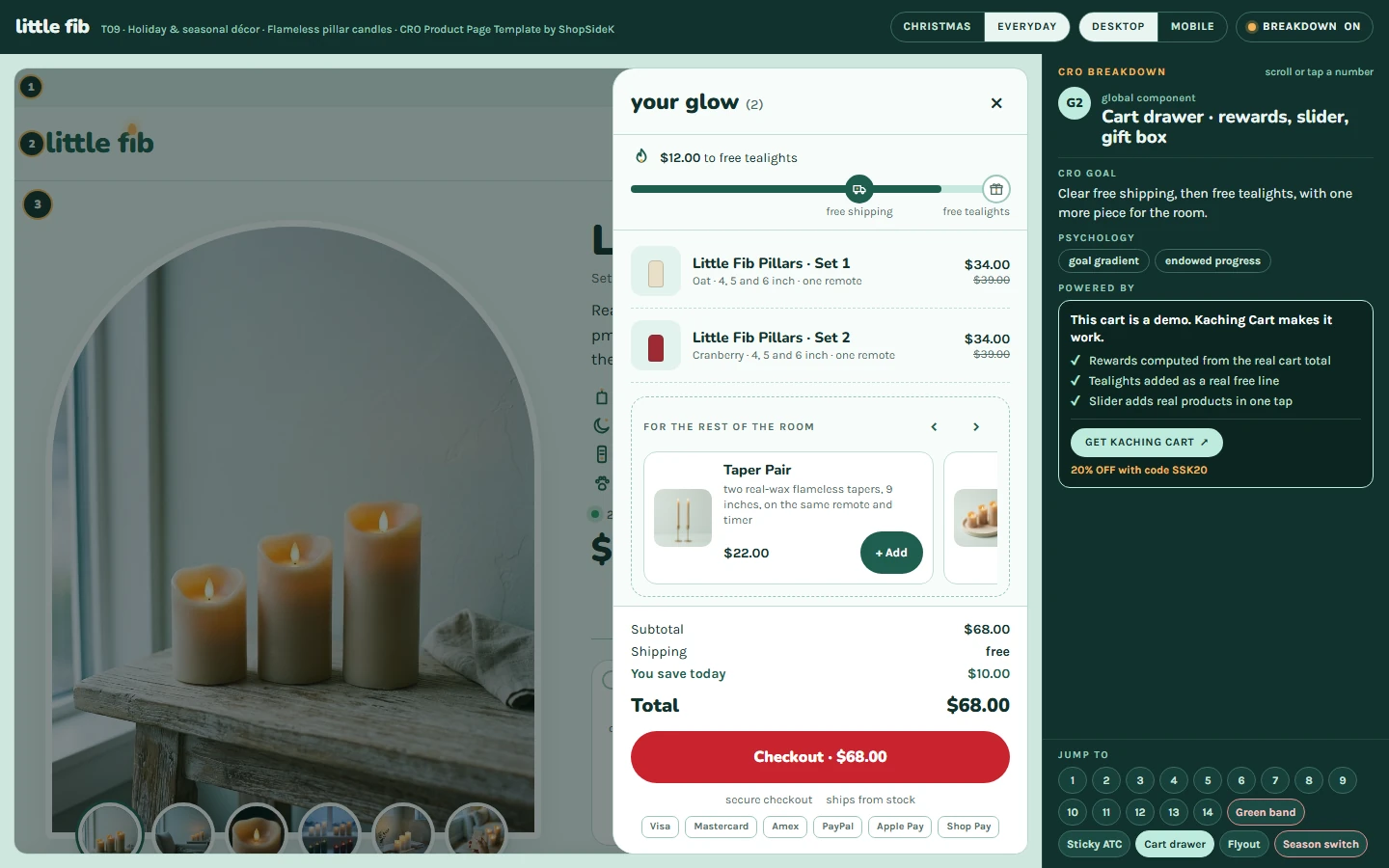
The email flyout opens halfway down the page and offers 10% off a first order, which in the everyday version combines with the bar prices. The demo models that worst case before choosing it: three sets with the code still keep about 59% gross margin on the demo’s assumed costs.
One thing not to copy
A tip-over section on the page lets shoppers vote for their household’s likeliest culprit next to a “fires so far: 0” counter. A store can’t count fires it never hears about, and a zero on a safety counter reads like a promise. Show the tipped-over pillar still glowing, and leave the tally out.
Rebuild the offer in Kaching
- A Quantity Break deal with bars of 1, 2 and 3 sets at fixed prices, bar 2 preselected, and “Let customers choose different variants for each item” switched on (Kaching help: bundle variant dropdowns).
- Horizontal tiles with wax swatches per set, a “house favorite” badge on bar 2, a savings line under the tiles.
- The spare AAs as an Add Upsell on every bar (Kaching help: add an upsell to your deal bar), not selected by default.
Safety facts a home decor page should get right
Decor pages make fewer health claims than skincare or supplement pages, but they still sell fire, batteries and plastics into people’s homes. Three sets of rules and data are worth knowing before you write the copy. This is general information, not legal advice.
Candles: use the real numbers, not scare words
US fire departments responded to an average of 5,830 home fires a year started by candles in 2019–2023, which caused an average of 70 deaths, 570 injuries and $270 million in direct property damage a year (NFPA, Home Structure Fires, August 2025). A flameless candle page can cite that figure, with its source, instead of words like “fireproof” or “100% safe”, which make a promise no product page can keep. Little Fib’s sill photos show the same point without numbers.
Batteries: say which kind, and know Reese’s Law
Under Reese’s Law, consumer products that contain button cell or coin batteries must meet the standard the CPSC adopted at 16 CFR 1263.3 (Cornell LII). According to the CPSC’s business guidance, a compartment holding replaceable button or coin batteries must need a tool or at least two independent, simultaneous hand movements to open. The product’s packaging must carry a warning, the product itself must carry one if practicable, and the instructions must include the warnings (CPSC: button cell and coin battery business guidance). Packages of button or coin batteries, including spares shipped with a product, carry the warning label set out in 16 CFR 1263.4.
That guidance doesn’t address product listings, so the product page’s job is simpler: name the battery. Little Fib’s pillars run on AAs, which the page states in the buy box, the FAQ and the add-on. The demo doesn’t say what powers its credit-card-sized remote. A live page should, because a parent deciding whether a coin cell comes into the house will look for it.
Plastics: Proposition 65 warnings online
California’s Proposition 65 requires a warning when a product can expose people to a listed chemical, and for internet sales the warning must appear on the product display page, behind a clearly marked “WARNING” link on that page, or otherwise prominently before the purchase is completed (27 CCR § 25602, Cornell LII). Businesses with fewer than 10 employees are exempt from the warning requirement (Proposition 65 Warnings: exempt businesses). The state’s fact sheet notes that phthalates are added to many plastics to make them flexible and that six of them are on the Proposition 65 list (Proposition 65 fact sheet: phthalates).
Longbough’s needles are polyethylene, but its core fill is PVC, which the page states plainly. The demo carries no Proposition 65 warning because it has no supplier test data to base one on. A live store would ask its supplier for test results on the PVC parts and decide from those, rather than adding a blanket warning or leaving one out by habit.
How to set up a home decor bundle in Kaching
- Pick the unit the shopper measures. Runs of garland, sets of candles, panels of curtain. Each bar is a whole number of that unit, priced as a fixed total.
- Decide the variant rule first. If pieces join or sit side by side, leave “Let customers choose different variants for each item” off so the whole bar shares one finish. If pieces go to different rooms, turn it on.
- Name the bars by place, then preselect the most common spot. Two runs for a stair rail and two sets for a mantel and a sill are both the middle bar, which is where most orders land.
- Give the longer bundles the things a longer bundle needs. Hooks, a storage bag or spare batteries help more than a deeper percent; see free gift vs discount on Shopify.
- Set cart rewards just above the preselected bar. Longbough’s ribbon at $120 and Little Fib’s tealights at $80 both sit one add-on away from the default order.
- Price the worst order before launch. Both demos model the deepest bar with every gift and the first-order code: Longbough’s floor is about 51% gross margin and Little Fib’s about 59% on their assumed costs. Check your own in the Shopify discount break-even calculator, and see how Shopify bundle discounts stack before letting a welcome code combine with bar prices.
Home decor product page checklist
- Bundle bars named after spots (mantel, stair rail, window, room), with the most common spot preselected.
- A price per foot, per set or per panel on the bars that save.
- One shared finish when pieces join, a color per item when they don’t.
- A measuring tool or a “how many do I need” answer above the fold or one tap away.
- Photos from where the piece is seen: the bottom stair, the sofa, the street.
- Counts with a method line (“counted on ten runs”) instead of “lush” or “full”.
- A season or daily routine shown, not just the first day.
- Materials, battery type and placement limits stated plainly.
- A low-stock line or order-by date only when it is live and true.
- Cart add-ons that finish the spot, with a reward set one add-on above the default order.
- Safety copy built on sourced facts, and any required warnings decided from real test data.
FAQ
What should a home decor product page include?
The spot the piece is for, how many the shopper needs for it, how the pieces match, photos from where people will see it, plain materials and limits, a returns promise, and the price of every bundle before checkout. Little Fib and Longbough also show how the piece lives across a season.
How should home decor be bundled on Shopify?
Bundle by the spot, not by a bare quantity. Name each bar after what it dresses (a mantel, a stair rail, every room you sit in), price it as a fixed total, show the price per foot or per set, and preselect the bar that fits the most common spot.
Should each item in a decor bundle have its own color?
Only if the items will be apart. Garland runs that hook together need one shared finish, so the joins match. Candle sets bound for different rooms can each take their own color, which Kaching handles with its per-item variant setting.
How do I help shoppers work out how many to buy?
Ask for the spot and its size, and answer with the number of units and the hardware. Longbough’s one-sentence counter turns “my stair rail is 120 inches, straight” into two runs and seven ties, and every bar is named after a spot so the shopper can skip the maths.
Do I need a Proposition 65 warning on my product page?
Only if the product can expose people to a chemical on California’s list and your business has 10 or more employees. If you need one, an online sale requires it on the product display page, behind a clearly marked “WARNING” link there, or prominently before the purchase is completed.
Do products with coin batteries need special warnings?
Yes. Under Reese’s Law, products with button or coin batteries must meet the CPSC’s standard, which includes a secured battery compartment and warnings on the packaging, on the product if practicable and in the instructions. The CPSC guidance doesn’t cover product pages, but naming the battery type there helps buyers.
Are flameless candles safer than real candles?
They remove the open flame, which the NFPA counts as the cause of an average of 5,830 US home fires a year in 2019–2023. They still bring batteries into the home, so a page should state the battery type and avoid absolute claims such as “fireproof”.
More product page examples
Longbough and Little Fib are part of the ShopSideK library of Shopify product page templates, each with a free CRO breakdown of every section. For more pages in this niche, browse the holiday and seasonal decor templates.
For the Christmas version of the candle page, read Christmas product page examples. More pages people buy as gifts: personalized product page examples.
Sources
- NFPA: Home Structure Fires, August 2025
- 16 CFR 1263.3, requirements for consumer products containing button cell or coin batteries (Cornell LII)
- 16 CFR 1263.4, labeling requirements for button cell or coin battery packaging (Cornell LII)
- CPSC: button cell and coin battery business guidance
- 27 CCR § 25602, warning methods for consumer products (Cornell LII)
- Proposition 65 Warnings: are any businesses exempt?
- Proposition 65 fact sheet: phthalates (OEHHA, 2017)
- Kaching help: different bundle types
- Kaching help: customize bundle variant dropdowns
- Kaching help: add an upsell to your deal bar