Last updated: November 15, 2026. Both baby pages are live demos, free to click through, with no account or signup needed.
A baby product page gets read twice by the same parent: once to decide how many to buy, and once with a safety question in mind, when every word gets weighed. The pages that work answer both in the same scroll, with real numbers and no promise the product can’t keep. The two Shopify examples below are baby textiles sold in packs. Tuckless sells sleep sacks by the night (one on, one in the wash), with a size per sack and safe-sleep copy that stays inside federal guidance. Chinfold sells bandana drool bibs by the week, a print per bib, and puts one plain rule on the page: bibs are for awake time.
After the two breakdowns come the US rules both products touch: safe sleep, testing, lead, phthalates, loose snaps and fiber claims.
Key takeaways: 7 rules for a baby product page
- Name each bundle for the parent’s job, not the discount. Two sacks so one is always clean; five bibs for the daycare cubby, seven for a clean one every morning.
- Let every item in the pack take its own size or print. Babies outgrow sizes in months, so one order should hold this size and the next, or five different prints.
- Put the one safety rule where the decision happens. Tuckless keeps a safe-sleep tab in the buy box; Chinfold puts “off for naps and nights” in its fit tab and its first FAQ answer.
- Show the hard part working, and label your own tests. A night change with the zip opening from the feet, or 30 ml poured on a bib with the method printed, beats any adjective.
- Let parents wash it and still return it. Baby textiles get judged in the laundry, so both promises allow washing.
- Keep urgency gentle and true. One packing cut-off line, or one stock line read from real inventory; no viewer counter.
- Name materials and tests the way the rules do. The fiber’s generic name instead of bare “bamboo,” “organic” only for certified fiber, and “tested” only with a Children’s Product Certificate behind it.
The two examples at a glance
| Tuckless | Chinfold | |
|---|---|---|
| Product | 1.0 TOG sleep sack in viscose jersey made from bamboo, a zip that opens from the feet | Three-layer bandana drool bib: organic cotton front, terry core, fleece back |
| Sizes and variants | S, M and L from 0 to 24 months, six prints | One size on two plastic snaps, about 3 to 24 months, six prints |
| Kaching offer type | Bundle Upsell as mix & match over six print products | Quantity Break with a print picked per bib |
| Selected on load | Any 2 sacks, in two sizes | The daycare five |
| Bundle prices | $38 · $68.40 · $91.20 | $36 · $52 · $66 |
| Crossed-out price | $76 for two, $114 for three | $60 for five, $84 for seven |
| Free gifts | A fitted crib sheet with three sacks | A mesh wash bag from five bibs, plus a zip wet bag at seven |
| Cart | Three free burp cloths from $75 | Free shipping from $50, a teether ring, a $5 gift box |
| Guarantee | 60 nights, washed and slept in is fine | 60 days, washed is fine; a new bib if a snap gives out in year one |
| Live example | Tuckless template (T13) | Chinfold template (T30) |
Example 1: Tuckless, a sleep sack page that sells nights
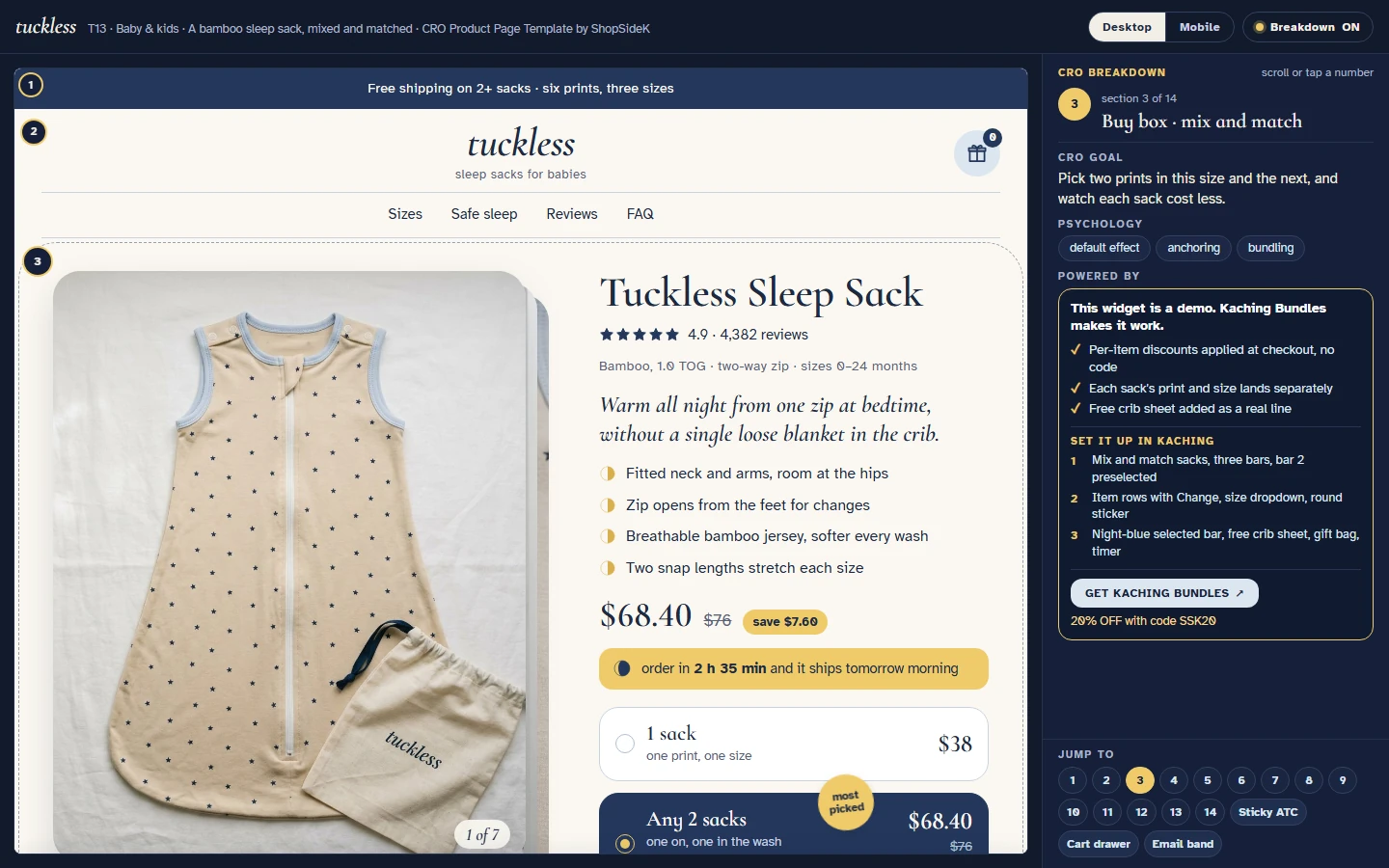
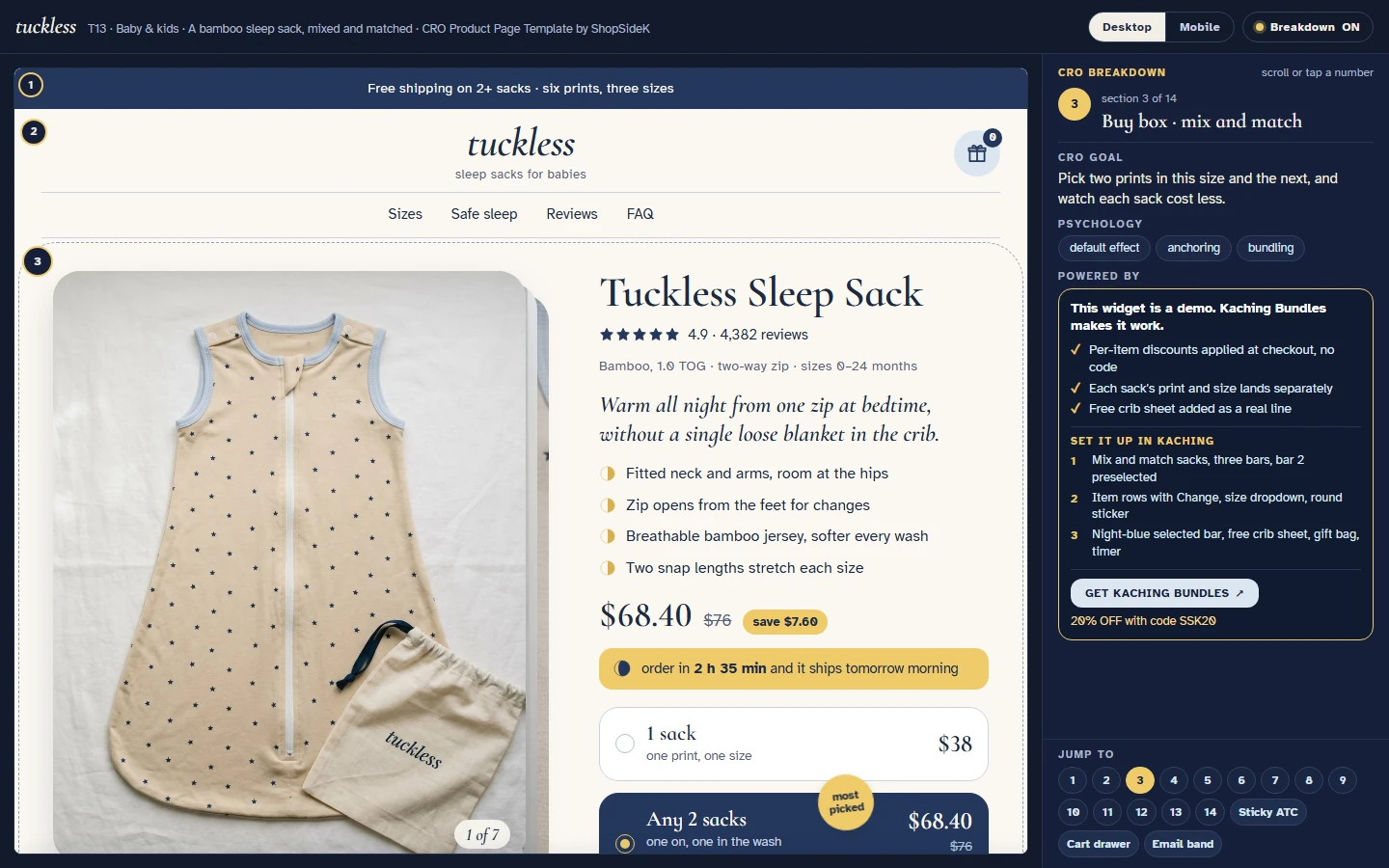
Every Tuckless sack costs $38 in any print or size, and each of the six prints is its own product in the store. That single price is what makes mix & match work: swapping a print or a size never moves the bundle’s total, so the parent can play with the rows freely.
The offer: nights covered, a size per sack
| Bundle bar | Loads with | Off each sack | Price | Crossed-out | Per sack | Extra |
|---|---|---|---|---|---|---|
| 1 sack | Oat Stars, S | none | $38 | none | $38 | pays $5.95 shipping |
| Any 2 sacks (preselected) | Oat Stars S + Little Clouds M | 10% | $68.40 | $76 | $34.20 | free shipping |
| Any 3 sacks | Oat Stars S + Little Clouds S + Butter Moons M | 20% | $91.20 | $114 | $30.40 | free shipping + fitted crib sheet ($28 value) |
The preselected bar loads with two different sizes on purpose: a size dropdown shows on each row before the parent touches anything, and the default says “this size now, the next one later.” A progress bar names the next step in dollars, and a $5 gift-ready option sits on every bar for shower buyers. For why this buyer needs mix & match rather than a quantity break, see fixed vs mix and match bundles on Shopify.
On the demo’s assumed costs ($6.80 a sack landed and packed, $4.40 for the gift crib sheet, $2.10 for the burp cloths, $0.90 an order for size swaps), orders with the first-order code TUCKLESS10 still hold: one sack keeps 77.5% gross margin, two sacks 66.2%, three sacks with both gifts 55.4%. See how Shopify bundle discounts stack before letting a welcome code combine with bundle prices.
The sections that do the persuading
- A calm buy box. One promise (warm all night from one zip, no loose blanket in the crib) and tabs that open on “Size & TOG,” beside a “Safe sleep” tab that ends on “no sack can prevent SIDS.”
- Durability shown, not claimed. The founders’ first sack after about 300 washes, with its flaws listed (paler, some pilling at the hips) and what held (the zip and the neck binding).
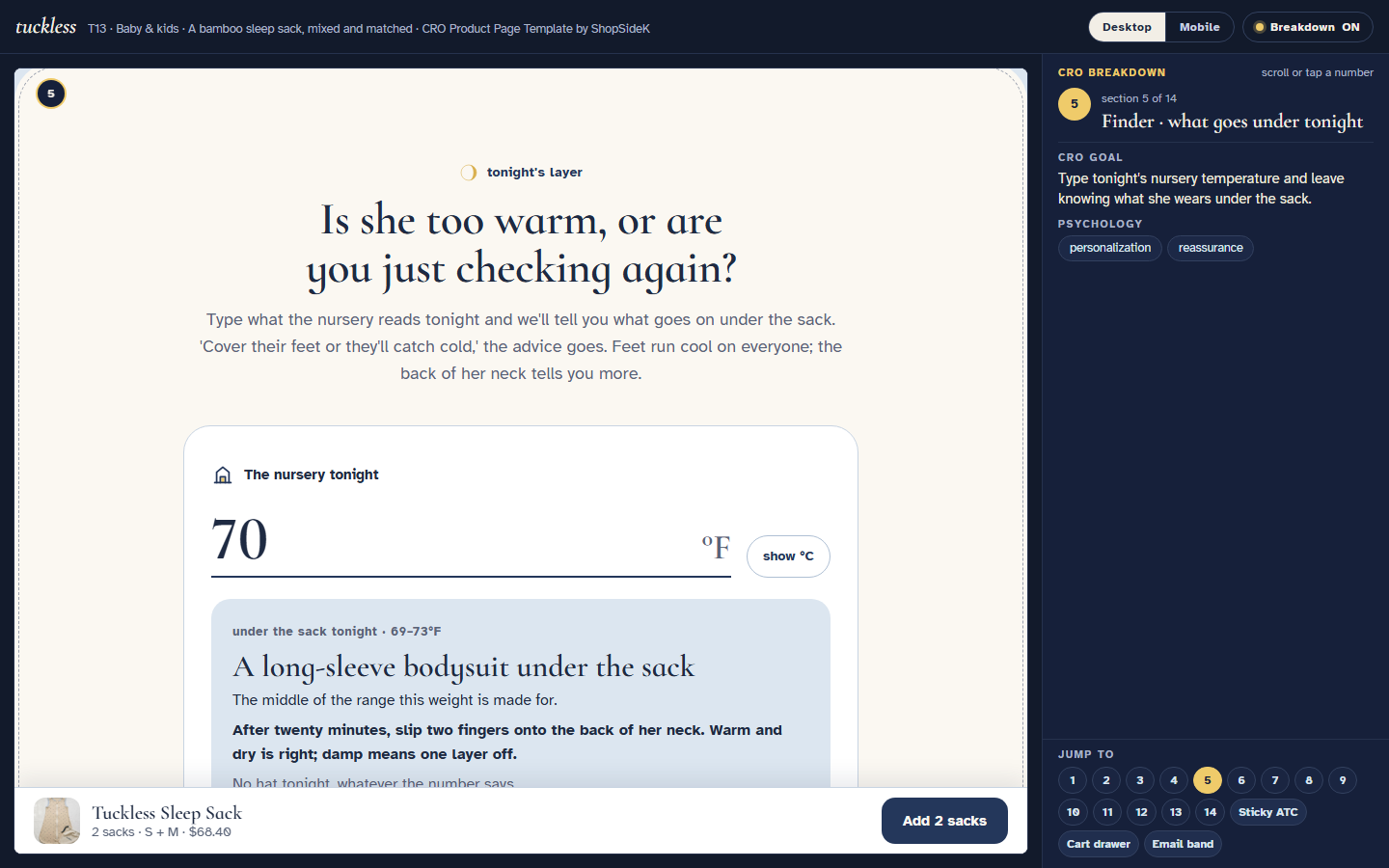
- The room-temperature finder. The parent types tonight’s nursery temperature and the page names the layer under the sack, from “a short-sleeve bodysuit, no sack” at 78°F and up to “warm the room first” at 59°F and below. Every answer that uses the sack names a layer of clothing under it, which matters for the flammability rules below.
- The change in the dark. A three-step clip: zip down from the feet, change the diaper with the chest still zipped, zip back up with the lights off.
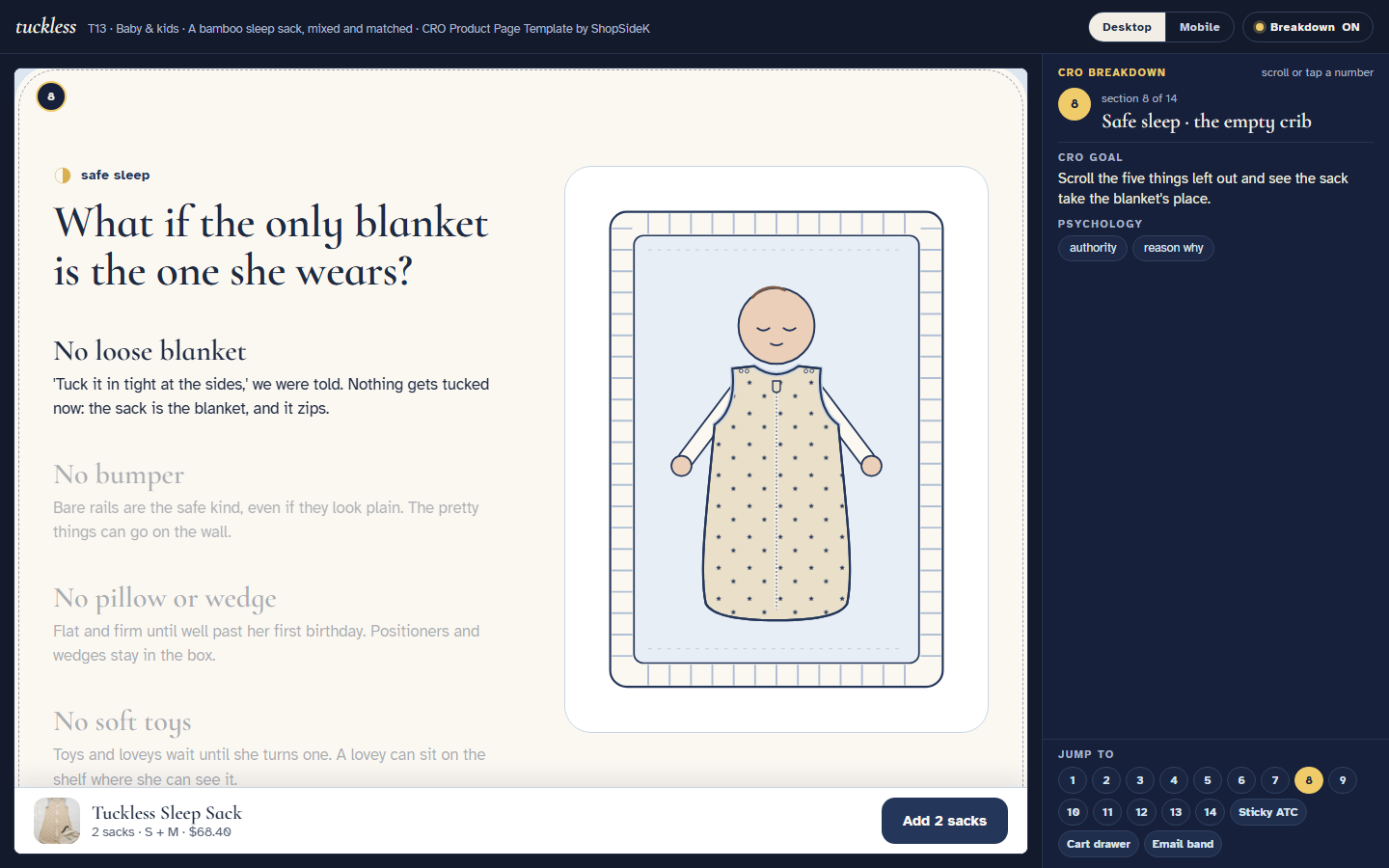
- The empty crib. Five blocks scroll past a drawing of an empty crib, each quoting old nursery advice and giving the current answer.
- When the arms come out. Four signs it’s time to stop swaddling, led by rolling. The demo says rolling often starts “around two months”; Safe to Sleep says usually around 3 months, and the sign, not the date, is the cue.
- Sizes by stage. Three cards give months, weight and length (S 8–16 lb up to 26 in, M 16–22 lb and 26–30 in, L 22–30 lb and 30–35 in) with a cue to size up.
- A guarantee for three fears. Wrong size (swapped free, even after a wash), not right for the baby (a refund within 60 nights) and a failed zip (a new sack), then one email when the next size is due.

The cart: a gift one row away
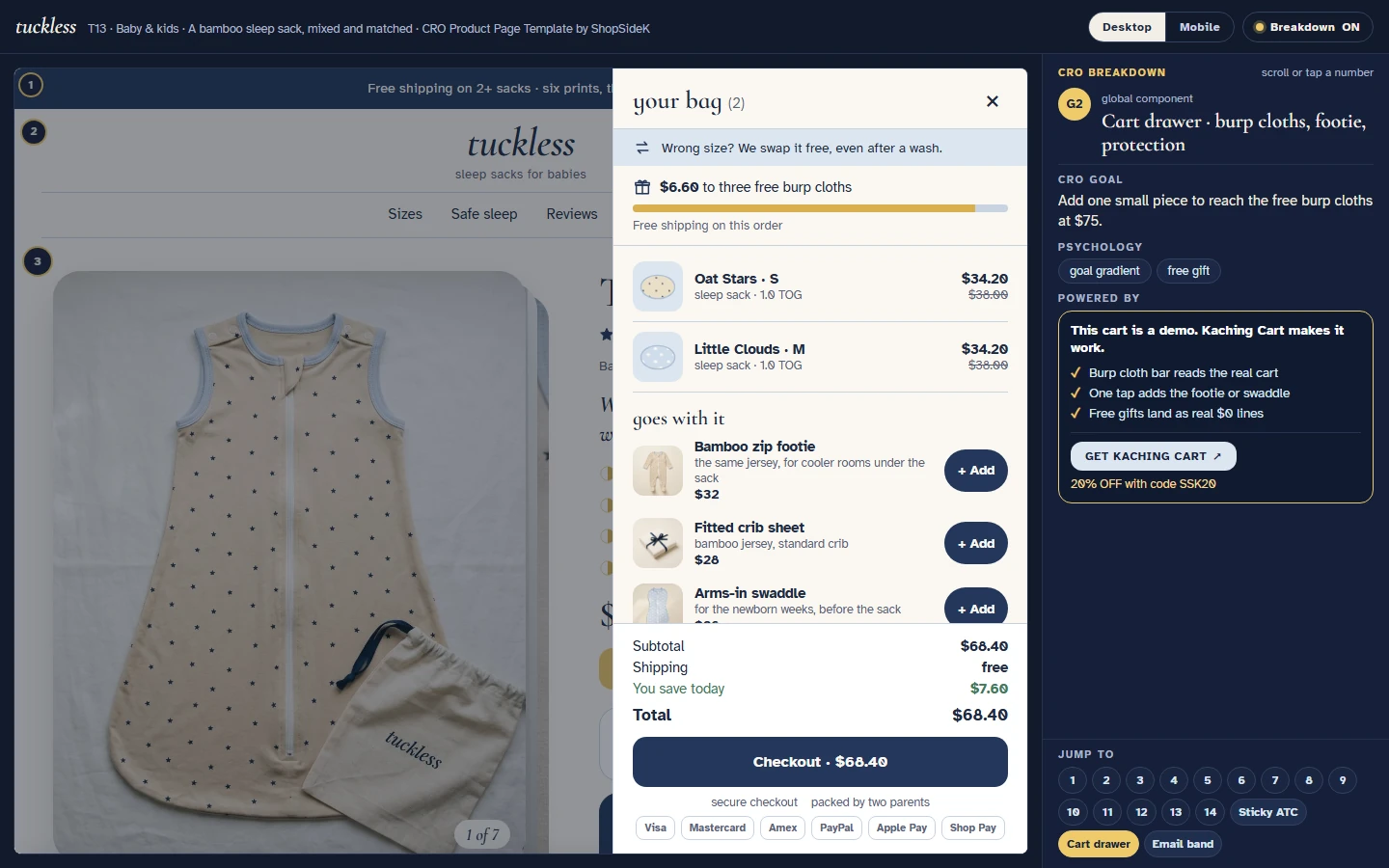
The two-sack bundle clears free shipping at $60 and lands $6.60 short of the cart’s reward: three free burp cloths from $75. A short “goes with it” list offers a zip footie ($32), a fitted crib sheet ($28, hidden when bar 3 already includes one) and an arms-in swaddle ($26). Adding the swaddle takes the order from $68.40 to $94.40 and unlocks the burp cloths.
One thing not to copy
The FAQ opens with “Is it safe from the first night, and can it ride up?” and the demo answers “Yes, once she fits the S (8 lb and up).” Don’t open a safety answer with an unconditional yes: safe sleep depends on how the baby is put down as much as on the product, and the page’s own tab says no sack can prevent SIDS. Answer with the conditions: the right size by weight, on the back, in an empty crib, nothing over the face. The review headline “Most parents stopped checking the monitor by week two” has the same problem; keep reviews about comfort and fit.
Rebuild the offer in Kaching
- A Bundle Upsell over the sleep-sack collection: 1, 2 and 3 sacks at 0%, 10% and 20% off each, bar 2 preselected.
- Item rows with Change for the print, a size dropdown per row, a progress bar and a “most picked” sticker.
- A free crib sheet on bar 3, a $5 gift-ready add-on on every bar, and a timer set to your real packing cut-off.
Kaching documents a Bundle Upsell with a discount on each item (Kaching help: bundle types) and a different variant per item (Kaching help: variant dropdowns); check in your editor that a size can be picked per row inside a mix & match bar. The demo’s timer (“order in 2 h 35 min and it ships tomorrow morning”) restarts at each day’s cut-off, so a live store should name the real ship day, which after a Friday cut-off is Monday.
Example 2: Chinfold, a bandana bib page that sells a week of clean bibs
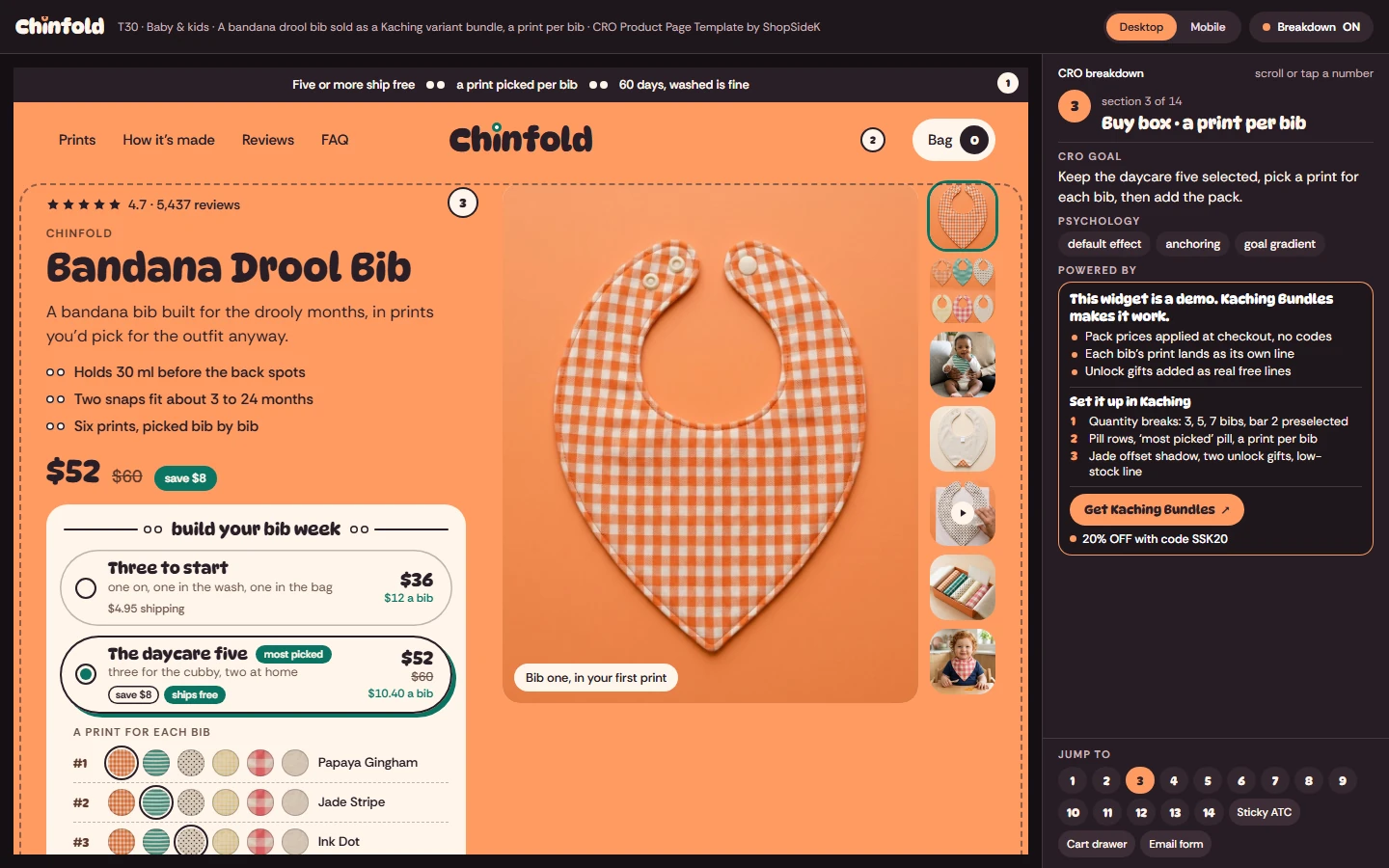
Chinfold sells one bib: a 13 × 7 in bandana of printed organic cotton over a terry core of viscose from bamboo and cotton, backed with fleece and closed with two plastic snaps that fit about 3 to 24 months. With one size, the print is the only choice per bib, so the page turns the pack into a week: how many bibs a drooly day uses and how many the daycare cubby needs.
The offer: three, five or seven bibs, a print for each
| Bar | Bibs | Price | Crossed-out | Per bib | Saving | Shipping | Free gift |
|---|---|---|---|---|---|---|---|
| Three to start | 3 | $36 | none | $12 | none | $4.95 | none |
| The daycare five (preselected) | 5 | $52 | $60 | $10.40 | $8 | free | Mesh wash bag ($6 value) |
| A bib a day | 7 | $66 | $84 | $9.43 | $18 | free | Mesh wash bag + zip wet bag ($20 value) |
The subtitles carry the argument: “one on, one in the wash, one in the bag,” “three for the cubby, two at home,” “a clean one every morning.” Under the selected bar, each bib gets its own row of six print swatches, and bib one’s print changes the main photo. The crossed-out price is simply the bibs at $12 each, the save pill names dollars rather than a percent, and the gift not yet earned shows as a greyed row (“Unlocks with 7 bibs”).
The demo’s assumed costs are $1.90 a bib landed, $0.45 and $1.60 for the two bags, $0.35 packing, $0.30 a bib for print swaps and snap replacements, 3% of product sales for refunds, card fees and a $4.10 to $5.60 mailer. On those, three bibs paying shipping keep 66.7% gross margin, five bibs with the first-order code CHINFOLD10 keep 59.5%, and the worst of 24 order combinations, seven bibs with the code, keeps 55.5%.
The sections that do the persuading
- The washing line. Seven bibs hang under day tags, Monday to Sunday, so all six prints show at once and seven reads as a clean one every morning.
- One seam, opened. A bib with its point unpicked; tap a letter and each part explains its job: cotton on the chin, terry that holds the drool, fleece that slows the rest, plastic snaps (“no metal anywhere”) and a name loop for daycare.
- Lift the bib. The shopper lifts a damp bib in the photo to find the onesie dry underneath, labeled “Our own photo, one baby, one morning.”
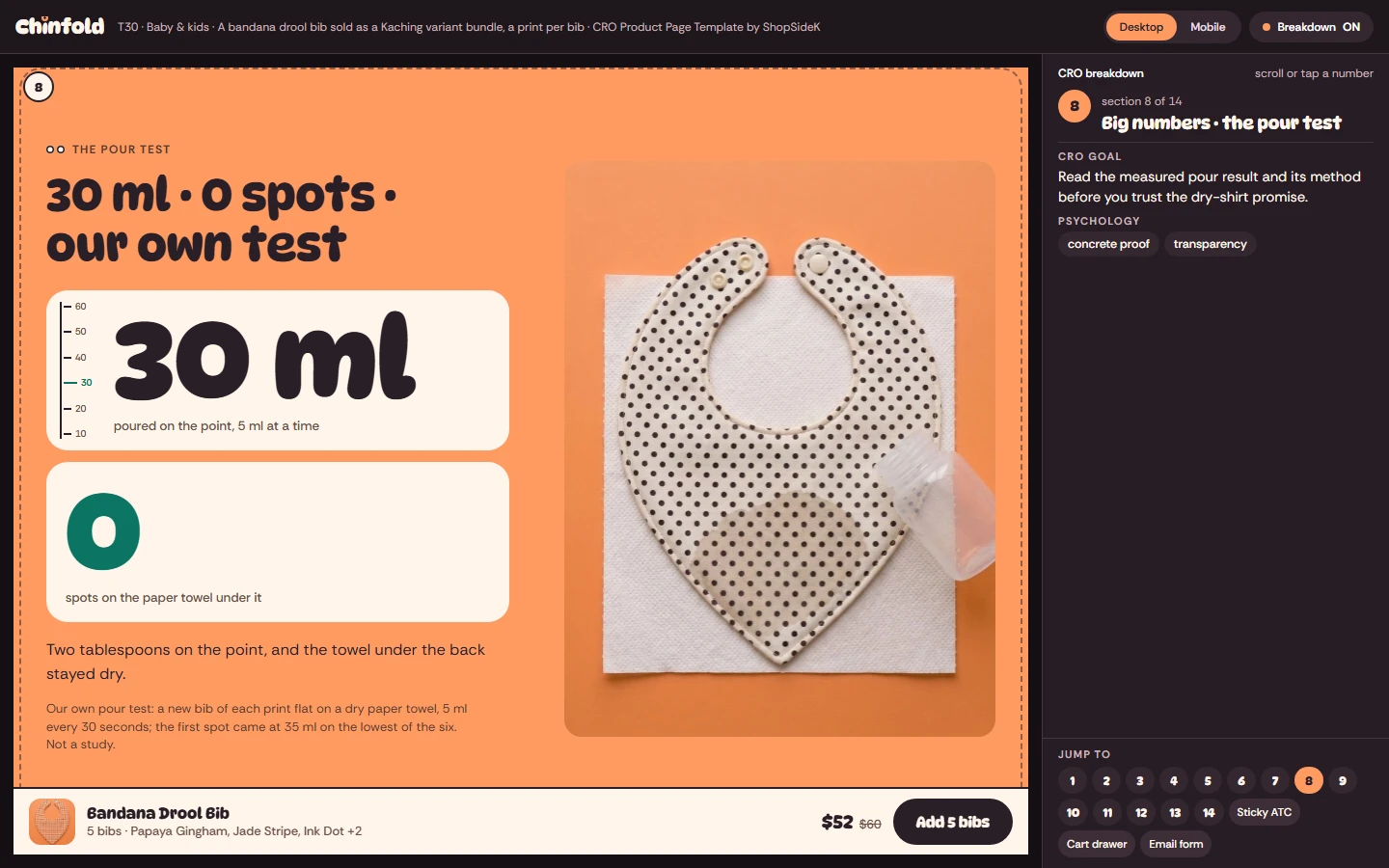
- The pour test. “30 ml · 0 spots”: water poured on the point 5 ml at a time over a paper towel, the first spot at 35 ml on the weakest of six prints, the method printed under it, and “Not a study.”
- A week at daycare. A notebook steps through Monday to Friday, the room’s notes and the parent’s replies, to show why five is the working number.
- The gift receipt. A giver types the parents’ name into a receipt with no prices on it.
- Plain answers. A guarantee table (print swaps within 60 days, washed is fine; a new bib if a snap gives out in year one) and an FAQ that opens with “Can she sleep in it?” and answers no.
The cart: three bibs and a teether, or five bibs for five cents more
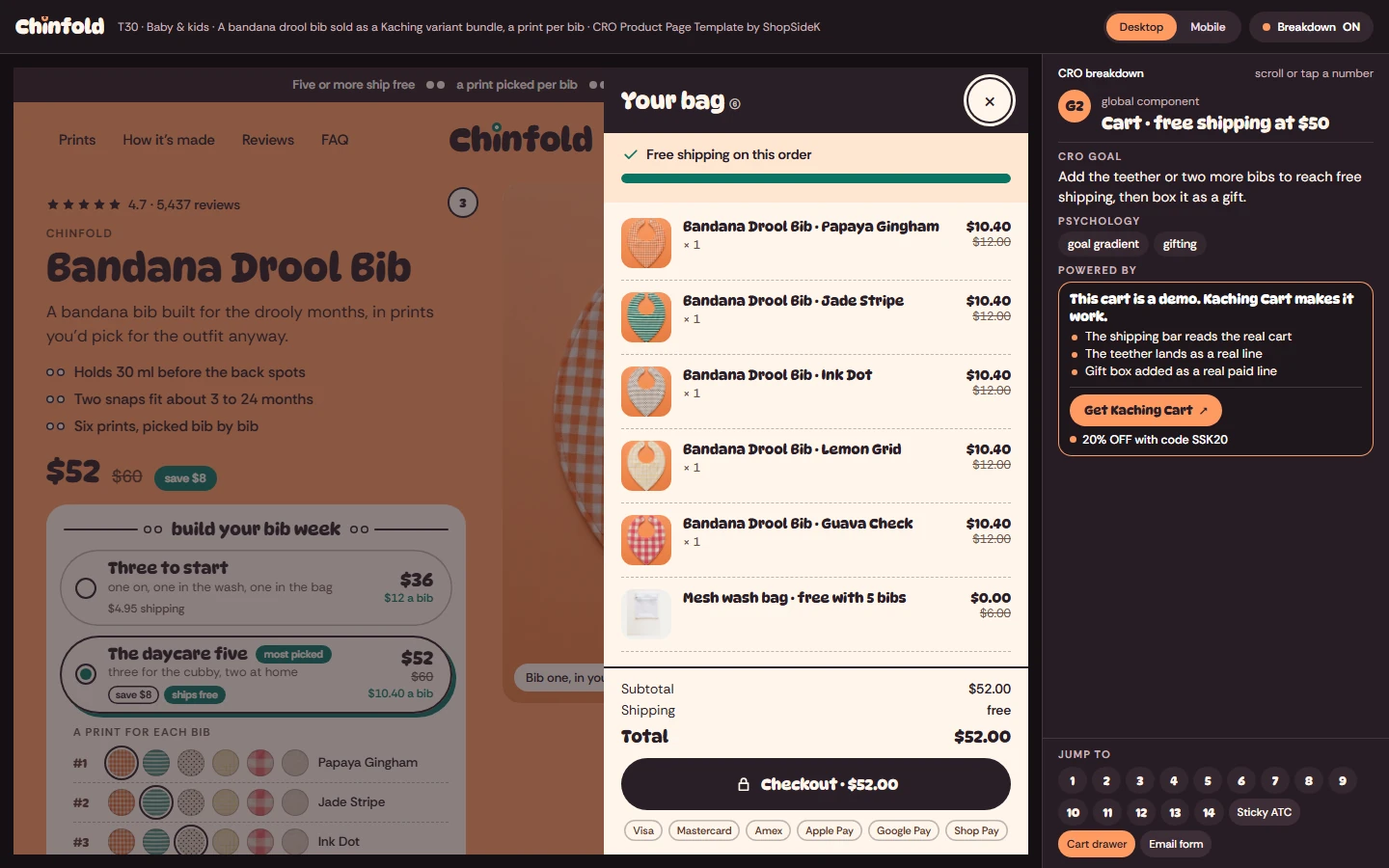
The cart drawer, built with Kaching Cart, runs a single bar: free shipping at $50, counted on the bibs and the teether before codes. The daycare five ($52) clears it on arrival; three bibs read “$14.00 to free shipping.” One card, “Goes with the drool,” offers a silicone teether ring for $11 (struck at $14). Three bibs plus the teether come to $47, still short, so that order pays $4.95 shipping and totals $51.95: five cents less than the daycare five, which ships free with two more bibs and the wash bag. A $5 gift box (“no prices inside”) never counts toward free shipping.
One thing not to copy
The daycare section’s headline reads “4,100 cubbies hold a Chinfold five.” On a demo that is copy; on a live store it is a claim about customers, and one no shop can measure, since the order system knows how many five-packs shipped, not where they hang. Use a number only when your own data says it, in words that match the data, or drop it: the notebook already makes the case. The FAQ headline “Asked at 5,000 changing tables” is the same kind of number, and the stock line under the bars (“Guava Check: 46 left from this print run”) has to read from real inventory.
Rebuild the offer in Kaching
- A Quantity Break on the bib with bars of 3, 5 and 7 at fixed totals of $36, $52 and $66, bar 2 preselected.
- “Let customers choose different variants for each item” turned on, with custom-image swatches in a circle.
- A free gift on bars 2 and 3, a “most picked” pill, a savings line and the price per bib.
Kaching documents a Quantity Break with a custom total for the selected quantity and free gifts in a deal (Kaching help: bundle types), and the per-item variant setting with uploaded swatch images in a circle (Kaching help: variant dropdowns). The locked-gift rows, the savings line, the per-bib price and a stock line on one print are not in the help articles we opened: check them in your editor.
In Kaching Cart, free shipping is a shipping-discount tier at 100%, and the gift box can be excluded from the count (Kaching help: free shipping progress bar). One difference from the demo: Kaching says discount codes lower the cart total that counts toward a tier, so a daycare five with CHINFOLD10 ($46.80) would sit under a $50 bar. The teether card can hide once added (Kaching help: hide upsell in cart); a paid gift-box toggle isn’t named in the cart quickstart guide, so check that too.
Safe-sleep guidance a sleep sack page must not contradict
The NIH’s Safe to Sleep campaign publishes the plain-language rules most US parents hear at the hospital (NIH Safe to Sleep: ways to reduce baby’s risk). A sleep sack page can repeat them and show them in its photos, and must never contradict them. This is general information, not medical advice.
- Back to sleep, for naps and at night, until age 1. Every crib photo on the Tuckless page shows a baby on her back.
- An empty, firm, flat surface with only a fitted sheet: no comforters, quilts, pillows, blankets or bumpers.
- A wearable blanket or an extra layer of clothing to keep the baby warm, instead of adding items to the sleep area.
- No overheating: keep the head and face uncovered, and take the hat off indoors.
- Nothing weighted. Weighted blankets, swaddles and objects are on Safe to Sleep’s list of sleep-area dangers.
- Swaddling stops at rolling. Swaddling doesn’t reduce SIDS risk, and once a baby rolls it raises the risk of suffocation and strangulation; rolling usually starts around 3 months.
US product rules a sleep sack or bib page touches
The CPSC’s rules cover testing, labels, chemicals, small parts and flammability; the FTC and the USDA govern how fabric is described; FDA advises on teething. This is general information, not legal advice.
- Children’s Product Certificate. Sleep sacks and bibs are children’s products (designed or intended primarily for children 12 or younger), so the US manufacturer or importer must issue a certificate based on testing by a CPSC-accepted third-party lab (CPSC: Children’s Product Certificate). Tuckless’s “tested to US children’s product rules” is only honest with one on file.
- Tracking labels. Children’s products need permanent marks on the product and its packaging, where practicable, naming the maker, where and when it was made and the batch (CPSC: tracking labels). Tuckless’s hand-me-down name label and Chinfold’s blank name loop don’t count.
- Lead. Children’s products may not contain more than 100 ppm of lead in an accessible component (CPSC: total lead content). Dyed or undyed fibers skip the third-party lead test, but textiles with applications that aren’t entirely dyes don’t, and plastics aren’t on that list (16 CFR 1500.91). So a printed front (unless the print is all dye) and plastic snaps go to the lab.
- Phthalates. CPSC names bibs among its examples of child care articles, so no accessible part may hold more than 0.1% of any of eight listed phthalates, and the bib needs third-party testing for them (CPSC FAQ: phthalates). The cart’s teether is covered too, since child care articles include products that help children 3 and younger with teething (16 CFR 1307.2). Only parts of polypropylene, polyethylene, certain polystyrenes or ABS, with listed additives, skip that test (16 CFR 1308.2); ask your lab about the snaps’ plastic.
- Loose snaps. The small-parts ban exempts children’s clothing and accessories, with buttons as the example, and feeding products (16 CFR 1501.3). CPSC still recalls bibs whose snaps come off: about 7,000 IKEA bibs in October 2019 (CPSC recall) and about 52 handmade bibs and stroller bags sold on Etsy in July 2026 (CPSC recall). Chinfold’s FAQ tells parents to check the snaps before each wear.
- Flammability. CPSC staff treat a wearable sleep blanket as general wearing apparel (16 CFR part 1610) when the baby wears sleepwear inside it, and as children’s sleepwear under the stricter part 1615 when the baby wears only a diaper; marketing must state the intended use clearly (CPSC FAQ: children’s sleepwear, 16 CFR 1615.1).
- “Bamboo.” The FTC says most textiles sold as bamboo are rayon and need the generic fiber name, as in “rayon made from bamboo” (FTC: how to avoid bamboozling your customers); in April 2022 it sought $2.5 million from Kohl’s and $3 million from Walmart over rayon sold as bamboo (FTC press release). Tuckless says bare “bamboo” in its variant line, a bullet and the FAQ; Chinfold writes “viscose from bamboo” every time.
- “Organic.” USDA’s National Organic Program doesn’t restrict “organic” on a textile if every fiber called organic was produced and certified under its rules; a textile made to the Global Organic Textile Standard may be sold as organic but without the USDA seal (USDA NOP Policy Memo 11-14). Chinfold claims organic only for its cotton front, so keep that fiber’s certificate on file. Fiber content and origin lines are covered in our clothing product page examples.
- Teething add-ons. FDA advises rubbing the gums with a finger or a firm, not liquid-filled, teether that isn’t frozen, with the child supervised, and warns against teething jewelry such as amber necklaces (FDA: safely soothing teething pain). Chinfold’s teether makes no pain claim but is called “soft,” where FDA says firm.
- Experts. Tuckless’s pediatrician is fictional; a live store’s expert must be real and must have reviewed the product, with any connection to the brand disclosed (16 CFR 255.5).
Baby product page checklist
- Bundles named for the parent’s job, not for a percent.
- A size or print per item, and the next size in the same order.
- Months, weight and length per size, or neck measurements for a one-size item.
- The one safety rule in the buy box and again in the FAQ.
- Photos that model safe use: on the back in an empty crib, or awake and watched.
- Your own tests labeled as your own, with the method beside the result.
- No unconditional “safe” answers, and no SIDS or teething-pain promises.
- The generic fiber name everywhere, and “organic” only for certified fiber.
- A Children’s Product Certificate covering every printed or plastic part, plus tracking labels.
- A guarantee that allows washing, and a gift option with no prices inside.
FAQ
What should a baby product page include?
Sizes by age, weight and length (or neck measurements), the full fiber content, care, the product’s safety rule in plain words, photos that model safe use, reviews tagged with the baby’s age, a returns promise that allows washing, and every bundle’s price.
Can a baby product page say the product is safe?
Not as a bare yes. Describe the conditions for safe use instead: for a sleep sack, the right size by weight, baby on the back in an empty crib, nothing over the face; for a bib, awake time only and snaps checked before each wear. No product can promise to prevent SIDS.
Do I need a Children’s Product Certificate to sell sleep sacks or bibs in the US?
Yes. Both are children’s products, so the US manufacturer or importer must issue a certificate based on testing by a CPSC-accepted third-party laboratory, and the product and its packaging need permanent tracking marks where practicable.
Do baby bibs have to meet the phthalate limits?
Yes. CPSC lists bibs among its examples of child care articles, so no accessible part may contain more than 0.1% of any of eight listed phthalates, and the bib must be third-party tested for them, except parts made of a few listed plastics.
Do bib snaps have to pass the small-parts test?
The small-parts ban exempts children’s clothing and accessories, with buttons as the example, and feeding products. Exempt or not, CPSC recalls bibs whose snaps come off, so test how well the snaps hold and tell parents to check them before each wear.
Are sleep sacks covered by children’s sleepwear flammability rules?
It depends on intended use. CPSC staff treat a wearable blanket worn over sleepwear as general apparel under 16 CFR part 1610, and one worn over only a diaper as children’s sleepwear under part 1615. Say clearly on the page what the baby wears underneath.
Can I call a baby fabric “organic” or “bamboo”?
“Organic” fits when the fibers called organic were produced and certified under USDA organic rules; a textile certified to the Global Organic Textile Standard may be sold as organic but without the USDA seal. Bare “bamboo” rarely fits: most bamboo fabric is rayon, and the FTC expects “rayon made from bamboo” or similar.
More product page examples
Tuckless and Chinfold are part of the ShopSideK library of Shopify product page templates, each with a free CRO breakdown. Browse the baby and kids product page templates, the Kaching mix & match templates or the Kaching variant bundle templates.
For more pages with a size or color per item, see clothing product page examples and pet product page examples; for gift-led pages, personalized product page examples.
Sources
- NIH Safe to Sleep: reduce baby’s risk
- CPSC: Children’s Product Certificate
- CPSC FAQ: tracking labels
- CPSC: total lead content
- 16 CFR 1500.91 (Cornell LII)
- CPSC FAQ: phthalates
- 16 CFR 1307.2 (Cornell LII)
- 16 CFR 1308.2 (Cornell LII)
- 16 CFR 1501.3 (Cornell LII)
- CPSC recall: IKEA infant bibs (2019)
- CPSC recall: Peony Design bibs (2026)
- CPSC FAQ: children’s sleepwear
- 16 CFR 1615.1 (Cornell LII)
- FTC: avoid bamboozling your customers
- FTC press release, April 8, 2022
- USDA NOP Policy Memo 11-14
- FDA: soothing teething pain (2024)
- 16 CFR 255.5 (Cornell LII)
- Kaching help: bundle types
- Kaching help: variant dropdowns
- Kaching help: free shipping bar
- Kaching help: Cart quickstart
- Kaching help: hide upsell in cart