Last updated: October 30, 2026. Both example pages are free to open and click through, no account needed.
A personalized product page has to win an argument a normal page never faces: the shopper is about to commit someone else’s name to wood or leather, and a typo can’t be sanded off. The two Shopify examples below settle that fear before they ask for the order. Each one promises a proof before production, gives every item in the bundle its own personalization, says in plain words what happens if the name comes out wrong, and uses a real production cut-off as its only clock.
Personalized gifts sell all year, on birthdays, anniversaries, weddings and first homes, so these are everyday pages rather than holiday pages:
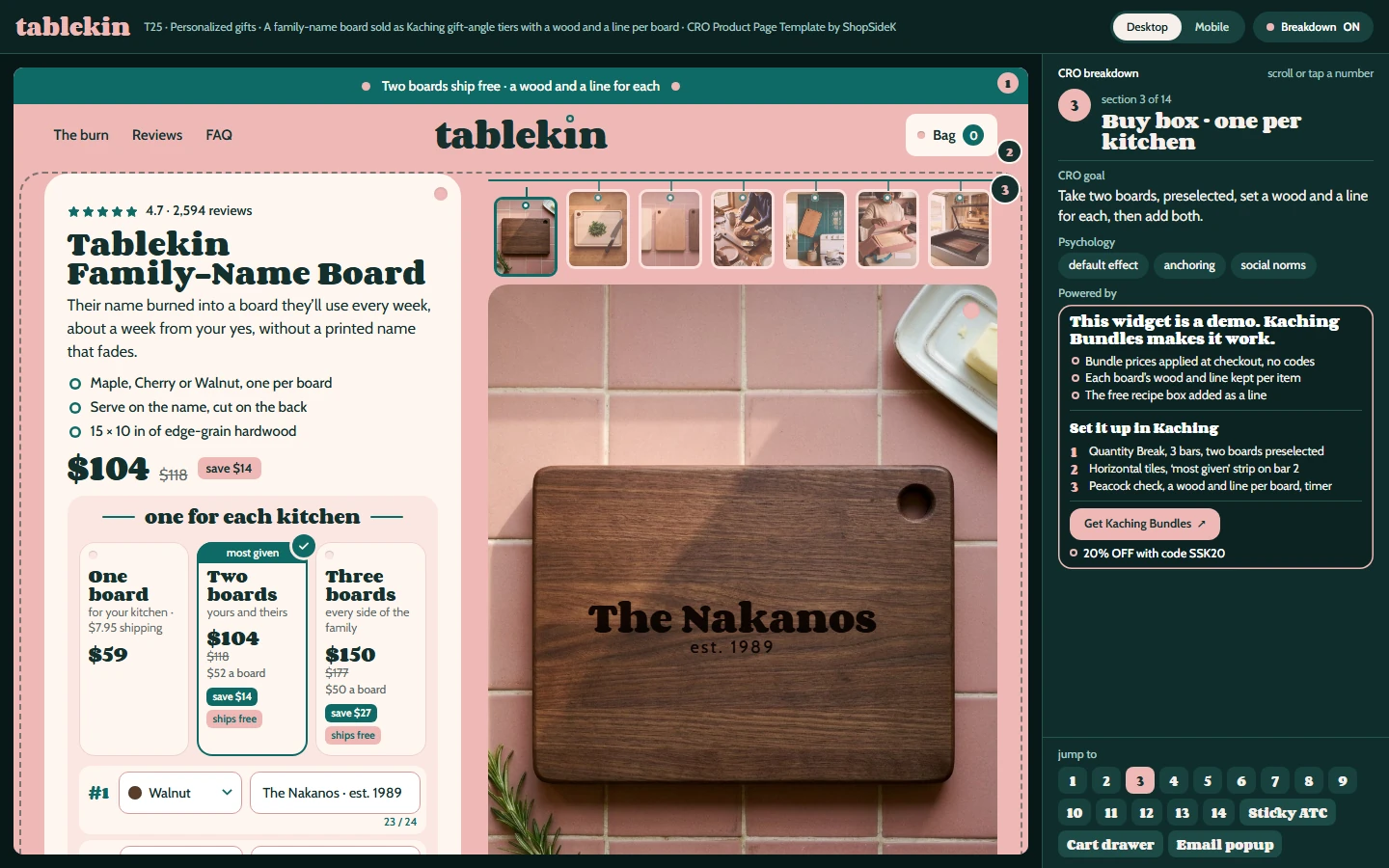
- Tablekin, a family-name cutting board sold one, two or three at a time, with a wood and a burned line for each board (Kaching Quantity Break, named for the people who receive the boards).
- Fairbend, an engraved leather bifold sold alone or as a set with a key fob and a valet tray (Kaching Bundle Upsell, complete the set), shown here in its everyday version.
Key takeaways: 7 rules for a personalized product page
- Promise a proof before anything is made. A short line such as “reply YES and it ships” turns the shopper’s biggest fear, a permanent typo, into a step they control.
- Give every item in the bundle its own personalization. One field per board or per piece, each landing on its own cart line, so a two-gift order never has to share one name.
- Show how the words will look at their real size. A rule that ties line length to letter height answers “will a long name fit?” before anyone emails to ask.
- Name the bundles after the people who get them. “Yours and theirs” sells a second unit better than “save 12%” when the second unit is a present.
- Use the production cut-off as the only clock. “Order in 3 h 12 min and your proof comes today” is urgency the shopper can check against the calendar.
- Say what happens to a custom item before checkout. Cancel before production, a remake when the mistake is yours, and an honest line about what can’t be returned.
- Collect the occasion, not just the email. Asking what the gift is for and in which month gives you a reason to write back three weeks before the next one.
The two examples at a glance
| Tablekin (family-name board) | Fairbend (engraved wallet, everyday) | |
|---|---|---|
| Product | Edge-grain hardwood board, 15 × 10 × ¾ in, in Maple, Cherry or Walnut | Full-grain vegetable-tanned leather bifold with a key fob and a valet tray |
| Kaching offer type | Quantity Break: 1, 2 or 3 boards | Bundle Upsell: the bifold, the gift set, the full carry |
| Prices | $59 · $104 · $150 | $49 · $58 · $82 |
| Crossed-out price | Boards × $59 ($118 and $177) | The pieces’ own total ($68 and $103) |
| What gets personalized | A wood and a line of up to 24 characters on every board | His initials (3 letters) on every piece, plus a hidden note of up to 40 characters in the bifold |
| Proof | Emailed before the burn; reply YES | Emailed before the laser; nothing engraved until the giver says yes |
| The one clock | Proof cut-off at 1 pm on the next weekday | Tonight’s cut-off for tomorrow morning’s engraving queue |
| Top-bar gift | A box of recipe cards ($14 value) with three boards | A Care Tin ($12 value) with the full carry |
| Paid extras | A $6 gift box in the cart | Gift wrap +$5 and rush engraving +$6 on every bar |
| Email capture | A prize wheel, mostly kitchen extras | An occasion reminder three weeks early, with 10% off |
| Live example | Tablekin template (T25) | Fairbend template, everyday version (T08) |
Example 1: Tablekin, a family-name board sold one per kitchen
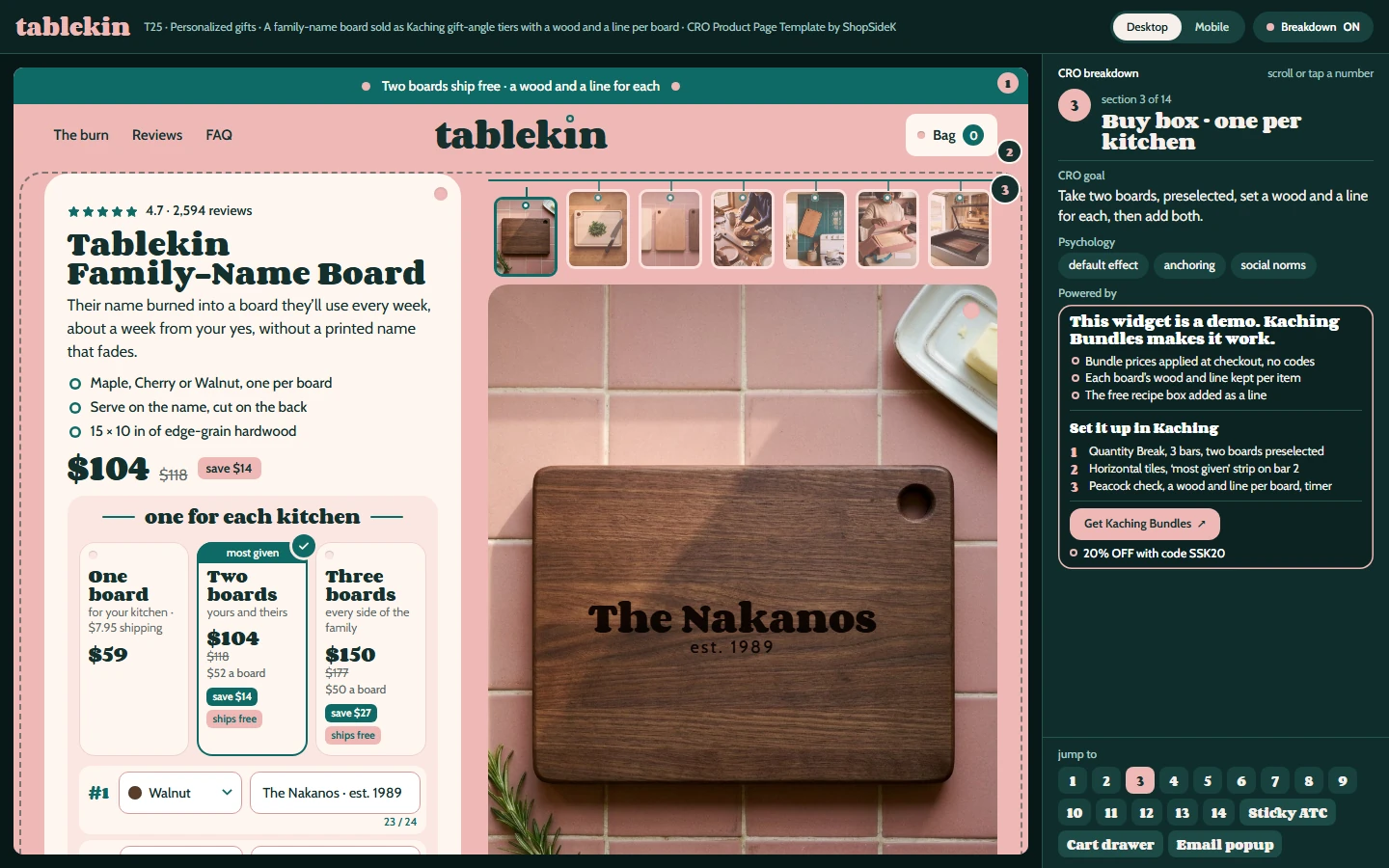
Tablekin burns a family name about half a millimeter into the serving face of a hardwood board and leaves the back plain for cutting. The page is built on one observation from its founder story: a family board gets wanted by more than one household. So the offer sells boards one per kitchen, and two boards, “yours and theirs,” load as the default.
The offer: tiles named for the people who receive them
| Bundle tile | Name on the tile | Price | Crossed-out | Per board | Shipping | Gift |
|---|---|---|---|---|---|---|
| One board | for your kitchen | $59 | none | $59 | $7.95 | none |
| Two boards (preselected) | yours and theirs | $104 | $118 | $52 | free | none |
| Three boards | every side of the family | $150 | $177 | $50 | free | recipe card box ($14 value) |
Every board in the selected tile gets its own row: a wood dropdown with a small grain dot, then a “Your line” field with a live counter out of 24. Two boards load as Walnut “The Nakanos · est. 1989” and Maple “The Parks · est. 1992,” so the shopper sees two different gifts before typing anything. An empty line stops the add-to-cart button and points at the board that still needs a name. Free shipping starts at $75, which is why the single board names its $7.95 shipping on the tile while two and three boards say “ships free.”
The wood per board is a Kaching setting (Kaching help: variant dropdowns for each item). The text field is drawn inside the widget in the demo, but Kaching’s help center doesn’t document a free-text field per item, so a live store would add the line as a Shopify line-item property in the theme or through a personalization app (Shopify: product template and line item properties).
The sections that take the spelling fear away
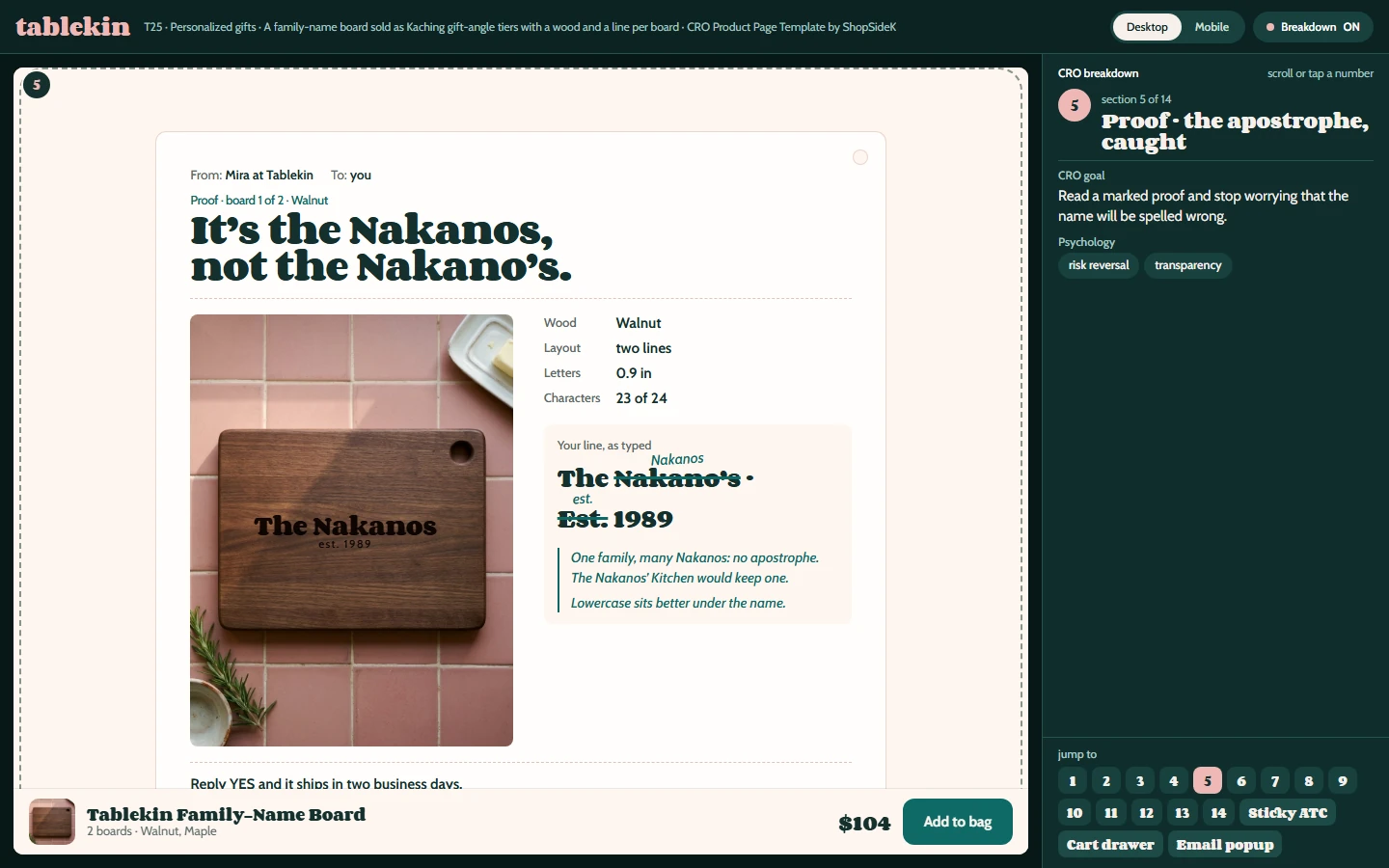
- A marked proof. The page prints a real-looking proof email titled “It’s the Nakanos, not the Nakano’s.” The typed line shows a struck apostrophe with the fix written above it, a second mark lowers “Est.” to “est.,” and the foot says: reply YES and it ships in two business days; no reply in 24 hours and it is burned as typed.
- Letter sizes by length. Up to 10 characters get one arch at 1.4 inches, 11 to 18 get one straight line at 1.1 inches, and 19 to 24 split into two lines at 0.9 inches. A pinned photo changes its example line (“The Lees,” “The Whitakers,” “Nana & Pop’s Kitchen”) as each card scrolls past.
- Three woods, one line. The same name on Maple, Cherry and Walnut, with a note on how each one ages and which reads best in a dim kitchen.
- Two sides, two jobs. A flip button turns the board over: serve on the name, cut on the back with its juice groove, so the burned letters never meet a knife.
- The founder’s three sentences. One board, three grandchildren who wanted it, and the one who learned to burn names and made two more. It explains the “one per kitchen” offer without saying “buy more.”
- A vote on the second board. Shoppers pick who their second board would go to, then see last year’s split: parents 34 in 100, a partner’s parents 29, a sibling’s new place 17, grandparents 12, a friend’s first house 8. The page labels its basis as demo data.
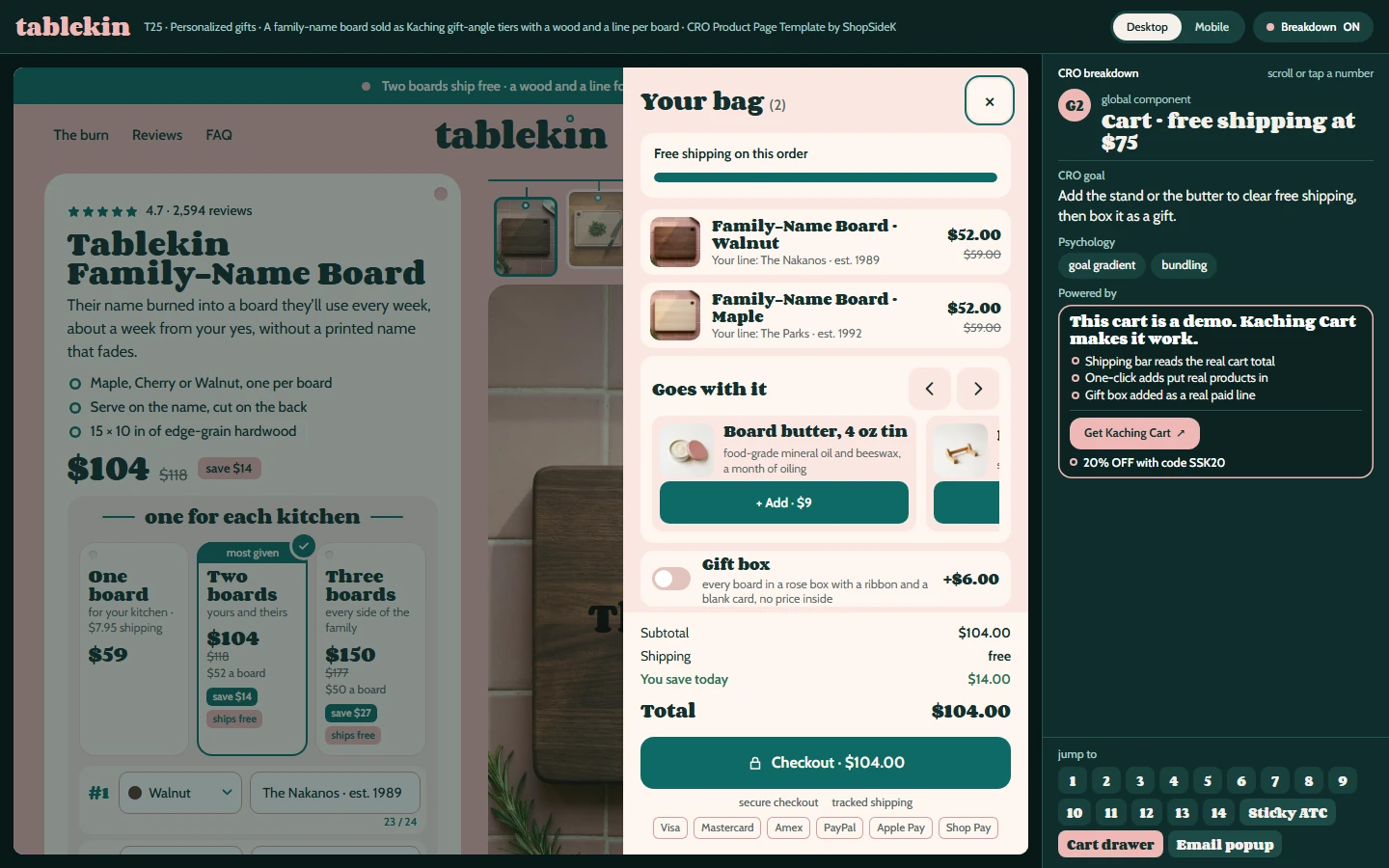
The cart: free shipping already lit, add-ons that close the gap
Two boards open the cart drawer with “Free shipping on this order” already showing. Under it, a “goes with it” slider offers board butter ($9), a beechwood stand ($14) and the recipe card box ($14), which disappears when three boards already include it. A $6 gift box is a separate toggle. The add-ons are priced to rescue the single-board order: one board shows “$16.00 to free shipping,” the stand brings it to “$2.00,” and the butter on top crosses $75. With two boards and the stand, the order goes from $104 to $118.
The email popup is a prize wheel whose prizes are mostly things for the kitchen: $10 off a first order, free shipping on one board, a free gift box, a tin of board butter, the recipe card box or a stand. On the demo’s assumed costs, the worst order it can produce (three boards, the $10 code and a paid gift box) still keeps about 52% gross margin.
One thing not to copy
The second-board vote only works with real answers. Its numbers come from an imagined post-checkout question; on a live page, show a split like that only after you have asked real buyers, and print the question and the date range beside it.
Rebuild the offer in Kaching
- A Quantity Break deal with three bars of 1, 2 and 3 boards, two boards preselected.
- Horizontal tiles, a “most given” strip on bar 2, a recipe card box as the free gift on bar 3.
- A wood dropdown per board; the line field added in the theme; the proof cut-off timer at the foot of the widget.
For a deeper look at how far each tile’s price should drop, see how deep quantity break discounts should go.
Example 2: Fairbend, an engraved wallet sold for any occasion
Fairbend’s everyday page sells a slim saddle-stitched bifold with his initials pressed into the front corner and a hidden note under the bill fold. The page has a Christmas version as well; the link below opens the everyday one, which is built for birthdays, anniversaries and Father’s Day.
The offer: complete the set, a leather per piece
| Bundle bar | Pieces | Price | Crossed-out | Gift |
|---|---|---|---|---|
| The Bifold | Bifold | $49 | none | none |
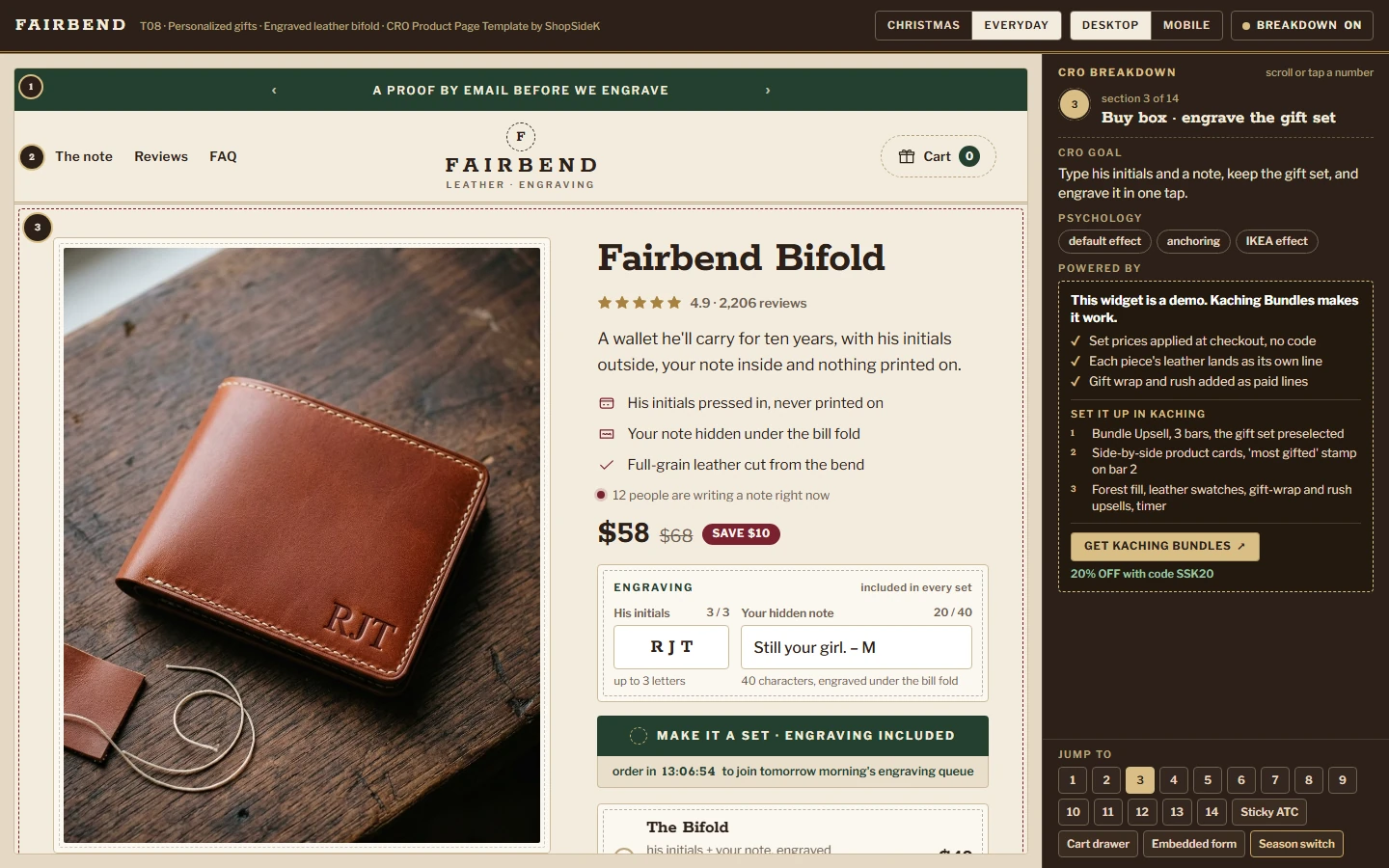
| The gift set (preselected) | Bifold + Key Fob | $58 | $68 | none |
| The full carry | Bifold + Key Fob + Valet Tray | $82 | $103 | Care Tin ($12 value) |
Each bar takes a fixed dollar amount off each piece so the total lands on a round number: the gift set takes $7 off the $49 bifold and $3 off the $19 key fob, and the full carry takes $9, $4 and $8 off the bifold, the key fob and the $35 tray. Every piece picks its own leather (Chestnut, Espresso or Black) without changing the price. Two paid extras sit on every bar, both unticked: gift wrap in a kraft box for $5, and rush engraving for $6, which moves the order to the front of the queue and ships it the next working day.
The initials and the note are typed once above the widget and apply to every piece in the bar. In a live store, those two fields are theme line-item properties, not a Kaching setting.
The sections that sell a gift bought for a date
- His pocket. The giver doesn’t know what’s in his wallet, so the page asks how he carries instead. “Cards and cash” moves 6 cards and folded cash into an 8 mm wallet, “Everything” fits 8 cards and cash at 9 mm and leaves the receipts behind, and “Phone pays” keeps an ID, 2 cards and an emergency twenty at 6 mm.
- The nightly set. One lamplit photo shows wallet, keys and watch dropped into the tray at the end of the day, each with his initials. It is the argument for the full carry, made as a habit rather than a discount.
- A guarantee for things that can’t be returned. “Engraved doesn’t mean final”: free re-stitching for as long as he carries it, one free remake within 30 days for any reason, and a free remake at any time if the engraving doesn’t match the approved proof.
- An occasion reminder instead of a popup. A form between the FAQ and the last call to action asks what the gift is for (birthday, anniversary, Father’s Day or just because) and the month, then an email address. In return: a 10% code for the first order and one reminder three weeks before the date.
The engraving preview, the wall of notes other buyers wrote and the cut-thread seam test are the same in both versions of the page.
The cart: from $58 to $76
The drawer opens on “Engraved by hand, out the door in 2 working days,” with free shipping (from $50) already unlocked by the gift set. The Bifold line repeats his initials and “note added.” One card under the lines fits the gift: a solid brass money clip for $18, which takes the order from $58 to $76. Package protection at $2.95 is offered and left off. On its own, the $49 bifold sits $1 short of free shipping, so any extra (gift wrap, rush or the clip) clears it.
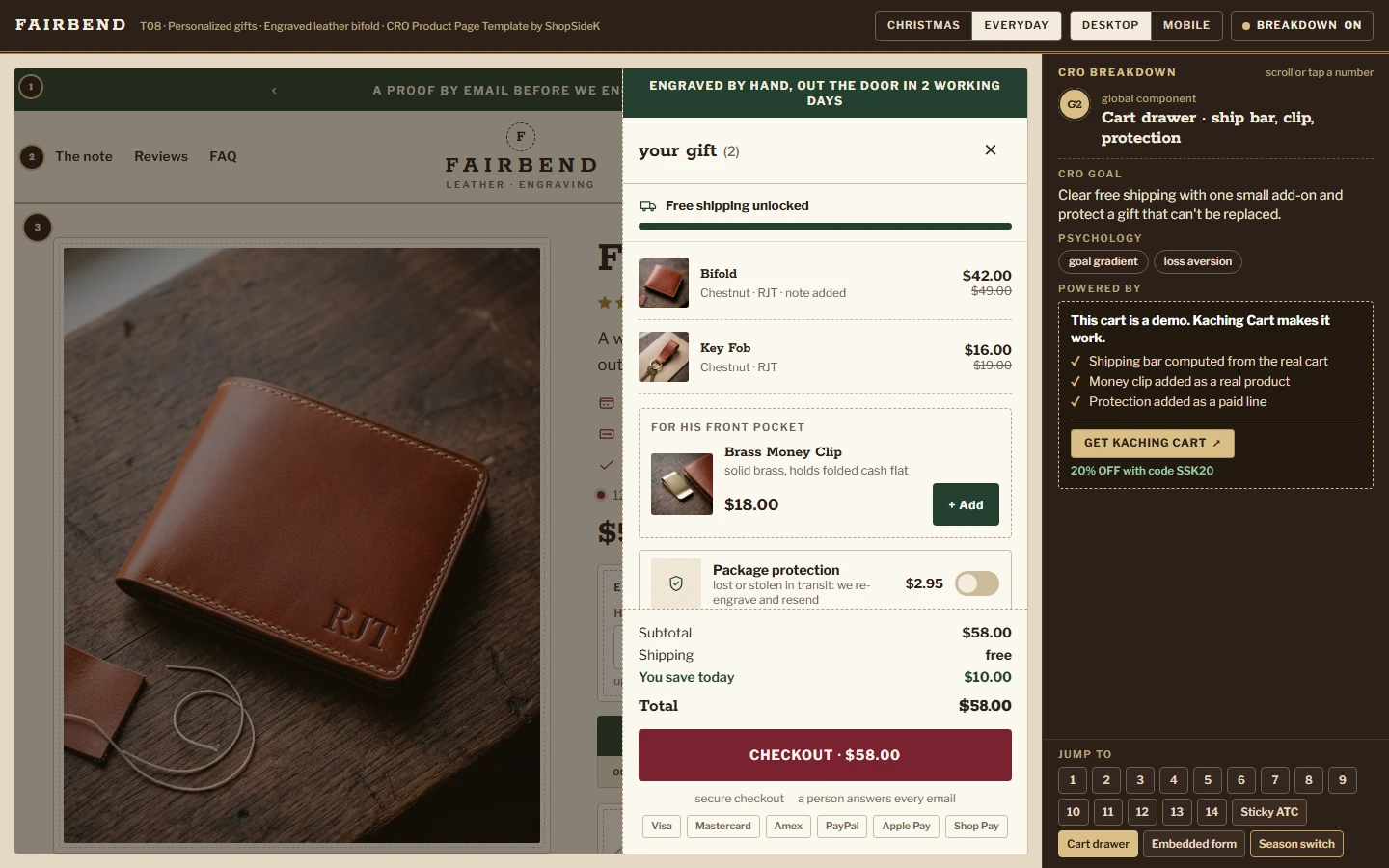
The page’s one timer, “order in [time] to join tomorrow morning’s engraving queue,” counts to midnight. The demo keeps that wording simple; a live store would name the next working day, so an order on Friday night reads “Monday morning.”
One thing not to copy
The “his pocket” picker works because cards and cash come in standard sizes, so three carrying styles cover most men. If your gift depends on a number the giver can’t know, such as a ring size, a picker would only invite guessing; a free size exchange answers the same worry better.
Rebuild the offer in Kaching
- A Bundle Upsell deal with three bars (the bifold, the gift set, the full carry), a fixed dollar discount per item, the gift set preselected.
- Side-by-side product cards joined by “+,” leather swatches per piece, a “most gifted” stamp on bar 2.
- Gift wrap and rush engraving as add-ons on every bar (Kaching help: add an upsell to your deal bar), and the Care Tin as the free gift on bar 3.
For deciding which pieces belong in a set, see how to choose products to bundle on Shopify.
Personalized gift pages and US rules: materials, food contact and ship dates
A personalized gift page makes three kinds of promises that US rules care about: what the item is made of, whether it is safe around food, and when a made-to-order item will ship. Here is what the primary sources say and how the two demos handle each one. This is general information, not legal advice.
- Leather words. Under the FTC’s Guides for Select Leather and Imitation Leather Products, the unqualified word “leather” is deceptive unless the product is leather in all substantial parts, non-leather parts that look like leather must be disclosed, and bonded or reconstituted leather that looks like leather has to state its percentage of leather fibers; disclosures belong in advertising too, close to the claim (16 CFR 24.2). The Guides don’t define “full grain,” so treat it as a factual claim your tannery’s spec has to back. Fairbend names the non-leather part a shopper can see: the solid brass ring on the key fob.
- “Food-grade” on a cutting board finish. FDA rules allow white mineral oil that meets the food-additive specification to be used as a component of articles that touch food (21 CFR 178.3620), and beeswax is affirmed as generally recognized as safe as a direct food substance (21 CFR 184.1973). Tablekin uses “food-grade” only for its mineral oil and beeswax finish and its board butter, and prints no certification mark. Keep your supplier’s spec sheet before you print the word.
- Ship dates for made-to-order items. The FTC’s Mail, Internet, or Telephone Order Merchandise Rule says you need a reasonable basis to ship within the time you state, or within 30 days if you state none; if you can’t ship on time, you must offer the buyer the choice to accept the delay or cancel for a prompt refund (16 CFR 435.2). A proof step adds days, so state the clock you can keep: Tablekin counts from the approved proof and ships within two business days of the yes, and Fairbend’s cart says “out the door in 2 working days.”
- Returns on a correct custom item. That rule covers late shipments, not return policies, so the return promise is yours to write. The two demos write it before checkout: Tablekin refunds in full before the burn, replaces anything it got wrong, and says a correct board with a name on it can’t be taken back; Fairbend offers one free remake within 30 days for any reason.
How to set up a personalized bundle in Kaching
- Pick the deal type. A Quantity Break suits several of the same item, each personalized; a Bundle Upsell suits a set of different pieces (Kaching help: bundle types).
- Turn on a variant per item. “Let customers choose different variants for each item” gives each board its wood or each piece its leather.
- Add the text in the theme. Put the name, initials or note in line-item properties, then place a test order and check that every item’s text lands on its own cart line and in the order.
- Sell services, not more discount. Gift wrap, a gift box and rush production are add-ons people pay for; a free gift on the top bar does more for the set than a deeper cut. See free gift vs discount on Shopify.
- Model the worst order. Add the deepest bar, the gift, free shipping and any welcome code a shopper can stack, then check the margin in the Shopify discount break-even calculator. On the demos’ assumed costs, the worst orders stayed at about 52% (Tablekin) and 61% (Fairbend).
- Wire the proof email. Decide what happens when nobody replies, and print it on the page, as Tablekin does with “no reply in 24 hours and it is burned as typed.”
Personalized product page checklist
- A proof promise in the buy box, with the reply step and what happens if nobody replies.
- One personalization field per item, with a live character counter and a clear limit.
- A size rule that shows how long names will look.
- An empty field that blocks the add-to-cart button and says which item still needs text.
- Bundle names written for the people who receive the gifts.
- A ship date counted from the approved proof, and a basis for that date.
- One clock only: the real production or proof cut-off, naming the real next working day.
- A return line written for custom items: before production, after production, and your own mistakes.
- Material words that match the spec sheet (“leather,” “full grain,” “food-grade”).
- Each item’s text carried into the cart line and the order.
- An email form that asks for the occasion and the month.
- Paid services (gift wrap, a gift box, rush) as add-ons, and one free gift on the top bar.
FAQ
What should a personalized product page include?
A proof promise, a personalization field for every item with a visible character limit, a preview or size rule for the text, a ship date counted from the approved proof, a plain return policy for custom items, and the wood, leather or material named exactly as the spec sheet says.
How do I add a personalization field to a Shopify product page?
Add it as a line-item property in your theme’s product form, or use a personalization app. Shopify’s theme docs explain line-item properties on the product template. Test that each item’s text appears on its own line in the cart and in the order.
Can a Kaching bundle have a different name or option for each item?
Kaching can give each item in a bundle its own variant, such as a wood or a leather color, through “Let customers choose different variants for each item.” Free text for each item, like a name, comes from line-item properties in your theme or an app, not from a documented Kaching setting.
Should I accept returns on personalized products?
That is your call, but say it before checkout. A common honest policy: free cancellation before production, a remake or replacement when the mistake is yours, and no return on a correctly made item with a name on it. Fairbend goes further with one free remake within 30 days for any reason.
How long can a made-to-order item take to ship?
Under the FTC’s mail-order rule, you need a reasonable basis for the ship time you state, or you must ship within 30 days if you state none. If an order will be late, you must offer the buyer the choice to wait or cancel for a prompt refund.
Can I describe a wallet as full-grain leather?
Yes, if it is. The FTC’s leather guides don’t define “full grain,” but they treat any misleading description of a product’s composition as deceptive, so the term has to match what your tannery supplies, and any non-leather part that looks like leather must be disclosed.
Is it OK to call a cutting board finish food-grade?
Only when the finish is made of materials FDA rules allow in contact with food, such as white mineral oil meeting the FDA specification or beeswax, and you hold the supplier’s documents. Tablekin limits the word to its oil-and-beeswax finish and its board butter.
More product page examples
Tablekin and Fairbend come from the ShopSideK library of Shopify product page templates, where every page opens with a section-by-section breakdown. For more in this niche, browse the personalized gift templates, or compare offer types in the Kaching gift tiers templates and the Kaching complete the look templates.
The Christmas version of the wallet page is in Christmas product page examples. For a gift page built around a delivery date, see a Valentine’s Day product page example.
Sources
- 16 CFR 24.2, Deception as to composition (FTC Leather Guides, Cornell LII)
- 21 CFR 178.3620, Mineral oil (Cornell LII)
- 21 CFR 184.1973, Beeswax (yellow and white) (Cornell LII)
- 16 CFR 435.2, Mail, Internet, or Telephone Order Merchandise Rule (Cornell LII)
- Shopify developer docs: product template and line item properties
- Kaching help: different bundle types
- Kaching help: customize bundle variant dropdowns
- Kaching help: add an upsell to your deal bar