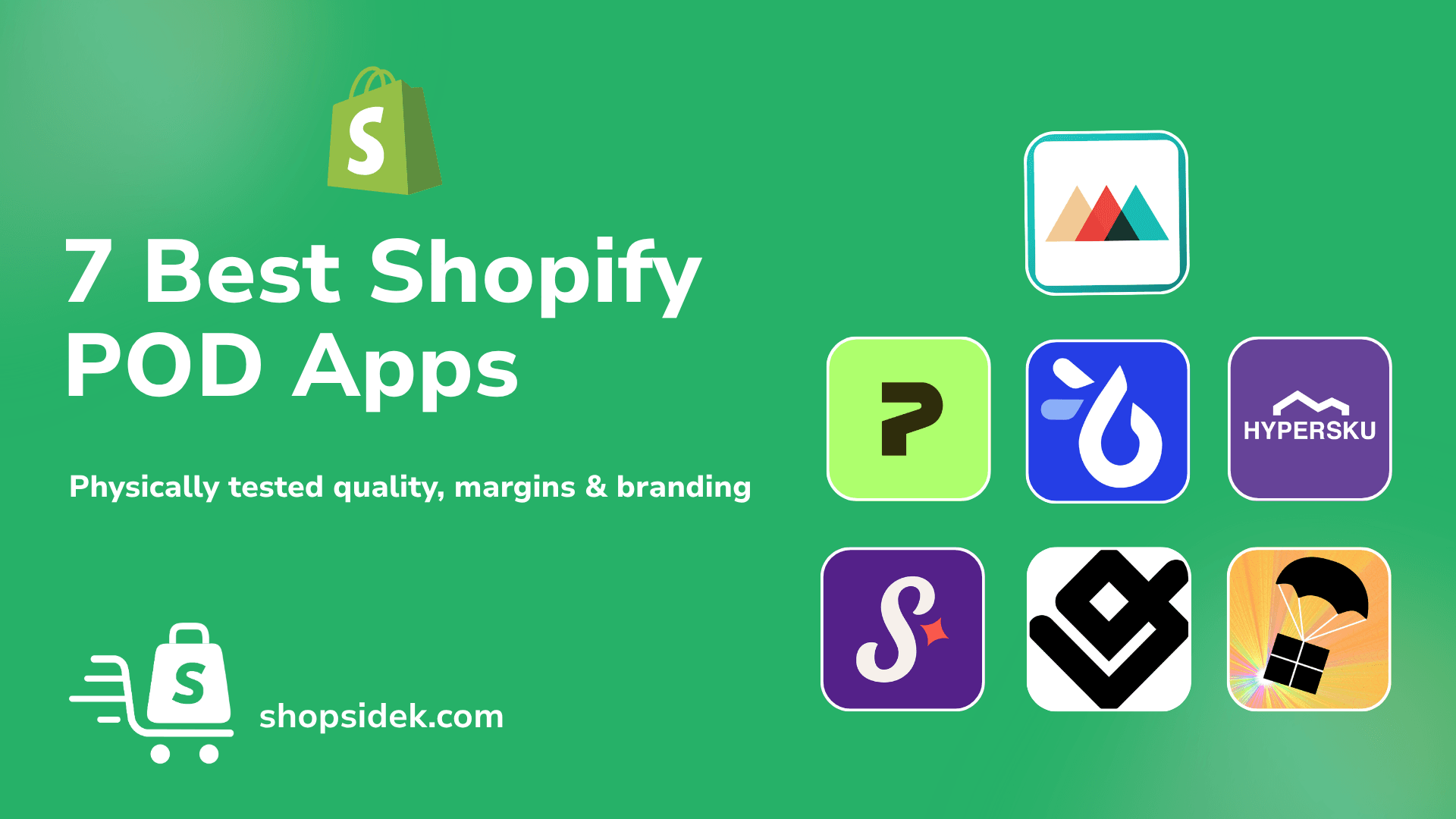
⚡ ShopSideK Verdict
The best Shopify print on demand app for most merchants is Printful — it scored 9.5/10 in our physical quality test, offers the best branding options, and delivers rock-solid consistency because it controls production in-house. For maximum profit margins and catalog variety, Printify is the strongest choice with ~54% margins. For global sellers who need fast, localized shipping across 33+ countries, Gelato is the clear choice, while FFOrder is the ultimate hybrid partner for factory-direct dropshipping and POD.
Printful
Best print sharpness, color accuracy, and wash durability in our hands-on test. In-house production ensures every order is identical. Premium branded packaging included.
💰 Free to install · You pay per order (~$12.95 base + shipping)
Start Selling Free →Printify
Lowest base costs via competitive supplier network. Massive product catalog (apparel, home goods, accessories). ~10% more margin per sale than Printful adds up fast at scale.
💰 Free to install · Base from ~$9.00 + shipping · Premium plan for extra discounts
Unlock Higher Margins Free →FFOrder Dropshipping
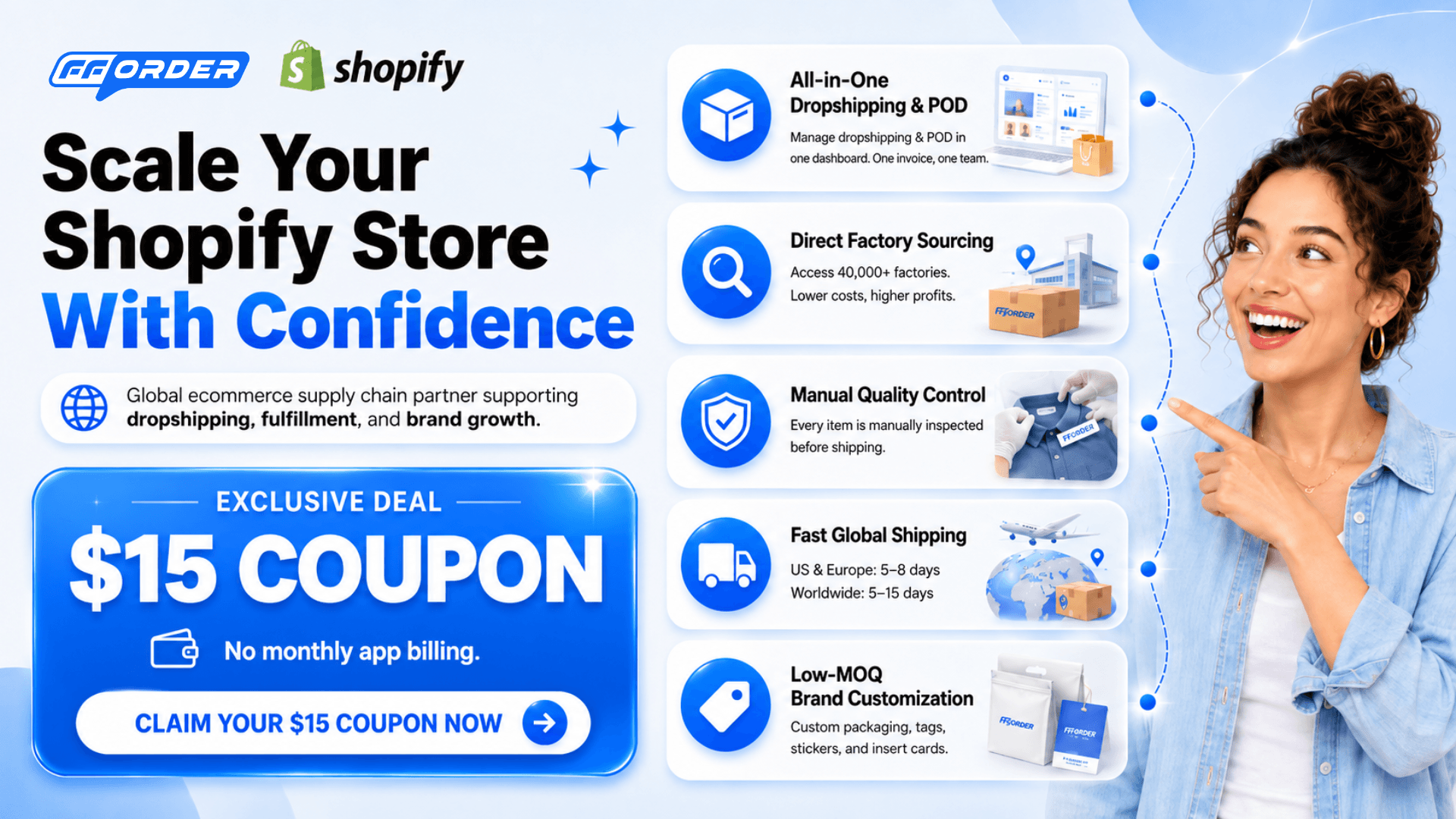
Consolidates custom print-on-demand and factory-direct dropshipping under one dashboard and invoice. Centralized production ensures print consistency with custom woven neck tags.
💰 Free to install · Direct wholesale prices · Fast shipping to US/EU in 7-9 days
Get $15 Signup Coupon →Also Reviewed
Print-on-demand (POD) offers one of the most powerful and low-risk paths to launching an eCommerce brand. It allows you to sell hundreds of custom products—from premium t-shirts to personalized jewelry—without ever buying inventory upfront. You only pay for a product after a customer has placed an order, making it the perfect model for bootstrapping a business.
But with dozens of options, choosing from the best Shopify print on demand apps is critical. Their print quality becomes your quality. Their shipping speed becomes your reputation.
That’s why this guide is different. We didn’t just compare feature lists from a distance. We put our money where our mouth is and physically ordered, unboxed, and tested products from the top contenders to see who really delivers. We analyzed print detail, compared garment quality, and put them through the wash.
Inside, you’ll find our unfiltered results and a strategic breakdown of the business models behind these apps, so you can make a choice based on real-world evidence.
- Printful
- Printify
- FFOrder Dropshipping
- 1. Printful: Best Overall for Premium Brand Quality & Consistency
- 2. Printify: Best for Maximum Profit Margins & Catalog Breadth
- 3. Gelato: Best for Global Selling & Localized Fulfillment
- 4. HyperSKU: Best for Fast Shipping & Scaling High-Volume Stores
- 5. Teeinblue: Best for Advanced Product Personalization & AI Previews
- 6. Apliiq: Best for Streetwear Brands & High-End Custom Finishes
- 7. ShineOn: Best for High-Margin Jewelry & Personalized Gifts
- Bonus Recommendation: FFOrder Dropshipping & POD
Our Top Picks: Best Print On Demand Apps for Shopify at a Glance
For those in a hurry, here’s a high-level look at our top recommendations based on our hands-on testing and market research. Each app excels in a different area, so the “best” choice truly depends on your business goals.
| App Name | Best For | Our Quality Score | Margin Potential | Shopify Rating |
|---|---|---|---|---|
| Printful | Premium Brand Quality & Consistency | 9.5 | Good | 4.8 / 5 |
| Printify | Maximum Profit Margins & Variety | 8.5 | Excellent | 4.7 / 5 |
| Gelato | Global Selling & Local Fulfillment | 9.0 | High | 4.8 / 5 |
| HyperSKU | Fast Shipping & Scaling Brands | 8.8 | High | 4.8 / 5 |
| Teeinblue | Advanced Product Personalization | 9.2 | Excellent | 4.9 / 5 |
Don’t Just Pick an App, Pick a Business Model (A Crucial First Step)
Before you even look at a product catalog or pricing page, it’s vital to understand that not all Shopify print on demand apps are built the same. Under the hood, they operate on one of two distinct business models. Your choice here has a bigger impact on your brand’s quality, consistency, and scalability than any single feature.
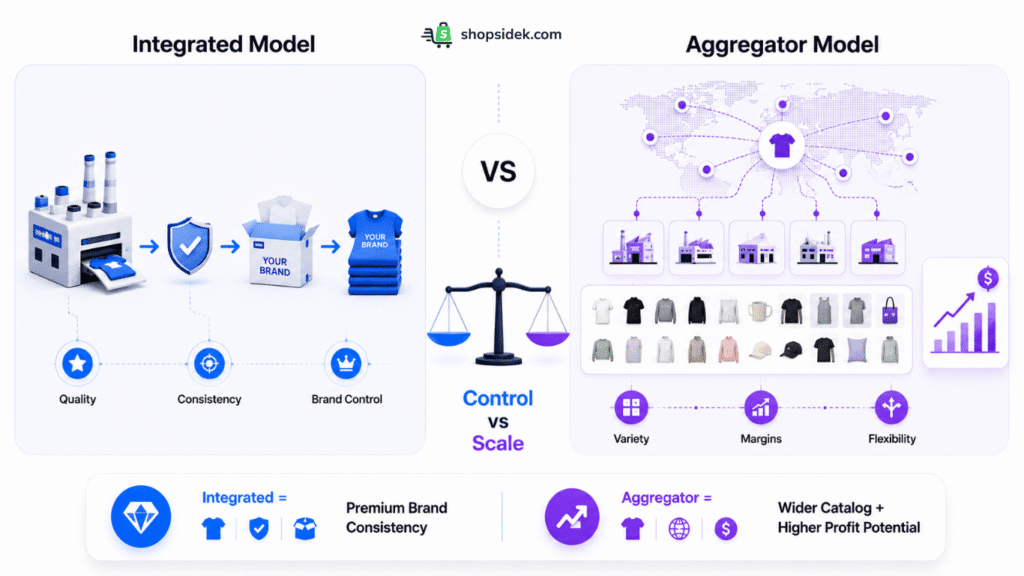
The Vertically Integrated Model (e.g., Printful): Quality and Consistency
A vertically integrated company owns and operates its own factories, printing equipment, and fulfillment centers. From the moment you submit a design to the second it ships, the entire process is handled in-house. Think of it like a restaurant that meticulously controls every ingredient and recipe in its own kitchen.
✅Pros:
- Rock-solid consistency: The t-shirt you order today will be identical to the one you order six months from now.
- Higher quality control: With direct oversight, these companies can maintain strict standards for printing, materials, and packaging.
- Superior branding options: They often offer more advanced branding features like custom neck labels, branded packaging, and pack-in slips.
❌Cons:
- Higher base costs: Owning and operating this infrastructure is expensive, which often translates to slightly higher product prices, narrowing your profit margins.
- More limited catalog: They tend to focus on a curated selection of proven bestsellers rather than offering endless variety.
The Aggregator Model (e.g., Printify, Gelato): Margins and Variety
An aggregator is a technology platform that connects you to a massive, global network of third-party print providers. They don’t own the printers; they manage the marketplace. This is like a food delivery app that lets you order from hundreds of different restaurants.
✅Pros:
- Massive product variety: Their catalogs are enormous because they tap into the combined capabilities of hundreds of printing partners worldwide.
- Competitive pricing and higher margins: Print providers compete for your business on the platform, which drives down base costs and gives you more room for profit.
- Flexibility and redundancy: If one print provider is out of stock or having issues, you can often reroute orders to another.
❌Cons:
- Potential for inconsistency: Because different partners may print the same product, there can be slight variations in print quality, color accuracy, and packaging between orders.
Your decision comes down to a strategic trade-off: The integrated model prioritizes brand control and consistency, while the aggregator model prioritizes catalog breadth and profit margin. We’ll explore how this plays out in our hands-on tests next.
The Great Print-Off: We Ordered Shirts from 5 Services. Here’s the Unfiltered Truth.
Talk is cheap. To truly find the best print-on-demand app, you have to become the customer. So, we did. We created a complex design with vibrant colors, sharp lines, and subtle gradients. Then, we ordered the same black Bella + Canvas 3001 t-shirt from our top five contenders—Printful, Printify, Gelato, HyperSKU, and Teeinblue—to see whose products and processes held up.
Here’s exactly how it went down.
Our Testing Methodology: What We Judged and Why
To ensure a fair and rigorous comparison, we graded each shirt on four key criteria that directly impact customer satisfaction and brand reputation:
- Print Sharpness & Detail: How crisp are the edges? Can you see fine details in the artwork, or do they look blurred? We looked for any signs of pixelation or ink bleeding.
- Color Accuracy: How closely does the color on the physical shirt match our original digital design file? We checked for vibrancy, desaturation, or any noticeable color shifts.
- Garment & Ink Feel: What is the tactile quality? Does the ink feel thick and heavy on the fabric, or is it soft and breathable? We also assessed the base garment’s softness and feel.
- The “Wash Test”: This is the ultimate test of durability. Each shirt went through three cold-water wash and dry cycles to check for any signs of cracking, peeling, or fading in the print.
The Unboxing & Branding Comparison: First Impressions Matter
The moment a customer receives their package is your brand’s first physical handshake. From what I’ve seen, ordering samples to vet this experience is non-negotiable.
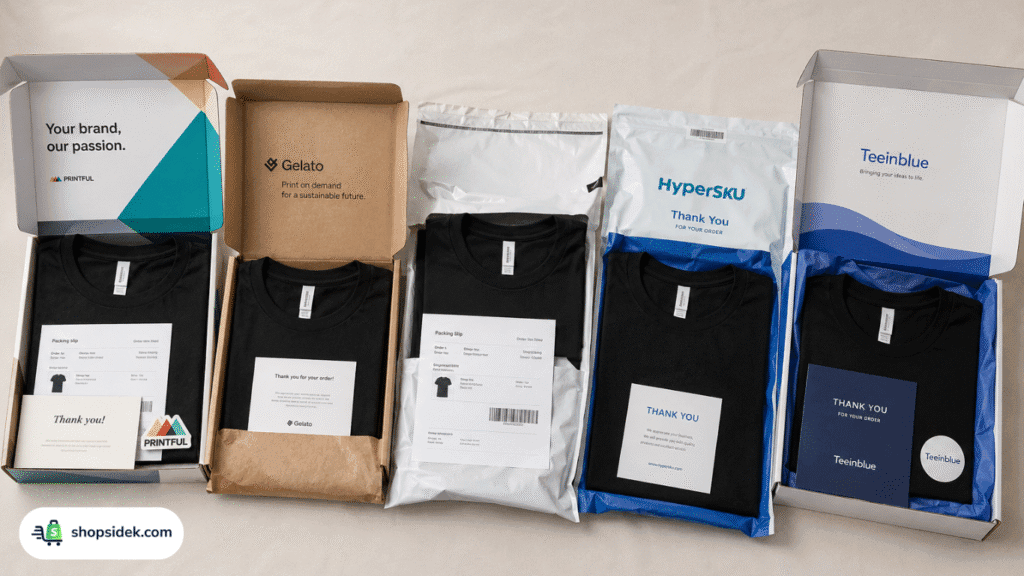
- Printful immediately stood out with clean, professional packaging featuring their logo. Inside, a branded packing slip clearly detailed the order, making the entire experience feel premium and cohesive.
- Gelato was a close second, arriving in a minimalist, eco-friendly mailer that reflected its focus on sustainability.
- Printify’s package, as expected from an aggregator, was more generic, reflecting the specific print partner who fulfilled the order. While perfectly adequate, it lacked the distinct brand touch of the others.
- HyperSKU’s packaging was simple but effective, with the standout feature being its speed—it was the first to arrive.
- Teeinblue delivered a solid experience, with the product looking exactly as it did in their powerful live preview tool.
The Quality Showdown: A Side-by-Side Look at Print Detail & Durability
After unboxing and washing, the physical differences in production quality became clear.
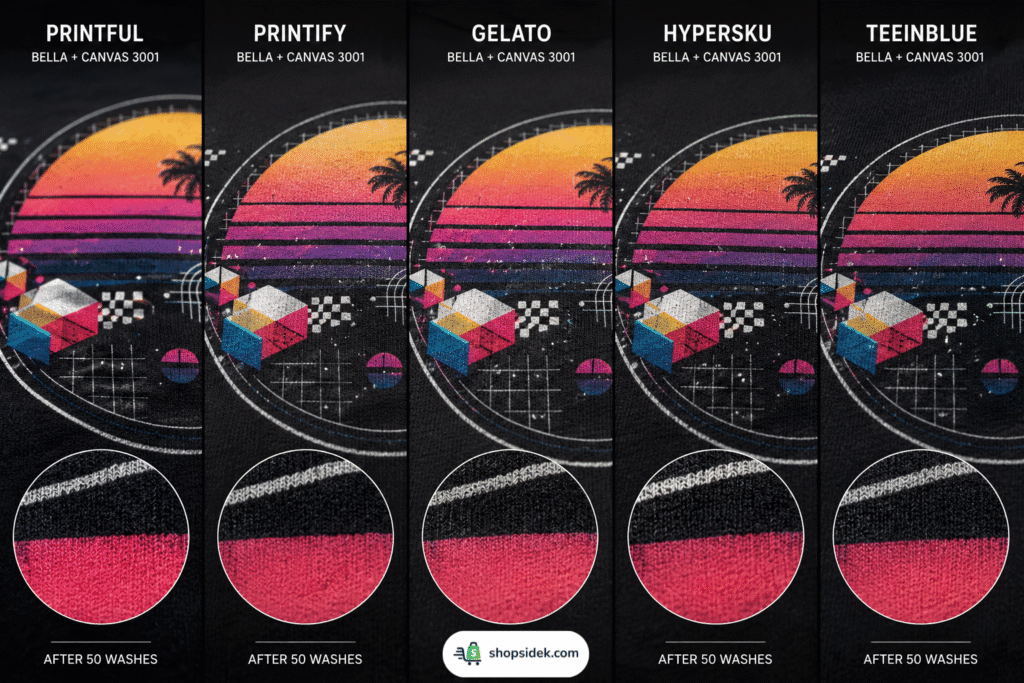
Printful was the undeniable winner for overall premium quality. The print was exceptionally sharp, the colors were rich and accurate, and the ink felt soft and perfectly integrated with the fabric rather than sitting heavily on top of it. It passed the wash test with flying colors, showing zero signs of degradation or cracking.
Gelato also delivered outstanding print quality, with excellent color matching and a durable finish that held up perfectly after three heavy wash cycles. The fine details in our gradient design remained distinct and clean.
Printify provided the best balance of quality and value. While the print saturation was a fraction less vibrant than Printful’s out of the package, it was still remarkably sharp. It easily survived the wash tests, proving it offers excellent durability for its highly competitive price point.
HyperSKU produced a crisp, highly reliable print. The ink coverage was even across the garment, and the fine lines of our test design remained distinct without any bleeding. It survived the wash cycles with strong color retention, proving their production facilities maintain strict quality control even at high volumes.
Teeinblue excelled in exact design replication. Because personalization often involves complex user-uploaded photos or custom text, print clarity is paramount. The physical shirt captured our intricate lines and gradients beautifully. More importantly, the ink proved highly durable, showing absolutely no peeling or cracking after the final heavy wash cycle.
In-Depth Reviews of 7 Best Shopify Print On Demand Apps
Now, let’s dive deep into each of the top Shopify POD apps. We’ve broken down the core features, pricing realities, and unique strengths of each app to help you align your brand vision with the right operational partner.
1. Printful: Best Overall for Premium Brand Quality & Consistency
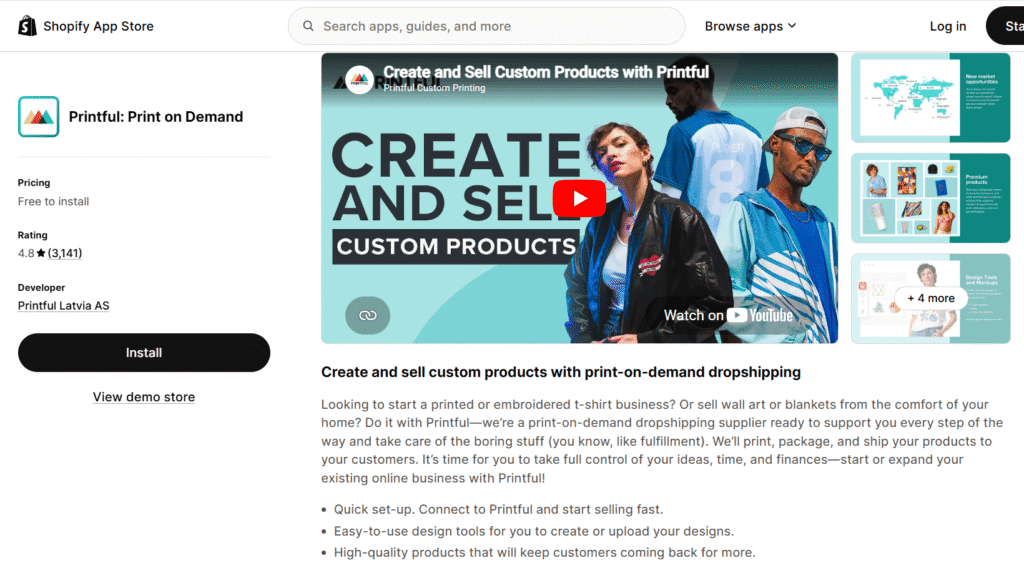
- Shopify Rating: 4.8/5 (from 3,140+ reviews)
- Best For: Brands that refuse to compromise on quality and want a premium, consistent customer experience from day one.
- Our “Print-Off” Quality Score: 9.5/10
Printful is a giant in the POD space for a reason. As a vertically integrated company, they control the entire production process in-house, from printing to packing and shipping. This gives them unparalleled control over the final product, resulting in a level of quality and consistency that aggregators struggle to match. They are trusted by major brands and creators like Ryan Hogue, who has generated over $100,000 in orders through the platform.
| Pros | Cons |
|---|---|
| ✅ Exceptional, consistent print quality | ❌ Higher base product costs |
| ✅ Superior branding (custom labels, packaging) | ❌ Smaller product catalog than aggregators |
| ✅ Reliable and predictable fulfillment | ❌ Can be less profitable for budget items |
| ✅ User-friendly mock-up generator |
Our Test Results: Printful was the clear winner in our physical print test. The shirt had the best hand-feel, the most accurate and vibrant colors, and showed zero wear after three wash cycles. The branded packaging created a professional unboxing experience that builds immediate customer trust.
Pricing & Margins Explained: You pay a premium for this quality. A standard Bella + Canvas 3001 shirt typically starts around $12.95, plus ~$4.99 for standard US shipping. To maintain a healthy profit, you need to price it competitively. At an estimated $32.00 retail price, your profit is ~$14.00, a roughly 44% margin.
2. Printify: Best for Maximum Profit Margins & Catalog Breadth
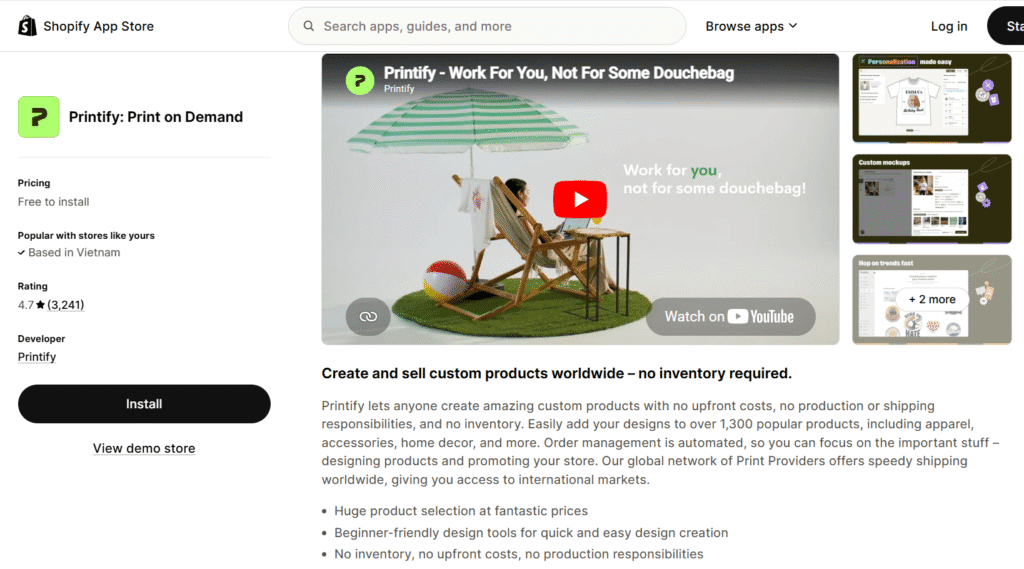
- Shopify Rating: 4.7/5 (from 3,235+ reviews)
- Best For: Entrepreneurs focused on price competitiveness, catalog variety, and maximizing profit margins.
- Our “Print-Off” Quality Score: 8.5/10
Printify operates on the aggregator model, connecting you to a vast network of print providers around the world. This creates a competitive marketplace where suppliers vie for your business, driving down prices. Their product catalog is one of the largest available, offering everything from apparel to home goods and accessories.
| Pros | Cons |
|---|---|
| ✅ Extremely competitive pricing | ❌ Quality can be inconsistent between suppliers |
| ✅ Massive product catalog with endless options | ❌ Branding options are more limited |
| ✅ Flexibility to switch providers if needed | ❌ Generic packaging |
| ✅ Optional Premium Plan for bigger discounts |
Our Test Results: The shirt we ordered from Printify was high-quality and durable, easily passing our wash test. While the colors were slightly less vibrant than Printful’s, the overall quality was excellent for the price point. For most use cases, the value is unbeatable.
Pricing & Margins Explained: This is where Printify shines. By selecting a cost-effective print partner, you can source the same Bella + Canvas 3001 shirt starting around $9.00 (and even lower if you use the Printify Premium subscription), plus ~$4.75 for shipping. At a $30.00 sale price, your profit is ~$16.25, a 54% margin. That extra 10% margin per sale adds up dramatically as you scale.
3. Gelato: Best for Global Selling & Localized Fulfillment
- Shopify Rating: 4.8/5 (from 820+ reviews)
- Best For: Sellers with a global audience who want fast, localized shipping and a strong focus on sustainability.
- Our “Print-Off” Quality Score: 9.0/10
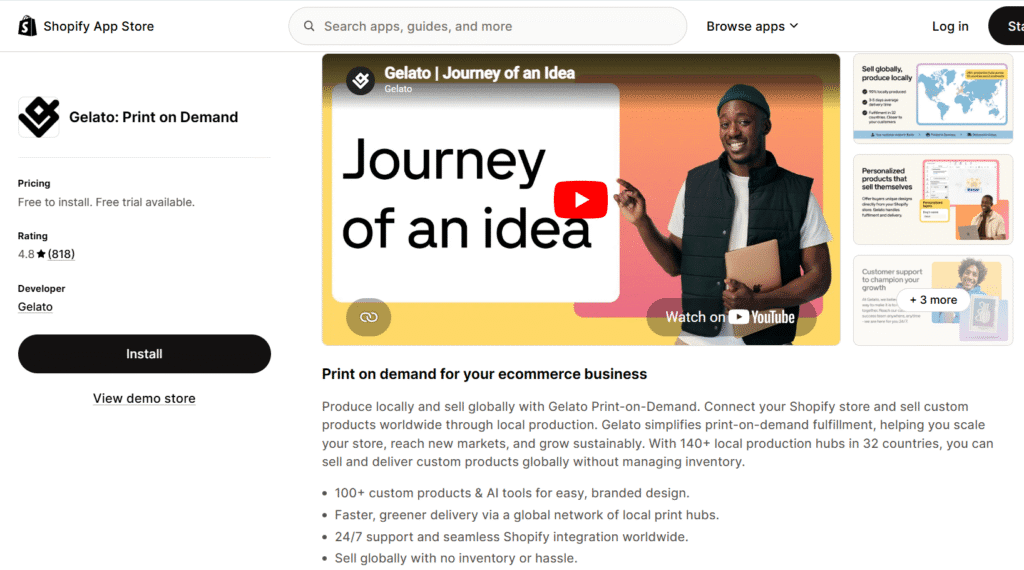
Like Printify, Gelato is an aggregator, but with a strategic focus. It boasts a network of over 100 production partners in 33 countries. When a customer orders from your store, Gelato automatically routes the order to the print facility closest to them. This drastically reduces shipping times, costs, and carbon emissions.
| Pros | Cons |
|---|---|
| ✅ Huge global network for fast, local shipping | ❌ Apparel catalog is more limited than Printify |
| ✅ Strong focus on sustainability & eco-friendly options | ❌ Fewer advanced branding features |
| ✅ High-quality printing for wall art and paper goods | |
| ✅ Simple, intuitive user interface |
Our Test Results: Gelato’s print quality was excellent, on par with the best in our test. The colors were accurate, and the print was durable. The shirt arrived in simple, eco-friendly packaging, reinforcing their brand promise of sustainability.
Pricing & Margins Explained: Gelato’s pricing is competitive, sitting comfortably between Printify and Printful. A standard t-shirt base cost might start around $11.00, plus localized shipping which often averages ~$4.50 depending on the country. At a $30.00 sale price, your profit is ~$14.50, an estimated 48% margin.
4. HyperSKU: Best for Fast Shipping & Scaling High-Volume Stores
- Shopify Rating: 4.8/5 (from 350+ reviews)
- Best For: Established dropshippers and high-volume brands looking for a fulfillment partner to help them scale.
- Our “Print-Off” Quality Score: 8.8/10
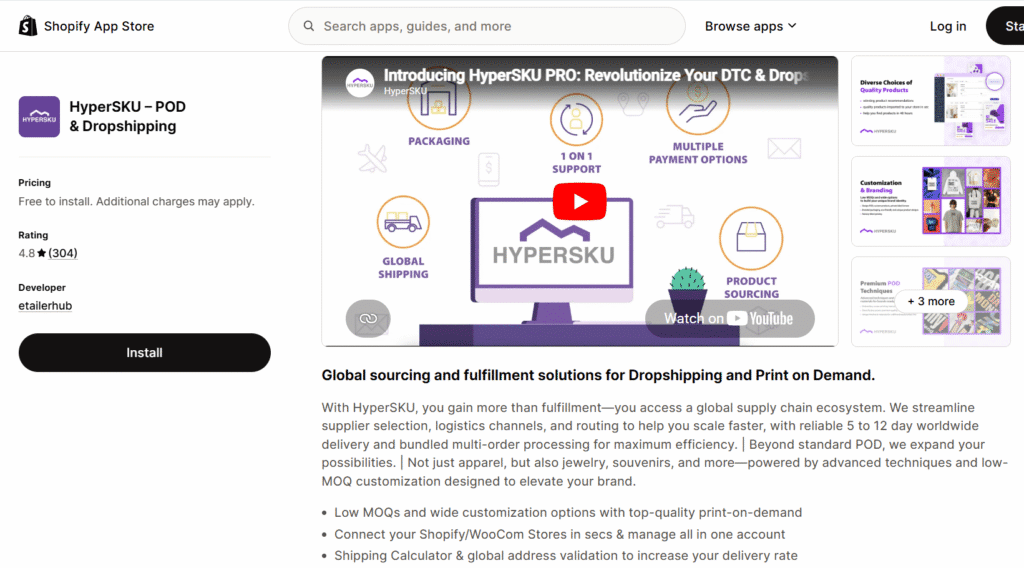
HyperSKU is more than just a POD app; it’s a comprehensive fulfillment platform designed for scaling. While they offer quality print-on-demand services, their core strength is their lightning-fast global shipping (typically 7-12 days) and ability to source custom products for established brands.
| Pros | Cons |
|---|---|
| ✅ Industry-leading 7-12 day global shipping | ❌ Less focused on beginners than other apps |
| ✅ Sourcing services for custom products | ❌ Can feel more complex than simple POD tools |
| ✅ Dedicated account managers for scaling brands | |
| ✅ Reliable product quality |
Our Test Results: The HyperSKU shirt arrived noticeably faster than most competitors, living up to their shipping claims. The print quality was sharp, reliable, and held up well in the wash. For stores where shipping speed is a key selling point, HyperSKU is a clear frontrunner.
Pricing & Margins Explained: Pricing is highly competitive and geared toward volume dropshippers. Expect a standard base t-shirt to start around $10.00, plus their express global shipping of ~$6.00. At a $32.00 sale price, your profit is ~$16.00, a 50% margin.
💡If you’re exploring a broader dropshipping strategy beyond custom products, see our full guide to the best dropshipping apps for Shopify for a complete rundown of fulfillment tools.
5. Teeinblue: Best for Advanced Product Personalization & AI Previews
- Shopify Rating: 4.9/5 (from 322+ reviews)
- Best For: Stores selling customizable products where the customer can upload photos, add text, or choose from design options.
- Our “Print-Off” Quality Score: 9.2/10 (for accuracy)
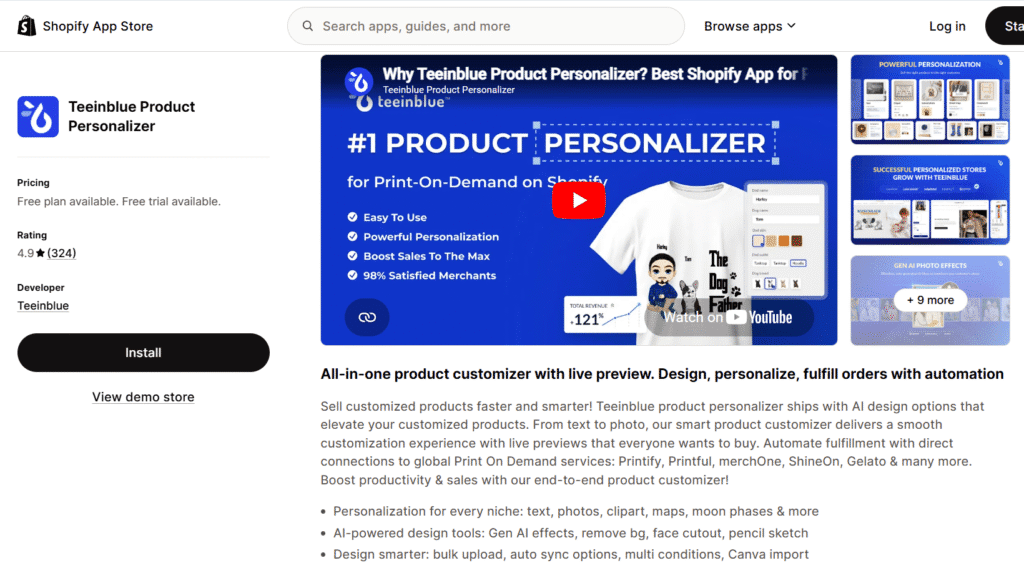
Teeinblue is different—it’s not a fulfillment company itself. It’s a powerful product personalizer app that sits on your Shopify storefront and integrates with other POD services (like Printify or CustomCat) for production. Its strength is giving your customers an incredible, live preview of their personalized designs.
| Pros | Cons |
|---|---|
| ✅ Powerful live preview and personalization engine | ❌ Is not a fulfillment service itself; requires another app |
| ✅ AI features help generate unique design mockups | ❌ Adds an extra subscription fee to your monthly costs |
| ✅ Enables complex options (photo uploads, text, maps) | |
| ✅ Seamlessly connects to major POD providers |
Our Test Results: We used Teeinblue to create a personalized design and fulfilled it through one of their partners. The final product was an exact match to the live preview on our store. This one-to-one accuracy is absolutely critical for building trust with customers who are designing their own unique items.
Pricing & Margins Explained: Your profit depends on two costs: Teeinblue’s monthly app subscription (which offers tiered pricing starting around $19/month) plus the base cost from your chosen fulfillment partner. If you route the order to Printify, your per-item margin remains high (around 50%+), but you must factor the software subscription into your monthly overhead.
6. Apliiq: Best for Streetwear Brands & High-End Custom Finishes
- Shopify Rating: 4.9/5 (from 282+ reviews)
- Best For: Fashion-forward streetwear brands that want premium details like embroidery, patches, and private labels.
- Our “Print-Off” Quality Score: Not Tested
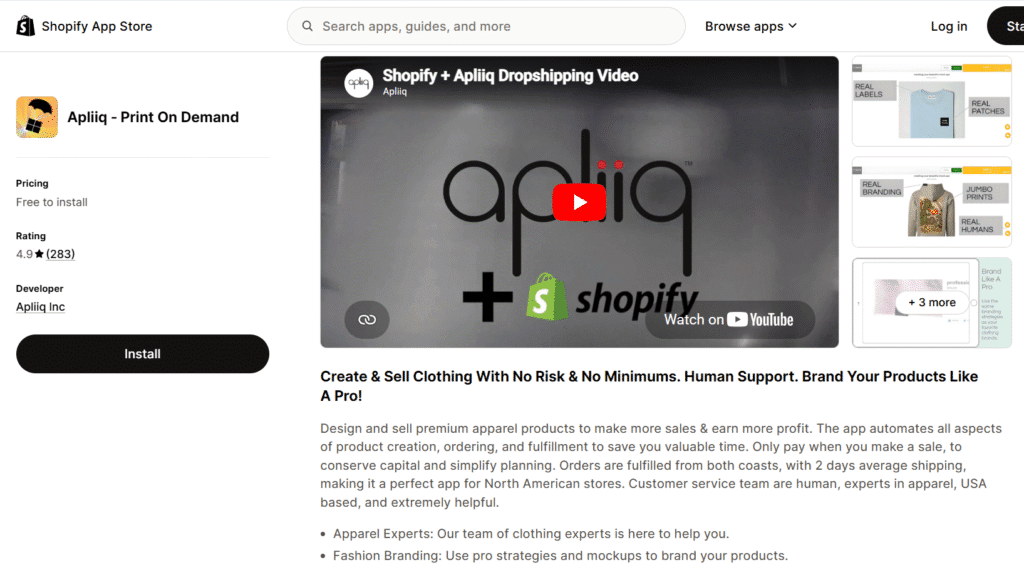
Apliiq is built for brands that want to create apparel that feels like it belongs in a high-end boutique, not a souvenir shop. They specialize in advanced customization options that go far beyond standard digital printing, allowing you to create truly unique and premium-feeling garments.
| Pros | Cons |
|---|---|
| ✅ Advanced options like embroidery and woven labels | ❌ Higher base costs due to premium finishes |
| ✅ Strong focus on fashion and streetwear aesthetics | ❌ Slower production times for complex orders |
| ✅ Pay-as-you-go or monthly plan discounts | |
| ✅ Ability to add custom woven neck labels |
Our Test Results: While Apliiq was not part of our t-shirt print-off, their reputation is built on the quality of their custom finishes. They are the go-to partner for creating products with tactile, high-end branding details that can command a higher retail price.
Pricing & Margins Explained: Base costs are higher, but so is the perceived value of the product. A standard custom-embroidered hoodie might have an estimated base cost of $30 plus shipping. However, this is a premium streetwear item you can easily sell for $65–$75. At a $70.00 sale price, your profit is ~$32.00, an estimated 46% margin.
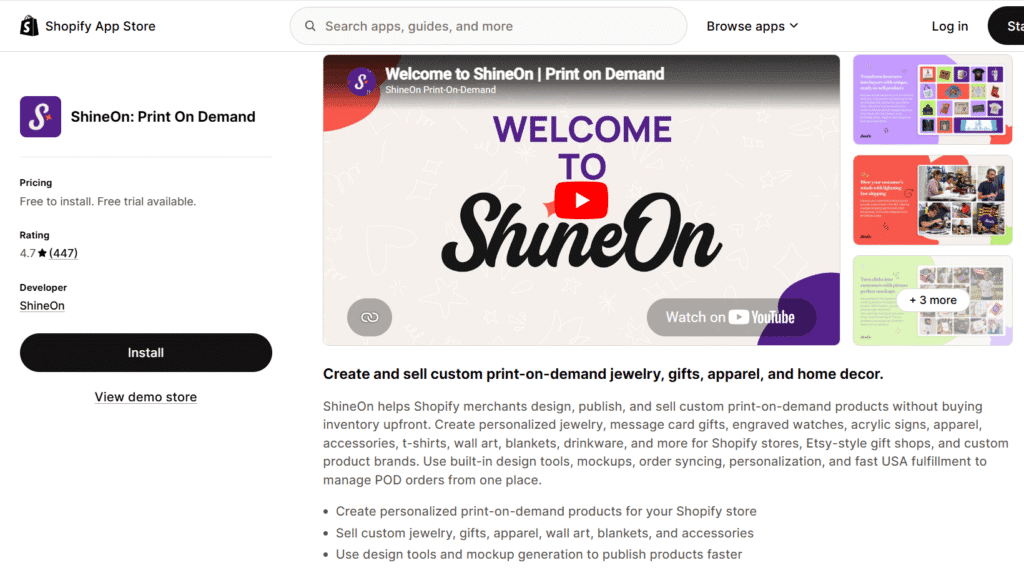
7. ShineOn: Best for High-Margin Jewelry & Personalized Gifts
- Shopify Rating: 4.7/5 (from 447+ reviews)
- Best For: Sellers targeting the highly profitable gift market with personalized jewelry, watches, and message cards.
- Our “Print-Off” Quality Score: Not Tested
ShineOn carves out a powerful niche by focusing exclusively on high-margin products like necklaces and bracelets. They have mastered the art of selling personalized gifts, providing not just the products but also proven design templates and marketing assets.
| Pros | Cons |
|---|---|
| ✅ Extremely high profit margins on jewelry | ❌ Highly specialized; not for apparel or other items |
| ✅ Proven best-selling product templates | ❌ Success depends on marketing to gift-giving occasions |
| ✅ Fast US-based production and shipping | |
| ✅ Includes high-quality mockups and marketing materials |
Our Test Results: ShineOn was not part of our apparel test. However, they are a dominant force in the POD jewelry space. Their model empowers sellers to tap into emotional buying triggers around holidays and special occasions (birthdays, anniversaries), which often results in higher conversion rates.
Pricing & Margins Explained: This is where ShineOn becomes so compelling. A standard message card necklace has a typical base cost of just $12 to $15, but it regularly sells for $49.95 or more due to its high perceived emotional value as a personalized gift. At a $49.95 sale price, your profit can easily exceed $30, unlocking margins of 60% to 70%+.
Bonus Recommendation: FFOrder Dropshipping & POD
- Shopify Rating: 4.9/5 (from 230+ reviews)
- Best For: Hybrid store models selling both custom POD designs and standard factory-direct dropshipping products in one invoice.
- Our Sourcing & QC Score: 9.2/10
If you find it difficult to manage separate supplier invoices and apps for standard dropshipping and POD products, FFOrder Dropshipping is a highly functional hybrid choice. It consolidates custom apparel printing and factory-direct sourcing under a single dashboard and invoice.
Unlike traditional print networks that outsource order execution to random local print shops (creating a “quality lottery” where colors fade and sizing varies), FFOrder features centralized in-house production. Because they hold controlling equity in core apparel factories, you get direct-from-source wholesale pricing on premium blanks, directly boosting your profit margins.
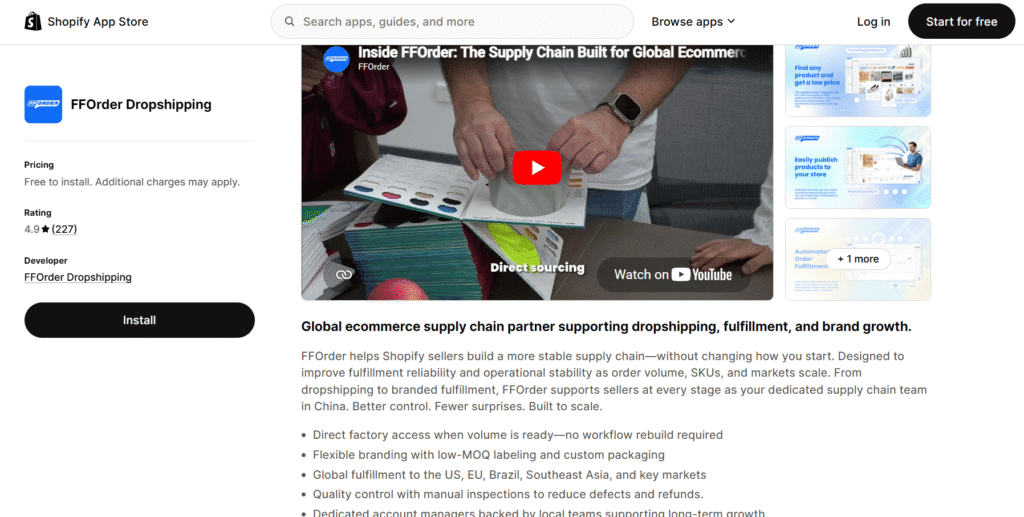
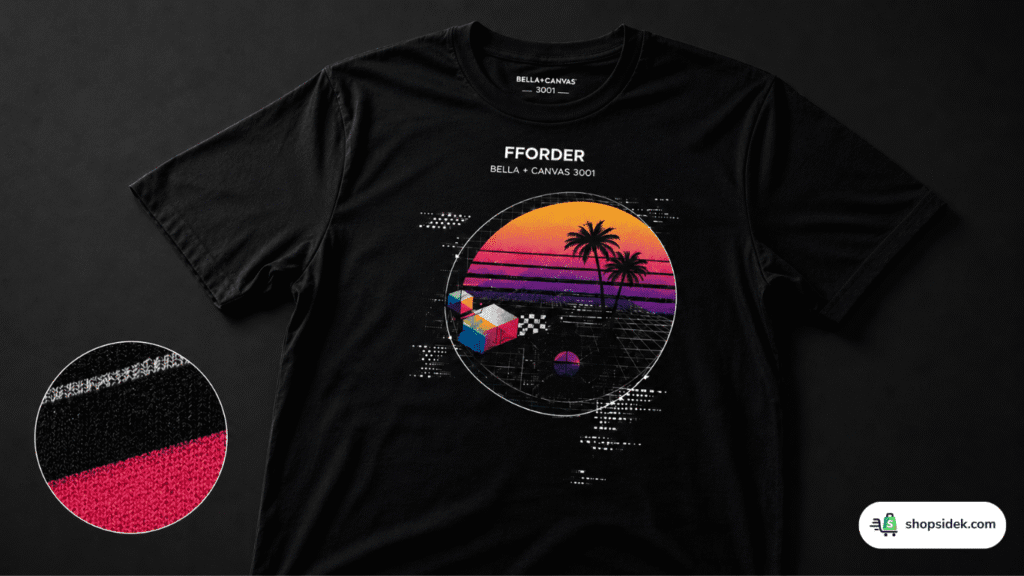
Our Test Results: FFOrder’s centralized manufacturing delivers excellent print consistency. In our analysis, prints across garments demonstrated high color accuracy and sharp details, made possible by their process of mathematically matching inks to fabric types (supporting DTG, DTF, 3D embroidery, and sublimation).
Custom orders undergo strict checks by their 25-person quality control team, and the company completely debrands blanks to support custom woven neck tags and branded eco-packaging inserts for a premium unboxing feel. If a print fails or logistics delays occur, they fund full refunds or reshipments.
Pricing & Margins Explained: Factory-direct ownership gives FFOrder a major price advantage. Standard blanks are sourced directly from core factories, keeping base costs extremely competitive compared to third-party aggregator middlemen.
Plus, they offer a unique scale mechanism: once a custom design starts selling, you can pay a 30% deposit to pre-print bulk stock, storing it in their 13,000㎡ warehouse for automated 24-hour global dispatch, locking in wholesale prices and shipping fast to the US/EU in 7-9 business days (10–15 business days globally) with 24h tracking auto-sync.
🎁 You can claim an exclusive $15 signup coupon here to get started!
Case Study: How Gay Pride Apparel Built a Global Brand with a 2-Person Team
Every successful print-on-demand store starts with a mission. For founders Jesus and Sergio, that mission began in 2019: to create a brand that keeps the spirit of Pride alive all year long. They had the passion and the designs, but faced the same barrier as most new entrepreneurs—no capital for a warehouse full of inventory.
Instead of taking a loan, they built their store on Shopify and chose Printful as their partner. This single decision transformed their business. By removing the need to buy inventory upfront, they could reinvest every dollar of profit back into what mattered most: building their community. While Printful handled the printing, packing, and shipping, Jesus and Sergio focused on growing their Instagram following to over 75,000 loyal fans.
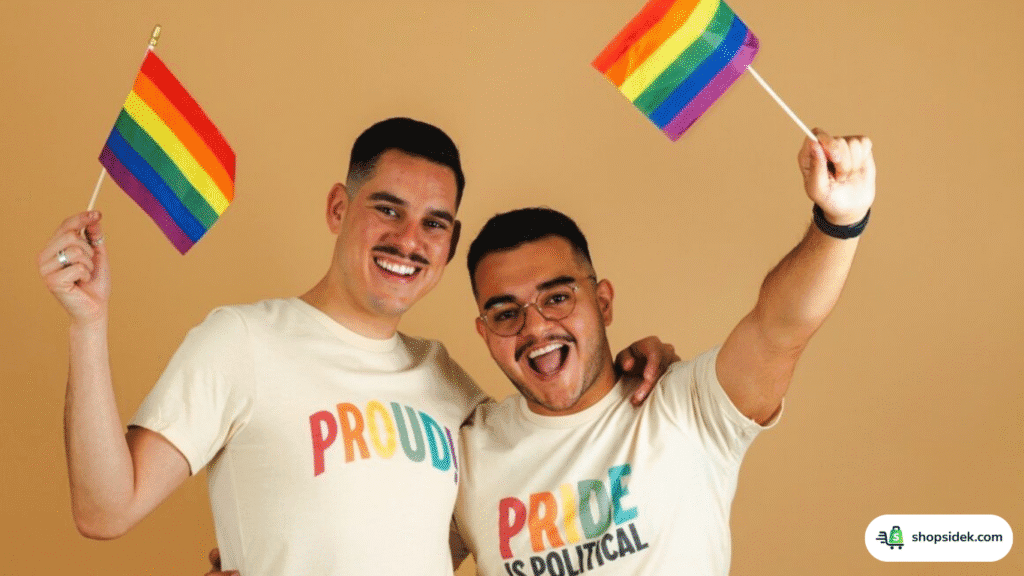
This “mission-first, logistics-second” approach paid off spectacularly. When their brand resonated globally, they didn’t need to figure out international shipping; Printful’s network already had them covered in Spain, the UK, and Canada.
The ultimate test came during the holiday season, when they generated over $300,000 in sales, including a peak of $35,000 on Black Friday alone. For a two-person team, this volume would be impossible to manage manually. But with their POD engine, they never touched a roll of tape. As Sergio put it, “There is no back-end operation; it’s just Jesus and I.”
Gay Pride Apparel’s story is powerful proof that with the right niche and the right POD partner, you don’t need a huge team or a massive budget to build a globally recognized brand.
How to Choose the Right POD Partner: A 5-Step Framework
You’ve seen the data and the real-world case studies. Now it’s time to make a decision. Choosing the right partner isn’t about finding a single “best” app, but about finding the app that best aligns with your brand’s specific needs. Follow this five-step framework to make a confident choice.
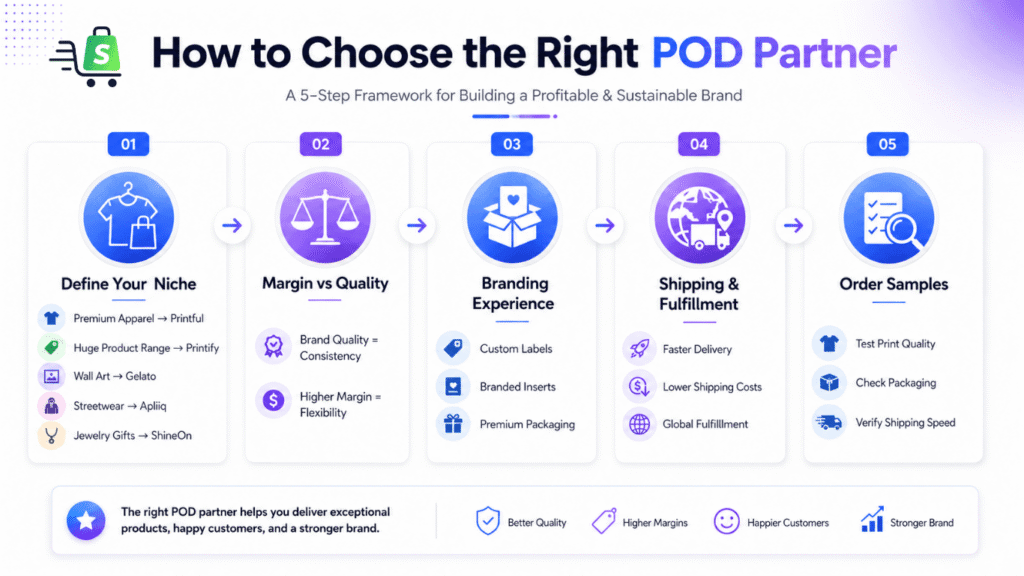
Step 1: Define Your Niche and Product Catalog
Your brand’s identity should guide your choice. Before you compare features, ask yourself: what am I actually selling, and to whom?
- If you are building a premium apparel brand where fabric feel and print consistency are your main selling points, Printful’s highly curated, high-quality catalog is your best starting point.
- If you want to sell a massive variety of merchandise (from t-shirts and hoodies to blankets, mugs, and phone cases) to test different trends, Printify’s unmatched catalog breadth is the obvious choice.
- If you’re an artist planning to sell high-quality wall art globally, Gelato’s localized printing network is a perfect match.
- If you’re launching a streetwear brand that needs premium details, Apliiq’s custom embroidery and woven labels are essential.
- And if your business is built around high-margin gifts like personalized necklaces, ShineOn is the undisputed leader.
Your catalog requirements immediately narrow down your best options.
Step 2: Prioritize Margin vs. Brand Quality
Refer back to the two core business models we discussed: integrated vs. aggregator. Keep in mind, this is the most important strategic decision you’ll make.
- Choose Brand Quality: If you are building a premium brand where every detail matters and consistency is paramount, a vertically integrated partner like Printful is the safer bet. The slightly higher cost is an investment in your brand’s reputation.
- Choose Maximum Margin: If your strategy involves competitive pricing, capitalizing on viral trends, or selling a huge variety of products, the aggregator model of Printify is your best friend. The higher profit margins give you more flexibility for marketing and growth.
Step 3: Check for Unique Branding Options (Custom Labels, Pack-ins)
Your brand experience doesn’t end with the product design; it extends to the unboxing. A plain poly-mailer and a generic packing slip scream “dropshipping.” A custom-branded package builds loyalty.
Look for apps that offer key branding features like custom-printed neck labels, branded packing slips, and personalized pack-in slips. As our physical test showed, partners like Printful excel at creating a premium, cohesive experience that makes your brand feel bigger and more established from day one.
Step 4: Research Global Shipping Times and Costs
In a world of two-day shipping, slow delivery can kill your business. Before you commit, investigate the shipping logistics for your primary target markets.
If you have a global audience, an app with localized fulfillment like Gelato is critical for reducing both shipping times and costs. If your entire business model is built on speed and you’re scaling quickly, a partner like HyperSKU with its guaranteed 7-12 day global delivery could be a game-changer. Don’t just look at the product cost; always factor in the real-world shipping speed and price.
Step 5: Always Order Samples Before Selling
This is the final, non-negotiable step. As our own “Great Print-Off” proved, you can’t know the true quality of a product until you hold it in your hands and run it through a wash cycle.
Order a sample of your flagship product from your top 1-2 choices. Judge everything: the print detail, the color accuracy, the garment feel, the packaging, and the shipping speed. This small upfront investment is the best insurance policy you can buy for your brand’s future reputation.
The Pro “POD Stack”: Why Successful Stores Use More Than One App
Here’s a secret that separates growing brands from beginners: you don’t have to be loyal to a single print-on-demand app. Instead, seasoned sellers build a “POD stack.” This means choosing the best-in-class provider for each specific product category to optimize for quality, speed, and margin across their entire store.
No single app is the absolute best at everything. One might offer unbeatable quality for apparel, while another has a superior network for shipping wall art or a better base cost on mugs. By using multiple apps, you can cherry-pick their strengths to build a more resilient and profitable business.
Here’s what a professional stack looks like in action:
You might use Printful for your core line of premium t-shirts where brand quality is non-negotiable. For your collection of posters and prints, you could route orders to Gelato to leverage their fast, localized global fulfillment. To tie it all together, you integrate an email marketing platform like Omnisend to drive repeat purchases and nurture the customers you acquire.
This multi-app strategy allows you to build a highly optimized business that isn’t limited by a single provider’s catalog or capabilities. It’s how you move from simply running a store to engineering a truly efficient eCommerce machine.
Your Quick-Start Guide to Launching Your POD Store This Week
You have the data and the strategy. Now it’s time for action. The beauty of the print-on-demand model is that you can go from idea to live storefront in just a few days. Here’s a simple plan to get your business off the ground this week.
Day 1-2: Set Up Your Shopify Trial & Integrate Your App
First things first, build your foundation. Start your Shopify 90-day free trial and get comfortable with the dashboard.

Just a heads-up: As a Shopify Media Partner, I may earn a small commission if you sign up. It won’t cost you anything, and it helps me continue providing free resources.
Choose a clean, simple theme that puts your products front and center—you can always customize it later. Once your store is set up, navigate to the Shopify App Store and install your top choice from this guide. Connecting an app like Printful or Printify takes just a few clicks.
Day 3-5: Design & Launch Your First Product
This is the creative part. Upload your first design and use your chosen app’s mockup generator to create realistic product photos. Spend time writing a compelling product description that tells a story, not just lists specs. Don’t forget to set a price that gives you a healthy profit margin. Once you’re happy with it, hit “publish.” Just like that, your first product is live and ready for sale.
Day 6-7: Your First Marketing Push & Ordering Samples
A live product needs eyeballs. Start your marketing push with simple, immediate actions. Share your product mockups on your personal social media channels. Send the link to friends and family who fit your niche. The goal is to get your first visitors and feedback.
Finally, execute the most important step: order your own product as a sample. This validates the entire process from a customer’s perspective and ensures the quality meets your standards. Once that sample arrives and you approve it, you are officially ready to start selling with confidence.
Final Verdict: Best Shopify POD App for Most Beginners
We’ve analyzed the supply chain models, compared the physical products side-by-side, and seen how a real brand scaled to over $300,000 in seasonal sales with a two-person team. After all the data and testing, the choice is clearer than ever and comes down to a single question: what is your primary business goal?
👉For Brand-Focused Founders Who Prioritize Quality: Choose Printful
If your strategy is to build a premium brand with maximum consistency, exceptional embroidery, and a superior unboxing experience, Printful is the unambiguous winner. The slightly higher product cost is a direct investment in customer loyalty, positive reviews, and fewer returns down the line. For brands that never want to compromise on quality, Printful is the most reliable choice.
👉For Entrepreneurs Focused on Maximum Profit & Variety: Choose Printify
If your goal is to offer the widest possible range of products—from apparel to home goods—and maximize your profit margin on every single sale, then Printify’s competitive aggregator model is the ideal choice. It gives you ultimate control over your unit economics, allowing you to select suppliers that meet your specific margin targets and out-price competitors.
👉Your Biggest Risk Isn’t Choosing Wrong—It’s Not Starting
The truth is, both platforms are excellent and can power a million-dollar brand. The most successful entrepreneurs don’t wait for the “perfect” app; they pick a great one and start building. If you need a complete step-by-step walkthrough, our Shopify business launch playbook covers everything from choosing a niche to making your first sale.
The journey of Gay Pride Apparel proves that the real power is in your brand and your marketing—the app is the engine that handles the logistics. The tools are ready. The business model is proven. Your only job is to start.
FAQs About Shopify Print on Demand Apps
1. What is the best free print on demand app for Shopify?
Nearly all major POD apps, including Printful, Printify, and Gelato, are free to install on your Shopify store. There are no monthly fees for their basic plans. The “cost” comes when a customer places an order—you then pay the POD service for the base price of the product and the cost of shipping. Your profit is the difference between your retail price and those costs. So, while the apps themselves are free to add, the business is not free to run.
2. Can you actually make good money with print on demand?
Yes, profitability is absolutely achievable, but it depends on your niche, designs, and marketing. As shown with the Gay Pride Apparel case study, it’s possible to scale to $300,000+ in seasonal sales with a two-person team. The key is to build a strong brand and treat it like a real business, not a get-rich-quick scheme. Margins typically range from 30% to 50%, depending on your pricing strategy and chosen products.
3. What is the main difference between Printful and Printify in simple terms?
Think of it this way: Printful is like Apple—they control the entire production process in-house, which ensures high, consistent quality at a premium price. Printify is like Amazon Marketplace—they connect you to a vast network of different sellers (print providers), giving you more choice and competitive pricing, but you need to be mindful of which provider you choose to ensure consistent quality.
4. How is print on demand different from traditional dropshipping?
Print on demand is a type of dropshipping, but with one crucial difference: customization. In traditional dropshipping, you sell a pre-existing, generic product from a third-party supplier (like from AliExpress). With print on demand, the product doesn’t physically exist until an order is placed, at which point it is created with your unique design. This makes POD a far superior model for building a unique brand that can’t be easily copied by competitors.