Last updated: October 30, 2026. Both example pages are free, interactive demos you can open without an account.
A fitness product page has to settle one question before the price: will this suit my body and the week I already have? Shoppers buying a foam roller or a set of ankle weights are rarely chasing a race. They want something they will actually use on a Tuesday night, at a firmness or a weight that won’t put them off. The two Shopify examples below answer that question first, with a choice made per piece, a dose the shopper can follow and claims they can check, and only then show the bundle.
That everyday framing matches US health guidance. The CDC says adults need at least 150 minutes of moderate-intensity activity a week, such as 30 minutes a day on 5 days, plus 2 days of muscle-strengthening activity (CDC: adult activity overview). Recovery tools and light weights sell into those ordinary minutes. A section near the end covers what a US fitness page can claim about soreness, strength and results.
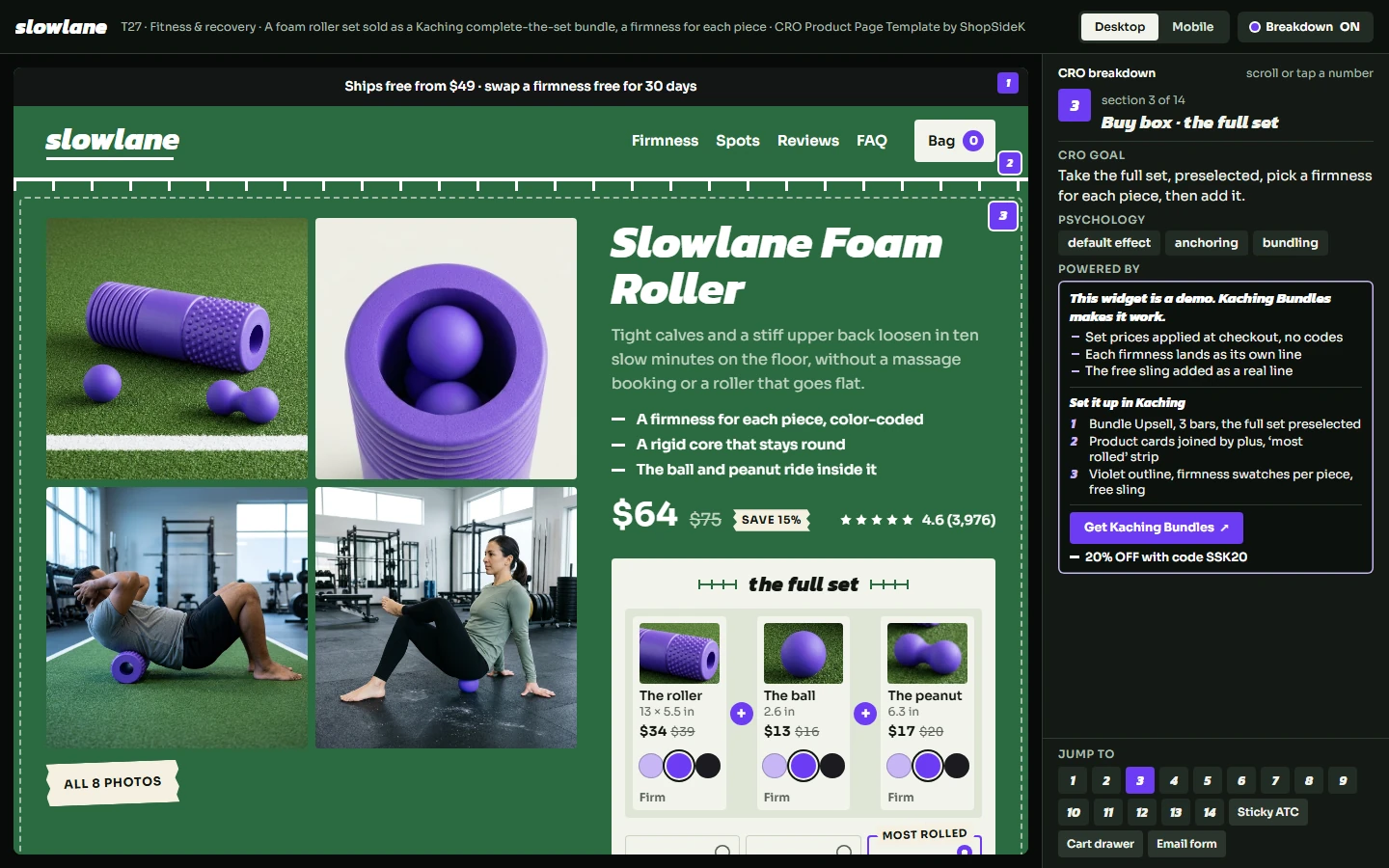
- Slowlane, a foam roller, massage ball and peanut ball sold as a set with a firmness for each piece, built on a Kaching complete-the-set bundle.
- Daylift (everyday version), wrist, ankle and palm weights sold in pairs you mix by job, built on a Kaching mix & match bundle.
Key takeaways: 7 rules for a fitness product page
- Sell the fit before the feature. A thumb-press finder or a rule for where each pair goes tells the shopper whether the product suits their body before they reach the price.
- Let each piece carry its own setting. A firmness for every roller piece or a color for every pair lets one bundle serve a beginner’s calves and a lifter’s glutes at once.
- Name the bars after the routine. “The full set” or “wrists for the walk, ankles for the rug” reads as a plan; “3-pack” reads as a quantity.
- Print the dose. Seconds per side, an inch a second, a pace you can still talk at: exact instructions show the product will get used, and they set honest expectations.
- If you show results, show the method. A before-and-after number needs the group size, the test, the range and how long the change lasts, on the same screen.
- Choose verbs the evidence can carry. “Loosen”, “reach” and “turn further” describe what one session can show; “heals”, “burns fat” or “speeds recovery” need clinical support.
- Cover the fear the warranty misses. A free firmness swap or a $5 cover for a lost cuff answers the worry that is specific to this product.
The two examples at a glance
| Slowlane (foam roller set) | Daylift, everyday version (wearable weights) | |
|---|---|---|
| Product | A 13 × 5.5 in roller, a 2.6 in massage ball and a peanut ball that ride inside the roller’s hollow core | Wrist pairs (2 × 1 lb), ankle pairs (2 × 2 lb) and palm pairs (2 × 1 lb): recycled steel sealed in silicone, one hook |
| What the shopper picks per piece | Firmness: Soft, Firm or Extra firm | Pair type and one of four colors |
| Kaching offer type | Bundle Upsell (complete the set): the roller, roller + ball, the full set | Bundle Upsell (mix & match): 1 pair, any 2, any 3 |
| Prices | $39 · $49 · $64 | $44 · $76 · $99 |
| Crossed-out price | The pieces’ own prices added up: $55 and $75 | The pairs’ own prices added up: $88 and $132 |
| Free gift in the widget | A mesh carry sling ($12 value) with the full set | Grip socks ($14 value) with three pairs |
| Cart reward | Free shipping at $49, a free stretch strap ($14 value) at $85 | A free cooling towel ($12 value) at $85; free shipping from $60 |
| Guarantee | 90 days with use allowed, a free firmness swap for 30 days | 45 days with wear allowed, two-year replacement |
| Order in the walkthrough | $64 → $86 | $76 → $90 |
| Live example | Slowlane template (T27) | Daylift everyday version (T10) |
Example 1: Slowlane, a foam roller page that sells a firmness for each piece
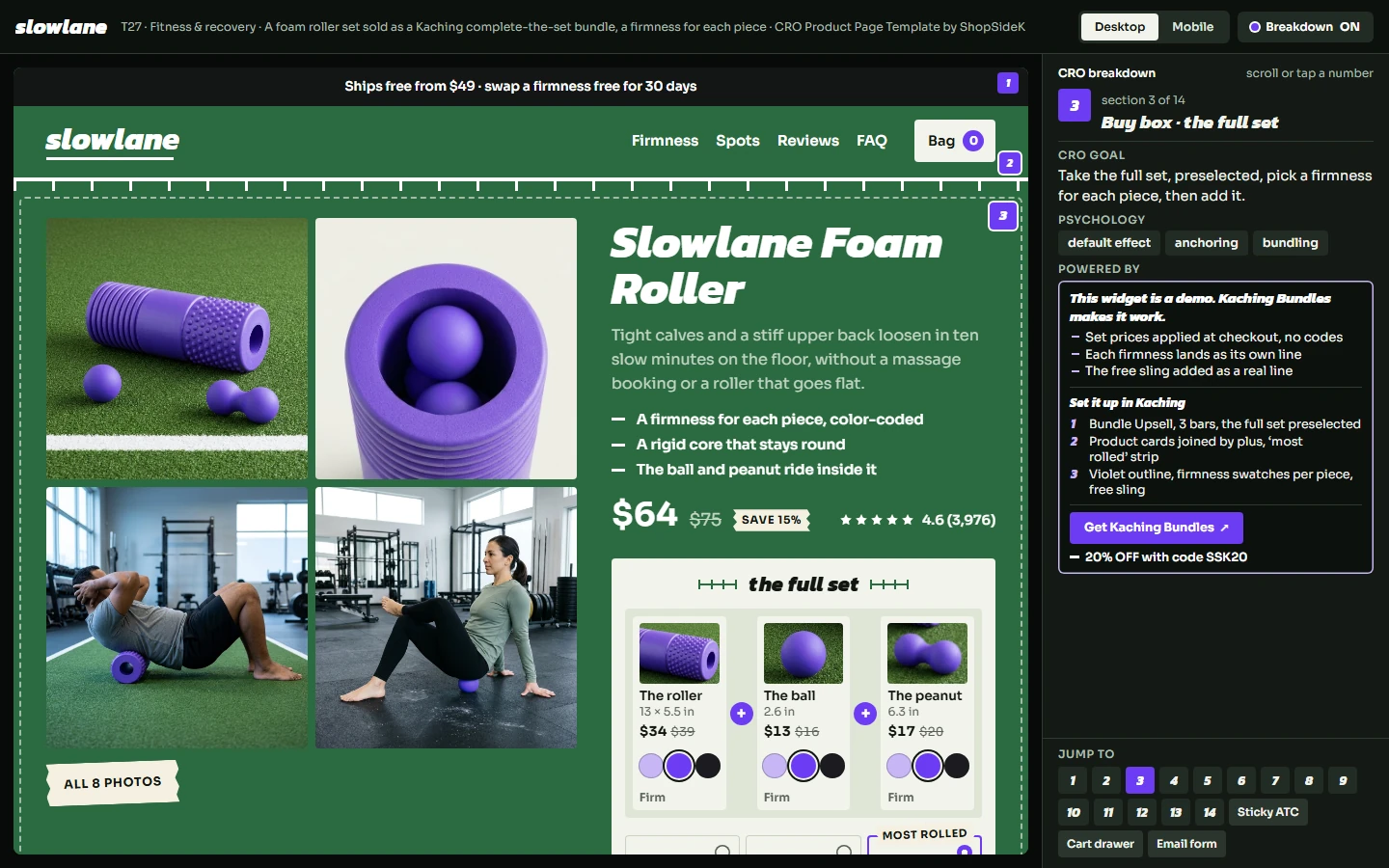
Slowlane sells three recovery pieces that nest into one cylinder: a roller with a closed-cell foam shell molded over a rigid core, a solid rubber ball and a two-lobed peanut ball, the last two riding inside the roller’s 3 in hollow. The page assumes the buyer’s real question is not “which roller” but “how hard”, so firmness is chosen piece by piece and the page spends its first section helping the shopper choose.
The offer: the roller, roller + ball, or the full set
| Bar | Pieces | Set price | Crossed-out price | Each piece in the set | Shipping and gift |
|---|---|---|---|---|---|
| The roller | Roller | $39 | none | $39 | $5.95 shipping |
| Roller + ball | Roller, ball | $49 | $55 | $35 + $14 | Ships free |
| The full set (preselected) | Roller, ball, peanut | $64 | $75 | $34 + $13 + $17 | Ships free, mesh carry sling free ($12 value) |
Each piece is a product card joined to the next by a “+”. Pieces outside the chosen bar stay on screen as dashed “in the full set” cards, so a shopper on the single roller sees what the set adds. Every card carries three firmness swatches: Soft (about 35 Shore C), Firm (about 45, the default) and Extra firm (about 60). The ladder is built around shipping: free shipping starts at $49, the single roller names its $5.95 fee in its subtitle, and roller + ball is the first bar that ships free.
The sections that do the persuading
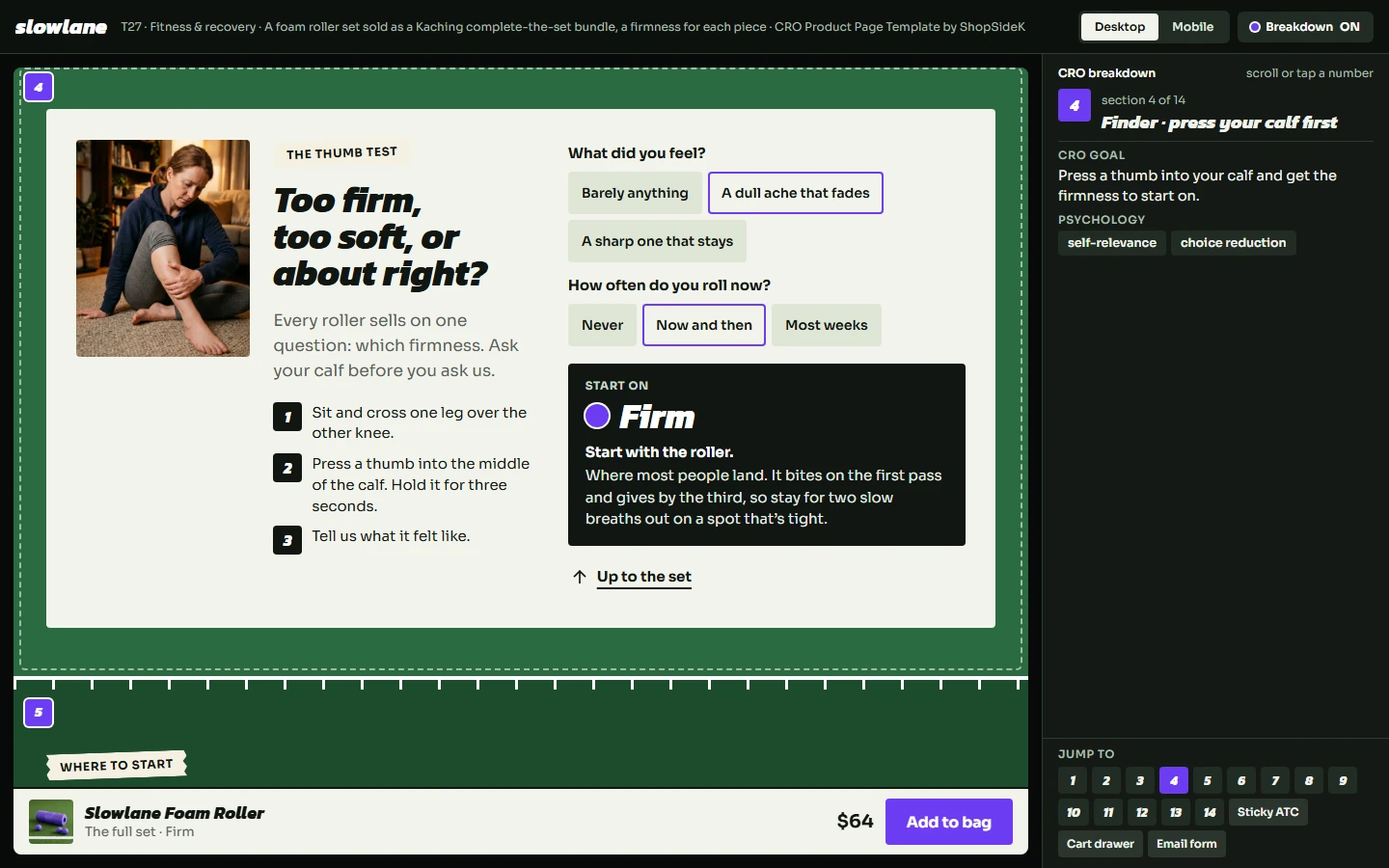
- Press your calf first. A two-question finder (what a three-second thumb press felt like, how often you roll now) returns a starting firmness and the piece to start with. If the press gave a sharp ache that stays, the answer is to skip that spot and have it looked at; the finder recommends nothing to buy for that answer.
- Six kinds of training, three spots each. Running, lifting, riding, climbing, court sports and desk days each get three spots with a piece and a time, such as calves on the roller for 90 seconds a side.
- Three sizes of spot. The roller covers long muscles, the ball sits in an arch or a glute, and the peanut straddles the ridge of the upper back: the case for three pieces instead of one big roller.
- Twelve seconds a pass. A play button sends one line across the band at about an inch a second, the speed of a slow pass up a calf.
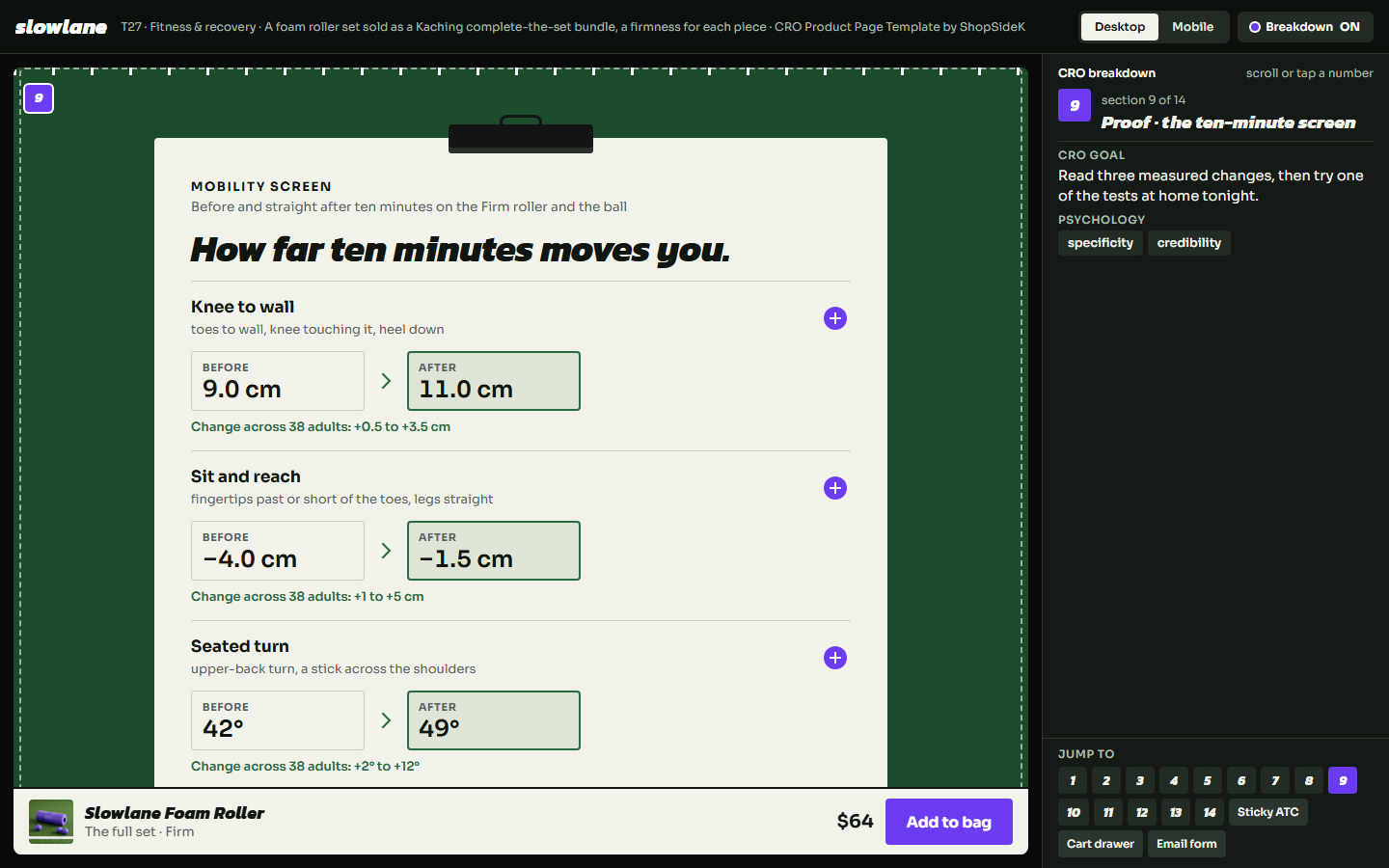
- The ten-minute screen. Three mobility tests show the median before and after one session, the range of change across 38 adults, the method and the line “the change fades over the day”, with instructions to run each test at home.
- Six months on our floor. A cheap open-cell roller and the Slowlane roller after six months on the same gym floor: one flat and oval, the other still round.
- The guarantee. 90 days with use allowed, two years against a flat spot or split shell, and a free firmness swap within 30 days that ships the new piece first.
The cart: from $64 to $86, with the strap
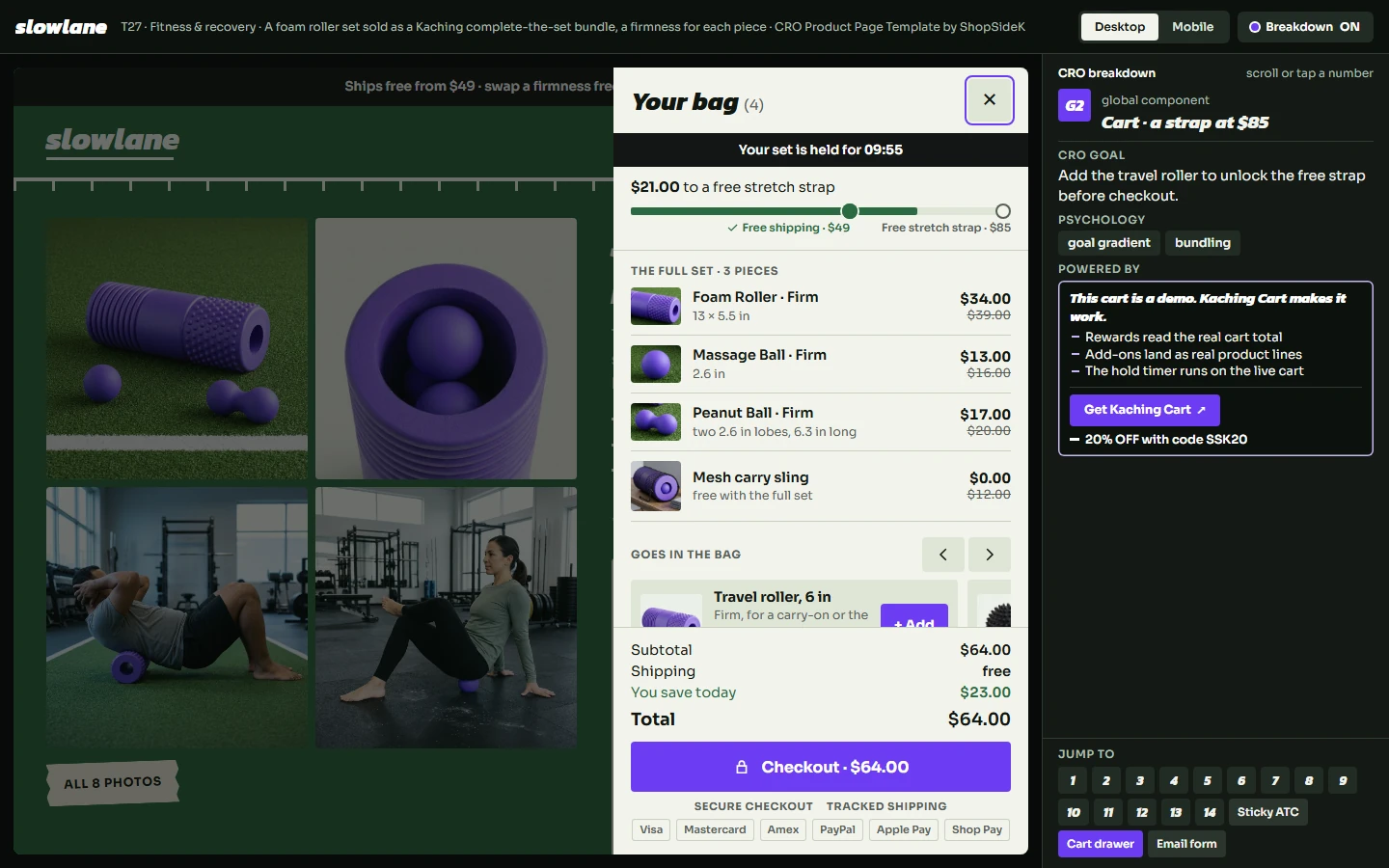
The cart drawer, built with Kaching Cart, has a two-step rewards bar: free shipping at $49 and a free 6 ft stretch strap ($14 value) at $85. The preselected full set lands at $64, $21 short of the strap. A slider called “Goes in the bag” offers three add-ons: a 6 in travel roller ($22), a spiky foot ball ($10) and a wall hook ($9). Adding the travel roller takes the order to $86 and drops the strap in as a $0 line. Each piece sits on its own line with its firmness (“Foam Roller · Firm · $34”), so the buyer can check every choice before checkout.
One thing not to copy
The drawer opens with “Your set is held for 10:00”, and when the clock runs out it says nothing left the bag. Everywhere else the page refuses scarcity: there is no stock line and no timer in the widget. A reservation countdown that reserves nothing undercuts that restraint, so leave Kaching Cart’s hold timer off unless stock really is set aside for the shopper.
Rebuild the offer in Kaching
- A Bundle Upsell deal on the roller ($39), the ball ($16) and the peanut ($20): the roller alone, then $4 + $2 off for roller + ball, then $5 + $3 + $3 off for the full set, which is preselected and carries the sling as a free gift.
- Product cards joined by “+”, “Let customers choose different variants for each item” with three firmness swatches, and a “most rolled” badge on the full set.
- A free-shipping label on bars 2 and 3 and a savings line at the foot of the widget.
Picking the three pieces is its own decision; this guide on choosing products to bundle on Shopify walks through it.
Example 2: Daylift, wearable weights sold by the job
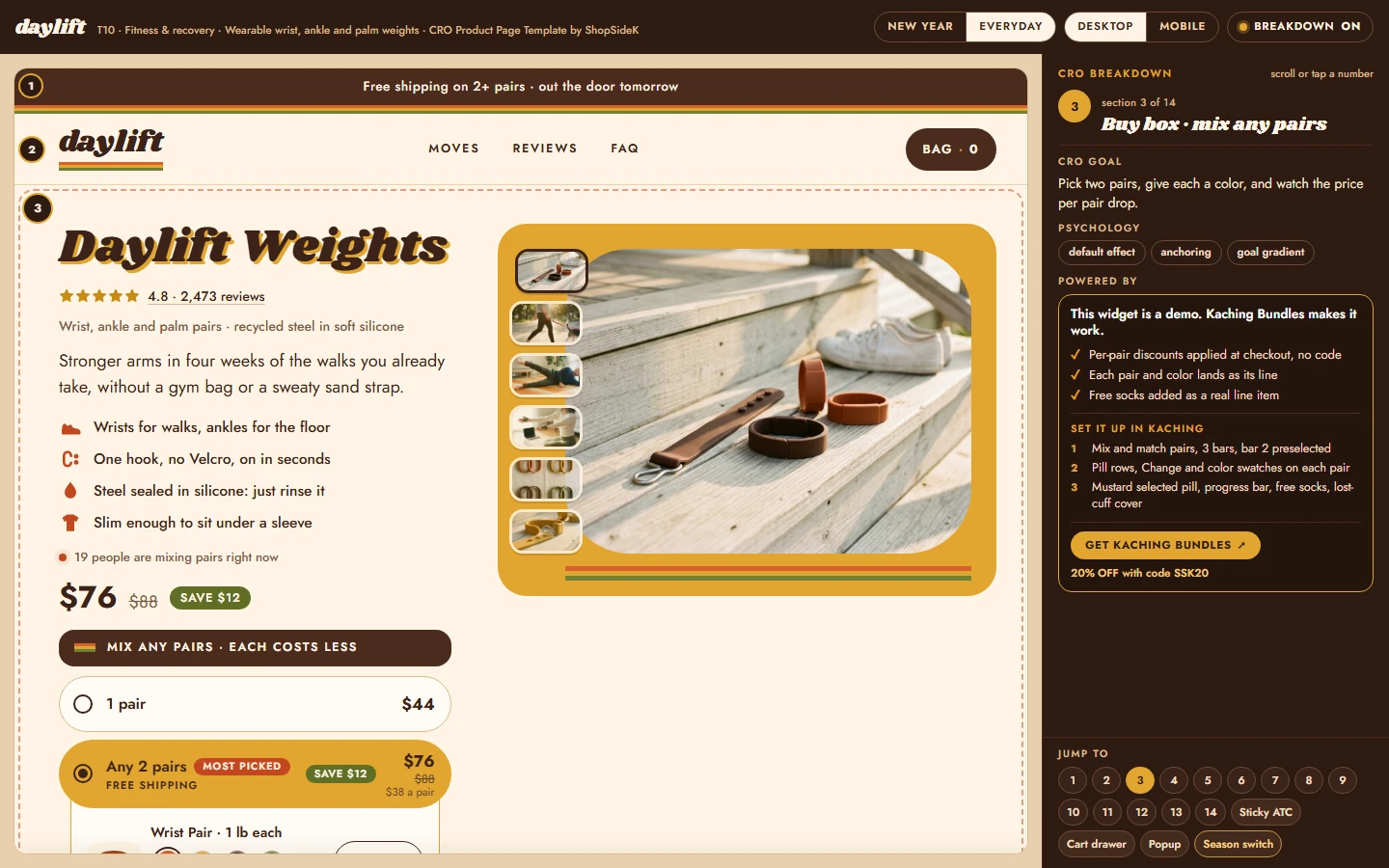
Daylift sells light weights you wear: a wrist pair for walks, an ankle pair for floor work and seated lifts, and a palm pair for pilates and barre. Every pair costs $44 and comes in Tangerine, Mustard, Cocoa or Avocado. The demo opens in its New Year skin by default; the link in this section opens the everyday version, which is the page the product carries most of the year.
The offer: one pair, any two or any three
| Bar | Pairs loaded by default | Price | Crossed-out price | Per pair | Extras |
|---|---|---|---|---|---|
| 1 pair | Wrist, Tangerine | $44 | none | $44 | $4.95 shipping (under $60) |
| Any 2 pairs (preselected, “most picked”) | Wrist, Tangerine + Ankle, Cocoa | $76 | $88 | $38 | Free shipping, “save $12” |
| Any 3 pairs | + Palm, Avocado | $99 | $132 | $33 | Free shipping, free grip socks ($14 value), “save $33” |
Kaching takes $6 off each pair on bar 2 and $11 off each pair on bar 3. Since every pair costs the same, swapping a wrist pair for a palm pair with the Change button never moves the total, and two of the same pair are allowed for two walkers in one house. A striped progress bar names the next step in price per pair: “Add 1 more pair → $38 a pair”, then “$33 a pair + free grip socks”.
Every bar also offers a $5 lost-cuff cover. Tears and snapped hooks are already replaced free for two years, so the paid cover sells only what a defect warranty never covers: a cuff left at the gym or dropped on a walk.
The sections that do the persuading
- The talk test. A drawn walker moves through three paces. At an easy pace she could sing, so the wrists go on; at a brisk pace she manages full sentences for twenty minutes; on the hill, two words at a time means the weight is too much, so the arms hang and the stride shortens.
- Inside a pair. A drag handle pulls an ankle pair apart into a flat recycled-steel bar, a sealed silicone skin and a strap with four posts and one hook, answering the sand-filled weights shoppers remember.
- Where each pair goes. A physical therapist’s three-line rule gives wrists, ankles and palms their jobs and names where ankle weights never go.
- Clip reviews by routine. Short vertical clips filtered by walks, floor or desk, each tagged with the pair, the color and the week of use.
- The guarantee. 45 days with wear allowed, the return label already in the pouch, and a two-year replacement for a bent hook, a snapped post or torn silicone.
The cart: from $76 to $90, with the towel
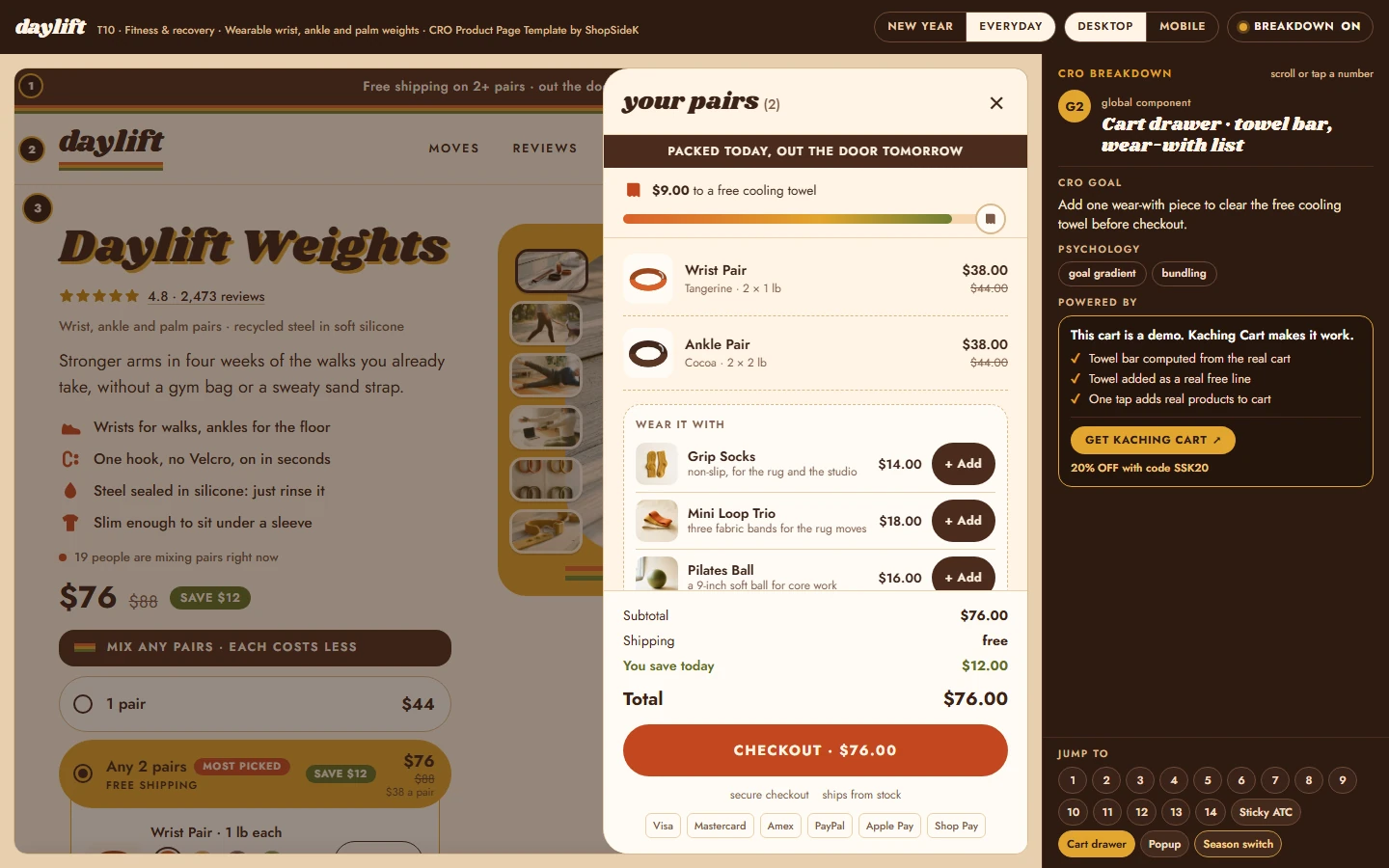
The everyday cart drawer opens with “Packed today, out the door tomorrow” and a free-gift bar that adds a cooling towel ($12 value) at $85. The preselected two pairs come to $76, $9 short, and a “wear it with” list offers grip socks ($14), a Mini Loop Trio of fabric bands ($18) and a 9 in Pilates Ball ($16). Any one clears the bar: the grip socks take the order to $90 and the towel arrives free. A $6 oak door hook sits below as a separate tick box.
One thing not to copy
The reviews section opens with the headline “Nine in ten buyers still wear them in week four.” It is a statistic with no count, no source and no method anywhere near it. On a live store, print a number like that only with the data behind it and a short note on how it was counted; otherwise let the reviews make the point. The demo’s “19 people are mixing pairs right now” chip and its “34 left in this batch” line are sample text in the same way.
Rebuild the offer in Kaching
- A Bundle Upsell deal over a collection of three $44 pairs: 1 pair, any 2 and any 3, with $0, $6 and $11 off each pair, bar 2 preselected and a Change button on every pair.
- Pill rows with a color swatch per pair, “save $12” and “save $33” labels, a progress bar and grip socks as the free gift on bar 3.
- An Add Upsell on every bar, “Add lost-cuff cover · $5”, not selected by default.
For when a mix & match bundle beats a fixed set, read fixed vs mix and match bundles on Shopify.
What a fitness page can claim about soreness, strength and results
Fitness copy drifts toward outcomes: looser hips, stronger arms, faster recovery. In the US those are health claims, and the FTC expects evidence before the page goes live. This is general information, not legal advice.
- Fitness gear falls under the FTC’s health products guidance. The FTC’s Health Products Compliance Guidance names “health equipment” among the products it addresses and says the same legal principles apply to any health-related product: health benefit claims need competent and reliable scientific evidence (FTC: Health Products Compliance Guidance).
- A specific percentage needs the study that produced it. In 2011 Reebok agreed to pay $25 million to settle FTC charges over its EasyTone and RunTone shoes. The FTC alleged the ads falsely claimed walking in EasyTone had been proven to give 28% more strength and tone in the buttocks and 11% more in the hamstrings and calves, and the order bars such toning claims unless they are true and backed by scientific evidence (FTC press release, September 28, 2011).
- One customer’s results read as everyone’s. Under the FTC’s Endorsement Guides, a consumer endorsement about a key attribute is likely to be taken as the typical result. Without evidence that it is typical, the ad must clearly disclose the performance people can generally expect in that situation (16 CFR 255.2). A bare “results vary” line does not say what buyers generally get.
- Match the claim to what research found. A 2019 meta-analysis of 21 studies found that rolling before exercise improved sprint performance by about 0.7% and flexibility by about 4.0%, and that rolling after exercise eased perceived muscle pain by about 6.0%. The authors concluded the evidence supports foam rolling as a warm-up rather than a recovery tool (Wiewelhove et al., Frontiers in Physiology, 2019).
How the two demos sit against those rules:
- Slowlane keeps to sizes, firmness in Shore C numbers, materials and a screen with its medians, ranges and method on one sheet. Its copy never uses the words pain, sore, heal, relief or burn, and the change it measures is a short-term mobility change that fades over the day, the kind of effect the research reports. The coach, the 38 testers and the floor test are invented for the demo; a live store would need its own.
- Daylift’s talk test matches the CDC’s description of effort: at moderate intensity you can talk but not sing, and at vigorous intensity you can say only a few words before pausing for breath (CDC: how to measure physical activity intensity). Its “stronger arms in four weeks” promise and one walker’s four timed Saturdays are results claims, so a live store would need proof they are typical or a clear line on what buyers generally see.
How to set up a fitness bundle in Kaching
- Pick the deal type by what you sell. Different products with a discount on each item, such as a roller, a ball and a peanut, or three kinds of pairs, fit a Bundle Upsell (Kaching help: bundle types).
- Put the choice on each item. Turn on “Let customers choose different variants for each item” and add swatches, so firmness or color is picked per piece (Kaching help: variant dropdowns).
- Take dollars off each item. A fixed amount per piece keeps round bar prices, and when every item costs the same, as Daylift’s pairs do, a swap never changes the total (percentage vs fixed bundle discounts).
- Attach the gift to the bar you want to sell. Slowlane’s sling rides on the preselected full set; Daylift’s socks sit on the top bar to pull shoppers past the middle (free gift vs discount on Shopify).
- Sell protection only for a real gap. An Add Upsell on the deal bar suits a cover like Daylift’s lost cuff, which the defect warranty leaves out (Kaching help: add an upsell to your deal bar).
- Price the worst order, then test one. On the demos’ assumed costs the weakest order kept 64.4% gross margin for Slowlane (roller + ball with a 10% welcome code) and 68.1% for Daylift (three pairs with its 10% code); run yours in the Shopify discount break-even calculator, then place a test order to check every piece’s setting and the gift.
Fitness product page checklist
- A finder, a rule or a short quiz that answers “which one suits me” before the price.
- A setting per piece in the bundle: firmness, color, size or weight.
- Bar names that describe the routine, not only the count.
- Exact dimensions, weights and materials for every piece, with firmness or load as numbers.
- A dose the shopper can follow: seconds per side, sets and reps, or a pace.
- Before-and-after numbers only with the group, the method, the range and how long the change lasts.
- Verbs that match your evidence; no “heals”, “burns fat” or “speeds recovery” without proof.
- Customer results stories only with proof they are typical, or a plain line on what buyers generally get.
- A guarantee long enough to use the product, plus a fix for the fear the warranty misses.
- A cart reward one add-on above the preselected bar, and no countdowns or stock lines unless they count something real.
FAQ
What should a fitness product page include?
A way to choose the right version for the shopper’s body, exact sizes and materials, a dose to follow, proof shown with its method, reviews from people who train the same way, a guarantee long enough to try it properly, and every bundle price before checkout.
How do I help shoppers choose a foam roller firmness?
Ask what they feel and how often they roll. Slowlane’s finder uses a three-second thumb press on the calf and a frequency question, then recommends Soft, Firm or Extra firm and the piece to start with. Publishing firmness as a Shore C number helps shoppers compare across brands.
Can a fitness product page say it reduces soreness or speeds recovery?
Only with competent and reliable scientific evidence for that specific claim, which is the FTC’s standard for health-related products, including health equipment. A 2019 meta-analysis found foam rolling’s effects small and better supported as a warm-up than as a recovery tool, so claims about loosening up before training are easier to support than recovery claims.
Do customer reviews about fitness results need a disclaimer?
Under the FTC’s Endorsement Guides, a customer’s story about a key result is read as typical. If you can’t show it is typical, you need to clearly disclose the results people can generally expect; “results vary” on its own doesn’t do that.
How do I let shoppers pick a different firmness or color for each item in a Kaching bundle?
Turn on “Let customers choose different variants for each item” in the Kaching deal and add swatches for the option, so every item in the bar shows its own picker. Then place a test order to see how the choices appear in your cart and order.
What activity guidelines can a fitness product page quote?
If you cite a target, quote it exactly and link the source. The CDC says adults need at least 150 minutes of moderate-intensity physical activity a week and 2 days of muscle-strengthening activity, and its talk test describes moderate effort as being able to talk but not sing.
More product page examples
Slowlane and Daylift are part of the ShopSideK library of Shopify product page templates, each with a free CRO breakdown of every section. For more pages in this niche, browse the fitness and recovery product page templates, or compare offers across niches with the Kaching complete-the-look templates and the Kaching mix & match templates.
The New Year version of the wearable weights page is in New Year product page examples. For claim rules on health-adjacent products, see supplement product page examples.
Sources
- CDC: Adult Activity, An Overview
- CDC: How to Measure Physical Activity Intensity
- FTC: Health Products Compliance Guidance
- FTC: Reebok to Pay $25 Million in Customer Refunds To Settle FTC Charges of Deceptive Advertising of EasyTone and RunTone Shoes (September 28, 2011)
- 16 CFR 255.2, Consumer endorsements (Cornell LII)
- Wiewelhove et al. (2019), A Meta-Analysis of the Effects of Foam Rolling on Performance and Recovery, Frontiers in Physiology 10:376
- Kaching help: different bundle types
- Kaching help: customize your bundle variant dropdowns
- Kaching help: add an upsell to your deal bar