When asking do you need a business license to sell on Shopify, the direct answer is: No.
Shopify doesn’t ask for a business license when you sign up for an account. But to operate your business legally and collect payments, you will almost certainly need licenses or permits based on your location, the products you sell, and your sales volume.
I know navigating the world of permits and licenses can feel intimidating. But it’s a manageable and crucial step in building a sustainable brand. This guide provides a clear checklist to help you determine exactly what you need, so you can launch your store with confidence.
If you’re a visual learner, I’ve recorded a video to give you the answer.
Key Takeaways
- You can start a Shopify free trial and build your store without a business license.
- Your legal requirements are determined by your city, state, product type, and sales volume.
- Most e-commerce stores need, at a minimum, a seller’s permit to legally collect sales tax.
- This guide will walk you through every step of getting your Shopify store licensed and ready for business.
Want to explore the platform while you learn? You can start a free Shopify trial HERE and follow along.
First, Let’s Answer the Real Question: Is Your Shopify Store a Hobby or a Business?
Before you even think about licenses, it’s important to clarify the legal status of your online store. Are you casually selling a few items for fun, or are you building a real e-commerce business? The Internal Revenue Service (IRS) has specific guidelines to differentiate between a hobby and a for-profit venture, and this distinction is the foundation for your tax and legal obligations.
From what I’ve seen, what starts as a hobby quickly evolves for many entrepreneurs. Understanding when you’ve crossed that line is the first step toward building a legitimate, protected brand.
The 4-Point Checklist to Know if You’re a Business
Use this simple checklist to see where your Shopify store stands. It’s based on the key factors tax authorities consider.
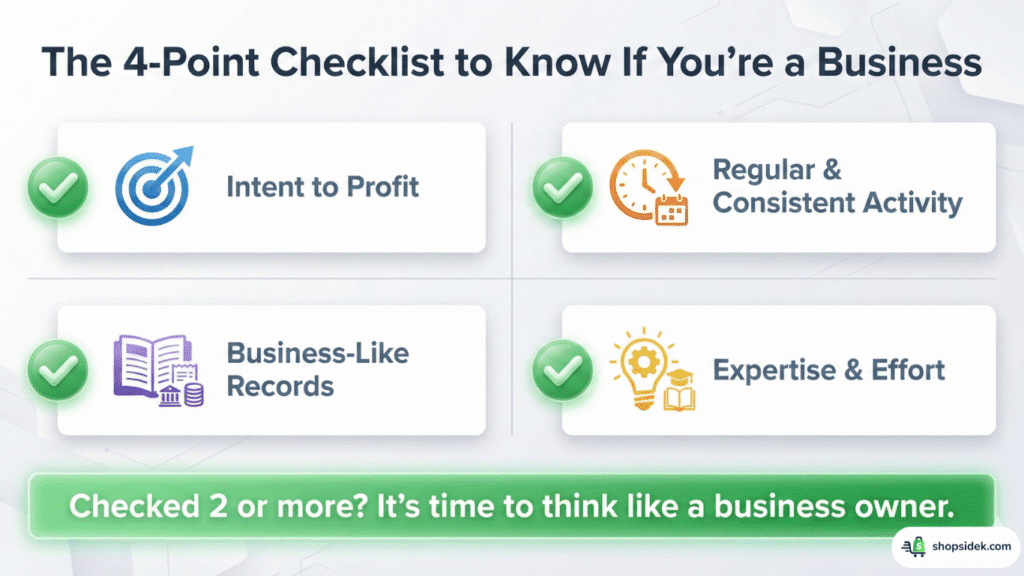
✅ Intent to Profit: Is your primary goal to make an income or profit? If you invest time and money with the expectation of making a return, you’re operating like a business. Hobbies, in contrast, are pursued for sport or recreation, not for income.
✅ Regular and Consistent Activity: Are you dedicating consistent time and effort to your store? This includes sourcing products, marketing on social media, managing inventory, and fulfilling orders. A business operates with continuity, while a hobby is often sporadic.
✅ Business-like Records: Do you keep detailed records of your income and expenses? Have you considered opening a separate bank account for your store? In my opinion, treating your finances in an organized, professional manner is a strong indicator of a business.
✅ Expertise and Effort: Are you working to become an expert in your niche? Time spent learning about your products, customers, and market demonstrates a level of seriousness and effort that goes beyond a casual pastime.
If you checked two or more of these boxes, it’s time to start thinking like a business owner. Let’s get your new venture set up correctly.
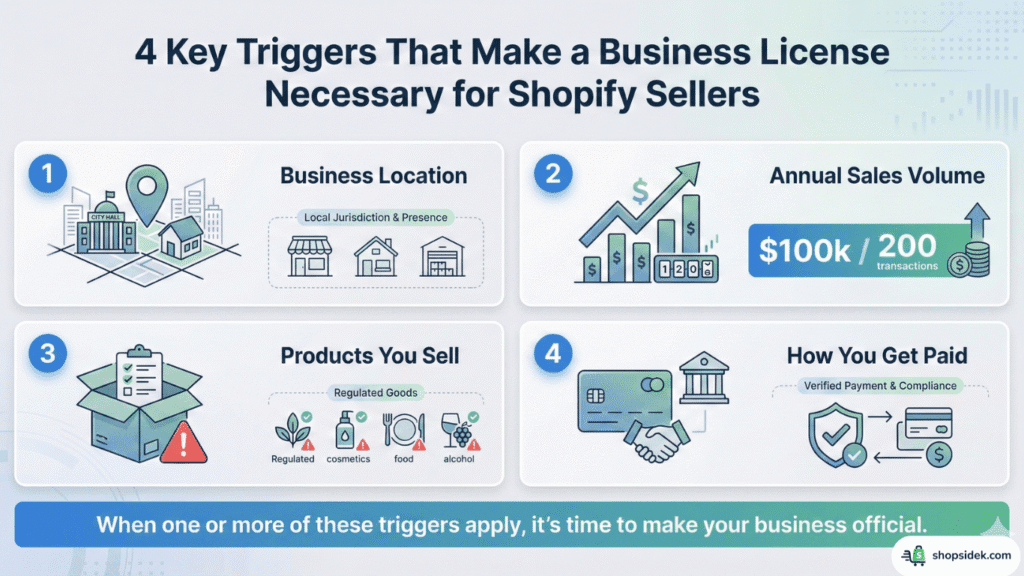
4 Key Triggers That Make a Business License Necessary for Shopify Sellers
While you can start building your store anytime, certain milestones and decisions will officially require you to get licensed. These triggers aren’t determined by Shopify, but by federal, state, and local laws. Here are the four most common signals that it’s time to make your business official.
Trigger 1: Your Business Location
The most fundamental requirement for a business license comes from your physical location. Nearly every city, county, or state requires businesses—even those run from a home office or a laptop at a coffee shop—to have a general operating license. This registers your business with the local government and confirms you are permitted to operate in that jurisdiction.
I’ve found that this is often the first and most basic license you’ll need. To find out your specific requirements, a quick search on your local city hall or county clerk’s website is the best place to start.
Trigger 2: Your Annual Sales Volume (The Real Numbers)
Once you start making sales, you trigger a responsibility to collect and remit sales tax. This requires a seller’s permit from your state. While some online guides mention a vague “$20,000 a month” figure, the actual rules are based on a legal concept called “economic nexus.”
As Shopify’s own guides explain, most states now have laws where you are required to collect sales tax once you hit $100,000 in sales or 200 transactions within a year in that specific state. Hitting this threshold creates a legal obligation, making a seller’s permit non-negotiable if you plan to grow.
Trigger 3: The Products You Sell
What you sell is just as important as where and how much you sell. Certain product categories are regulated by federal and state agencies to ensure consumer safety and compliance. If your Shopify store sells these items, you will need special permits in addition to your general operating license.
Common regulated e-commerce products include:
- Food, beverages, supplements, and cosmetics (regulated by the FDA)
- Alcoholic beverages (regulated by the Alcohol and Tobacco Tax and Trade Bureau, or TTB)
- Plants, animals, or agricultural products (regulated by the USDA)
- Firearms and tobacco (regulated by the Bureau of Alcohol, Tobacco, Firearms and Explosives, or ATF)
Trigger 4: How You Get Paid
To accept money from customers, you need a payment processor like Shopify Payments or PayPal. These financial services are required by law to verify that they are doing business with legitimate, legally compliant entities.
As your sales grow, they will likely ask for official business information, such as a business license or an Employer Identification Number (EIN). Failing to provide this can lead to your funds being frozen or your account being suspended. Getting licensed ensures you can get paid without interruption, turning your hard work into real revenue.
What Licenses and Permits Might Your Shopify Store Need? (A Simple Breakdown)
It’s not just one ‘business license’—you may need a few different documents depending on your business model and location. This can sound complex, but the types of permits required by most Shopify sellers are quite straightforward. Each one serves a distinct purpose, from allowing you to operate locally to enabling you to collect sales tax legally.
Here’s a breakdown of the most common licenses and permits for Shopify sellers, designed to demystify the paperwork and show you exactly what applies to your store.
E-Commerce Licenses at a Glance
| License/Permit Type | What It Is | Who Needs It | Real Shopify Store Example |
|---|---|---|---|
| General Business License | A basic permit from your city/county to operate legally in that jurisdiction. | Virtually every business, even home-based online stores. | A dropshipper working from their apartment in Austin, TX. |
| Seller’s Permit | A state-level permit that allows you to collect sales tax from customers. | Any store selling taxable goods to customers in a state where they have “nexus.” | A print-on-demand store selling t-shirts to customers across the U.S. |
| Home Occupation Permit | A permit allowing you to run a business out of your residence. | Sellers who store inventory, package products, or have business-related traffic at their home. | A creator who makes and ships handmade candles from their garage. |
| DBA (“Doing Business As”) | A registration for using a business name that is different from your legal name. | A sole proprietor named “John Smith” whose Shopify store is called “Retro Gaming Supply.” | A store owner with the LLC “JS Ventures LLC” who operates an online store called “The Modern Kitchen.” |
A General Business License is your local permission slip to operate. Most cities and counties require this as a baseline, and it’s how they track businesses within their jurisdiction for tax and regulatory purposes. For an online-only business, this is often a simple form and a modest annual fee.
The Seller’s Permit (also known as a sales tax permit or resale license) is essential for nearly all e-commerce stores. It’s issued by your state and authorizes you to collect sales tax on behalf of the government. Even if you only sell online, you are legally required to have one to collect tax from customers in states where you have a physical or economic nexus. The good news is that in many states, obtaining a seller’s permit is free.
If you’re running your Shopify store from your house, a Home Occupation Permit may be necessary. This permit ensures your business activities don’t violate local residential zoning laws. It’s most relevant for sellers who store inventory, use their garage as a workshop, or have frequent deliveries and pickups.
Finally, a DBA (Doing Business As) registration is for branding. If you are a sole proprietor, your legal business name is simply your own name. A DBA allows you to operate your store under a more creative, marketable name like “The Urban Gardener” instead of “Jane Doe.” Similarly, if you form an LLC called “JD Creative Ventures LLC,” a DBA lets you run a Shopify store with a different name, such as “Modern Pet Supplies.”
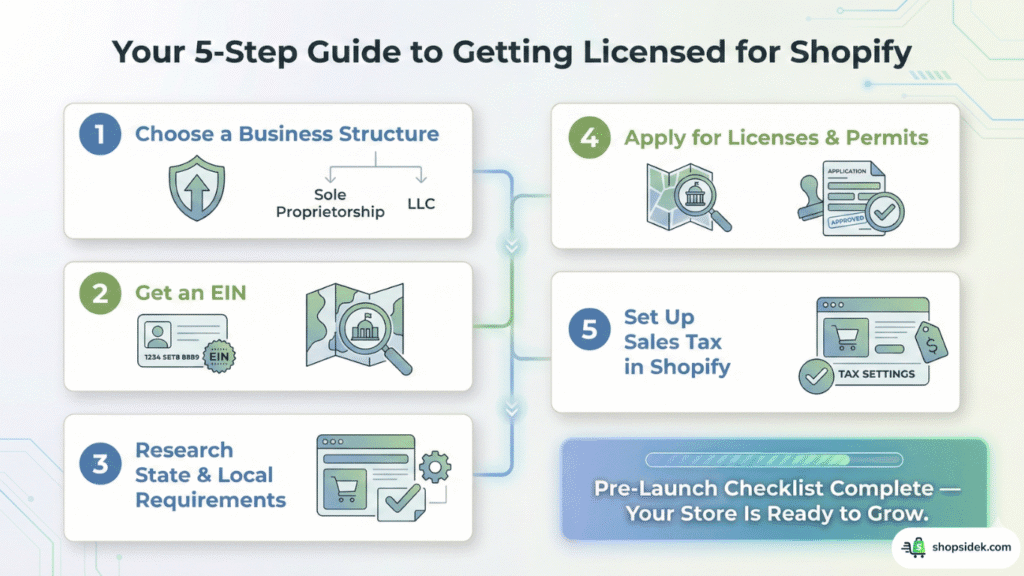
Your 5-Step Guide to Getting Licensed for Shopify
Getting your Shopify store licensed is a straightforward process. By tackling it in a few simple steps, you can ensure your business is compliant and set up for long-term success. Think of this as your official pre-launch checklist.
Step 1: Choose a Business Structure
First, decide how your business will be legally structured. The two most common choices for e-commerce sellers are a sole proprietorship or a Limited Liability Company (LLC). A sole proprietorship is the default for an individual starting a business—it’s easy and requires no formal action to create. However, it offers no legal separation between you and your business.
For serious sellers, my advice is that forming an LLC is often the smarter choice. It creates a legal shield that protects your personal assets (like your home and savings) from business debts and lawsuits, providing crucial peace of mind as you grow.
Step 2: Get a Federal Employer Identification Number (EIN)
An Employer Identification Number (EIN) is like a Social Security number for your business. Issued for free by the IRS, this nine-digit number is essential for opening a business bank account, applying for licenses, and hiring employees. Using an EIN instead of your personal Social Security Number on business documents also helps protect your personal identity. You can apply for one directly on the IRS website in minutes.
Step 3: Research Your State and Local Requirements
With your business structure and EIN in hand, it’s time to find out exactly what your state and city require. The U.S. Small Business Administration (SBA) offers an excellent online tool to find licensing requirements by location and industry. For more specific guidance, many states have their own portals, such as California’s CalGold website, which provides a customized list of the permits your business needs.
Step 4: Apply for Your Licenses and Permits
Once you’ve identified the necessary licenses, the next step is to apply. Most applications can be completed online through your state or city’s official websites. You’ll need to provide basic information like your business name, address, and EIN. Be prepared for filing fees, which can range anywhere from $50 to $550, depending on your location and business type. As a reminder, seller’s permits are often free to obtain.
Step 5: Set Up Sales Tax Collection in Shopify
After you receive your seller’s permit, you can connect your legal compliance directly to your store operations. Navigate to the “Taxes and duties” section in your Shopify admin and enter your permit number. This allows you to use tools like Shopify Tax to automatically calculate and collect the correct amount of sales tax from customers at checkout, ensuring you stay compliant without the headache.
Once your legal framework is in place, the real fun begins. See how easy it is to build your store with Shopify’s powerful tools.
Shopify Business License FAQ
Do I need an LLC to sell on Shopify?
No, you are not required to form an LLC to sell on Shopify. You can legally start as a sole proprietor, which is the simplest structure. However, I always suggest forming an LLC as your business grows because it provides liability protection, separating your personal assets from your business debts. Think of it as a safety net for your personal finances.
Can I sell on Shopify without a business license at all?
You can build your store, add products, and design your site on Shopify without any licenses. But once you start making sales, you are legally operating a business and must comply with the law. Selling without the required licenses and permits for your area puts you at risk of fines, penalties, or even being legally shut down by local or state authorities.
How much does it cost to get all the required licenses?
The total cost varies widely depending on your state and city. You can generally budget between $50 and $550 for initial filing and registration fees. Many states offer seller’s permits for free or for a very small fee, such as around $5 in Florida. However, other permits or state registration fees can be higher, making it important to research your specific local costs.
Do I need a license for dropshipping on Shopify?
Yes. Even though you aren’t physically handling inventory, you are still the owner and operator of the business. You are responsible for having a general business license to operate legally in your location and a seller’s permit to collect and remit sales tax from your customers. Your supplier handles shipping, but you are the legal retailer in the transaction.
The Bottom Line: Do You Need a Business License to Sell on Shopify?
Think of getting your business license not as a bureaucratic hassle, but as the official launchpad for your entrepreneurial journey. It’s a one-time setup task that transforms your idea into a legitimate business, granting you the peace of mind to focus on what truly matters: creating great products, finding customers, and growing your brand. By establishing a solid legal foundation from the start, you unlock the freedom to scale your operations, build trust with customers, and operate with confidence.
Don’t let the paperwork hold you back. You now have the complete roadmap to get your Shopify store started on the right foot. Ready to build your business? Sign up for Shopify today and get your first 3 months for just $1/month.

Note: I’m a Shopify Media Partner, which means I might earn a small commission if you sign up through my link. It doesn’t cost you anything extra and helps keep this blog running.