The peptide market is booming, with analysts projecting its value to soar past $90 billion by 2033. It’s no wonder savvy entrepreneurs are eager to enter the space. You have a promising product, an ambitious business plan, and you’ve heard that Shopify is the best place to launch an online store. But can people use Shopify to sell peptides legally and safely?
Let’s get straight to the point: No, selling peptides directly on Shopify violates their Acceptable Use Policy (AUP) and is an extremely risky business strategy.
This doesn’t mean your entrepreneurial journey ends here. It simply means you need a better map. This guide will explain exactly why Shopify isn’t the right tool for this specific product and provide a clear, compliant path forward—whether you’re committed to the peptide niche or open to even more profitable, scalable ideas.
Key Takeaways: Your 30-Second Guide
- Shopify’s Stance: Shopify explicitly prohibits the sale of products classified as “pseudo-pharmaceuticals” or certain “research chemicals.” Selling peptides puts your store in direct violation of this policy.
- The Real Risks: Attempting to sell peptides on Shopify will likely lead to sudden account suspension, frozen funds, and a permanent ban from the platform. You also face legal scrutiny from the FDA.
- The High-Risk Path: The only viable way to sell peptides online is by using a more flexible platform like WooCommerce, combined with a specialized high-risk payment processor.
- The High-Growth Alternative: While Shopify isn’t the platform for peptides, it’s the #1 choice for building a scalable health and wellness brand in compliant niches like fitness supplements, nootropics, or apparel. You can start a free trial to explore its potential as you read through your options.
If you prefer video over text, I’ve recorded a full explanation of this guide for you.
The Short Answer: Why Shopify’s Policies Prohibit Peptide Sales
To understand why Shopify takes such a hard line against peptides, you need to look at two key components: its official policies and the real-world consequences of violating them. The restriction isn’t arbitrary; it’s a calculated risk-management decision at the platform level.
A Direct Look at Shopify’s Acceptable Use Policy (AUP)
Shopify’s rules for all merchants are laid out in its Acceptable Use Policy (AUP). While this document may not specifically name every type of peptide, the products fall squarely into several prohibited categories, most notably pseudo-pharmaceuticals and certain research chemicals.
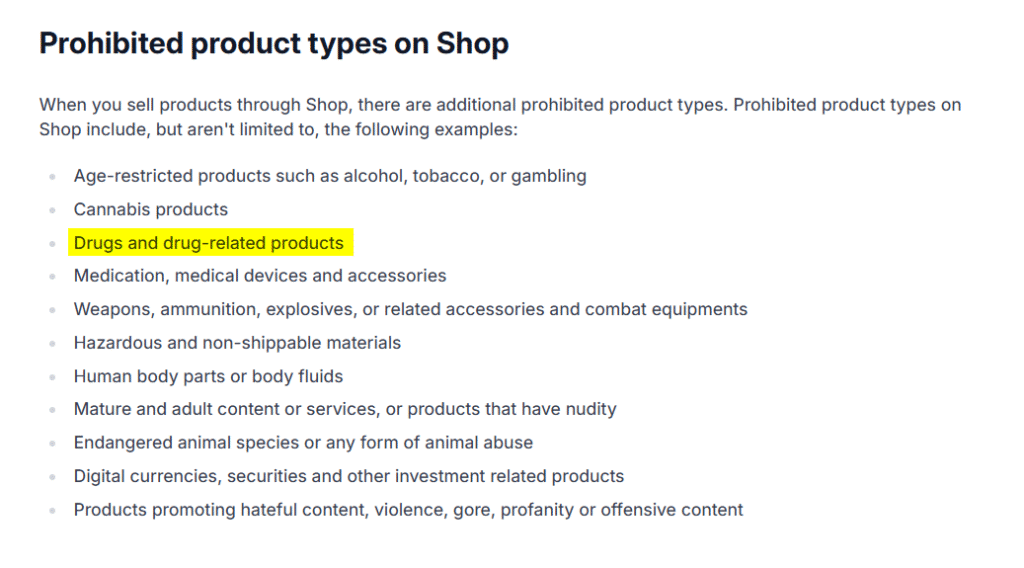
Because many peptides make unverified health claims and are not approved as drugs by the FDA, they are considered a high-risk product.
These platform-level rules are strictly enforced by Shopify’s own payment processor, Shopify Payments (which is powered by Stripe), making it nearly impossible to process transactions for these items compliantly. Any attempt to sell them is a direct violation from day one.
The Inevitable Consequence: Account Suspension and Frozen Funds
What happens if you try to sell peptides anyway, perhaps by using vague product descriptions or clever marketing? The outcome is predictable and severe. Sooner or later, Shopify’s compliance algorithms will flag your store, leading to a swift and often irreversible shutdown, frequently without warning.
This isn’t just a temporary setback. Merchants who violate the AUP face a cascade of problems:
- Sudden Store Shutdown: Your website goes offline, cutting off all traffic and sales instantly.
- Frozen Funds: Any money in your Shopify Payments account, including revenue from recent sales, will be held for an extended period—often 120 days or longer.
- Permanent Platform Ban: Shopify can blacklist you, preventing you from opening any other stores on their platform in the future.
Ultimately, and I’ve seen this happen, all the time, money, and effort you invested in building your brand can be lost overnight.
The Legal Minefield: Navigating FDA Rules and State-Level Laws
Beyond Shopify’s platform rules, a far greater challenge looms: the complex and shifting legal landscape. The risks of non-compliance go far beyond a store shutdown, extending to regulatory action from federal and state authorities.
Why the FDA Classifies Peptides as “Unapproved New Drugs”
The core legal issue is how peptides are marketed. The U.S. Food and Drug Administration (FDA) pays close attention to products that make health claims.
If your product descriptions, ads, or customer testimonials suggest that a peptide can treat a condition, enhance performance, or alter the body’s structure—like popular peptides such as semaglutide or tirzepatide—the FDA classifies it as a drug.
Since these products have not undergone the FDA’s expensive and lengthy clinical trial process for approval, they are deemed “unapproved new drugs.” Selling them is a violation of federal law. This isn’t just a theoretical risk. The FDA actively enforces these rules.
For instance, it has issued public warning letters to companies like USAPEPTIDE for selling unapproved and misbranded drugs, demonstrating a clear willingness to take action against online vendors.
The “Not for Human Consumption” Disclaimer: A Shield That Won’t Protect You
Many sellers attempt to sidestep these regulations by labeling their products “For Research Use Only” or “Not for Human Consumption.” I’ve found that this disclaimer is not the legal loophole many believe it to be.
Regulators, payment processors, and platforms like Shopify look at marketing intent. If your website features images of athletes, discusses benefits related to fitness or anti-aging, or has customer reviews praising personal results, the disclaimer is rendered meaningless.
The Federal Trade Commission (FTC) and FDA will argue that your product is clearly intended for human use, regardless of the fine print. This discrepancy is a massive red flag for any compliance department, making the “research chemical” defense ineffective in practice.
The New Wave of Compliance: State-Specific Age & Shipping Laws
Adding another layer of complexity, state governments are now stepping in with their own regulations. This creates a patchwork of rules that sellers must navigate, requiring sophisticated compliance systems.
For example, New York and New Jersey have already enacted laws restricting the sale of certain performance-enhancing products. This trend is growing, with other states like California, Texas, Massachusetts, and Illinois considering similar legislation.
For a merchant, this means you can’t just sell to anyone in the US; you need technology to block sales and shipments to specific states and verify customer age, adding significant technical and financial burdens. This emerging legal complexity is another key reason why mainstream platforms avoid the category entirely.
The High-Risk Compliance Triad: Platform, Payments, and Policy
Now that you understand the risks, let’s explore the solution. Building a sustainable business in a high-risk category requires a fundamentally different approach. We call it the High-Risk Compliance Triad—a framework focusing on the three pillars you must get right to operate safely.
For entrepreneurs committed to the peptide niche, navigating these three areas is non-negotiable. This is the expert-level path.
Part 1: Choosing a Compliant Platform (The Top 3 Shopify Alternatives)
My advice is choosing an e-commerce platform that gives you full control over your store’s policies. Unlike Shopify, which is a hosted service with a universal AUP, self-hosted or more flexible platforms allow high-risk businesses to operate. As long as they comply with the law and their chosen payment processor’s rules. WooCommerce, BigCommerce, and Shift4Shop are the most commonly recommended alternatives.
Here’s a head-to-head comparison to help you choose the right foundation:
| Feature | Shopify | WooCommerce | BigCommerce |
|---|---|---|---|
| Policy Freedom | Very Low. Prohibits peptides and other high-risk products at the platform level. | Very High. Open-source; you are only limited by your payment gateway and hosting provider. | Medium. Less restrictive than Shopify but has its own AUP. Known to be friendly to CBD and supplements. |
| Monthly Cost | Starts at ~$29/mo, plus app fees. | Free core software, but you pay for hosting, security, and premium plugins (~$30 – $200+/mo). | Starts at ~$29/mo, but high-volume stores must upgrade to more expensive plans. |
| Technical Skill | Low. Very beginner-friendly with drag-and-drop tools and 24/7 support. | Medium to High. Requires you to manage your own hosting, security, and updates. More technical freedom. | Low. A hosted SaaS platform similar to Shopify, offering ease of use with more built-in features. |
| Scalability | Excellent. From startup to enterprise with Shopify Plus. | Excellent. Highly scalable but requires more technical resources to manage growth. | Excellent. Built for growing businesses, especially those with large product catalogs. |
Part 2: Securing a High-Risk Payment Processor
Even on a flexible platform like WooCommerce, you cannot use standard payment processors like Stripe or PayPal. They will shut you down for the same reasons as Shopify Payments. I always suggest you apply for and get approved by a high-risk payment processor.
These specialized providers underwrite businesses in regulated industries, but they come with higher fees and a more intensive application process. Top names in this space include Corepay, Easy Pay Direct, PayKings, and Durango Merchant Services. To apply, you’ll need to have your documentation in order. Be prepared to provide:
- A government-issued ID
- A voided check or bank letter
- Bank statements (personal and business)
- Processing statements (if you have them)
- A Certificate of Analysis for your products
- Proof of a legally registered business (EIN documentation)
Part 3: Establishing Your Store Policies and Compliance
Finally, your platform and payment gateway are only as safe as your day-to-day operations. You must implement strict internal policies and use technology to enforce them. This includes displaying clear and prominent legal disclaimers on every page and providing third-party Certificates of Analysis for each product to build trust and prove legitimacy.
Most importantly, to comply with the emerging patchwork of state laws, you’ll need specialized tools. A simple age-gate pop-up is no longer enough. Services like Token of Trust can be integrated into your site to perform geo-fencing (blocking sales to restricted states) and robust age verification, creating a defensible audit trail that shows you are operating in good faith.
The Smarter Path: Profitable Health Niches That Thrive on Shopify
The high-risk path is a complex, resource-intensive journey. But what if there was a more strategic route? Instead of navigating legal minefields, you could channel your entrepreneurial drive into a booming health niche that is perfectly aligned with the world’s most powerful commerce platform. This isn’t a consolation prize; for most entrepreneurs, it’s the smarter business decision.
Why Build on Shopify? Speed, Scale, and the World’s Best App Store
There’s a reason brands like Gymshark and countless others are built on Shopify. The platform is designed to handle the technical complexities of e-commerce so you can focus on what matters: your product, your brand, and your customers.
Seeing what a winning store looks like is the best inspiration; you can explore our data-backed analysis of the 50+ best Shopify stores to see what makes them successful.

Compared to the technical setup of a high-risk store, building on Shopify offers incredible advantages: seamless payment processing, world-class security, 24/7 support, and an App Store with thousands of tools to handle everything from email marketing with Mailchimp to sophisticated analytics. It’s a foundation built for speed and scale.
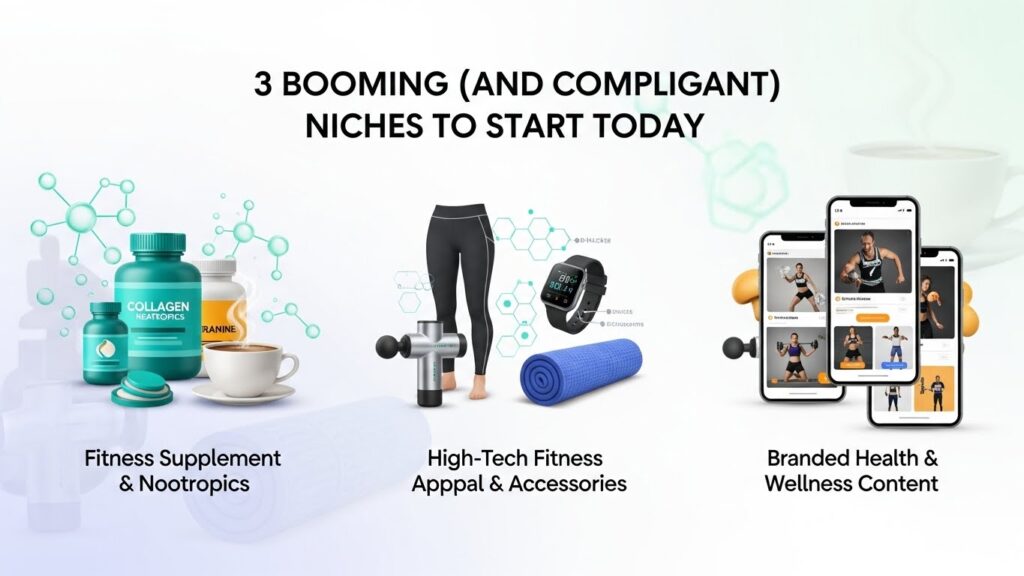
Three Booming (and Compliant) Niches to Start Today
Your passion for health and human performance can be the engine for a thriving brand on Shopify. These niches scratch the same customer itch as peptides but operate in a high-growth, low-risk environment.
- Fitness Supplements & Nootropics: The demand for cognitive and physical enhancement is massive. You can sell fully compliant and popular products like collagen supplements for skin and joint health, creatine for muscle growth, or mushroom coffees and other nootropics for focus.
- High-Tech Fitness Apparel & Accessories: Move beyond basic leggings and tap into the “bio-hacker” and performance-focused consumer. Think about performance fitness apparel with advanced fabrics, smartwatches, recovery tools like massage guns, or specialized yoga mats that you can easily dropship.
- Branded Health & Wellness Content: Eliminate product risk entirely by selling your expertise. You can use Shopify to sell digital products like customized workout plans, nutrition guides, or exclusive access to a wellness video series. This is a high-margin business model with infinite scalability.
Find Your Winning Idea: Explore 200+ Products to Sell on Shopify
Feeling inspired? The first step to building a powerful brand is finding the perfect product that aligns with your vision and market demand. While the options might seem endless, narrowing down to a winning idea is a critical part of the process. You need a product that not only excites you but also has a clear path to profitability on a platform built for growth.
To help you move from idea to action, we’ve done the heavy lifting. We’ve compiled a comprehensive list of over 200 product ideas that are perfect for launching and scaling your brand on Shopify. Each idea is selected to spark creativity and help you envision how to position, promote, and build a memorable brand around it.
Ready to find your niche? Read it here: What to Sell on Shopify: 200 Winning Product Ideas & How to Market Them.
The Alternative Path: Checklist for Selling Peptides on WooCommerce
For entrepreneurs who have evaluated the risks and are committed to the peptide niche, a self-hosted platform like WooCommerce on WordPress is the most common path. However, it requires a careful technical setup that is far more involved than launching on a platform like Shopify. This path essentially makes you responsible for every component of your store’s compliance and security.
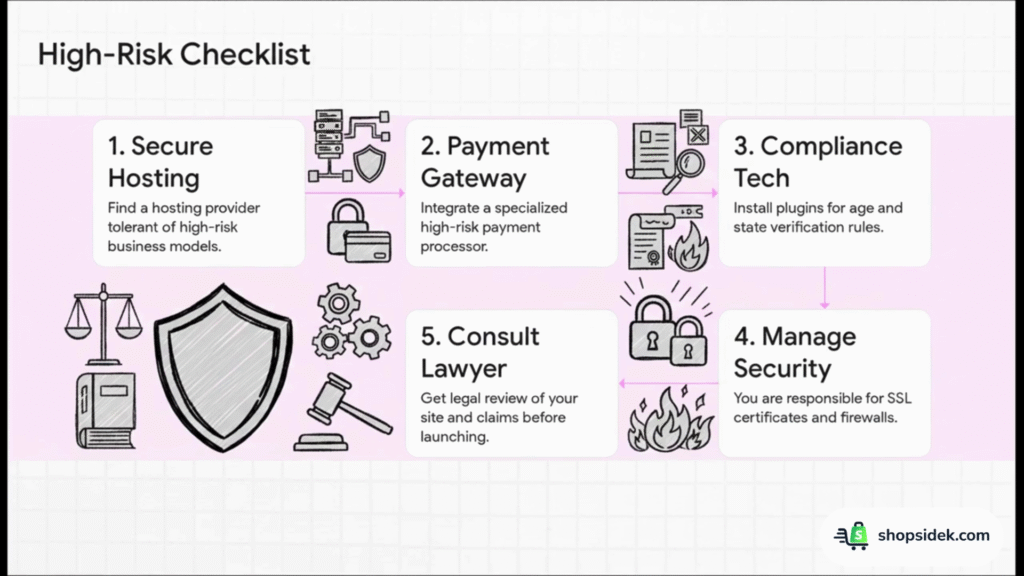
Your High-Risk E-commerce Launch Checklist
Here is a checklist of the essential steps you will need to complete to launch a peptide store on a self-hosted platform:
- ✅ Choose a specialized hosting provider. You must secure a hosting provider that is explicitly tolerant of high-risk business models, as many standard hosts have restrictive terms of service.
- ✅ Integrate a high-risk payment gateway. You will need to apply for and be approved by a processor (like Corepay or Easy Pay Direct) and integrate their gateway, often using a third-party connector like NMI or Authorize.net.
- ✅ Install and configure compliance plugins. You must source and set up specific WordPress plugins for state-aware age verification, shipping restrictions, and displaying prominent legal disclaimers across your site.
- ✅ Implement robust security measures. On a self-hosted platform, you are responsible for your own security. This includes configuring SSL certificates, setting up web application firewalls (WAF), and performing regular site backups.
- ✅ Consult a legal expert. Before launching, it is crucial to have a legal professional review your website, product descriptions, marketing claims, and disclaimers to ensure they align with federal and state regulations.
Final Verdict: Choose a Platform Built for Growth, Not Just a Product
Your journey started with a single product idea—peptides. But a successful brand is built on a solid foundation that allows for growth, flexibility, and peace of mind. After exploring the complexities of the high-risk market, you now have two clear paths forward.
The High-Risk Path: A complex, technically demanding route on platforms like WooCommerce, requiring constant legal vigilance, specialized payment processors, and hands-on security management.
The High-Growth Path: Building a scalable brand in the booming, compliant health and wellness space on a platform like Shopify, which handles the technical side so you can focus on marketing and growth.
For the vast majority of entrepreneurs, the choice is clear. The smartest move is to channel your ambition into a business model that is set up for success from day one. By choosing a compliant product and the world’s leading e-commerce platform, you are not just starting a store; you are building a future-proof asset.
Ready to build your brand the right way? Start your free Shopify trial and see how quickly you can bring a winning product idea to life.

Affiliate Disclosure: I partner with Shopify as an official Media Partner. If you sign up using my link, I may receive a small commission at no extra cost to you. Thank you for supporting the content I create.
FAQ: Can People use Shopify to Sell Peptides
What health and wellness products can I sell on Shopify?
Shopify is an excellent platform for thousands of high-growth health and wellness products. Popular and compliant categories include fitness supplements like creatine and collagen, nootropics such as mushroom coffee, high-tech fitness apparel, yoga accessories, and home-gym equipment.
You can also sell digital products like workout guides and nutrition plans, which have very high profit margins. For a full list of opportunities, explore our guide to 200+ products you can sell on Shopify.
Is it legal to sell peptides online in the USA?
Selling peptides online in the USA exists in a legal grey area. While not explicitly illegal in all cases, they are heavily regulated by the FDA, which often classifies them as “unapproved new drugs” if they are marketed for human consumption.
This regulatory complexity, combined with restrictions from payment processors and e-commerce platforms, is why most successful online health brands choose to focus on fully compliant products with a clear legal status.
Can I dropship peptides using an app like Spocket?
It is highly unlikely. Successful dropshipping requires approval from both the e-commerce platform (like Shopify) and the dropshipping supplier or app (like Spocket). Since peptides violate Shopify’s Acceptable Use Policy, you wouldn’t be able to run the store in the first place.
This difficulty stands in stark contrast to the ease of dropshipping thousands of compliant fitness and wellness products, which offers a much faster and safer way to get your business to market.
Do I really need a lawyer to start a high-risk e-commerce business?
For high-risk products like peptides, I strongly recommend consulting a lawyer who specializes in FDA and e-commerce law. They can help you navigate federal and state regulations, review your marketing claims, and draft appropriate disclaimers.
This legal counsel is another significant cost and complexity that entrepreneurs can avoid by choosing a business model with lower regulatory risk on a user-friendly platform like Shopify.