Last updated: October 30, 2026. Both example pages are free, interactive demos that open without an account.
A stationery product page sells paper the shopper can’t touch, so it has to answer three questions in words and numbers: which paper suits the way I write, will my pen come through the page, and how long until I need more. The two Shopify examples below answer all three, with exact prices, the sections that persuade, the cart, one thing not to copy and the Kaching Bundles settings behind each widget. A section near the end covers what a US stationery page may say about recycled paper and FSC labels.
- Slipleaf, a canvas notebook cover with three slim inserts, sold as a build-your-own bundle where every insert gets its own paper.
- Lamplit (everyday version), an undated six-month planner sold as “For you”, “For you, and one to give” or “For you, and two to give”.
Key takeaways: 7 rules for a stationery product page
- Let each insert or book get its own paper or cover. People write different things on different paper, so a bundle of three identical notebooks sells the wrong set.
- Print the paper as numbers. Paper weight in gsm, page count, ruling spacing and trim size let a shopper compare your notebook with the one already on their desk.
- Publish a pen test that names the pens, including the one that fails. A table that admits the permanent marker bleeds makes the other six rows believable.
- Turn “how long will it last” into arithmetic. Pages a day in, weeks per insert out, labeled as a sum rather than a promise.
- Name the bundle bars for people when the extra unit is a gift. “For you, and one to give” explains why anyone would buy two planners.
- Keep the refill optional and spell out its terms. A refill switch in the cart, off until the shopper turns it on, with the price, the interval and how to skip.
- Claim only the materials you can document. “Recycled”, “recyclable” and the FSC logo come with specific rules; gsm, canvas weight and page counts only have to be accurate.
The two examples at a glance
| Slipleaf (refillable notebook) | Lamplit (undated planner, everyday version) | |
|---|---|---|
| Product | A5 cover in 16 oz cotton duck canvas, three elastic bands, slim inserts of 64 pages at 120 gsm | Undated six-month daily planner, A5, linen hardcover, 182 pages of 100 gsm cream paper |
| Kaching offer type | Bundle Upsell, build-your-own: the cover plus 1, 3 or 6 inserts | Quantity Break with bars named for people: 1, 2 or 3 planners |
| Prices | $44 · $52 · $66 | $38 · $66 · $90 |
| Crossed-out price | The items’ own total: $60 and $84 | Quantity × $38: $76 and $114 |
| Free gift | A zip pouch insert ($10 value) with six inserts | A brass bookmark rule ($14 value) with three planners |
| Per-item choice | A paper for every insert, a color for the cover | A linen cover for every planner |
| Cart reward | Free shipping from $50, a free Kraft insert from $70 | Free shipping from $50 |
| Built-in next sale | An optional refill: three inserts every 6, 8 or 12 weeks for $20.40 | Planners for other people, gift wrapped for $4 a book |
| Order in the walkthrough | $52 → $73 | $38 → $50 |
| Live example | Slipleaf notebook template (T28) | Lamplit planner template, everyday version (T11) |
Example 1: Slipleaf, a refillable notebook sold as a build-your-own bundle
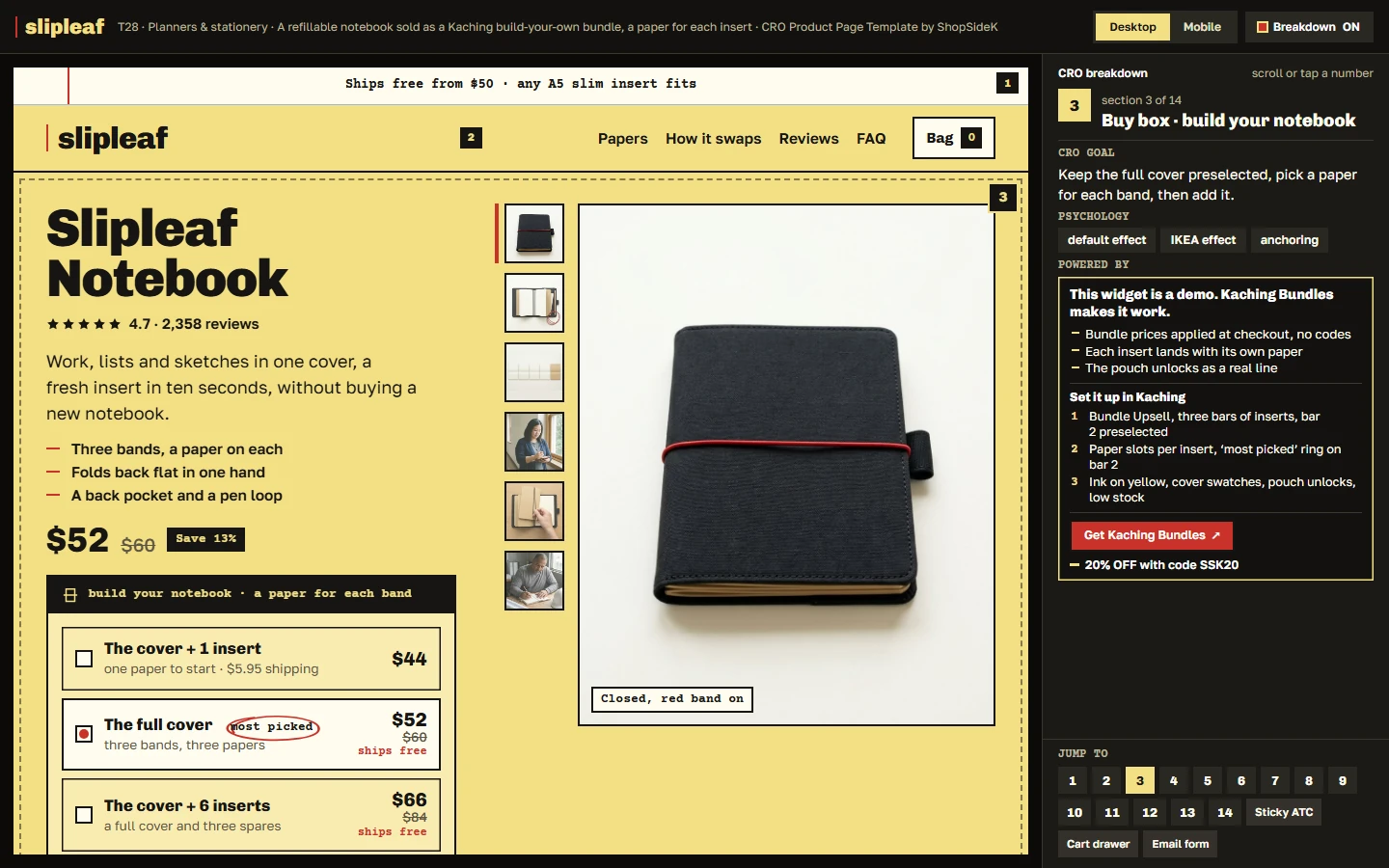
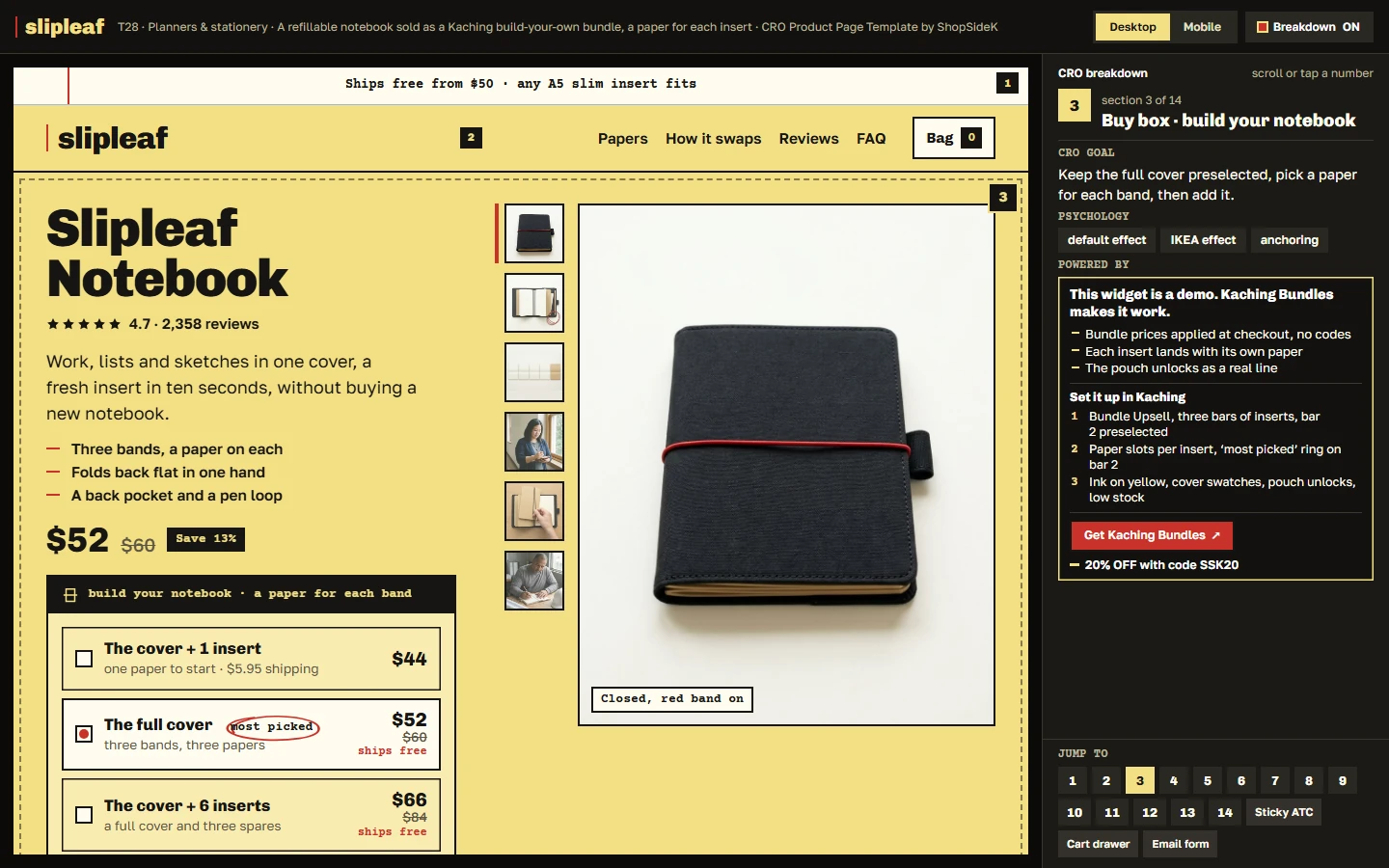
Slipleaf sells a soft A5 cover in cotton duck canvas with no board inside, three elastic bands sewn into the spine, a pen loop and a back pocket. Slim inserts slide under the bands, so one cover carries meeting notes, a list and a sketchbook at once. The promise under the title: “Work, lists and sketches in one cover, a fresh insert in ten seconds, without buying a new notebook.”
The offer: the cover plus one, three or six inserts
| Bundle bar | Price | Crossed-out price | Inside the set | Extras |
|---|---|---|---|---|
| The cover + 1 insert (“one paper to start”) | $44 | none | Cover $36 + insert $8 | $5.95 shipping |
| The full cover, three bands, three papers (preselected, “most picked”) | $52 | $60 | Cover $31 + 3 inserts at $7 | Ships free |
| The cover + 6 inserts, a full cover and three spares | $66 | $84 | Cover $30 + 6 inserts at $6 | Ships free, zip pouch insert free ($10 value) |
The selected bar shows a cover slot with three color swatches (Ink, Brick, Natural) and one slot per insert, each opening a picker of five papers: Dot 5 mm, Grid 5 mm, Lined 7 mm, Blank and Kraft. The full cover loads as Lined, Dot and Blank, so the default is already a working notebook. On the six-insert bar, the spare slots show a “?” and the button reads “Choose 3 more papers” until each has a paper. A red progress line counts the papers chosen, and a line under the widget states the saving (“You save $8 on this notebook”). The crossed-out prices are the pieces’ own prices added up, so the saving holds against buying them one by one. For more on bundling separate products, see how to choose products to bundle on Shopify.
The sections that do the persuading
- Three jobs, three bands. “You don’t need three notebooks.” Three questions (what do you write most, what else, what do you keep for later) map to a paper each: Meetings, Lists and Sketches come out as Lined, Dot and Blank.
- Five papers on a ring. Each paper comes up with its spec, what it is good at and its one limit. Kraft suits pencil, gel pens and a glued-in ticket; its “not for” line reads “Wet fountain ink. It feathers into the fibers.”
- The swap, in three frames. “Out from under the band in ten seconds”: lift the band, slide the full insert out, slide the new one under. No rings, no glue, no hole punch.
- Desk or standing up. A switch shows the cover flat on a desk, then folded back in one hand in a school corridor, because no board stops it bending.
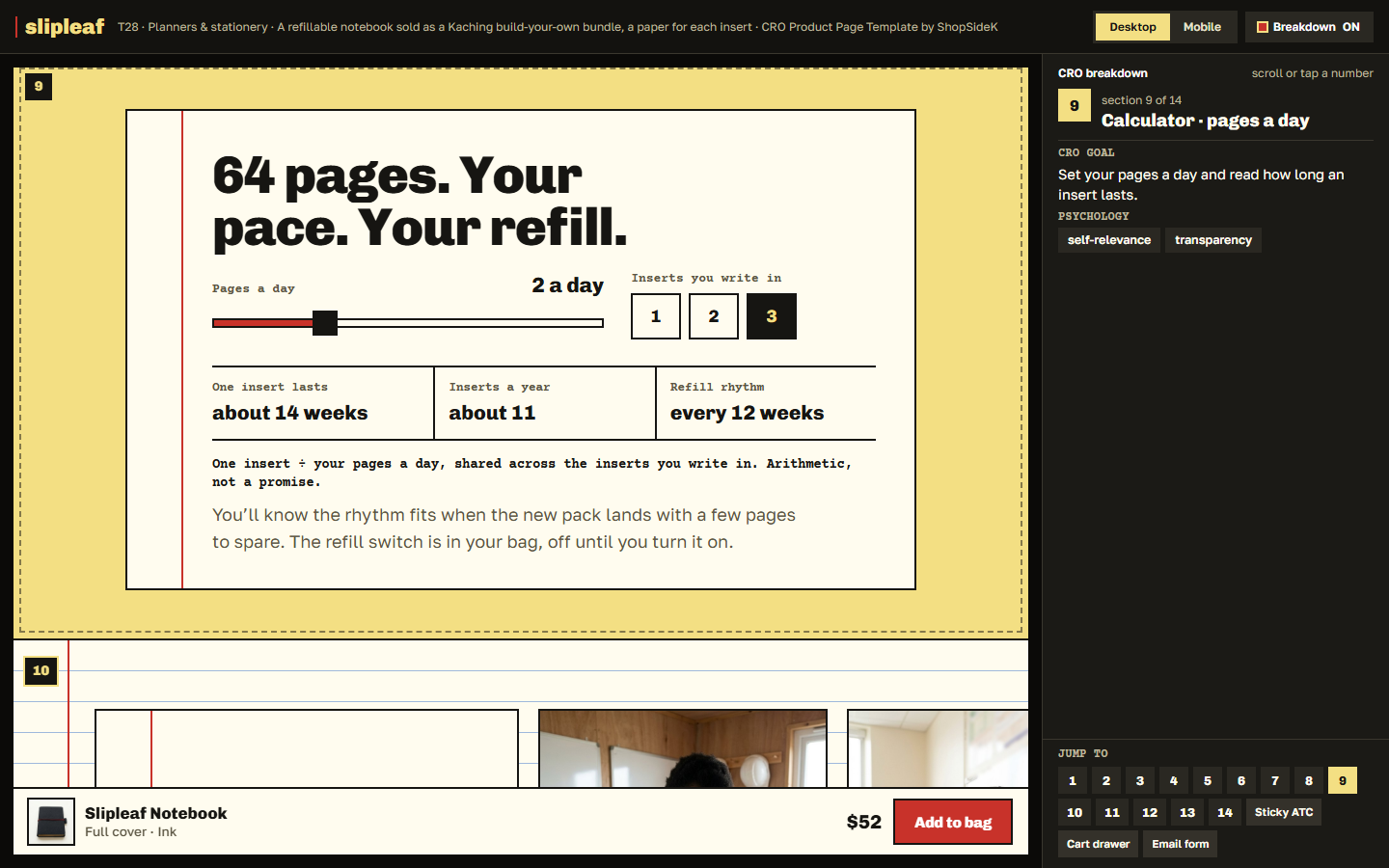
- Pages a day. Set pages per day and inserts in use; at the default of 2 pages a day across 3 inserts, a 64-page insert lasts about 14 weeks, about 11 inserts a year, with a refill every 12 weeks. The method line: “Arithmetic, not a promise.”
- Five covers at work. A drag row of five working days, from a site cabin to a ward station, each with the three papers that person carries.
The cart: from $52 to $73, and a refill that stays off
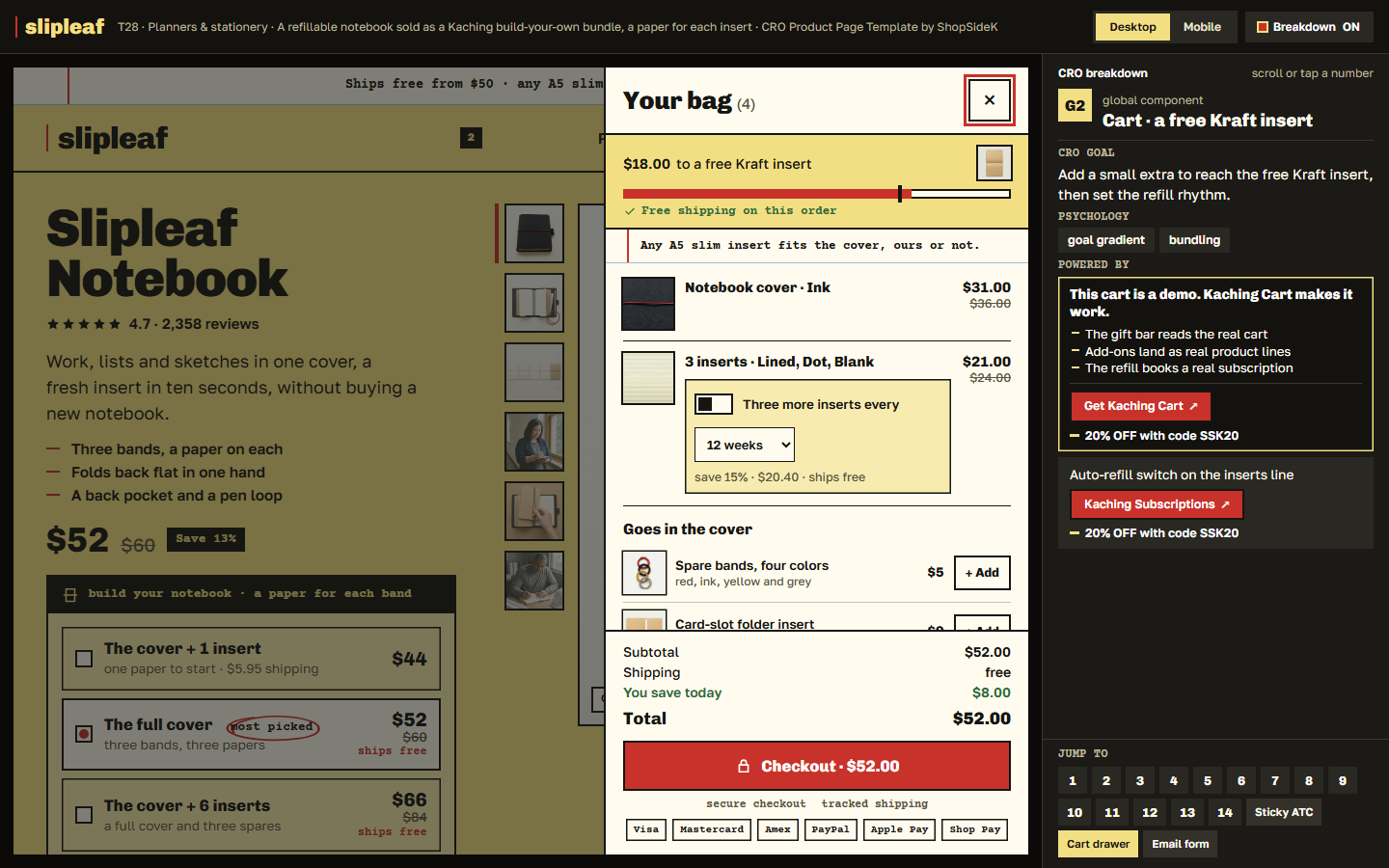
The full cover at $52 opens the Kaching Cart drawer with free shipping reached and a reward bar reading “$18.00 to a free Kraft insert” at $70. A list headed “Goes in the cover” offers spare bands ($5), a card-slot folder insert ($9) and a brass pen clip ($7); adding all three takes the order to $73 and drops the Kraft insert in as a $0 line. A ruled line at the top answers a fear about refills: “Any A5 slim insert fits the cover, ours or not.”
The inserts line carries the repeat purchase: three more inserts every 6, 8 or 12 weeks at $20.40 (15% off three at $8), shipped free, with a note that today’s total doesn’t change. It stays off until the shopper turns it on, and the pages-a-day card is what tells them which interval fits.
One thing not to copy
The three-band finder works because the cover has exactly three bands, so three questions land in three slots. If your notebook holds one block of paper or a variable number of inserts, a finder like this has nowhere to put its answers; a short paper guide does the job better. The demo’s “Brick covers: 38 left from this dye lot” line is sample text: on a live store, show it only if it reads a real stock count.
Rebuild the offer in Kaching
- A Bundle Upsell deal on the cover and the inserts: the cover + 1, 3 and 6 inserts at fixed bundle prices, bar 2 preselected.
- Different variants per item, so each insert takes its own paper and the cover its own color swatch; empty items shown as “choose” slots.
- The zip pouch as a progressive gift unlocked on bar 3, a progress bar, a savings line and a free-shipping label on bars 2 and 3.
Browse more Kaching build-your-own box templates in the library.
Example 2: Lamplit, an everyday planner page that sells to two people
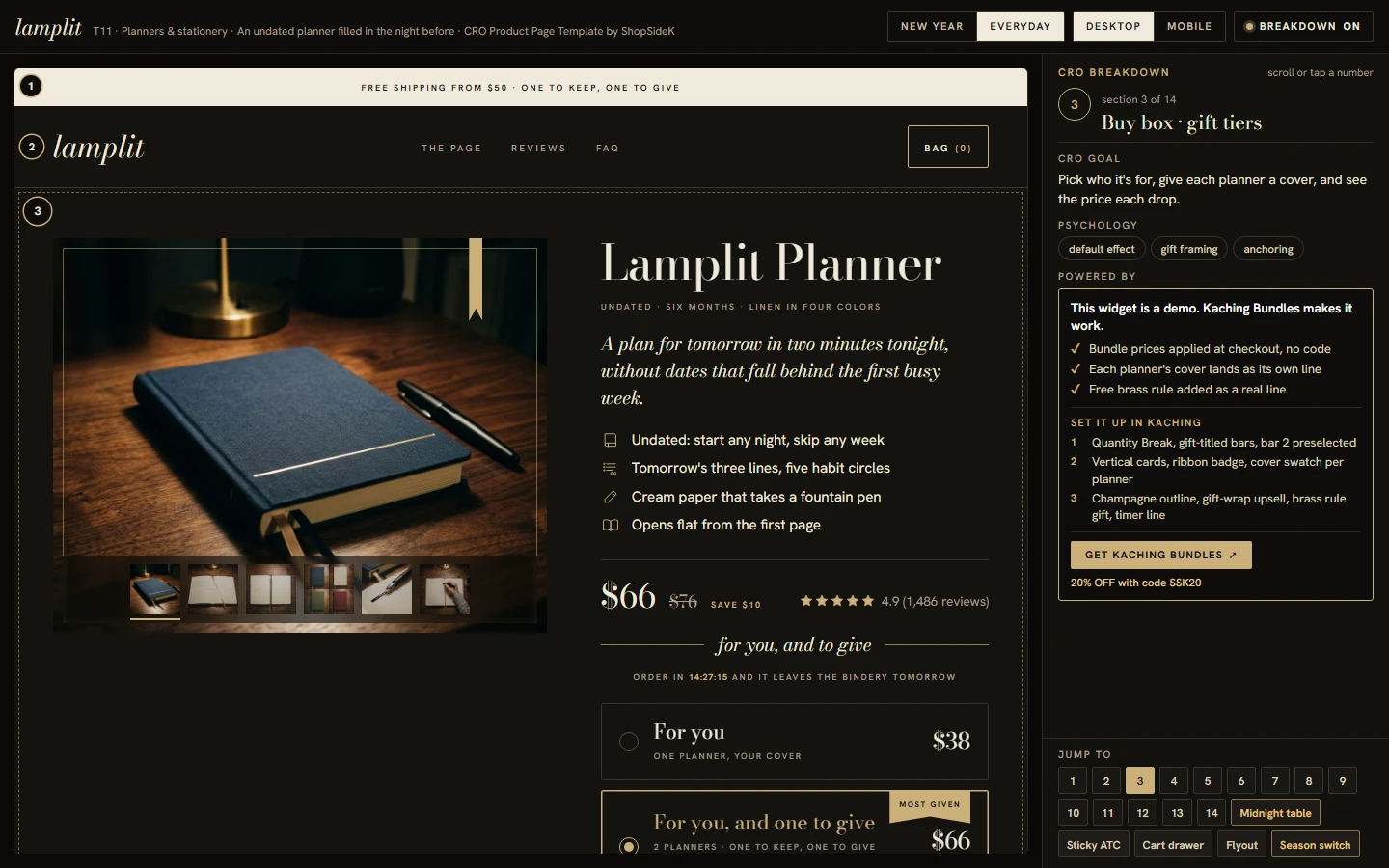
Lamplit sells an undated six-month planner: a linen hardcover in Midnight, Parchment, Moss or Claret, sewn to lie flat, with three lines for tomorrow and five habit circles on every page. The demo opens on its New Year version; the link below opens the everyday page, dark ink with champagne details, which sells a two-minute evening routine.
The offer: bars named for people, not quantities
| Bundle bar | Price | Crossed-out price | Price each | Extras |
|---|---|---|---|---|
| For you | $38 | none | $38 | |
| For you, and one to give (preselected, “most given”) | $66 | $76 | $33 | Ships free, gift wrap for the one you give $4 |
| For you, and two to give | $90 | $114 | $30 | Ships free, free brass rule ($14 value), gift wrap $8 |
Each planner gets its own cover, so the one you keep and the one you give can differ; the default pair is Midnight and Claret. Gift wrap appears only on the two gift bars, priced per book that leaves the house, and the top bar adds a solid brass bookmark that doubles as a 15 cm rule. The bar names do the job a percent does elsewhere: the second planner isn’t “save 13%”, it’s the person you plan the week with. For pricing bars like these, see how to set profitable Shopify quantity breaks.
The sections that do the persuading
- Under the lamp. Dragging a pool of lamplight across a dark photo of a page names each part as the light reaches it: tomorrow’s three lines, the habit circles, one line about today, the handwritten date.
- A quarter to ten. “4 moves · 2 minutes · 1 page a night”: tick today’s circles, write tomorrow down, add one line about today, move the ribbon, shown in a drag row of four photos.
- Two desks. Why the second bar exists, shown rather than argued: two sisters a thousand miles apart who call on Sunday at half past nine and each read one line from her week. Only hands and desks appear.
- A promise that expects ink. Thirty nights to decide with the planner written in, and a rebind if the sewing ever loosens.
The cart: from $38 to $50
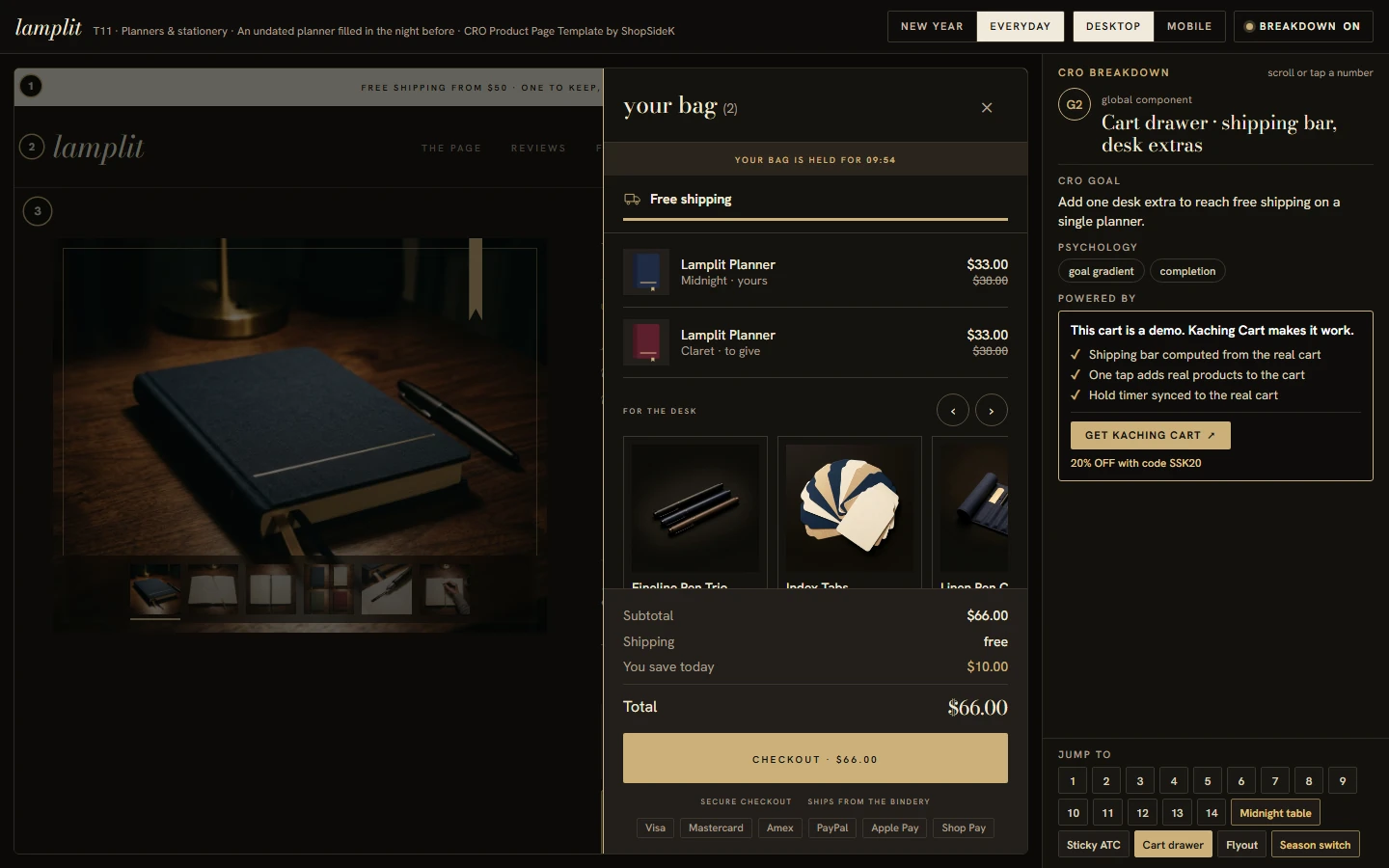
A single planner at $38 opens the cart $12.00 short of free shipping, and the first card in the add-on slider is a Fineline Pen Trio at exactly $12, fineliners the page says dry in under three seconds on this paper. One tap takes the order to $50 and clears the shipping line. Index tabs ($9), a linen pen case ($18) and optional package protection ($2.50) complete the drawer.
The buy box also shows a dispatch line, “Order in [time] and it leaves the bindery tomorrow.” In the demo it counts down to midnight every day so there is always a time on screen; a live store should name the real ship day, which after a Friday-night order is Monday.
One thing not to copy
The cart drawer opens with “Your bag is held for 10:00”, and the timer starts again on every visit. Nothing is held: a planner from a standing print run doesn’t sell out while a bag is open. A reservation timer is honest only when stock really is set aside for that shopper, as with a limited batch.
Rebuild the offer in Kaching
- Quantity Break bars for one, two and three planners, each bar titled for who it’s for, with the second bar selected on load.
- Different variants per item for the cover, a “most given” badge on bar 2 and the brass rule as a free gift on bar 3.
- Gift wrap as an add-on on bars 2 and 3, set to show only when its bar is selected.
See more Kaching gift tiers templates.
What a stationery page can claim about its paper
Specs a buyer can check only need to be accurate; environmental words come with specific FTC guidance and certification rules. This section covers both. This is general information, not legal advice.
Specs and tests a buyer can check
Both demos sell their paper with numbers rather than adjectives: Slipleaf’s inserts are 64 pages of 120 gsm with 5 mm dots or squares and 7 mm lines, and Lamplit’s planner is 182 pages of 100 gsm cream paper in A5. Neither calls its paper “premium”, and a shopper who knows their current notebook’s gsm can compare without help.
The pen test is the second half. Lamplit’s table lists seven pens most people own, front and back, with a drying time for each:
| Pen | Back of the page | Bleeds through | Dry |
|---|---|---|---|
| Ballpoint | Nothing | No | Instant |
| Gel pen, 0.5 mm | Faint | No | 6 s |
| Fountain pen, medium nib | Faint | No | 11 s |
| Felt fineliner, 0.4 mm | Nothing | No | 2 s |
| Brush pen | Faint | No | 8 s |
| Highlighter | Faint | No | 3 s |
| Permanent marker | Shows through | Yes | 4 s |
Slipleaf states its result in one accordion line: on the white papers a 0.5 gel pen, a 0.4 fineliner and a medium fountain nib don’t come through, and a wet fountain line leaves a faint shadow. Its guarantee backs the test by swapping an insert that bleeds with your pen for another paper, once an order. Both tests belong to the demos, so a live store runs its own with its buyers’ pens.
Recycled, recyclable and FSC claims
- Recycled content. Under the FTC’s Green Guides, an unqualified “recycled” claim fits only a product made entirely of recycled material, minor incidental parts aside; otherwise state the recycled share by weight, and support any pre-consumer or post-consumer split you print (16 CFR 260.13). The rule’s own example is a greeting card with 50% recycled fiber.
- Recyclable. An unqualified “recyclable” claim needs recycling facilities available to at least 60% of the consumers or communities where the item is sold, and a product with only some recyclable parts should say which (16 CFR 260.12). A notebook of paper, canvas, elastic and brass is that kind of mixed product.
- What the FSC labels mean. FSC 100% marks virgin material from FSC-certified forests, FSC Mix FSC virgin fiber and/or recycled material, and FSC Recycled 100% recycled fiber (FSC US: what the labels mean).
- Who may use the FSC logo. An on-product FSC label can only be applied under a valid FSC certificate, approved by the holder’s accredited certification body (FSC UK: FSC labels), and a shop reselling FSC-labelled notebooks needs a promotional licence from its FSC trademark service provider to use the logo in its own marketing (FSC: trademarks and labels).
Neither demo says recycled, recyclable, eco-friendly or FSC. They name materials (cotton duck canvas, a linen hardcover, a kraft card cover) and stop there. If your paper really is recycled or certified, keep the mill’s documentation and word the claim as the rules above describe.
How to build a stationery bundle in Kaching
- Choose the deal type by what is in the bundle. Different products with a price on each item, like a cover and its inserts, call for a Bundle Upsell; more of the same planner calls for a Quantity Break (Kaching help: bundle types).
- Turn on a variant choice for each item, so each insert gets its own paper and each planner its own cover (Kaching help: variant dropdowns and swatches).
- Show gift wrap only where a gift is likely, as an upsell on the gift bars that is visible only when its bar is selected (Kaching help: add an upsell to your deal bar).
- Offer the refill in the cart, not the widget. Slipleaf keeps its subscription out of the bars and puts an optional switch on the inserts line (Kaching Subscriptions in the demo). In the US, the Restore Online Shoppers’ Confidence Act requires clear terms before billing details are collected, the shopper’s express consent and a simple way to stop the charges (15 U.S.C. 8403). See also a subscription plan for each quantity tier.
- Price the worst order before you publish. On the demos’ assumed costs, Slipleaf’s weakest order (the full cover with its 10% welcome code) keeps 64.1% gross margin and a refill order 59.5%; Lamplit’s (three planners with its 10% code) keeps 68.8%. Run your own figures in the Shopify discount break-even calculator.
Stationery product page checklist
- Paper weight in gsm, page count, ruling spacing and size, in the same units for every paper.
- A paper guide: what each paper is good at and the one thing it isn’t for.
- A pen test with named pens, front and back, including the pen that fails.
- A bundle where each insert or book takes its own paper or cover.
- A free-shipping line the preselected bar clears and the starter bar almost reaches.
- Gift wrap only on the bars that include a gift.
- An optional refill with its price, interval and how to skip, off by default.
- A dispatch line that names the real ship day, and timers or stock lines only where something is really running out.
- Material names you can document, and no recycled, recyclable or FSC claims without the paperwork.
FAQ
What should a stationery product page include?
The paper in numbers (gsm, page count, ruling and size), what each paper suits, a pen test that names the pens, photos of the notebook open and in use, the price of every option and a clear returns promise. A refillable product should also say how long a refill lasts and what it costs.
How do I let shoppers choose a different paper for each insert in a Shopify bundle?
Make each insert its own item with a paper variant and turn on a variant choice for every item in the bundle. Slipleaf does this on a Kaching Bundle Upsell: the cover takes a color swatch and every insert slot opens a picker of five papers.
Should a notebook page offer a refill subscription?
It can, if the refill is optional and its terms are plain. Slipleaf offers three inserts every 6, 8 or 12 weeks for $20.40, off until the shopper turns it on, with a pages-a-day calculator to pick the interval. In the US, a recurring charge needs clear terms, express consent and an easy way to cancel.
How do I show whether a pen bleeds through the paper?
Test the pens your buyers already own on both sides of the page and publish every result, including the failures. Lamplit’s demo lists seven pens on 100 gsm paper with drying times, and only the permanent marker bleeds through.
Can I call my notebook recycled or eco-friendly?
In the US, say “recycled” without qualification only if the product is made entirely of recycled material; otherwise give the recycled percentage by weight. Say “recyclable” only if recycling is available to at least 60% of the consumers or communities where you sell, or name the parts that are recyclable.
Can I put the FSC logo on my stationery product page?
Only with FSC permission. On-product FSC labels require a valid FSC certificate, and a shop that resells FSC-labelled products needs a promotional licence before using the FSC logo in its own marketing.
More product page examples
Slipleaf and Lamplit are both in the ShopSideK library of Shopify product page templates, where every template comes with a free breakdown of each section. For more pages in this niche, browse the planner and stationery templates.
For the New Year version of the planner page, read New Year product page examples. More pages with a name or initials on the product: personalized product page examples.
Sources
- 16 CFR 260.13, Recycled content claims (Cornell LII)
- 16 CFR 260.12, Recyclable claims (Cornell LII)
- FSC US: What do the FSC labels mean?
- FSC UK: FSC labels
- FSC: trademarks and labels
- 15 U.S.C. 8403, Restore Online Shoppers’ Confidence Act (Cornell LII)
- Kaching help: different bundle types
- Kaching help: customize your bundle variant dropdowns
- Kaching help: add an upsell to your deal bar