Last updated: October 30, 2026. Both pages are live demos you can click through for free, with no account needed.
A supplement product page has to answer three questions before anyone buys: how long until it works, how much to buy, and what happens if I want to stop. The two Shopify examples below answer them in opposite ways. Lushroot, a hair gummy, sells the length of the result: 30, 90 or 180 days of supply, with the 90-day pack picked for you. Saltline, an electrolyte drink mix, sells a habit: a box that arrives every 4, 8 or 12 weeks, with subscribe and save picked for you and the cancel terms shown up front.
Below: each page’s prices, persuading sections, cart, what not to copy and Kaching setup, then what most supplement page examples skip: which claims a US supplement page can make, and what each needs behind it.
Key takeaways: 7 rules for a supplement product page
- Sell the timeline, not the bottle. If results take about 90 days, name each bundle by its days of supply, so the 90-day pack reads as the starting point.
- Preselect what matches how the product gets used up. A slow-acting product defaults to the cycle pack; a daily consumable defaults to a subscription timed to one serving a day.
- Print the cost per serving on every option. “$0.91 a stick” lets the shopper compare the bundle with what they already pay.
- Show the way out before you ask for the subscription. Skip, pause, swap and cancel belong next to the subscribe option, not deep in the FAQ.
- Let the shopper measure their own problem. A hair-tie count or a weigh-in turns a general promise into the shopper’s own number.
- Back every health claim with evidence, not reviews. Under FTC guidance, individual experiences never prove what a health product does.
- Give a free item, not a percent that stacks. When bundles and subscriptions already discount, a free sampler protects margin a welcome code would eat.
The two examples at a glance
| Lushroot | Saltline | |
|---|---|---|
| Product | Hair growth gummies, 2 a day, 30 days a bottle | Sugar-free electrolyte drink mix, 30 sticks a box |
| What the page sells | A 90-day result cycle | A daily habit on a schedule |
| Kaching offer type | Quantity Break as supply packs: 1, 3 or 6 bottles | Quantity Break, subscription first: 30, 60 or 90 sticks |
| Selected on load | 3 bottles, one-time purchase tab | 60 sticks, Subscribe tab, every 8 weeks |
| One-time prices | $39 · $87 · $144 | $36 · $68 · $96 |
| Subscribe and save | 15% off: $33.15 · $73.95 · $122.40 | 20% off: $28.80 · $54.40 · $76.80 |
| Free gifts | 2 gifts with 3 bottles; 3 gifts and a locked pillowcase with 6 | A free steel bottle in the cart from $70, first order only |
| Email signup offer | 10% off the first order | A free four-flavor sampler |
| Urgency signals | Sale countdown and a live viewer count | None |
| Order in the walkthrough | $39 → $87 → $106 | $54.40 → $77.40, plus the free bottle |
| Live example | Lushroot template (T01) | Saltline template (T18) |
Example 1: Lushroot, a supplement page that sells a 90-day cycle
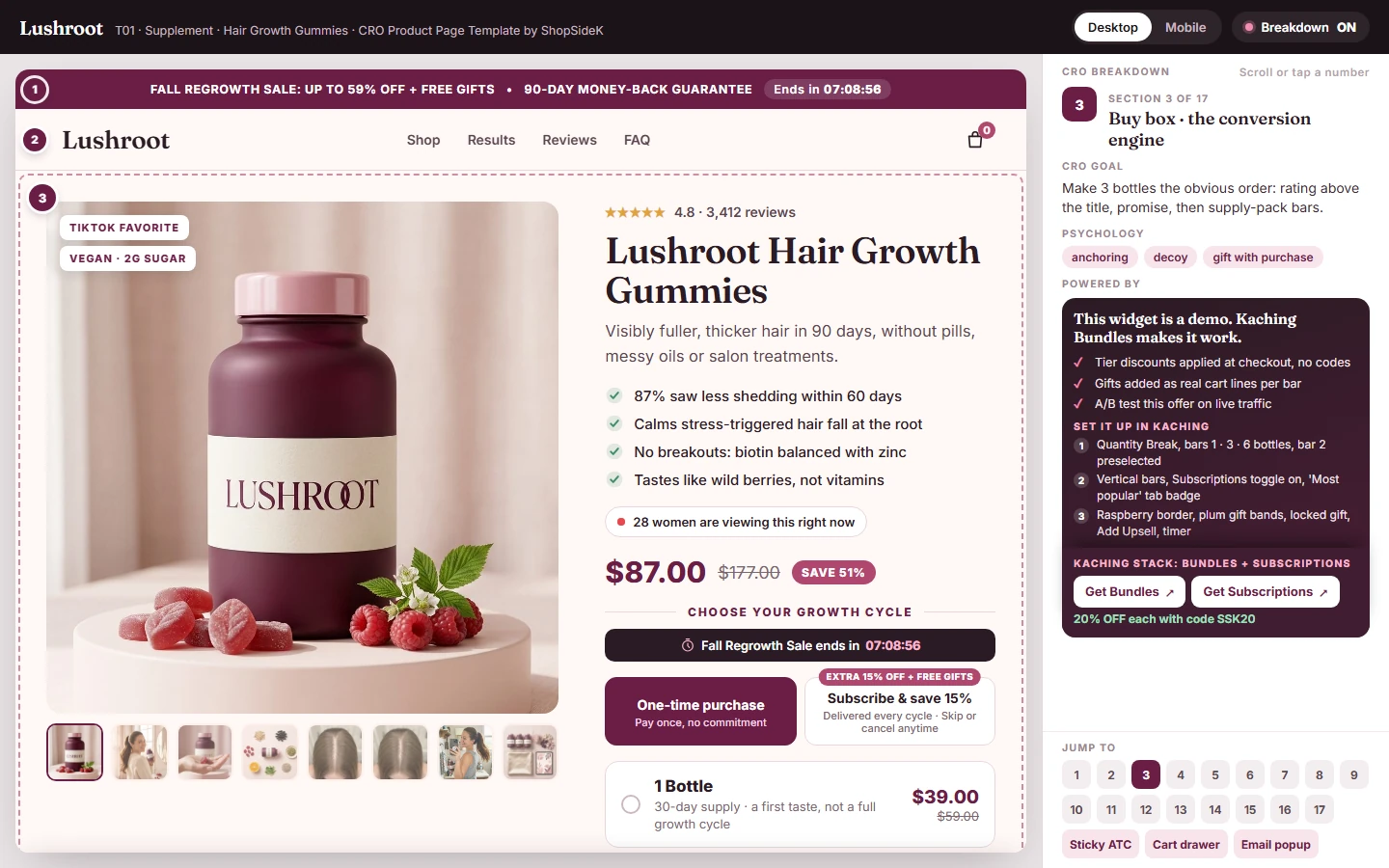
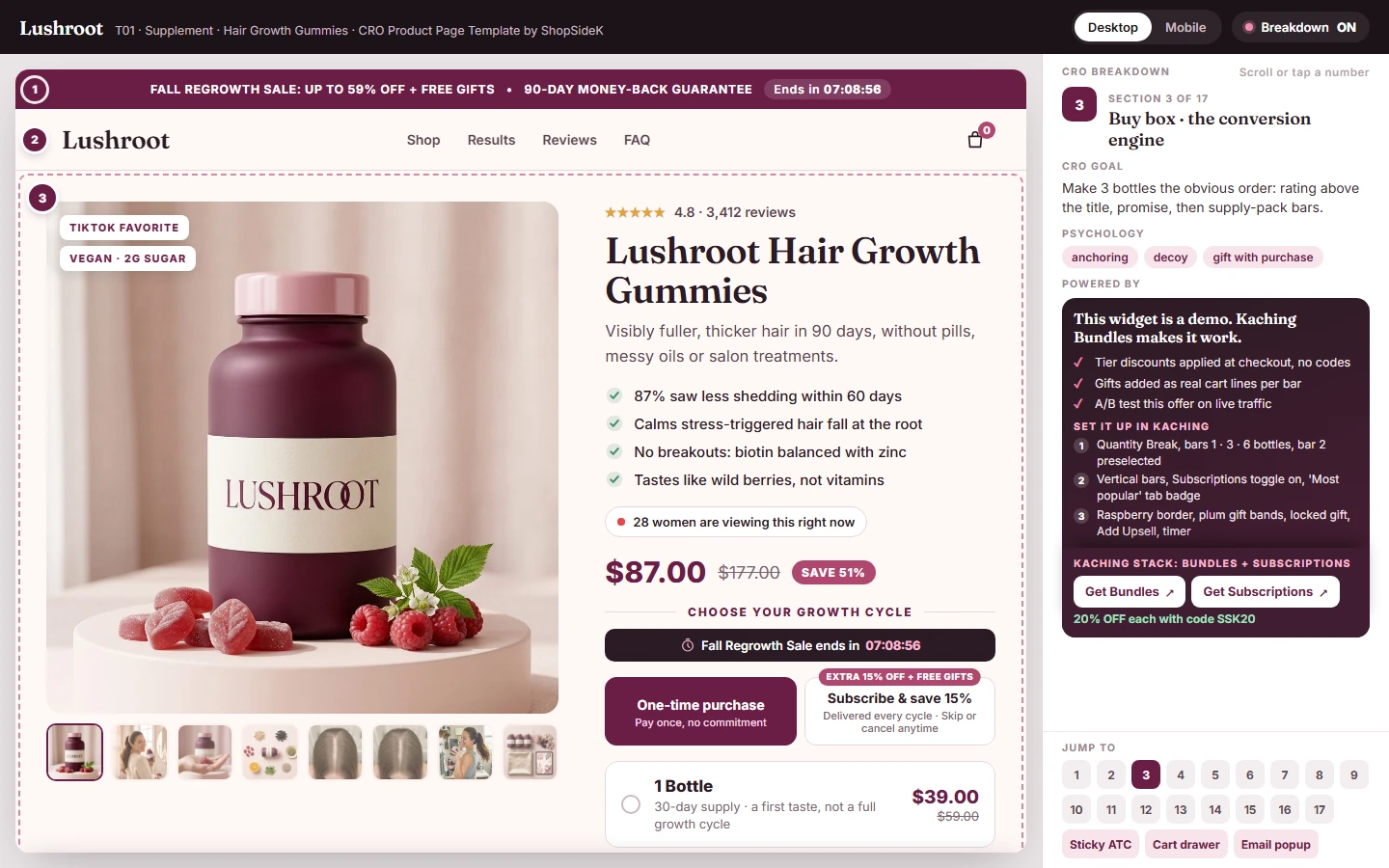
Lushroot sells hair gummies whose results, by the page’s own account, take about three months. One bottle lasts 30 days and the first visible change it promises lands around day 45, so a one-bottle order sets the buyer up to quit early. The page therefore sells days of supply instead of bottles.
The offer: supply packs named by days
| Supply pack | One time | Subscribe and save 15% | Per bottle, one time | What comes with it |
|---|---|---|---|---|
| 1 bottle, 30 days | $39 | $33.15 every 30 days | $39 | Shipping $4.95 |
| 3 bottles, 90 days (selected) | $87 | $73.95 every 90 days | $29 | Free shipping, a scalp massager, an e-guide |
| 6 bottles, 180 days | $144 | $122.40 every 180 days | $24 | Free shipping, three gifts, plus a satin pillowcase that unlocks only at 6 bottles |
The subtitles carry the argument: “a first taste, not a full growth cycle” under one bottle, “one full growth cycle” under three. A greyed strip under the bars reads “Choose 6 Bottles to unlock a FREE Satin Pillowcase ($39)”, which gives the largest pack a reason beyond price.
The sections that do the persuading
- Hair-tie test. The shopper counts how many times her hair tie wraps and reads which stage that usually means, so she names her own problem before the page promises anything.
- Shelf tally. She ticks the products already in her bathroom and a running total climbs (from about $94 to about $229 in the demo) next to the $87 cycle. The price is compared with her own spending, not with a crossed-out number.
- Day-30 wall. A wall calendar shows bottle one running out before the first visible change, which is the page’s case for the 90-day pack.
- Reviews filtered by situation. Chips such as Postpartum, Stress shedding and Thinning narrow a large review wall to people like her.
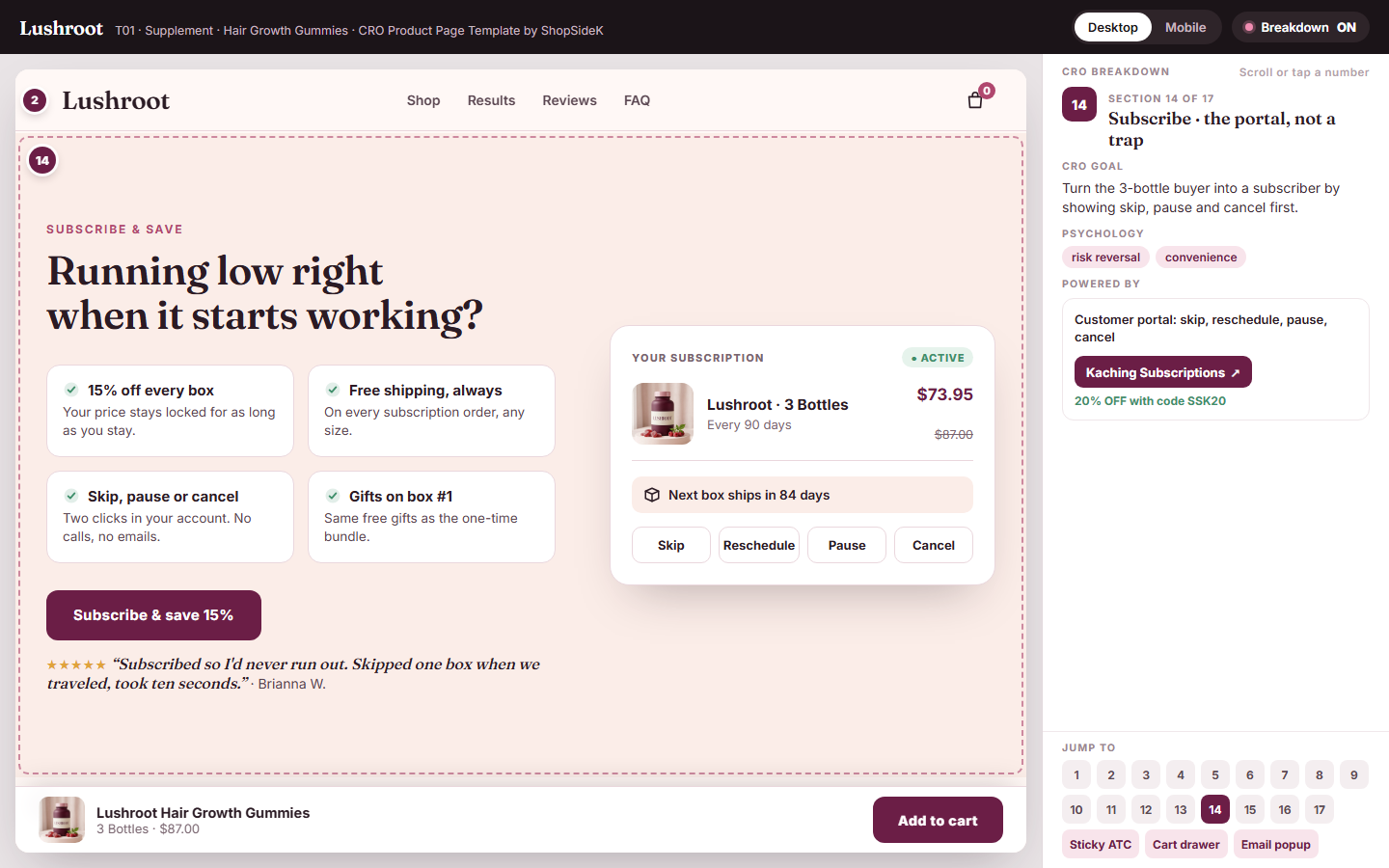
- The subscription portal, shown first. A mock account screen with Skip, Reschedule, Pause and Cancel answers “will I get stuck?” before she opens the subscribe tab.
- A 90-day guarantee that counts empty bottles. The refund window covers a full cycle, matching the timeline the page sells.
The cart: from $87 to $106
Under the selected 3-bottle pack sits one add-on: a scalp serum for $19, struck at $34, added with one tick. That takes the order from $87 to $106 before the cart opens. The cart drawer, built with Kaching Cart, then shows free shipping unlocked (from $50), one more add-on (a $12 comb) and an optional $4.95 line for priority processing and shipping protection.

Two things not to copy
- The day-30 wall, if your product works faster. The calendar exists only because this product’s results are slow. For something that works on day one, it invents a waiting period.
- The always-on sale. The demo runs a “Fall Regrowth Sale” countdown, a “women are viewing this right now” counter and a struck $59 on the single bottle. Use a countdown only for a sale that really ends, a viewer count only if it is real, and a crossed-out price only if you charged it before (16 CFR 233.1). Saltline, built later, drops all three.
Rebuild the offer in Kaching
- A Quantity Break deal with bars of 1, 3 and 6 bottles, bar 2 preselected.
- Vertical bars, the Subscriptions toggle on, a “Most popular” badge.
- Free gifts on bars 2 and 3, a locked gift on bar 3, and an Add Upsell for the serum.
For how to size the packs and their discounts, see how to set profitable Shopify quantity breaks.
Example 2: Saltline, a supplement page that sells the subscription first

Saltline sells sugar-free electrolyte sticks (750 mg sodium, 350 mg potassium, 70 mg magnesium), one a day, 30 to a box. A product that runs out on a schedule needs a schedule that fits, not a push. So the subscription is the default, the interval matches the box, and there is no countdown, low-stock line or viewer count.
The offer: subscribe first, interval matched to the box
| Box | Subscribe and save 20% | One time | Per stick, subscribed | Lasts at one a day | Savings line, subscribed |
|---|---|---|---|---|---|
| 30 sticks | $28.80 | $36 | $0.96 | 4 weeks | Save $7.20 a box |
| 60 sticks (selected) | $54.40 | $68 | $0.91 | 8 weeks | Save $17.60 a box |
| 90 sticks | $76.80 | $96 | $0.85 | 12 weeks | Save $31.20 a box |
A “Deliver every” dropdown offers 4, 8 or 12 weeks, set to 8, with a hint: at one a day, 30 sticks last 4 weeks, 60 last 8 and 90 last 12. Savings are shown in dollars against the one-box price times the quantity, never as an “up to” percentage. Every subscription ships free, and perk lines under the tabs say how to leave: skip, swap a flavor, pause, or cancel in two taps with no call and no form.
The sections that do the persuading
- Salt lines. Six photos of dried salt on a cap brim, a work tee, a helmet strap and more, so the shopper finds their own sweat in the row.
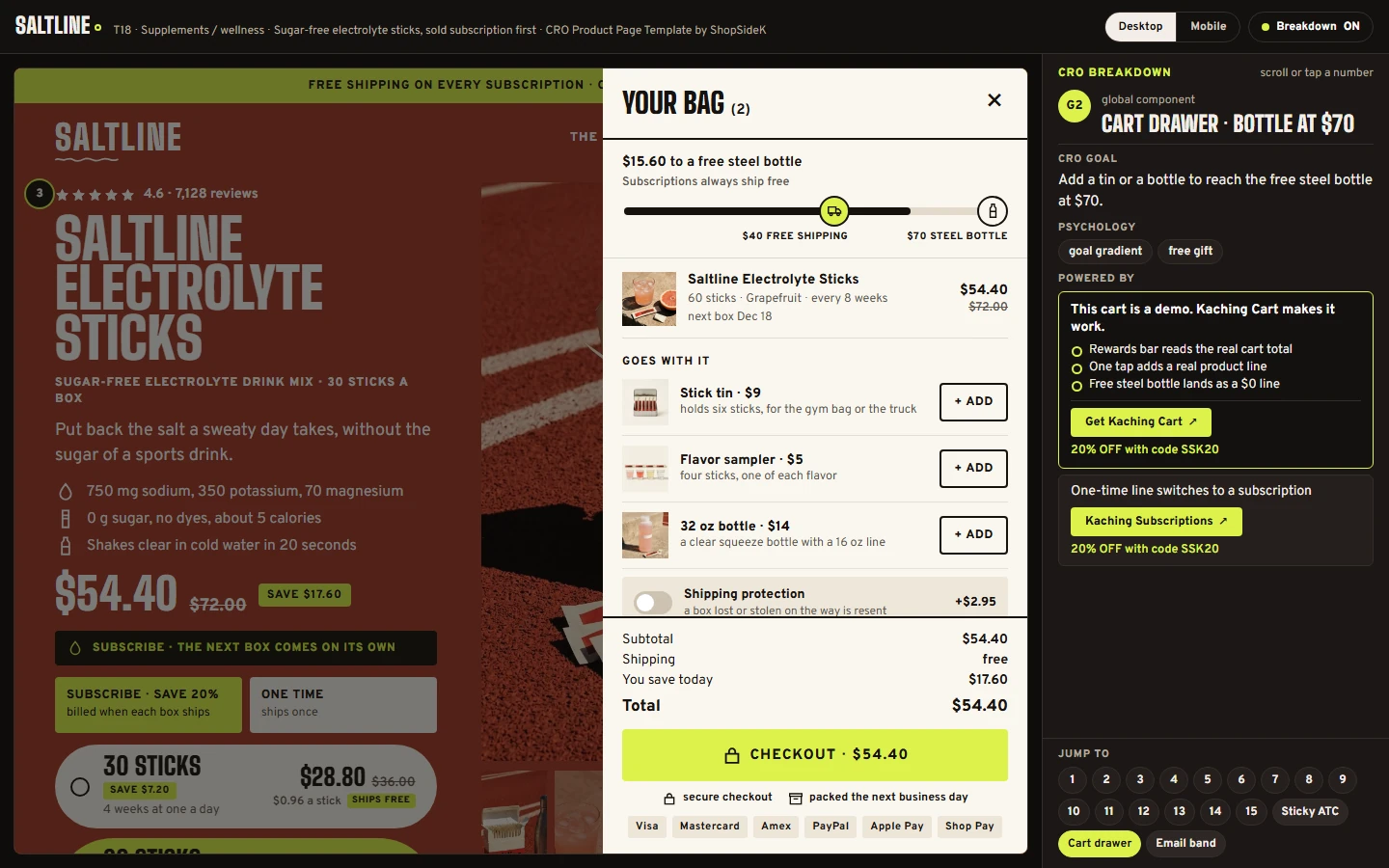
- The weigh-in. Two sliders, weight lost in one sweaty hour and water drunk during it, estimate the sodium lost and the sticks’ worth. The card states its method (about 900 mg of sodium per liter of sweat), the real range (about 400 to 2,000 mg) and that a sweat test gives an exact number.
- The label, side by side. One stick next to a typical 20 oz sports drink: 0 g against about 34 g of sugar, 750 mg against about 270 mg of sodium, about $0.96 against about $2.29 a serving.
- The water line. “Too salty just means too little water”: a 16 oz / 32 oz switch describes how each tastes, answering the likeliest complaint before it becomes a return.
- Flavors, saltiest first. Four flavors in order, each with what it mixes into, so a first box doesn’t mean buying all four.
- A guarantee that counts the empty box. Thirty days, opened is fine, plus a free flavor swap.
- An FAQ that says who should check first. One stick is about a third of a day’s sodium, so the page asks people on a doctor-ordered low-sodium diet, pregnant shoppers and anyone buying for a child to ask a doctor first.
The cart: a reward to reach, then things that go with it
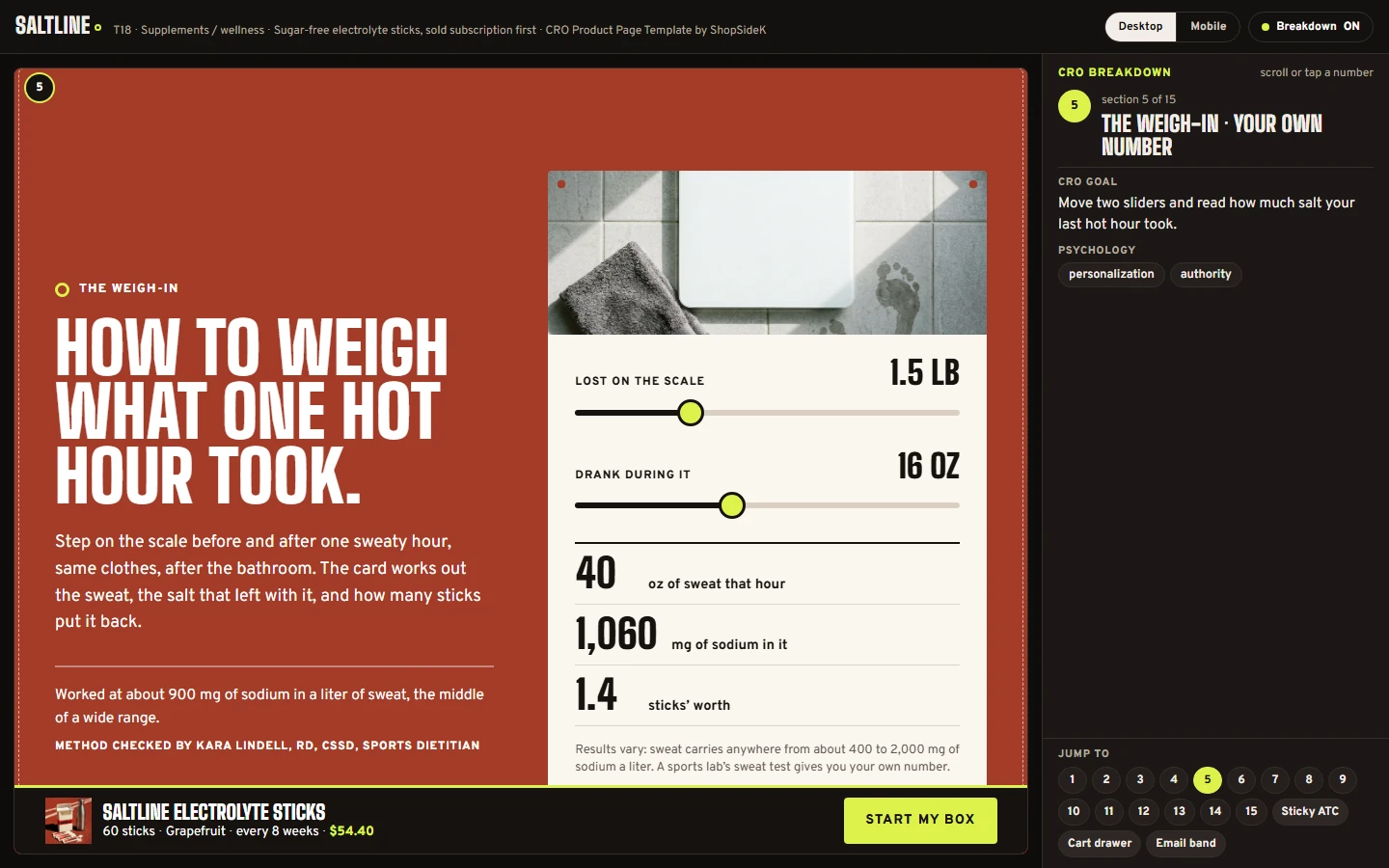
The cart drawer, built with Kaching Cart, opens on a two-step rewards bar: free shipping at $40 and a free 24 oz insulated steel bottle at $70, first order only. The selected subscribed box, $54.40, sits $15.60 short of the bottle, and the list below offers things that go with sticks: a six-stick tin ($9), a four-flavor sampler ($5) and a 32 oz squeeze bottle ($14). Add the squeeze bottle and the tin, and the order reaches $77.40 with the steel bottle free. The email signup gives the sampler free instead of a percentage, so nothing stacks on the 20%.
One thing not to copy
The flavor section earns its space because taste is the first doubt about a drink mix. If you sell capsules, a tasting flight is a section about a question nobody has; spend that space on the doubt your buyers do have, such as capsule size or when to take it.
Rebuild the offer in Kaching
- A Quantity Break deal with bars of 30, 60 and 90 sticks, bar 2 preselected.
- Pill rows, a “most picked” sticker, the Subscriptions toggle on with plans every 4, 8 or 12 weeks.
- A savings line, “ships free” tags and one row of flavor chips.
For whether each quantity should get its own subscription discount, see subscription plans per quantity tier on Shopify.
What a US supplement product page can claim
A supplement page can describe how an ingredient affects the normal structure or function of the body. It cannot claim to diagnose, treat, cure, mitigate or prevent a disease, and every claim it does make needs evidence before it goes live. Here is how the rules apply to the lines a supplement page typically carries. This is general information, not legal advice; have a regulatory lawyer review your label and product page.
- Structure/function claims need a disclaimer and a notice to FDA. Under 21 CFR 101.93, a claim such as “supports healthy hair growth” must carry this disclaimer on the label and in labeling: “This statement has not been evaluated by the Food and Drug Administration. This product is not intended to diagnose, treat, cure, or prevent any disease.” The brand must also notify FDA within 30 days of first marketing the claim (FDA compliance guide). Both demo pages carry the disclaimer in their footer.
- Disease claims, stated or implied, are off limits. The same rule counts a statement as a disease claim if it names or implies a disease, or presents the product as a substitute for a therapy for one. FDA’s 2000 final rule does not treat common conditions of natural states, such as hair loss associated with aging, as diseases.
- Health claims need scientific evidence, and reviews don’t count. The FTC’s Health Products Compliance Guidance expects competent and reliable scientific evidence, generally randomized, controlled human trials. Individual experiences are never sufficient, and a “results may vary” line does not fix a misleading testimonial.
- Experts and reviews must be real. Under the Endorsement Guides (16 CFR Part 255), an expert must have actually evaluated the product, with any payment disclosed. The FTC’s consumer reviews rule (16 CFR Part 465), published in August 2024, prohibits fake reviews, bought reviews and suppressing negative ones.
- Subscriptions follow ROSCA, whatever happens to “click to cancel.” The Restore Online Shoppers’ Confidence Act (15 U.S.C. 8403) requires clear disclosure of all material terms before billing information is taken, express informed consent before charging, and simple mechanisms to stop recurring charges. A federal appeals court vacated the FTC’s 2024 click-to-cancel amendments in July 2025; the FTC reopened rulemaking with an advance notice in March 2026, and as of October 30, 2026 no replacement rule is in force. State automatic-renewal laws, such as California’s, can add requirements.
- Biotin products should mention lab tests. FDA warns that biotin can cause incorrect results on some lab tests, including troponin tests used to help diagnose heart attacks, so the FAQ should tell buyers to let their doctor and lab know they take it.
| Line on the page | Kind of claim | What it needs before it goes live |
|---|---|---|
| “Supports healthy hair growth” | Structure/function | Evidence for the effect, the FDA disclaimer, notice to FDA within 30 days |
| “Visibly fuller, thicker hair in 90 days” (Lushroot) | A specific result on a timeline | Scientific evidence for that result in that time, typically human clinical trials |
| “87% saw less shedding within 60 days” (Lushroot) | An efficacy claim stated as a customer number | The same scientific evidence; self-counted customer check-ins do not prove an effect |
| A minoxidil box in a “what you’ve already tried” tally (Lushroot) | Possible implied claim that the gummy replaces a drug | Remove it, or have it reviewed: presenting a supplement as a substitute for a therapy for a disease is a disease claim |
| “A dermatologist reads the photos” (Lushroot), “Method checked by a sports dietitian” (Saltline) | Expert endorsement | A real, qualified expert who actually evaluated it, with any payment disclosed |
| “750 mg sodium, about a third of a day’s sodium” (Saltline) | Nutrition facts | Figures that match the Supplement Facts panel and the Daily Value (750 of 2,300 mg) |
How to build a supplement offer in Kaching
- Decide whether you sell a cycle or a habit. Slow, cyclical results suit supply packs named by days; a daily product that runs out suits a subscription-first box.
- Set the deal and name the bars by use. A Kaching Quantity Break with fixed bundle prices covers both pages (Kaching help: bundle types).
- Turn on subscriptions and match the intervals to the bars. Kaching Bundles shows subscription options inside the deal once its Subscriptions toggle is on (Kaching help: sell subscriptions for bundles).
- Add gifts or one add-on instead of a deeper cut. See free gift vs discount on Shopify.
- Keep welcome codes from stacking. A 10%-off signup code on top of a bundle price and a subscription discount cuts three times; see how Shopify bundle discounts stack.
- Price the worst order before you publish. On the demos’ assumed costs, Saltline’s least profitable order (a subscribed 30-stick box with the free sampler) keeps about 54% gross margin, and Lushroot’s 6-bottle subscription about 57%. Run your own numbers in the Shopify discount break-even calculator.
Supplement product page checklist
- Bundles named by days of supply or servings, with a cost per serving on each.
- A default that matches how the product is used up: a cycle pack or a subscription.
- Subscription price, interval and the skip, pause and cancel steps visible before checkout.
- Delivery intervals that match how long each bundle lasts.
- One section where the shopper measures their own problem.
- Every efficacy line backed by scientific evidence on file, not by reviews.
- The FDA disclaimer wherever structure/function claims appear; no disease names, drug comparisons or “treats” language.
- Real reviews, with the critical ones visible, and a safety line for anyone who should ask a doctor first.
- Urgency only when true: no evergreen countdowns, invented viewer counts or “was” prices you never charged.
- A free item, not a stacking percent, as the signup offer.
FAQ
What should a supplement product page include?
A clear promise in plain words, the dose and ingredients, bundles named by days of supply or servings, the cost per serving, subscription terms with the cancel steps, proof the shopper can relate to, a safety note, a guarantee, and the FDA disclaimer next to any structure/function claim.
Should a supplement product page default to subscribe and save?
Default to the subscription when the product is used daily and runs out on a schedule, as Saltline does. When results take a full cycle, as with Lushroot, defaulting to the cycle-length pack and offering the subscription as a tab can fit better. Either way, show how to skip, pause and cancel before checkout.
How big should a subscribe and save discount be for supplements?
The two demos use 15% (Lushroot) and 20% (Saltline). Pick the rate after pricing your worst order: the subscription discount, plus any bundle discount, gifts, free shipping and codes that could stack. If that order still clears your margin floor, the rate is affordable.
Can a supplement product page say it treats hair loss?
No. Claims to treat, cure, mitigate or prevent a disease make a supplement an unapproved drug. A supplement can make structure/function claims such as “supports healthy hair growth” if it has evidence, carries the FDA disclaimer and has notified FDA. FDA does not treat hair loss associated with aging as a disease.
Do I need the FDA disclaimer on my supplement product page?
Under 21 CFR 101.93 the disclaimer is required on the label and in labeling for every structure/function claim, and most brands repeat it on the product page next to those claims, linked with an asterisk.
Are customer reviews enough to back a supplement claim?
No. FTC guidance says individual experiences are never sufficient to substantiate a health claim. Reviews can show what using the product is like; claims about what it does need competent and reliable scientific evidence.
Is the FTC click-to-cancel rule in effect?
No. A federal appeals court vacated the FTC’s 2024 click-to-cancel amendments in July 2025, and the FTC reopened rulemaking in March 2026 without a new rule in force as of October 30, 2026. The Restore Online Shoppers’ Confidence Act still requires clear terms, express consent and a simple way to cancel, and state laws may add more.
More product page examples
Lushroot and Saltline are part of the ShopSideK library of Shopify product page templates, each with a free section-by-section CRO breakdown. For more pages in this niche, browse the supplement product page templates.
More breakdowns from this series: Black Friday product page examples, Christmas product page examples, New Year product page examples and a Valentine’s Day product page example.
Sources
- 21 CFR 101.93, Certain types of statements for dietary supplements (eCFR)
- FDA, Small Entity Compliance Guide on Structure/Function Claims
- FDA final rule on structure/function statements for dietary supplements, 65 FR 1000 (January 6, 2000)
- FTC, Health Products Compliance Guidance (December 2022)
- 16 CFR Part 255, Guides Concerning the Use of Endorsements and Testimonials in Advertising (eCFR)
- 16 CFR Part 465, Use of Consumer Reviews and Testimonials (eCFR)
- 15 U.S.C. 8403, Restore Online Shoppers’ Confidence Act (Cornell LII)
- FTC press release: advance notice of proposed rulemaking on the Negative Option Rule (March 11, 2026)
- 16 CFR 233.1, Former price comparisons (eCFR)
- FDA, Biotin interference with troponin lab tests
- Kaching help: different bundle types
- Kaching help: how to sell subscriptions for bundles