Last updated: October 30, 2026. The example page is live and free to click through, with no signup.
A Valentine’s Day product page has a different reader than the everyday page: the person buying is usually not the person who will wear it. So the page has to answer the giver’s questions first (will it arrive by the 14th, will they like it, can they swap it, will the price show in the box) and still make the case for the product. The Shopify example below does that with one switch between an everyday version and a Valentine’s version, and it never uses a single heart.
The stakes are real for jewelry sellers. In the National Retail Federation’s 2026 Valentine’s Day survey, Americans planned to spend a record $29.1 billion, jewelry was the largest category at a projected $7 billion, and 25% of consumers planned to buy jewelry. Online was the most common place to shop, named by 38% (NRF, January 27, 2026).
Key takeaways: 7 rules for a Valentine’s Day product page
- Write for the giver. Put the giver’s four worries on the page in plain words: the arrival date, the right choice, an easy exchange and no price in the box.
- Warm the palette, skip the hearts. A rosier version of your own colors says “Valentine’s” and still looks like your brand. Hearts, cupids and hot pink make it look like everyone else’s.
- Show a delivery cut-off you can keep. Count it backwards from your own packing and transit times in business days, for this year’s calendar.
- Sell the set people give. Preselect the bundle a giver is most likely to want, and label the saving in dollars.
- Let the giver hedge. A finish choice for every piece, and exchanges the recipient can make without a receipt or a call to the giver.
- Put the gift where most people buy. Move the free gift down to the preselected bundle, and swap the popup’s percent for a free gift box.
- Name the materials exactly. Write “cultured pearl” and “gold-tone” where the rules call for them, and leave out claims you can’t prove.
The example at a glance
| Everyday version | Valentine’s Day version | |
|---|---|---|
| Product | Pearl Drop Pendant ($48), sold as a set with Pearl Drop Huggies ($38) and a Three-Pearl Bracelet ($34) | Same products |
| Page colors | Jasper blue canvas, coral buttons | Rose jasper canvas (#9C5F68), a deeper rose banner, shell pink details, dark blue buttons, no hearts |
| Bundle title | “complete the set” | “the set to give” |
| Bundle prices | $48 · $72 · $96 | $44 · $64 · $84 |
| Free travel case ($18 value) | With the full set only | From the pair up |
| Urgency cue | “41 pendants left from this batch of pearls” | A shipping timer: “order in [time] and it ships tomorrow morning” |
| Delivery line | Live dates only | A cut-off line above the live dates |
| Email popup | 10% off a first order | The $6 gift box free on a first set |
| Cart top line | “Every piece arrives in its pouch, care card inside.” | “Gift sets ship with no prices in the box.” |
| Live example | Pearlstead template (T17) | Same page, Valentine’s Day switch on |
The product and the offer
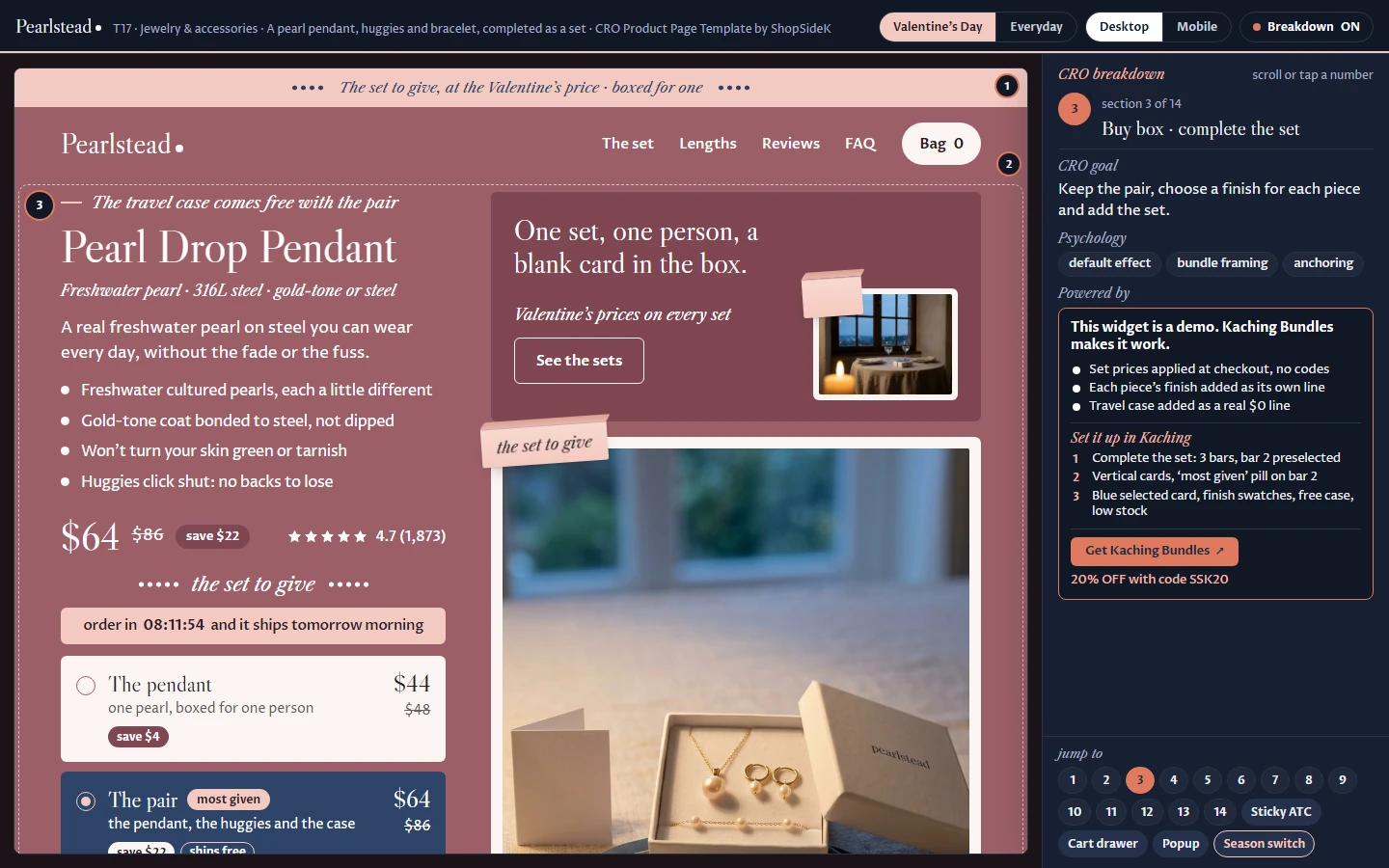
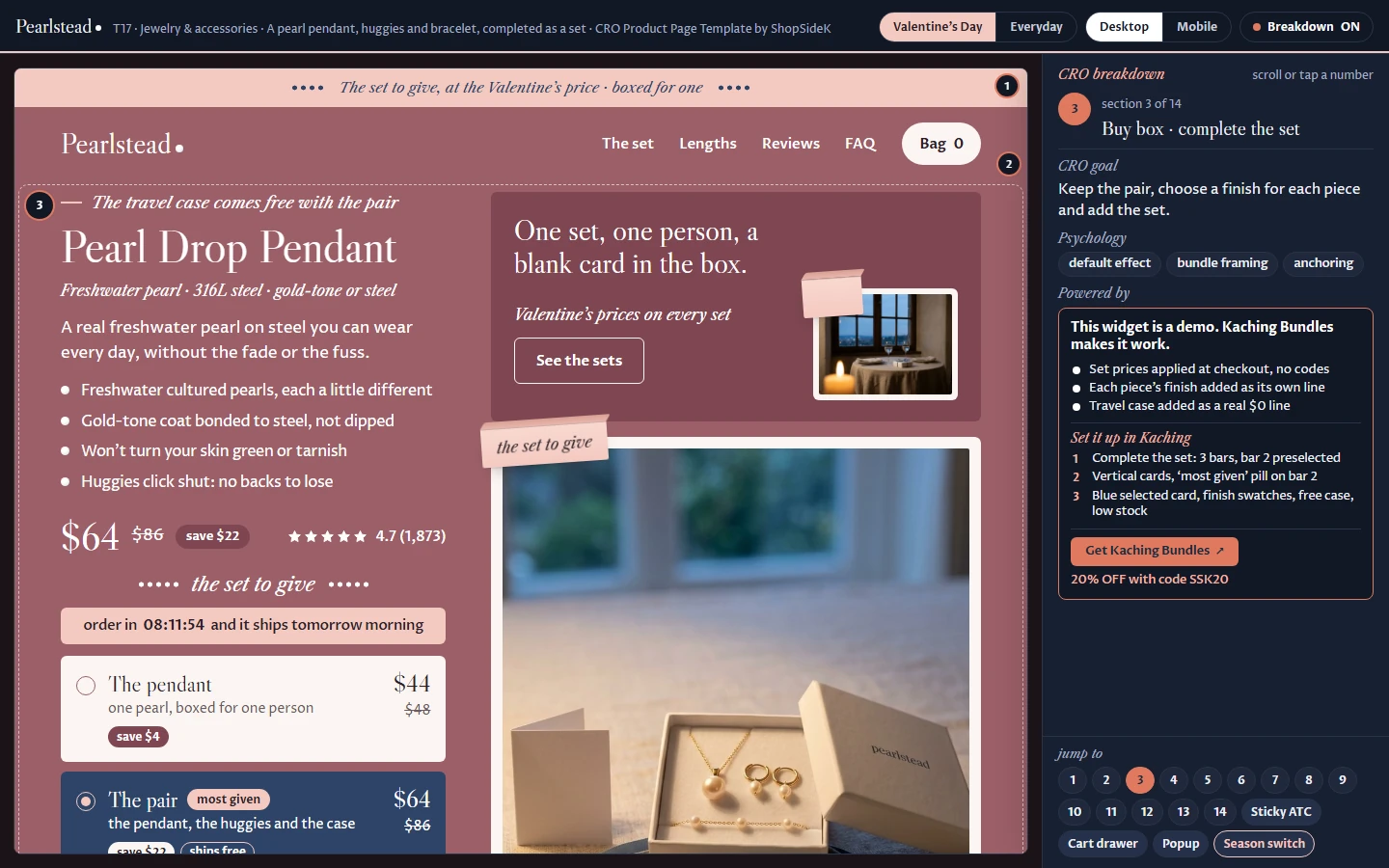
Pearlstead sells everyday pearl jewelry: freshwater cultured pearls on 316L stainless steel, either with a gold-tone PVD coat or in plain steel. The bundle completes the pendant as a set instead of selling more of the same thing:
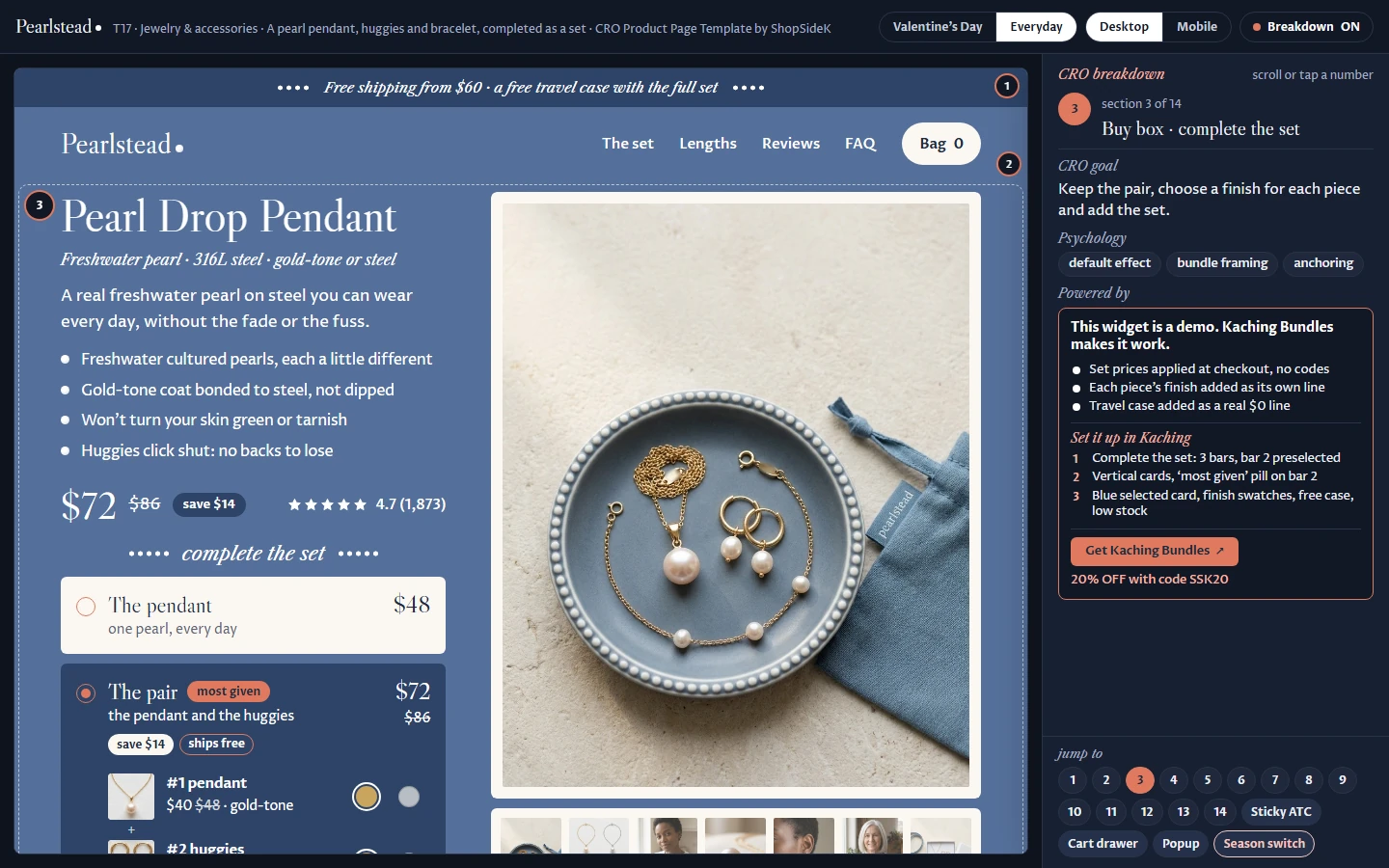
- The pendant, $48: the price anchor, with no strike and no label.
- The pair, $72: the pendant and matching pearl drop huggies. It’s the set most people give, so it’s preselected and carries a “most given” pill.
- The full set, $96: all three pieces plus a free travel case.
Nobody wants three identical pendants, which is why the deal is a complete-the-set Bundle Upsell rather than a quantity break. Each piece in the selected bundle gets its own finish swatch, gold-tone or steel, so an unsure giver can mix them. The finish never changes the price.
What changes for Valentine’s Day
A Valentine’s Day / Everyday switch in the demo’s toolbar flips between the two versions. The Valentine’s version changes these things and nothing else:
- A rosier version of the same palette. The jasper-blue canvas warms to rose jasper (#9C5F68), with a deeper rose banner (#7E4651), shell pink details (#F4C9C0) and dark blue buttons. Fonts, cards and the beaded rules of small pearl dots stay.
- One season shape, used three times. A small folded note sits on the banner photo, on the first gallery photo as a “the set to give” sticker and on the final call to action.
- A banner written for one person. “One set, one person, a blank card in the box.” Its only button scrolls to the bundle cards.
- Three new photos. The set in an open keepsake box with a blank card, a table for two at dusk, and someone fastening the clasp from behind.
- Deeper prices, still in dollars. The same Kaching deal lands on $44, $64 and $84, labeled “save $4”, “save $22” and “save $36”. There’s no percent on the page.
- The case moves down a step. The free travel case now comes with the pair, the bundle that’s already selected.
- One urgency cue, swapped. The low-stock line goes off and a shipping timer comes on, so the page never shows both.
- A cut-off line. “Order by Feb 10 for delivery by the 14th” sits above the live delivery dates. (Check your own date in the cut-off section below.)
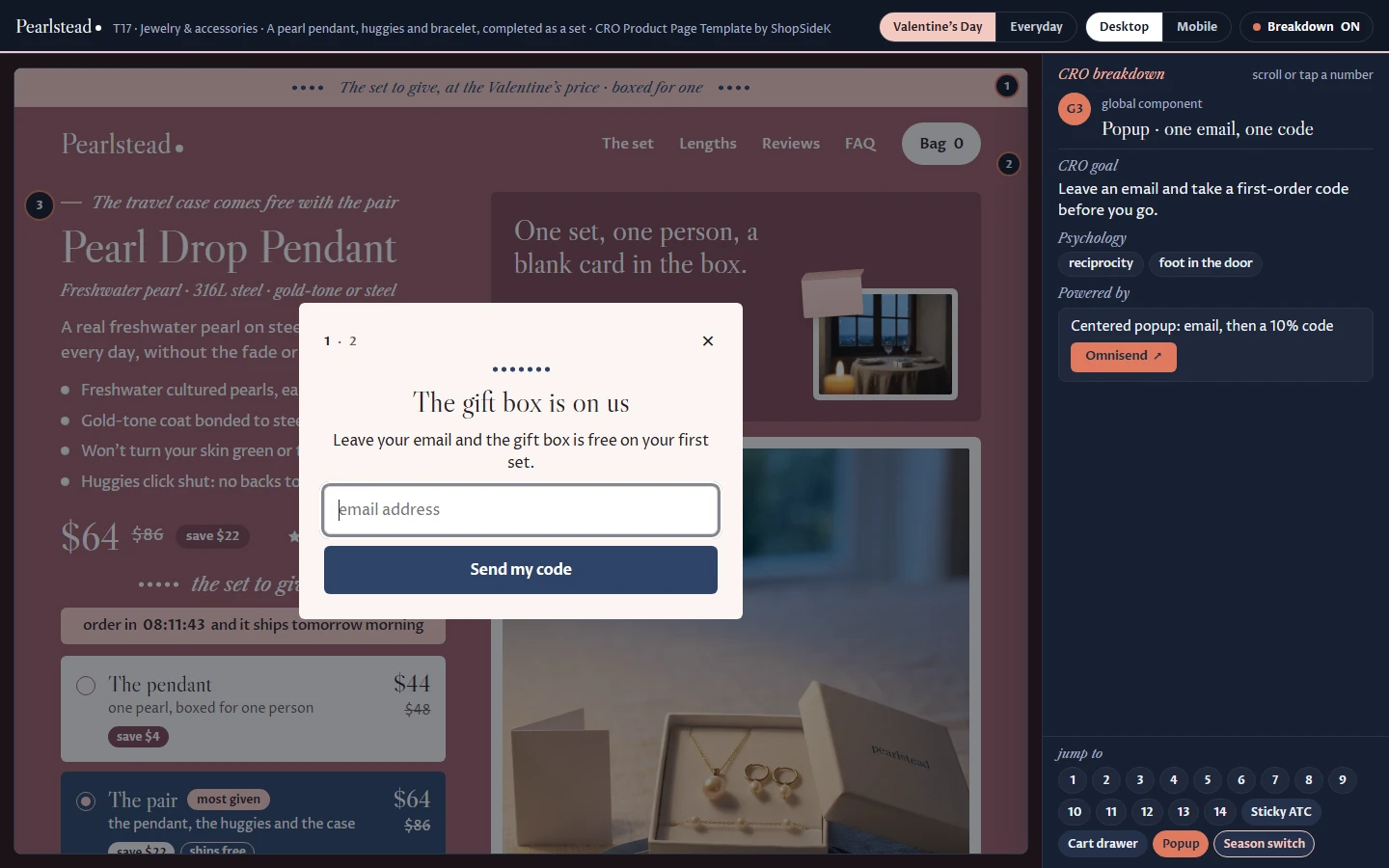
- A popup and a cart line for givers. The popup offers the gift box free on a first set of $60 or more instead of 10% off, and the cart opens on “Gift sets ship with no prices in the box.”
The bundle prices: everyday vs Valentine’s Day
| Bundle | Everyday | Valentine’s Day | Crossed-out price | Saving label (Valentine’s) |
|---|---|---|---|---|
| The pendant | $48 | $44 | $48 (Valentine’s only) | save $4 |
| The pair (preselected) | $72 | $64 + free travel case | $86 | save $22 |
| The full set | $96 + free travel case | $84 + free travel case | $120 | save $36 |
Each price is a fixed dollar amount off each piece. On the Valentine’s pair, the pendant drops $12 and the huggies $10 ($36 + $28 = $64); on the full set, the pieces drop $14, $12 and $10 ($34 + $26 + $24 = $84). The crossed-out price is the pieces’ own everyday prices added up, which is what Kaching shows for a Bundle Upsell. Shipping is free from a $60 product subtotal, so only the pendant alone pays for shipping.
The margin math behind the Valentine’s prices
A deeper price on a gift only works if the worst possible order still makes money. We priced every order a shopper could build on the demo’s assumed costs: the pieces, a pouch per piece, the care card, packing, shipping on free-shipping orders, a $2.50 return reserve per order (returns are allowed after wear) and $0.30 per piece for the two-year coat promise.
| Scenario | Revenue | Margin after those costs |
|---|---|---|
| Everyday, worst order: the full set with the travel case and a 10% code | $86.40 | 67.7% |
| Valentine’s, worst order with the season’s own code: the pair, the case and the free gift box | $64.00 | 61.6% |
| Valentine’s, absolute worst: the pair and the case with an old 10% code instead | $57.60 | 60.4% |
Two choices hold the floor above 60%. The free gift is cheap to give and easy to value: the travel case costs about $2.40 and is shown at $18. And the popup gives a $6 gift box instead of a percent off sale prices. Your costs will differ, so check them in the Shopify discount break-even calculator, and see free gift vs discount on Shopify for when a gift beats a deeper cut.
What Valentine’s Day leaves alone
Below the bundle cards, the body is the same in both versions. It answers the giver’s doubts about quality and the wearer’s later ones:
- One set, six ways. A swipeable lookbook of six different people wearing the set their own way: with a white tee, over a turtleneck, next to a second piercing.
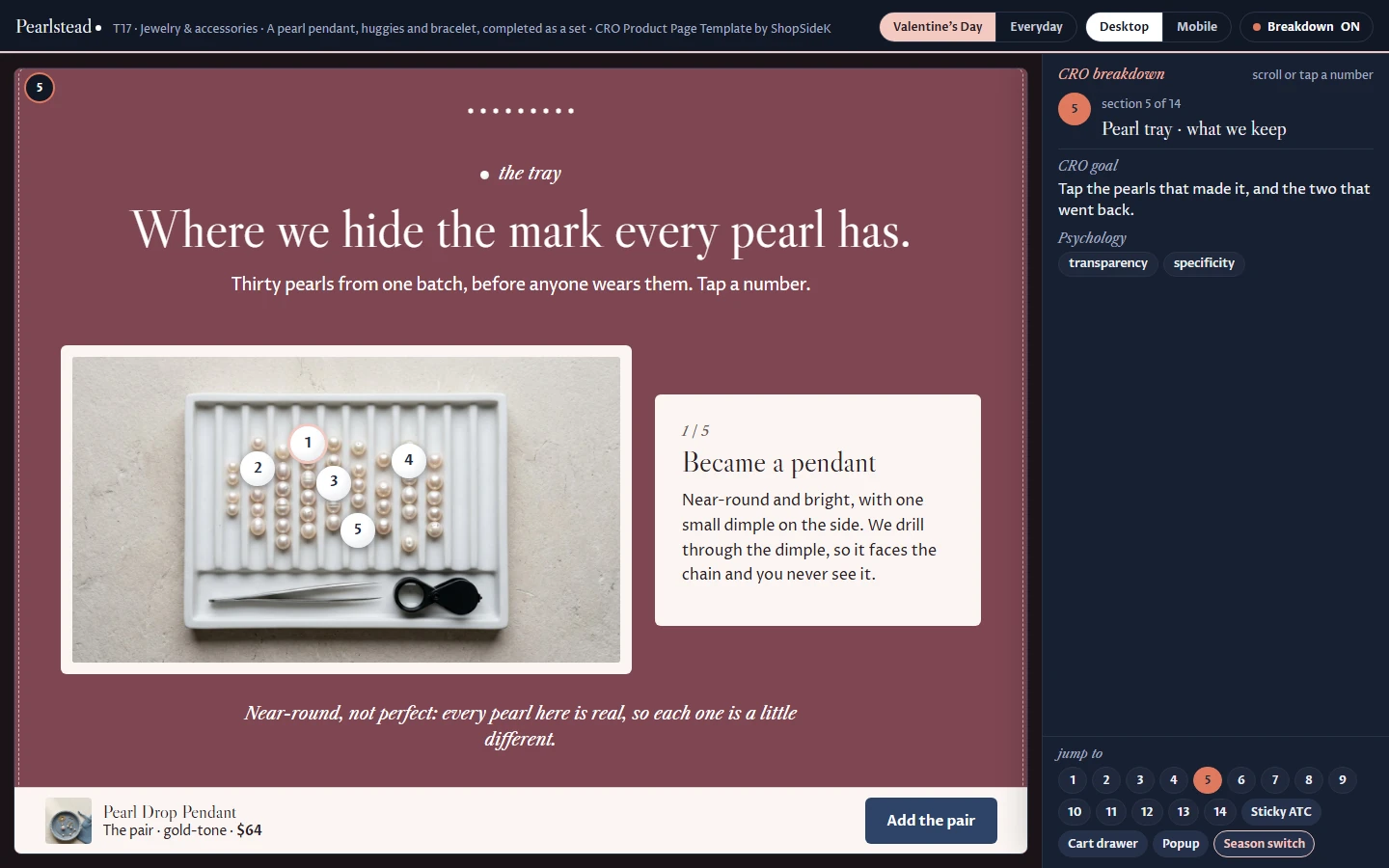
- The tray they’re picked from. About thirty pearls from one batch with five tap points: the pearl that became a pendant (its one dimple is drilled so it faces the chain), the matched pair, the bracelet pearls, and two that went back to the farm.
- Bonded, not dipped. What the gold-tone coat is, what it shrugs off, and what it doesn’t: a hard knock on stone can scratch it, and underneath it’s steel, not gold.
- Pearls by the millimeter. A drawn gauge with the bracelet pearl at 4.5 mm, the huggie drop at 6 mm and the pendant pearl at 8.5 mm. Nothing under 8 mm becomes a pendant.
- Which length, which neckline. Where the pendant sits at 16, 17 and 18 inches on four necklines, with 17 inches tagged “most worn”.
- Reviews, one quote at a time. A Loox carousel with reviews from two givers and four wearers, two of them honest four-star reviews.
- The card in the box. The care card that ships with every order, front and back.
- Three promises. Sixty days to return it, worn is fine, and the recipient can return or swap it with the order number on the care card. Two years on the coat. A lost huggie’s twin at half price ($19), once a year.
- Questions in two columns. “If you’re giving it” next to “If you’re wearing it,” every answer visible.
The cart: a calm drawer for gift orders
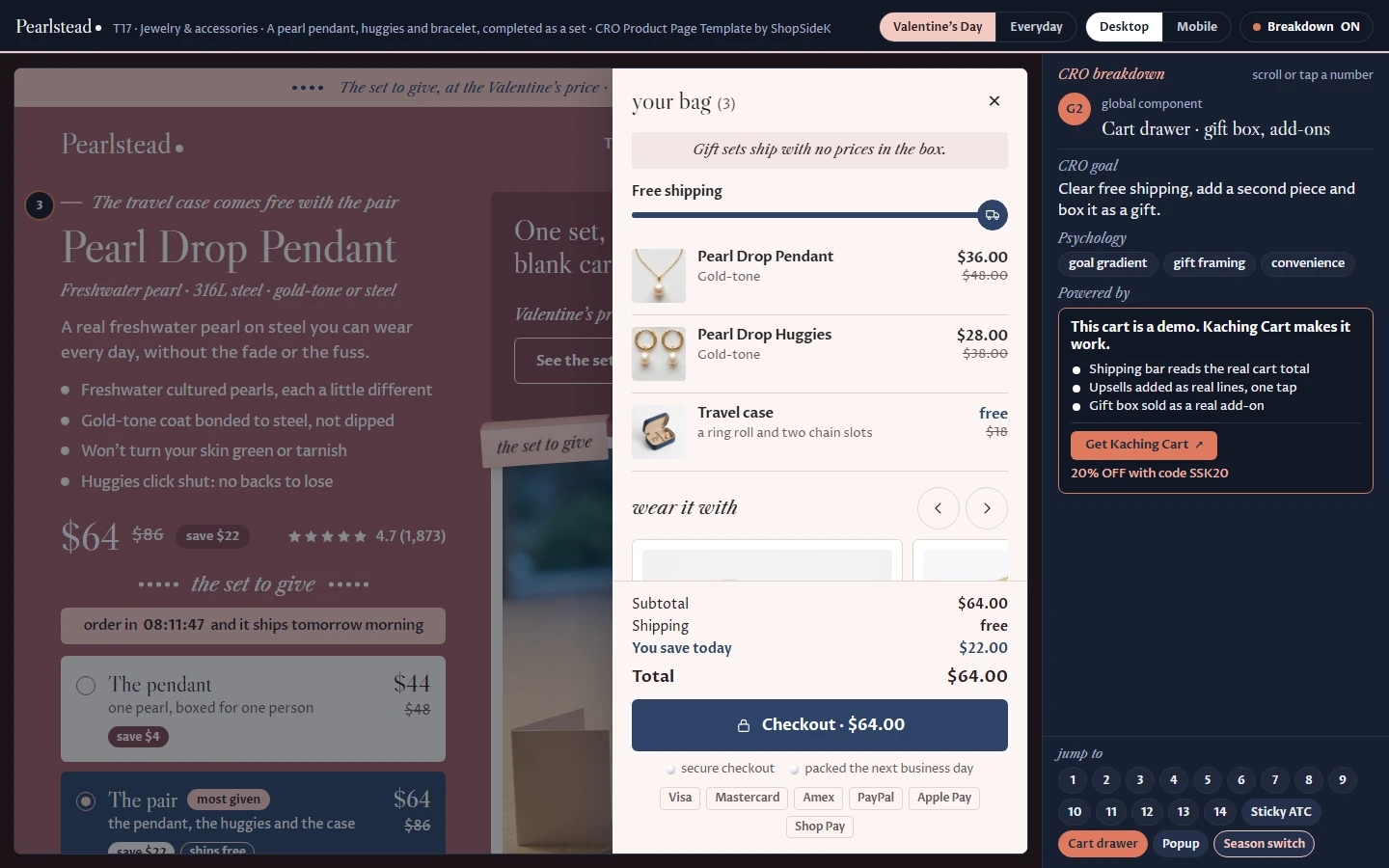
The cart drawer, built with Kaching Cart, has one reward: free shipping at $60. The Valentine’s pendant alone ($44) reads “$16.00 to free shipping,” and the $16 stoneware ring dish closes the gap exactly. A “wear it with” slider offers pearl studs ($28), a 20-inch layering chain ($24) and the ring dish. The $6 gift box, with a ribbon and a blank card, is a toggle in the drawer rather than a line in the bundle widget, which keeps the widget short.
One thing not to copy
The pearl tray works because the page shows a real selection step: some pearls become pendants, some go back. If you buy finished pieces from a supplier and nobody in your business grades them, don’t stage a sorting story. Show what is true instead, such as the spec sheet you were given and the checks you do on arrival.
Rebuild the offer in Kaching
- A Bundle Upsell on the pendant with the huggies and the bracelet as added items: three bars, a fixed dollar discount per item, bar 2 preselected.
- Vertical cards, a “most given” pill on bar 2, a finish swatch for each piece, a free travel case on bar 3.
- For Valentine’s Day, edit the same deal: deeper per-item discounts, the case on bars 2 and 3, the low-stock line off and the timer on. Edit it back after the 14th.
Kaching documents the deal types (Kaching help: bundle types) and the per-item swatches (Kaching help: variant dropdowns and swatches). For how a Bundle Upsell compares with other offers, see quantity breaks vs BOGO vs bundle upsell.
How to set a Valentine’s Day delivery cut-off you can keep
A cut-off line is the most useful urgency a Valentine’s page can show, because it is a fact, not a countdown. It only works if it holds, so count it backwards in business days:
- Start from the last delivery day you trust. Valentine’s Day 2027 falls on a Sunday, so plan for delivery by Friday, February 12.
- Subtract your carrier’s slowest transit time. The demo assumes 3 to 5 business days.
- Subtract your packing time. The demo packs orders the next business day.
- Check for holidays in that window. In 2027 no US federal holiday falls between early February and the 14th; Washington’s Birthday is the day after, Monday, February 15 (OPM federal holidays).
On the demo’s own numbers, delivery by Friday, February 12, 2027 needs orders by Thursday, February 4 for 5-day transit, or Monday, February 8 for 3-day transit. The demo’s “Order by Feb 10” was written without a year, so treat it as a placeholder. A timer like “order in [time] and it ships tomorrow morning” is honest only if it counts to your real daily packing cut-off and names the real ship day: on a Friday, Monday.
What you can say about pearls and gold-tone metal
Jewelry has its own US rulebook: the FTC’s Guides for the Jewelry, Precious Metals, and Pewter Industries, 16 CFR Part 23 (Cornell LII). Four points matter for a page like this one. This is general information, not legal advice.
- Pearls. A cultured pearl may be called a pearl only if “cultured” or “cultivated” comes right before the word, just as prominently (16 CFR 23.20). If your pearls are cultured, write “freshwater cultured pearl” in the title, the variant line and the bullets, not only in the spec table.
- Gold. “Gold plate” and “gold electroplate” are defined terms that require at least 10-karat gold of a minimum thickness, and the unqualified word “gold” is misleading on a plated or coated piece (16 CFR 23.3). A PVD coat on steel that doesn’t meet those terms is “gold-tone,” and the page says what’s underneath: steel.
- Claims you can’t prove. The demo never says “hypoallergenic,” “nickel-free,” a karat number or a pearl grade, because its spec doesn’t support them. Its answer on sensitive ears is the return window, not a promise.
- The crossed-out price. The pair’s $86 is the two pieces’ everyday prices added up, while the pair sells for $72 on an ordinary day. In the EU, a reduction must be measured from the lowest price you charged in the 30 days before it (Article 6a, Directive 98/6/EC), so compare with the everyday bundle price there, or hide the strike (Kaching help: remove the compare-at price).
Valentine’s Day product page checklist
- A rosier or deeper version of your own palette, with no hearts or cupids.
- One season shape, such as a folded note or a ribbon, repeated two or three times at most.
- The bundle a giver wants preselected, with savings labeled in dollars.
- A finish or size choice for each piece in the bundle, and the free gift on the preselected bundle.
- A delivery cut-off counted backwards in business days for this year’s calendar.
- A popup that adds to the gift instead of a percent off sale prices.
- Exchanges the recipient can make alone, and a “no prices in the box” line.
- Material names that follow the FTC Jewelry Guides: “cultured pearl,” “gold-tone” and the base metal.
FAQ
Should a Valentine’s Day product page use red and hearts?
It doesn’t need to. A rosier version of your own brand colors and one small season shape, such as a folded note, reads as Valentine’s while still looking like your store. The example page uses no hearts at all.
How do I set a Valentine’s Day delivery cut-off date?
Count backwards from the last delivery day you trust: subtract your carrier’s slowest transit time and your packing time in business days, then check the calendar for holidays. With 1 day to pack and 3 to 5 days in transit, delivery by Friday, February 12, 2027 needs orders by February 4 to 8.
Should Valentine’s Day bundle discounts be shown as a percent or in dollars?
The example shows dollars (“save $22”) and takes a fixed dollar amount off each piece so every bundle lands on a round price. A concrete amount reads easily next to a gift budget, and it doesn’t invite percent codes to stack on top.
Can I call PVD-coated stainless steel jewelry gold-plated?
Only if it meets the FTC’s definitions: “gold plate” and “gold electroplate” require at least 10-karat gold of a minimum thickness. Otherwise call it gold-tone and name the base metal, as the example does with “gold-tone coat bonded to steel”.
Do I have to say “cultured pearl” on a product page?
In the US, yes, if the pearl is cultured: the FTC Jewelry Guides say “cultured” or “cultivated” must come right before “pearl,” just as prominently. “Freshwater cultured pearl” covers it.
When should the Valentine’s Day version of a page go live?
In early January. ShopSideK’s template library moves its Valentine’s templates to the top from January 2 to February 14, which gives a page about five weeks before a cut-off in the first week of February.
More product page examples
Pearlstead is one of the templates in the ShopSideK library of Shopify product page templates, each with a free CRO breakdown of every section. For more jewelry pages, browse the jewelry & accessories templates.
Earlier breakdowns in this series: Black Friday product page examples, Christmas product page examples and New Year product page examples.
Sources
- National Retail Federation: Valentine’s Day spending expected to reach new records (January 27, 2026)
- 16 CFR Part 23, Guides for the Jewelry, Precious Metals, and Pewter Industries (Cornell LII)
- 16 CFR 23.20, Misuse of the word “pearl” (Cornell LII)
- 16 CFR 23.3, Misrepresentation as to gold content (Cornell LII)
- Directive 98/6/EC on price indication, consolidated text including Article 6a (EUR-Lex)
- US Office of Personnel Management: federal holidays
- Kaching help: different bundle types
- Kaching help: customize your bundle variant dropdowns
- Kaching help: remove the compare-at price from a bundle deal