Last updated: October 30, 2026. You can click through both demo pages for free, no account needed.
A New Year product page works best when it sells the first day of a habit, not a whole new year. The two Shopify examples below, a planner and a set of wearable weights, keep their everyday page and change only what the season needs: a January look, a lower price on every bundle, a gift that helps the buyer get started, and a popup that adds something instead of taking a percent off. Neither page prints a year, so the same New Year version can run again next December.
January shoppers arrive in goal mode. In a well-known study by Wharton researchers, Google searches for “diet” rose 82.1% at the start of a new year compared with baseline (Dai, Milkman & Riis, 2014). A page that helps someone take the first step meets that mood; a page that shouts “new year, new you” sounds like every other brand in January.
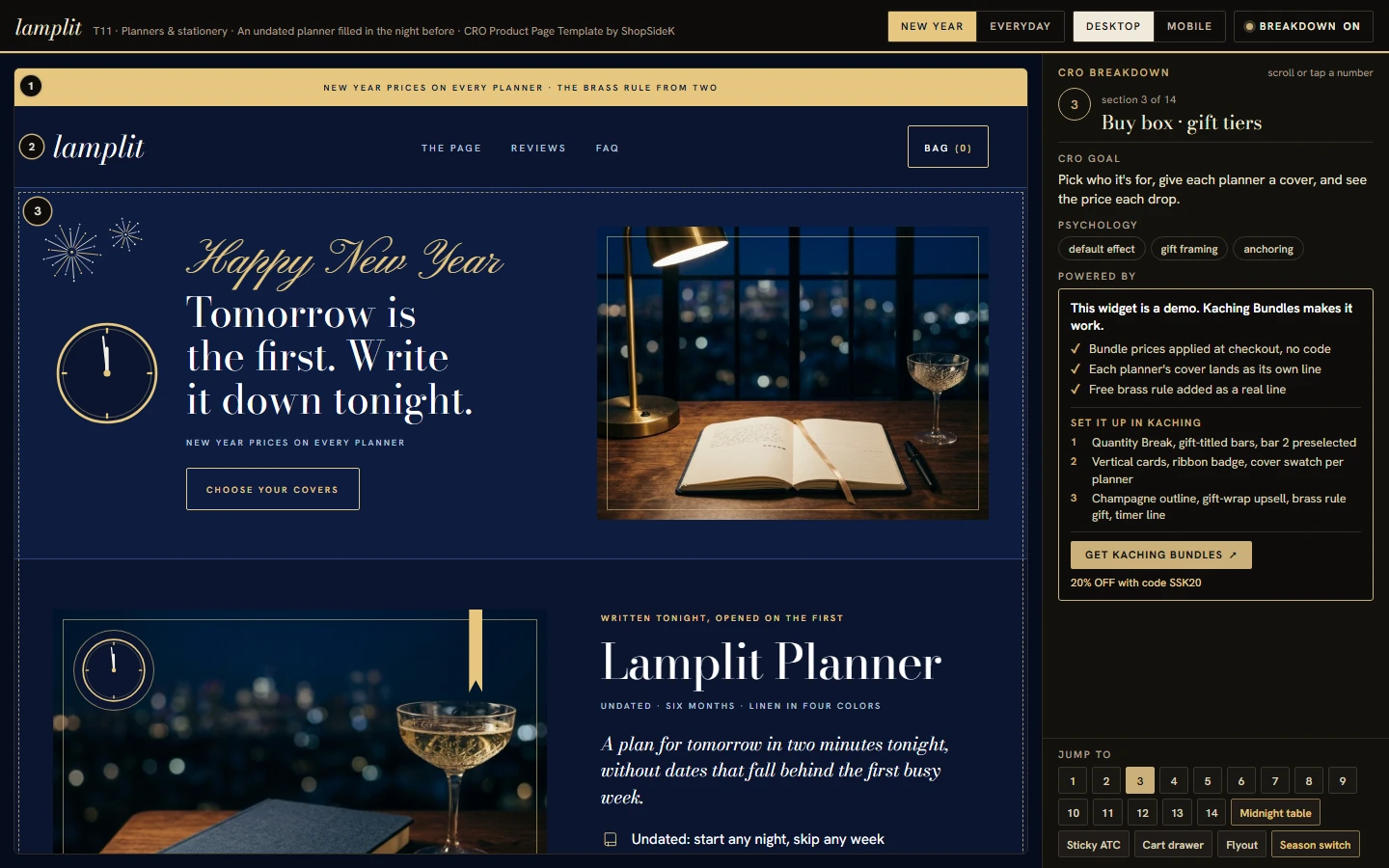
- Lamplit, an undated planner whose bundles are named for the people you give to, built on a Kaching Quantity Break.
- Daylift, wearable wrist and ankle weights where every pair has a job, built on a Kaching Bundle Upsell (mix & match).
Key takeaways: 7 rules for a New Year product page
- Sell the first day, not the whole year. “Tomorrow is the first. Write it down tonight.” asks for one evening, not twelve months of belief.
- Leave the year off the page. With no “2027” in the New Year layer, the same banner and copy run again next December with nothing to edit.
- Name each unit for a person or a job. “For you, and one to give” and “for the walk you already take” say what a second unit is for. “2-pack” does not.
- Blame the old method, never the buyer. If people have quit before, name what made them quit, such as dated pages, instead of hinting they lacked willpower.
- Make the season gift a way to start. A four-week plan deck or free index tabs help someone begin; an extra 10% only makes the order cheaper.
- Say where your product doesn’t belong. One clear “skip it for this” line answers the safety question before it becomes a return.
- Keep small proof small. One walker’s four Saturdays and one night in a sleep lab are labeled as exactly that, which makes them easier to believe.
The two examples at a glance
| Lamplit (New Year planner) | Daylift (New Year fitness) | |
|---|---|---|
| Product | Undated six-month daily planner, A5, linen cover in four colors | Wearable wrist, ankle and palm weights, steel sealed in silicone, sold in pairs |
| Kaching offer type | Quantity Break: 1, 2 or 3 planners | Bundle Upsell (mix & match): any 1, 2 or 3 pairs |
| Each unit is named for | A person: “#1 · yours”, “#2 · to give” | A job: the walk, the rug and desk, pilates and barre |
| Everyday prices | $38 · $66 · $90 | $44 · $76 · $99 |
| New Year prices | $34 · $60 · $81 | $39 · $68 · $87 |
| Crossed-out price | Quantity × the everyday $38 | Number of pairs × the everyday $44 |
| Season gift | The brass rule ($14 value) moves down from bar 3 to bars 2 and 3 | A new four-week plan deck ($12 value) on bars 2 and 3 |
| Season popup | Free index tabs instead of 10% off | Free shipping and the plan by text instead of 10% off |
| Order in the walkthrough | $34 → $60 → $72 | $39 → $68 → $86 |
| Live example | Lamplit template (T11) | Daylift template (T10) |
Example 1: Lamplit, a New Year planner page with bundles named for people
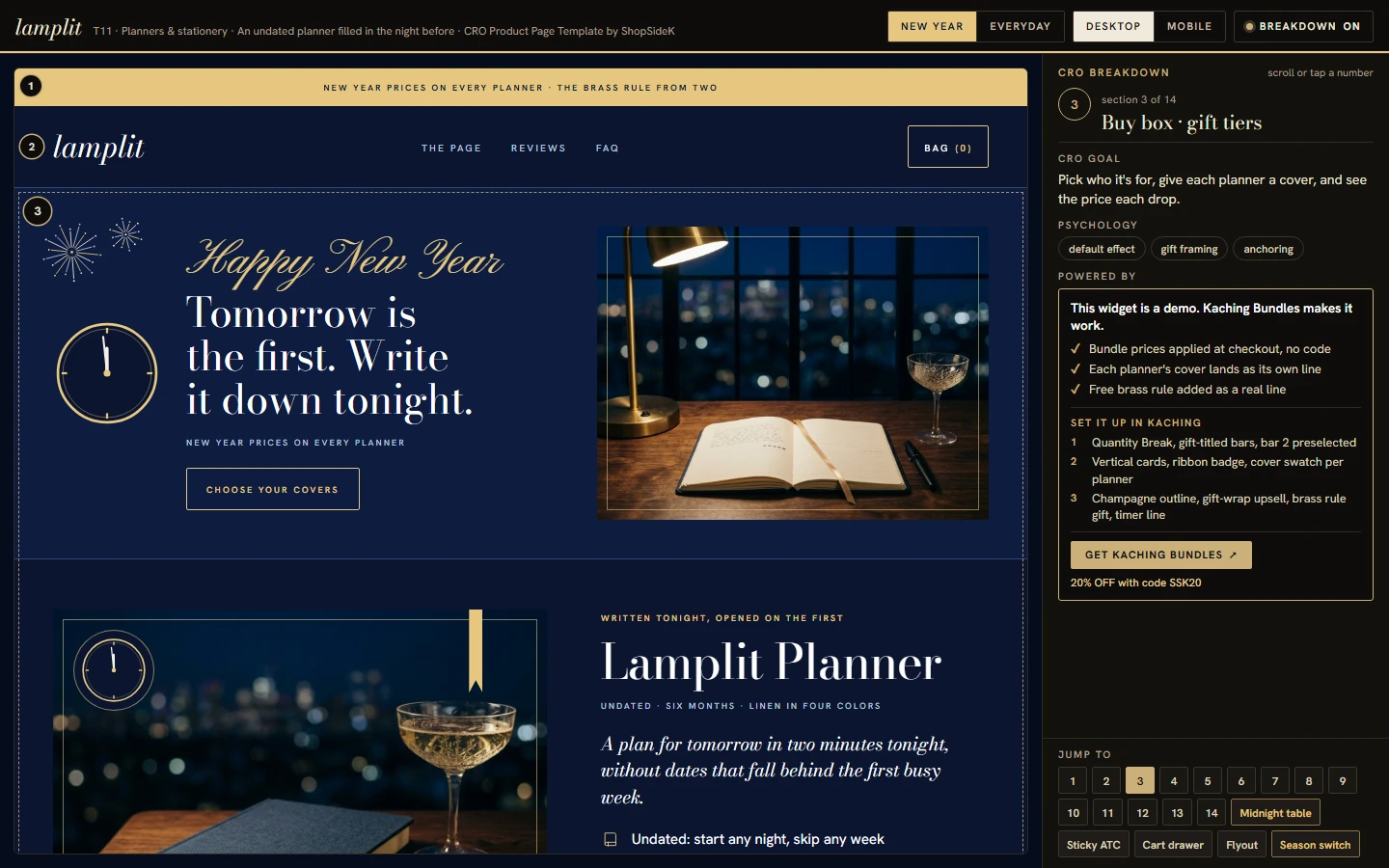
Lamplit sells an undated six-month planner you fill in the night before. Its everyday page is already dark and quiet, so the New Year version sells New Year’s Eve as the biggest “night before” of the year. A toolbar switch flips between the New Year and everyday versions.
What changes for New Year
- Midnight, not confetti. The brand’s Midnight cover color deepens into a navy page and champagne turns gold. A drawn clock at 11:59 appears three times (banner, first photo, final call to action), and two flat fireworks stay still.
- A headline about tonight. “Tomorrow is the first. Write it down tonight.” Its one button, “Choose your covers”, scrolls to the bundle.
- No year anywhere, so the layer can be switched on again next December as it is.
- Two photos swap: the planner beside a champagne glass at midnight, then open on a bed tray the next morning.
- The same Kaching deal, edited. Every bar drops ($38 → $34, $66 → $60, $90 → $81) and gets a gold “New Year price” label.
- The gift moves down a bar. The brass rule bookmark ($14 value), normally free with three planners, comes free with two.
- A popup that adds. The everyday flyout offers 10% off; the New Year one gives free index tabs ($9 value) with any planner.
- One section that exists only in season. “Who’s starting the year with you?” Type a name and a second planner appears beside yours with that name on its ribbon. “Set the table” selects the matching bar and puts the names on the gift-wrap cards.
The price ladder: everyday vs New Year
| Bundle bar | Everyday price | New Year price | Crossed-out price | Per planner at New Year |
|---|---|---|---|---|
| For you | $38 | $34 | $38 (New Year only) | $34 |
| For you, and one to give (preselected) | $66 | $60 + free brass rule | $76 | $30 |
| For you, and two to give | $90 + free brass rule | $81 + free brass rule | $114 | $27 |
The bar names stay the same all year: giving the second planner is the brand’s idea, not the season’s. Each planner gets its own linen cover and a “#1 · yours” or “#2 · to give” label, and gift wrap costs $4 a book.
What New Year leaves alone
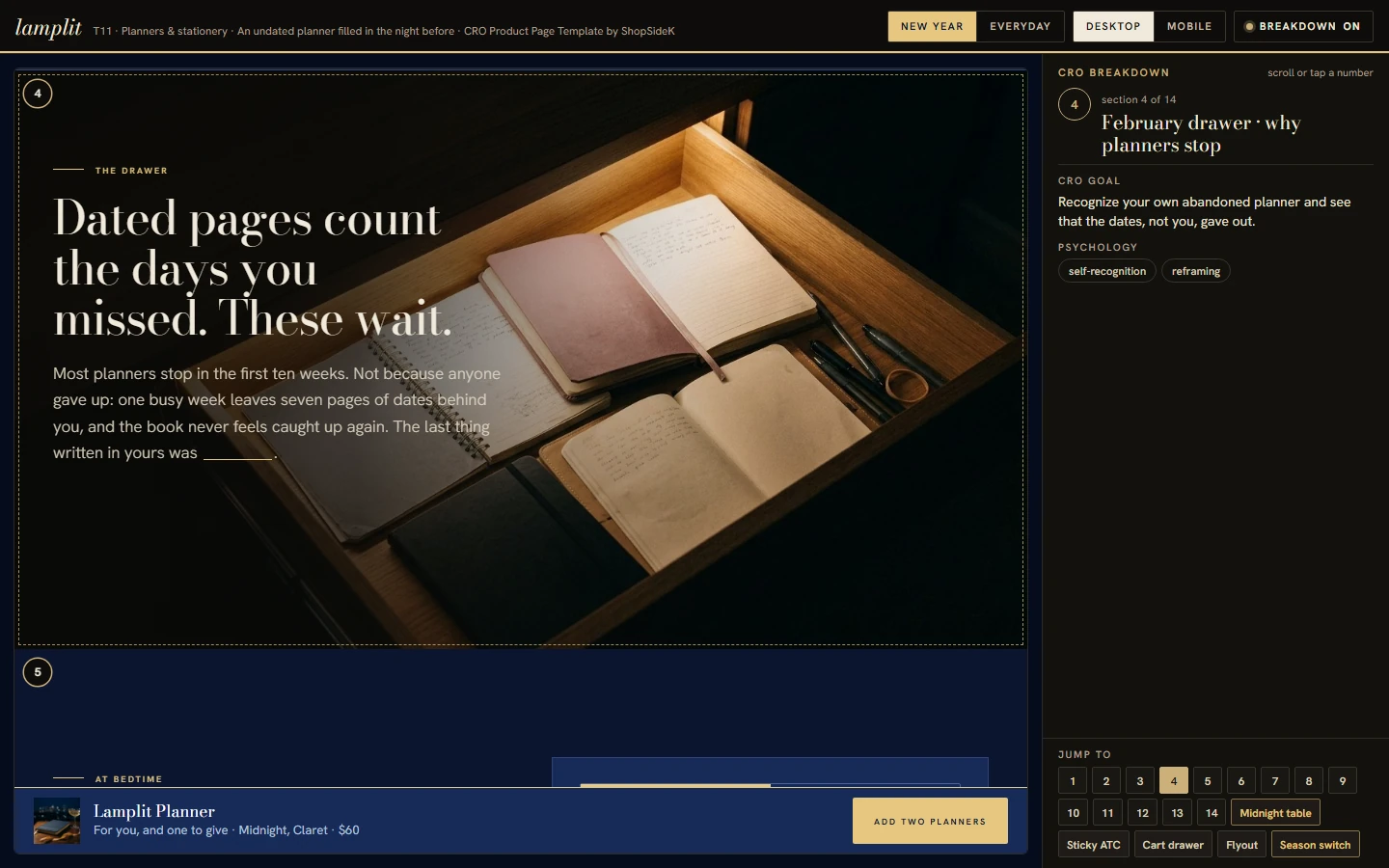
- The February drawer. Four dated planners abandoned in a drawer, each open at its last written page: “Dated pages count the days you missed. These wait.” The page blames the printed dates, never the reader.
- Two lists at bedtime. A switch flips between a done-today list and a tomorrow list, with the sleep-lab study behind it and a line saying the study is small.
- The pen drawer. Seven everyday pens tested on the 100 gsm paper, including the one that bleeds through: a permanent marker.
- A written-in guarantee. Thirty nights to decide, returns accepted after you’ve written in it, and a rebind if the sewing ever loosens.
The cart: from $60 to $72
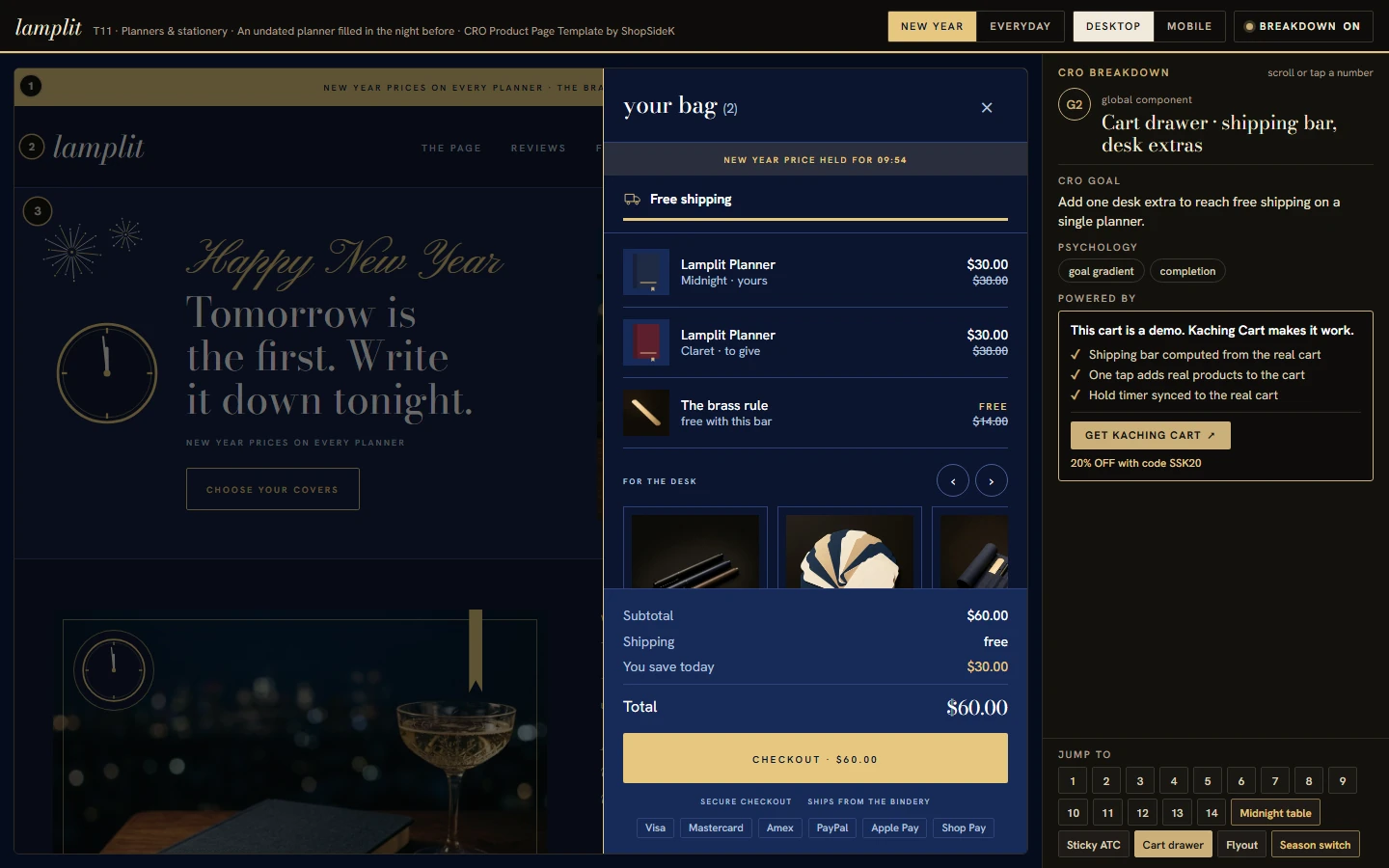
The preselected bundle opens the cart drawer (Kaching Cart) with free shipping already reached at $50, one line per planner (“Midnight · yours”, “Claret · to give”) and the brass rule as a free line. From a slider of desk add-ons, the Fineline Pen Trio ($12), fineliners that dry in under three seconds on this paper, takes the order from $60 to $72.
One thing not to copy
Lamplit’s FAQ answers the common questions with five numbers: 100 gsm, 182 pages, A5, 0 dates printed, 1 working day to ship. That only works because each question really has a number for an answer. If yours don’t, a plain FAQ beats numbers padded out to make five.
Rebuild the offer in Kaching
- A Quantity Break deal with bars of 1, 2 and 3 planners, titled for people, bar 2 preselected.
- Vertical cards, a cover choice for each planner, a “most given” ribbon on bar 2.
- For New Year, lower every bar, add the gold label, move the free gift to bar 2, and show gift wrap only on the gift bars.
See more Kaching gift tiers templates and how to price quantity break bars for profit.
Example 2: Daylift, a New Year fitness page with a mix & match bundle
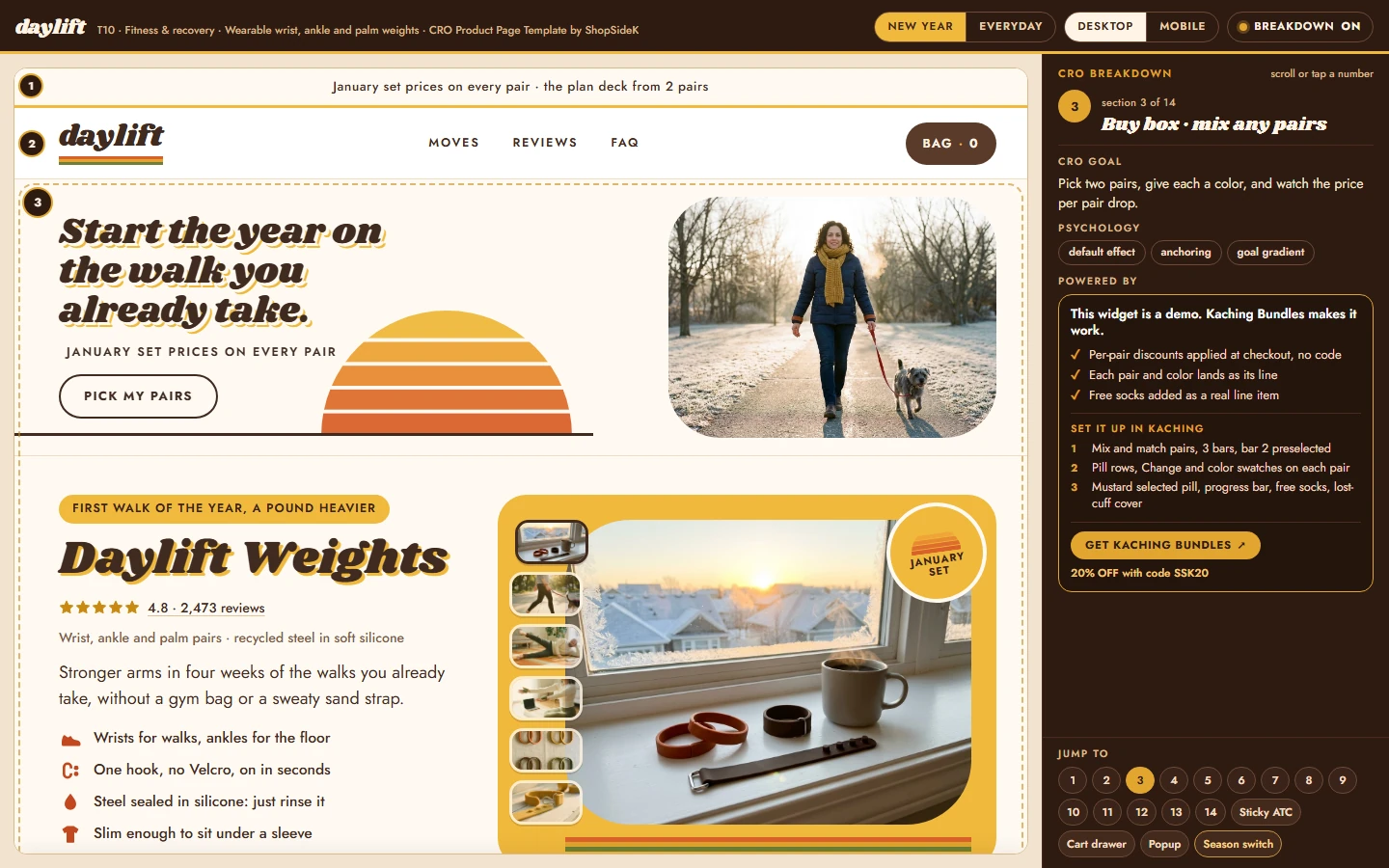
Daylift sells wearable weights in pairs: wrist (1 lb each) for walks, ankle (2 lb each) for floor and desk moves, palm (1 lb each) for pilates and barre. Every pair is $44, mixed in any of four colors. Many January fitness pages sell a new person; this one adds a pound to the day the buyer already has.
What changes for New Year
- A January morning, not a party. Vanilla lightens to morning white, mustard turns sun gold, and a striped half sun appears three times. No fireworks, no confetti.
- A headline that asks for nothing new. “Start the year on the walk you already take,” over a photo of a woman walking her dog on a frosty path at sunrise.
- A fixed amount off each pair. $5, $10 or $15 off per pair by bar (everyday: $0, $6, $11), so the bars read $39, $68 and $87. Bar 2’s badge changes from “most picked” to “January start”.
- A season-only gift that is a plan. Two or more pairs come with a printed four-week plan deck ($12 value): 28 cards, one a day, for walk, rug, desk and rest days. No app.
- A popup without a percent. Everyday: 10% off plus a walking plan by email. January: free shipping on a first order plus the plan by text.
- One urgency cue. The everyday “34 left in this batch” stock line is hidden while the New Year layer is on.
The price ladder: everyday vs New Year
| Bundle bar | Everyday price | New Year price | Crossed-out price | Per pair at New Year |
|---|---|---|---|---|
| 1 pair | $44 | $39 | $44 (New Year only) | $39 |
| Any 2 pairs (preselected) | $76 | $68 + free plan deck | $88 | $34 |
| Any 3 pairs | $99 + free grip socks | $87 + free plan deck and grip socks | $132 | $29 |
Each pair has a Change button, and the picker lists jobs instead of products: “for the walk you already take”, “for the rug and the desk”, “for pilates and barre”. The preselected bar is wrists plus ankles.
What New Year leaves alone
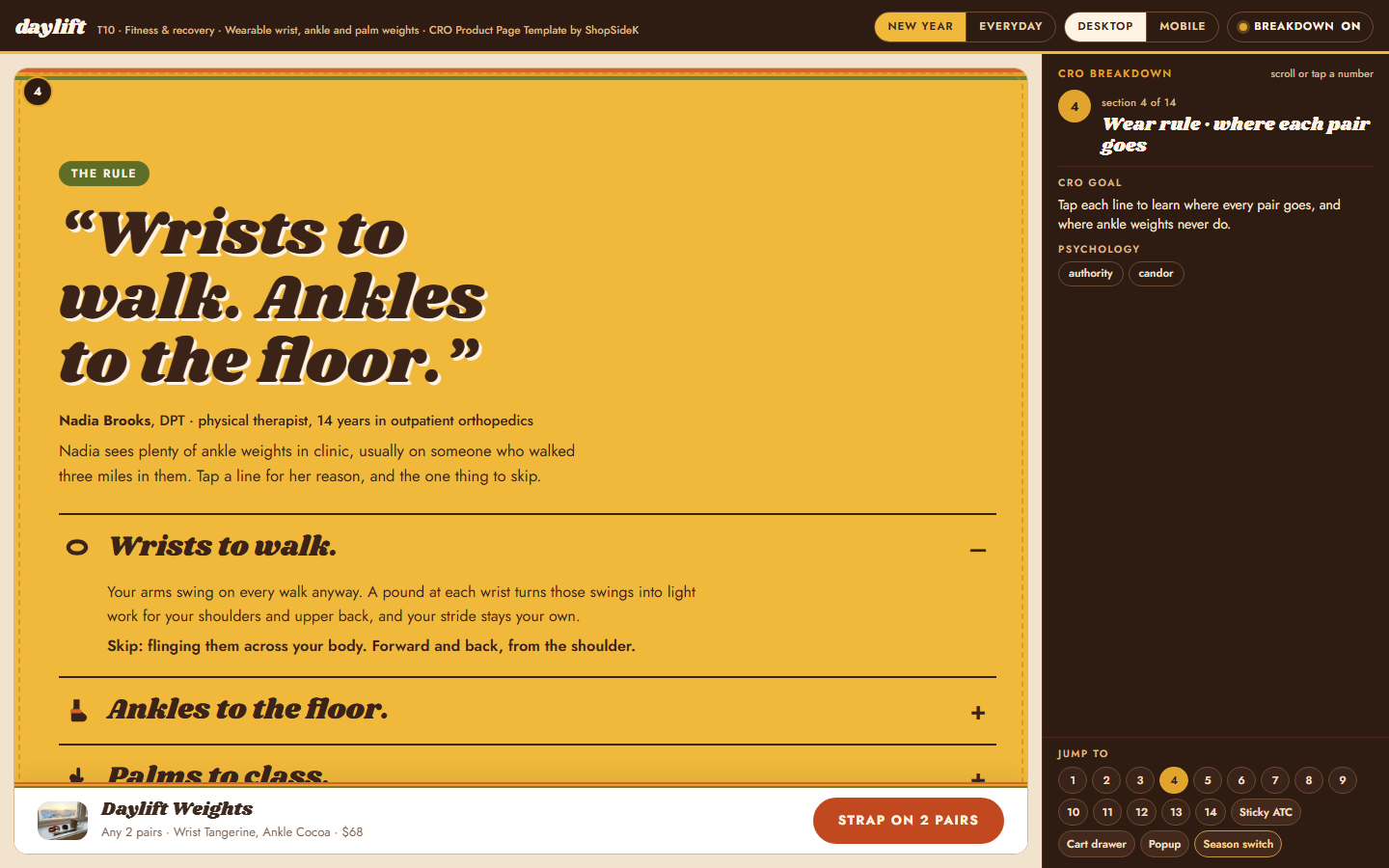
- The wear rule. The page’s physical therapist sets one rule in huge type, “Wrists to walk. Ankles to the floor.”, and the ankle line names what to skip: walking, running or stairs with them on.
- Under the desk. Flip a drawn video call’s camera under the desk and the ankle pair is doing slow leg lifts while the meeting goes on.
- Four Saturdays. One walker’s 2.1-mile loop on four Saturdays in a row, timed on her own watch at 41:30, 40:05, 38:40 and 37:10, under the line “Results vary.”
- The guarantee. 45 days to decide, worn is fine, plus a two-year replacement.
The cart: from $68 to $86
The cart drawer’s free-gift bar adds a cooling towel at $85, so the preselected bundle opens $17 short. Adding the Mini Loop Trio ($18, three fabric bands for the rug moves) takes the order from $68 to $86 and drops the towel in free: the threshold sits one small add-on away.

One thing not to copy
Daylift’s FAQ is a chat with “the Daylift coach”, typing dots and all. That format promises a person on the other end. If nobody at your store answers messages, a chat-shaped FAQ reads like a bot, so keep plain questions and answers.
Rebuild the offer in Kaching
- A Bundle Upsell deal over three pairs (1, any 2 or any 3), a fixed dollar amount off each pair, bar 2 preselected.
- Pill rows with a Change button and a color for each pair, a progress bar, free grip socks on bar 3.
- For New Year, deepen the per-pair discount, add the plan deck as a free gift on bars 2 and 3, and relabel bar 2 “January start”.
Read when mix & match beats a fixed bundle and why a dollar amount off can beat a percent.
What research says about the New Year buyer
Three peer-reviewed studies explain why both pages sell a first step, and why they handle their evidence carefully.
Fresh starts drive goal behavior, and January is the biggest one
Dai, Milkman and Riis called it the fresh start effect (Management Science, 2014). Compared with baseline, Google searches for “diet” rose 14.4% at the start of a week, 3.7% at the start of a month and 82.1% at the start of a new year. University students’ gym visits rose 33.4% at the start of a week and 11.6% at the start of a year, and new commitments on a goal-setting website rose 145.3% at the start of a year (Dai, Milkman & Riis, 2014).
For a product page: January is the biggest fresh start, not the only one. Copy about “tonight” or “the first walk” keeps working after January 1; copy about 2027 doesn’t.
Resolutions stick more often than the jokes suggest, when they start something
In a study of 1,066 people, 55% of those who answered the one-year follow-up considered themselves successful in keeping their New Year’s resolution. Approach-oriented goals, which start something, beat avoidance-oriented goals, which stop something: 58.9% against 47.1% (Oscarsson, Carlbring, Andersson & Rozental, PLOS ONE, 2020).
For a product page: write the season’s copy as something to start. “Start the year on the walk you already take” is an approach goal; “stop sitting all day” would be an avoidance goal.
Small studies should be labeled small
In a sleep-lab study, 57 healthy adults aged 18 to 30 wrote for five minutes at bedtime. Those who wrote a to-do list for the coming days fell asleep significantly faster than those who listed tasks already completed (Scullin et al., Journal of Experimental Psychology: General, 2018), and the researchers said a larger future study would be of value (Baylor University, 2018).
For a product page: Lamplit cites this study and says it was one night in one lab, “a nudge, not a promise”. Research next to a buy button should carry its size and limits.
How to set up a New Year bundle in Kaching
Both pages edit one year-round Kaching deal for the season. The cuts are small, about 10% to 34% off the crossed-out price, and much of the season’s value comes from the gift.
- Name the bars for the buyer’s reason. Kaching gives each bar a title, subtitle, labels and badges (Kaching help: bundle types). Use them for people (“one to give”) or jobs (“for the walk”), not counts.
- Let each unit be chosen on its own, so every planner gets its own cover and every pair its own color (Kaching help: variant dropdowns).
- Put the season gift on bars 2 and 3, and add gift wrap or a protection line as an add-on only where it fits (Kaching help: add an upsell to your deal bar). See when a free gift beats a discount.
- Swap the popup’s percent for an item, then price the worst order. On the demos’ assumed costs, the deepest New Year bar with its gifts, shipping and a leftover 10% code still kept about 63–64% gross margin, and about 66–67% without the old code. Run your own numbers in the Shopify discount break-even calculator and see how Shopify bundle discounts stack.
- Switch it on in early December. Gift buyers shop in December and self-buyers in January, so a gift bar serves both. Our template library shows its New Year pages from December 1 to January 15.
- Restore the everyday deal afterwards: prices, gifts, labels and the popup offer.
New Year product page checklist
- A headline that sells the first evening, walk or day, not the whole year.
- No year printed anywhere in the New Year layer.
- A season look built from the brand’s own colors, with one recurring shape.
- Every bar on a New Year price, struck at the real everyday price.
- Bars or units named for people or jobs, not only counts.
- A season gift that helps the buyer start, and a popup that adds an item instead of a percent.
- A line about where the product shouldn’t be used, if there is one.
- Small evidence labeled with its size and limits.
- One urgency cue at a time; a timer, if you use one, counts to the real end of the offer. Both demos restart theirs at midnight only so a countdown is always visible.
FAQ
What should a New Year product page say instead of “new year, new you”?
Name the first small step the product makes easier, inside the buyer’s own day, such as “Start the year on the walk you already take” or “Tomorrow is the first. Write it down tonight.” A concrete first step is easier to believe than a new identity.
Should I discount or add a gift for a New Year sale?
Both, but let the gift carry the season. Lamplit and Daylift cut prices by about 10% to 34% against the crossed-out price, add a gift that helps the buyer begin, and swap the popup’s 10% off for a free item so no extra percent stacks on sale prices.
When should the New Year version of a product page go live?
In early December, so gift buyers see it, and it can stay on until mid-January for people buying for themselves. Our template library shows its New Year pages from December 1 to January 15.
Should I put the year on my New Year product page?
No. Leave the number off the banner, photos and copy, and the same New Year version can be switched on again next December without edits. Talk about “tonight”, “the first” or “January” instead.
How do I sell a second unit in January?
Give the second unit a reason. Lamplit names its bars for people (“For you, and one to give”), and Daylift gives every pair a job (“for the rug and the desk”), which sells a second unit better than a bigger number.
Can I cite research on a product page?
Yes, if you state the study’s size and limits next to the claim. Lamplit cites a sleep-lab study of 57 young adults and adds that it was one night in one lab, “a nudge, not a promise”.
Can I use these templates on my store?
Yes, as references. Each demo explains every section and shows the Kaching settings behind its bundle; you set up the offer in Kaching and build the sections into your Shopify theme.
More product page examples
Both demos live in the ShopSideK Shopify product page template library. Browse the planner and stationery templates, the fitness and recovery templates and the Kaching mix & match templates.
Earlier in this series: Black Friday product page examples and Christmas product page examples.
Sources
- Dai, Milkman & Riis (2014), The Fresh Start Effect: Temporal Landmarks Motivate Aspirational Behavior, Management Science 60(10)
- Oscarsson, Carlbring, Andersson & Rozental (2020), A large-scale experiment on New Year’s resolutions, PLOS ONE 15(12)
- Scullin et al. (2018), The effects of bedtime writing on difficulty falling asleep, Journal of Experimental Psychology: General 147(1) (PubMed)
- Baylor University (2018), Can writing your to-do’s help you to doze?
- Kaching help: different bundle types
- Kaching help: customize your bundle variant dropdowns
- Kaching help: add an upsell to your deal bar