Choosing the best email marketing app for Shopify store is one of the most critical decisions you’ll make as a founder. The right tool can turn one-time buyers into loyal fans, recover lost sales while you sleep, and build a direct line to your customers that you truly own.
But with dozens of options, it’s easy to feel overwhelmed. Most articles present a massive, undifferentiated list, leaving you to figure out which one fits your specific needs and budget.
This guide is different.
We’ve created a strategic roadmap that matches the perfect tool to your store’s current growth stage. Instead of a confusing list, you’ll get a clear, step-by-step plan. We’ll help you find the right app for right now—and show you exactly when it’s time to upgrade. Let’s find the best email marketing app for Shopify business.
- 1. Shopify Messaging (Your Best First Step for Stage 1)
- 2. Omnisend (Best All-in-One Platform for Stage 2)
- 3. Sequenzy (Best AI-Native Platform for Shopify Lifecycle Marketing)
- 4. Privy (Best for Rapid List Growth in Stage 2)
- 5. Klaviyo (Best for Data-Driven Scaling in Stage 3)
- 6. ActiveCampaign (Best for Advanced Automation in Stage 3)
3 Stages of Email Marketing for Your New Shopify Store
Before we dive into app reviews, let’s start with a core concept that will simplify your decision: the best email marketing app for Shopify depends entirely on your business stage. A brand new store has very different needs than one with 20,000 customers.
Think of your email list as the most valuable asset your business owns. Unlike social media followers—which exist on “rented land” where algorithms can change overnight—your email list is a direct, reliable line to your customers. With an average return of $36 for every $1 spent, it’s the most powerful sales channel you have.
Our “3 Stages of Growth” framework will act as your roadmap, ensuring you have the right tool at the right time.
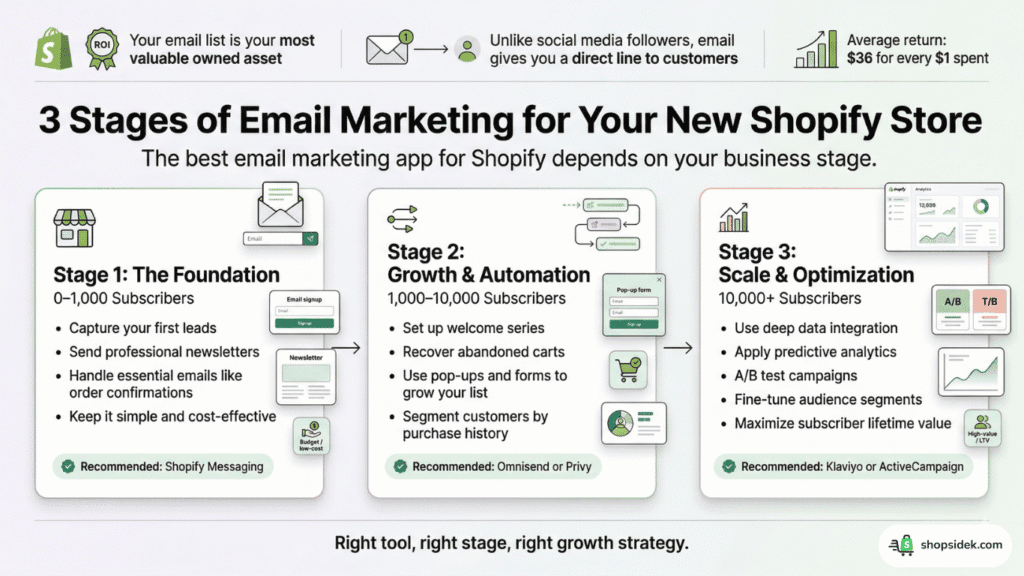
Stage 1: The Foundation (0 – 1,000 Subscribers)
This is the starting line. Your primary goal is to master the fundamentals without adding to your monthly costs. You need to capture your first leads, send professional-looking newsletters, and ensure essential emails like order confirmations are handled perfectly. At this stage, complexity is the enemy; simplicity and cost-effectiveness are key.
Your recommended tool: Shopify Messaging.
💡As a Stage 1 store, you’ll also benefit from pairing Shopify Messaging with other free Shopify apps to cover your other essential needs without adding costs.
Stage 2: Growth & Automation (1,000 – 10,000 Subscribers)
You’ve built a small audience—now it’s time to put your growth on autopilot. This is where you implement the core automations that drive sales, like welcome series for new subscribers and abandoned cart reminders. You’ll also start actively building your list with pop-ups and forms, and begin segmenting customers based on their purchase history.
Your recommended tools: Omnisend, Sequenzy or Privy.
Stage 3: Scale & Optimization (10,000+ Subscribers)
Your business is now a sophisticated operation, and you need a tool that can keep up. Your focus shifts to deep data integration, using predictive analytics to understand customer behavior before it happens. Every campaign is A/B tested, every segment is finely tuned, and your goal is to maximize the lifetime value of every single subscriber.
Your recommended tools: Klaviyo or ActiveCampaign.
In-Depth Reviews: 6 Best Email Marketing App For Shopify
You know your stage in the growth journey, let’s look at the best tools for the job. We’ve selected the top six apps, each perfectly positioned to help you conquer your current goals—from sending your first newsletter to building a predictive marketing machine.
1. Shopify Messaging (Your Best First Step for Stage 1)
Best for: New store owners who need a simple, free, and fully integrated solution to cover the basics.
Shopify App Store Rating: 4.7 / 5.0 (from 3,479+ reviews)
For anyone just starting their journey, Shopify Messaging is the undisputed best choice. It lives directly inside your Shopify admin, meaning there’s no complex setup, no data syncing to worry about, and no new interface to learn. You can create and send professional-looking emails using customizable templates that automatically pull in your logo, products, and brand colors.
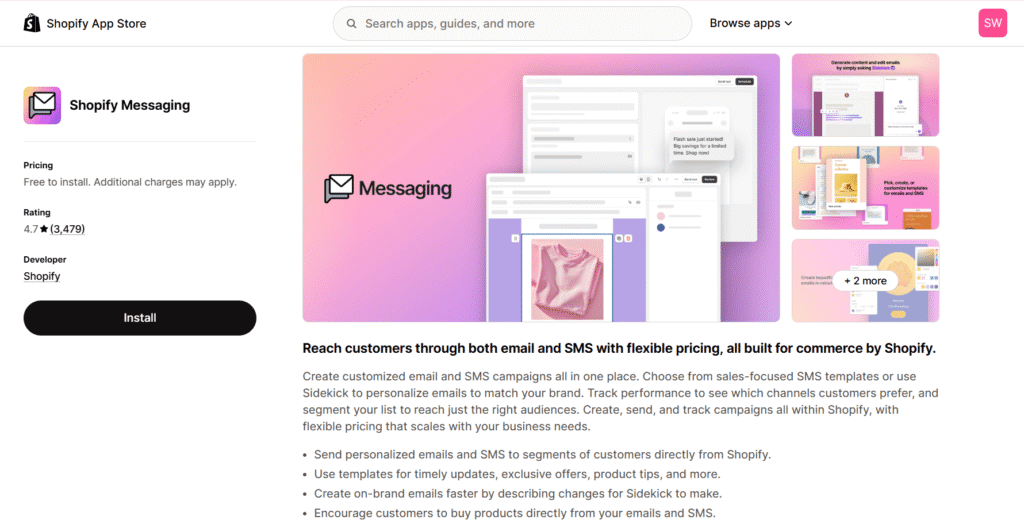
The platform is intentionally simple. It handles essential tasks beautifully, like sending newsletters to your customer list or creating simple email automations for order confirmations and shipping updates. Best of all, you can send up to 10,000 emails per month for free, making it the most cost-effective way to get started.
Integration Quality & Support: As a native Shopify app, the integration is flawless. All your customer data, product catalogs, and purchase history are available instantly. Support is handled directly by the Shopify team you already know and trust.
When you’ll know it’s time to upgrade:
- You want to create a multi-email welcome series for new subscribers.
- You need to A/B test subject lines to see what gets more opens.
- You want to segment customers based on complex behavior (e.g., “viewed product X but didn’t buy”).
- You need more advanced automation triggers beyond the basics.
2. Omnisend (Best All-in-One Platform for Stage 2)
Best for: Stage 2 stores that are ready to graduate to a powerful, all-in-one platform that combines email, SMS, and push notifications.
Shopify App Store Rating: 4.8 / 5.0 (from 2,937+ reviews)
I always suggest Omnisend as the perfect “next step” for stores that have outgrown Shopify Messaging. It strikes an ideal balance between powerful features and ease of use. As one Reddit user put it after trying the platform, “I get the hype.”
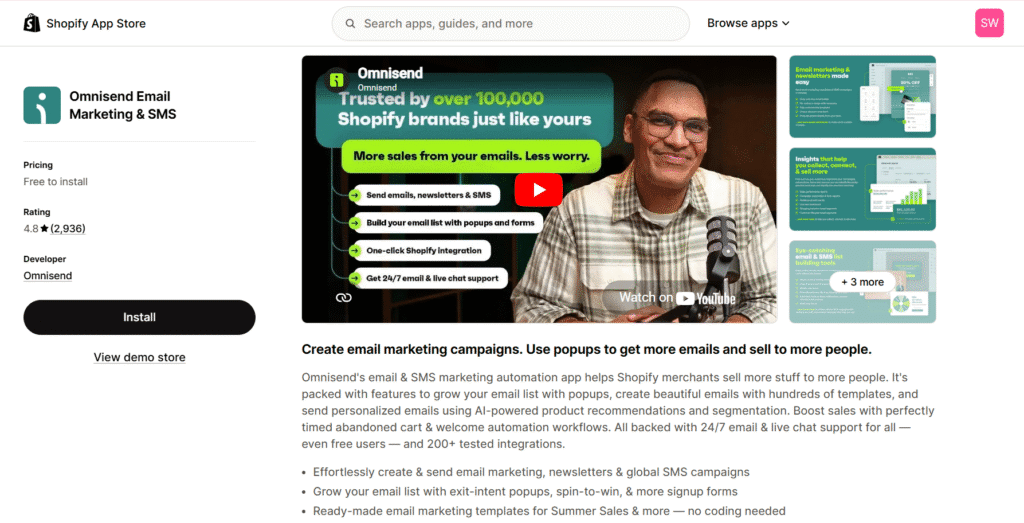
Its platform truly covers the entire customer lifecycle. You can grow your email list with exit-intent popups, spin-to-win wheels, and other customizable signup forms.
Once subscribers are in, its standout feature is the visual automation builder, which lets you drag and drop different channels—like email and SMS—into a single workflow. To make content creation effortless, you can even use built-in AI to generate email copy, subject lines, and preheaders in seconds.
For example, you can create an abandoned cart flow that sends an email first, then follows up with an SMS message an hour later if the customer hasn’t purchased. This combination of list growth, AI-powered generation, and multi-channel automation makes it an incredibly effective tool for managing the entire customer journey from one place.
Integration Quality & Support: Omnisend offers a robust Shopify integration that syncs all your customer, product, and order data. This allows for deep personalization, like including items left in a cart directly in an email.
3. Sequenzy (Best AI-Native Platform for Shopify Lifecycle Marketing)
Best for: Growing Shopify stores that want AI-generated campaigns, advanced lifecycle automation, and unlimited subscribers without per-contact pricing.
Shopify App Store Rating: 5.0 / 5.0 (from 5+ reviews)
For merchants comparing email marketing tools for Shopify, Sequenzy stands out as an AI-native platform that connects directly to Shopify store data. After installation, it syncs customers, products, orders, checkout activity, and stock events into detailed subscriber profiles.
That data can power welcome flows, abandoned-cart and checkout recovery, post-purchase follow-ups, win-back campaigns, back-in-stock alerts, and replenishment reminders. Segments can use purchase history, total spend, order count, products purchased, Shopify tags, and email engagement.
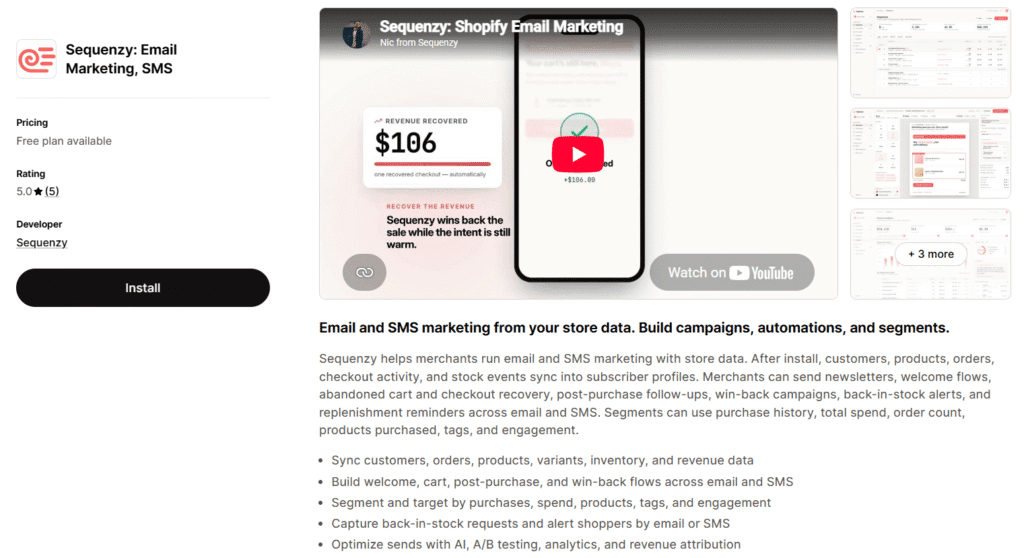
Sequenzy’s AI can generate complete campaigns and automation sequences, including copy, subject lines, timing, and triggers. The visual automation builder gives merchants direct control over every workflow, while MCP, CLI, API, and webhook access allow AI assistants and custom systems to work with campaigns, subscribers, and analytics.
Unlike platforms that increase prices based on contact count, Sequenzy includes unlimited subscribers and charges according to email volume. The free plan includes 2,500 emails per month, while paid plans start at $19 per month for 15,000 emails. Every plan includes campaigns, automations, segmentation, transactional email, analytics, revenue attribution, and Shopify data synchronization.
Integration Quality & Support: Sequenzy is available directly through the Shopify App Store. Installation connects Shopify customer, product, order, checkout, and inventory data without requiring manual imports. Personal founder support is included.
When it’s the right choice: Choose Sequenzy when you want to automate more of your Shopify lifecycle marketing with AI, avoid per-contact fees, and manage campaigns, transactional email, automation, segmentation, and revenue tracking from one platform.
4. Privy (Best for Rapid List Growth in Stage 2)
Best for: Stage 2 stores focused on aggressively converting website traffic into email and SMS subscribers.
Shopify App Store Rating: 4.5 / 5.0 (from 4,127+ reviews)
Privy has built its reputation as the master of list growth. Its core strength lies in its powerful and intuitive suite of pop-ups, flyouts, and embedded forms. You can design beautiful, on-brand conversion tools that trigger based on specific user behaviors like exit-intent, time on page, or scroll depth.
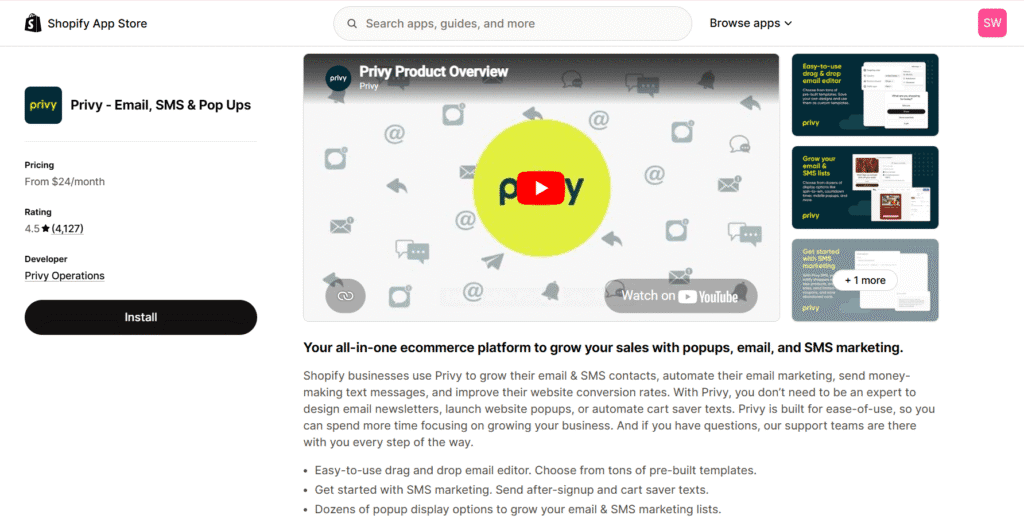
While it excels at capturing emails, Privy is also a capable email and SMS marketing platform. It offers a user-friendly email editor and pre-built automation templates for welcome messages, abandoned cart reminders, and post-purchase follow-ups.
Integration Quality & Support: Privy offers a deep, one-click integration with Shopify. It syncs customer data, cart contents, and coupon codes seamlessly, allowing you to create highly targeted campaigns and automate discount delivery.
5. Klaviyo (Best for Data-Driven Scaling in Stage 3)
Best for: Stage 3 stores that want to leverage deep customer data, predictive analytics, and best-in-class segmentation to maximize revenue.
Shopify App Store Rating: 4.5 / 5.0 (from 2,589+ reviews)
To me, Klaviyo is the industry standard for high-growth, data-obsessed Shopify stores. Its power comes from an incredibly deep integration with Shopify that captures every possible data point. Klaviyo doesn’t just know what a customer bought; it knows what they viewed, what they started to type in the search bar, and even predicts when they are likely to purchase again.
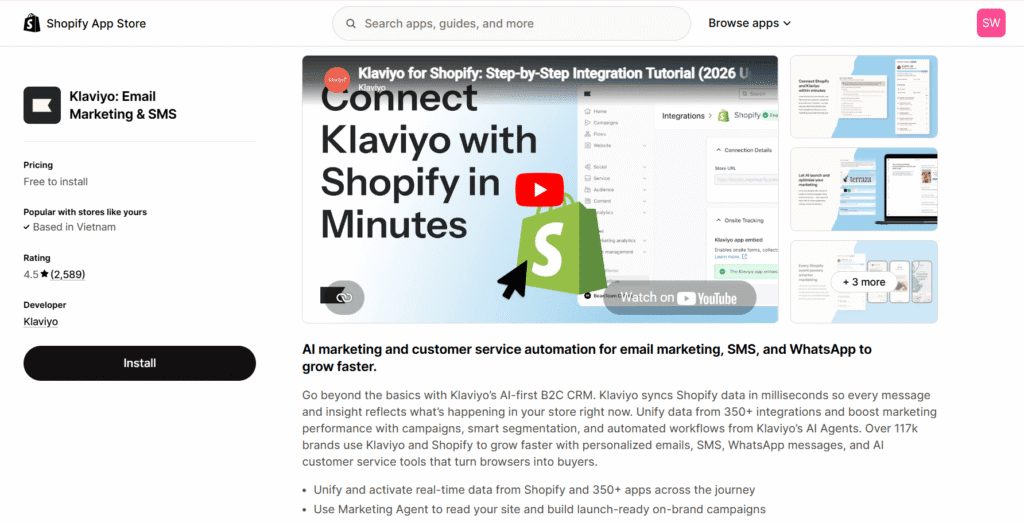
This granular data allows for segmentation that other platforms can’t touch (e.g., “Show me all customers who have purchased twice, live in New York, and have viewed our new sneaker collection”). While it comes with a steeper learning curve and a higher price tag, the return on investment is unmatched for stores ready to use its features. For businesses looking to optimize every touchpoint, Klaviyo is the ultimate tool.
Integration Quality & Support: Klaviyo’s integration is widely considered the gold standard. It provides real-time, two-way data sync that powers its predictive features and ensures your marketing is always based on the most up-to-date customer information.
6. ActiveCampaign (Best for Advanced Automation in Stage 3)
Best for: Stage 3 stores that need CRM-level automation power to manage complex, multi-path customer journeys.
Shopify App Store Rating: 4.5 / 5.0 (from 249+ reviews)
ActiveCampaign is a true marketing automation powerhouse that serves as a powerful alternative to Klaviyo. Its key differentiator is its visual automation builder, which is arguably the most flexible and powerful on the market. You can build intricate workflows with multiple “if/then” branches, goal tracking, and lead scoring to nurture customers through highly personalized paths.
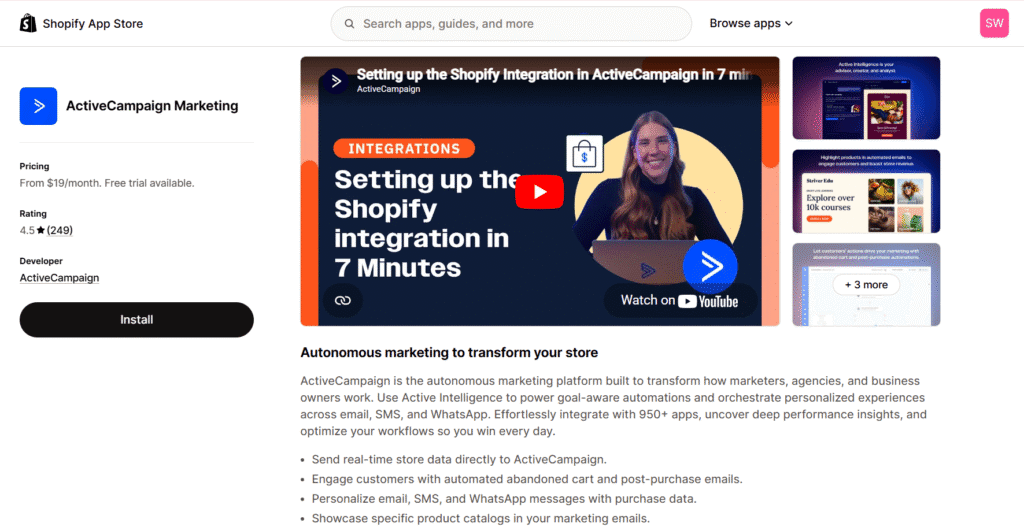
Where Klaviyo is laser-focused on eCommerce data, ActiveCampaign blends its eCommerce capabilities with a built-in CRM. This makes it an ideal choice for brands that have a longer sales cycle, deal with wholesale or B2B clients alongside their DTC store, or need to integrate sales team actions into their marketing flows. If your customer journey isn’t a straight line, ActiveCampaign gives you the tools to map it.
Integration Quality & Support: ActiveCampaign provides a deep Shopify integration that allows you to trigger automations based on dozens of customer and order data points, ensuring your complex workflows are powered by real-time store activity.
Putting It Into Practice: 3 Automated Workflows to Set Up This Week
Keep in mind that choosing a tool is just the first step. The real magic happens when you use automation to grow your business around the clock. These three workflows are the foundation of any successful eCommerce email strategy. Most apps in Stage 2 or 3 will have pre-built templates for these.
Blueprint 1: The 3-Part Welcome Series That Builds Trust
Your welcome series is your chance to make a powerful first impression. It has the highest open rates of any email you’ll send, so make it count. The goal isn’t just to make a quick sale; it’s to turn a new subscriber into a genuine fan of your brand.
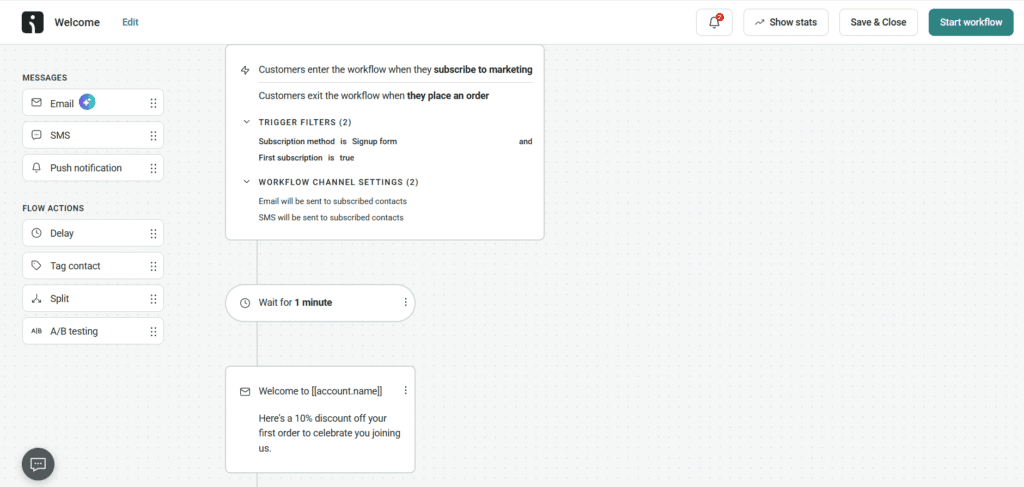
- Email 1 (Sent Immediately): Welcome & Discount. Deliver the promised incentive right away. Make it easy for them to shop with a clear call-to-action button and the discount code. This builds immediate trust and encourages that first purchase.
- Email 2 (Wait 1 Day): The Founder/Brand Story. This is where you build a connection. Share your “why”—the mission behind your brand, how you got started, or what makes your products special. This email separates you from faceless retailers.
- Email 3 (Wait 2 Days): Social Proof & Best-Sellers. Guide their next step. Showcase your most popular products and include a customer testimonial or a snippet of a 5-star review. This reduces purchase anxiety by showing them what others already love.
💡Need help collecting those reviews in the first place? Our guide to the best Shopify reviews apps covers tools that automate the entire process.
Blueprint 2: The 2-Step Abandoned Cart That Recovers Sales
Nearly 70% of online shopping carts are abandoned. This single automation is the most profitable one you can set up, recovering potentially thousands of dollars in lost revenue. The key is a timely, helpful, and gently persuasive sequence.
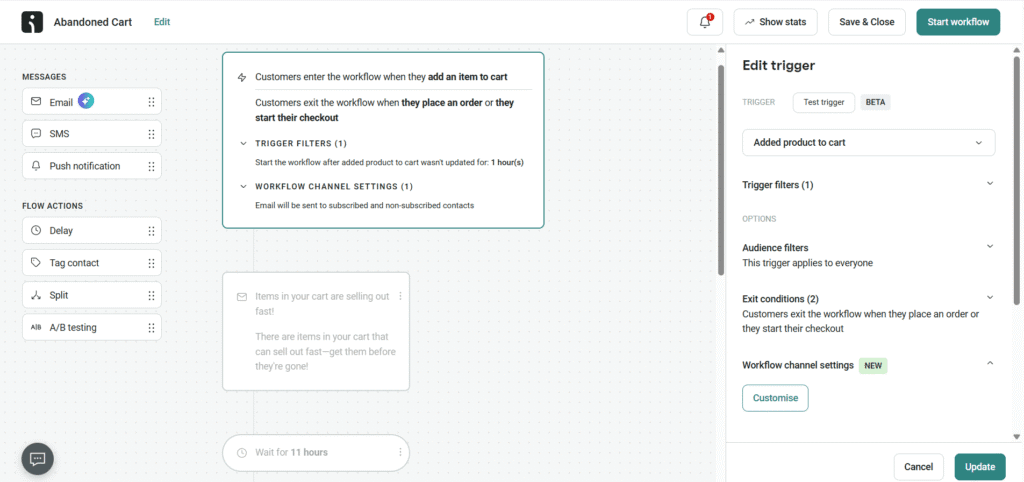
- Email 1 (Wait 1 Hour): The Gentle Reminder. The first message should be a simple customer service touchpoint. Use a subject line like, “Did something go wrong?” or “Your items are waiting.” The goal is to help, not to sell. Often, customers just got distracted.
- Email 2 (Wait 24 Hours): The Scarcity Nudge & Incentive. If they still haven’t purchased, it’s time for a slightly stronger nudge. Use a subject line that creates urgency, like “Your cart is about to expire.” Offer a small incentive, such as 10% off or free shipping, to close the deal.
💡If you’re building a dropshipping store and want to see how email marketing fits into your full tech stack, see our best dropshipping Shopify apps.
Blueprint 3: The Simple Post-Purchase Thank You & Upsell
The way I see it, your relationship with a customer shouldn’t end at checkout. The post-purchase period is the perfect time to build loyalty and encourage a second purchase. This simple flow keeps the conversation going and intelligently recommends their next favorite product.
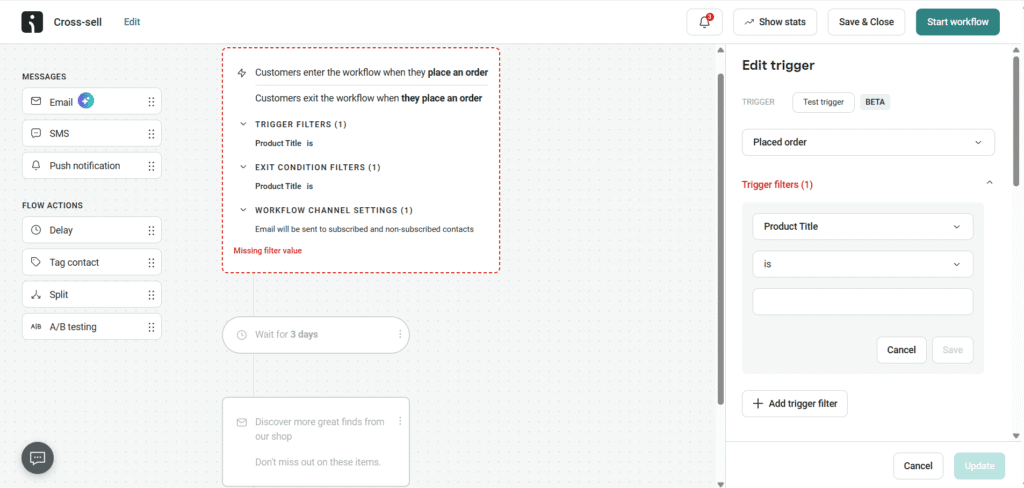
- Trigger (Wait 14 Days After Delivery): This timing gives the customer enough time to receive and use your product.
- Content: The email should have two parts. First, check in and ensure they’re happy (“How are you enjoying [Product Name]?”). This shows you care beyond the sale. Second, make a smart recommendation. Using dynamic product blocks, you can say, “Customers who bought this also loved [Related Product Name].” This is a low-pressure, highly relevant way to introduce them to more of your catalog.
These automated workflows are built to run on a powerful eCommerce platform. If you’re ready to put them to work for your business, it’s the perfect time to get started with Shopify.
Head-to-Head: The #1 Question for Growing Stores – Klaviyo vs. Omnisend
As your store gains momentum and moves into Stage 2, you’ll inevitably face the most common debate among growing merchants: Should you choose Omnisend or Klaviyo? Both are exceptional platforms, but they are built with different philosophies in mind. Choosing the right one can define your growth trajectory for years to come.
Omnisend is the perfect all-in-one solution, designed for ease of use and powerful multi-channel marketing. Klaviyo, on the other hand, is a data-first powerhouse, built for merchants who want to leverage the most granular analytics and predictive insights possible.
To help you decide, we’ve broken down their key differences in a simple table.
| Feature | Omnisend | Klaviyo |
|---|---|---|
| Best For | All-in-one email, SMS, and pop-ups | Deep data segmentation & predictive analytics |
| Ease of Use | Highly intuitive visual builder, very user-friendly | Powerful, but with a steeper learning curve |
| Automation Power | Excellent for multi-channel (email & SMS) flows | Unmatched for complex, data-triggered logic |
| Integrated SMS | Seamlessly integrated into its core platform | Powerful add-on, but often feels like a separate tool |
| Cost at 10,000 Contacts | More affordable (approx. $132/mo) | More expensive (approx. $150/mo for email only) |
The bottom line: Your choice depends on your primary goal.
If you want a powerful, user-friendly platform that combines email and SMS marketing beautifully and lets you build sophisticated automations without a steep learning curve, Omnisend is your best bet.
If your strategy revolves around deep data analysis, you need predictive features like lifetime value forecasting, and you’re willing to invest more time and money to unlock the most powerful segmentation engine on the market, Klaviyo is the clear choice.
Visualizing the Cost: What You’ll Really Pay as You Grow
One of the most misleading aspects of choosing an email marketing app is the “starting price.” Nearly every platform offers a free or low-cost introductory plan, but as your store succeeds and your email list grows, those costs can increase dramatically. Understanding your potential future investment is crucial for making a smart decision.
To give you a clear picture of the total cost of ownership, we’ve estimated the monthly price for our top recommended apps at four key subscriber milestones. This helps you see beyond the free plan and budget for your future success.
Monthly Email App Cost at Scale
Estimated Monthly Cost Comparison:
| Subscriber Count | Shopify Messaging | Privy | Omnisend | Klaviyo | ActiveCampaign |
|---|---|---|---|---|---|
| 250 | Free | ~$24 | Free | Free | ~$19 |
| 1,000 | Free | ~$24 | ~$16–$25 | ~$30 | ~$19 |
| 10,000 | ~$30* | ~$120 | ~$132 | ~$150 | ~$189–$229 |
| 25,000 | ~$90* | ~$270 | ~$210–$250 | ~$400 | ~$350–$400 |
The Key Takeaway:
- The tools designed for Stage 2 (Privy and Omnisend) continue to offer strong value as you grow, giving merchants more automation and list-building power at a manageable price point.
- The Stage 3 tools (Klaviyo and ActiveCampaign) command a premium for their deeper data, segmentation, and optimization capabilities, and that gap becomes much more noticeable once you scale past 10,000 subscribers.
This chart reinforces our framework: start lean, and invest in more power only when your business truly needs it.
Case Study: How “The Faded Candle Co.” Increased Orders by 12% with their Welcome Series
Theory and feature lists are helpful, but seeing a strategy in action makes all the difference. We spoke with Jenna, founder of The Faded Candle Co., a small Shopify store specializing in hand-poured soy candles, about how she transformed her new visitor traffic into loyal customers.
Like many new store owners, Jenna was struggling to convert first-time visitors.
“I was getting clicks from Instagram, but they felt like empty calories,” Jenna explains. “People would visit, maybe browse, and then leave forever. I realized I had no way to start a conversation. My welcome email was just a single, generic discount that wasn’t really connecting with anyone.”
Recognizing she had outgrown Shopify Email’s basic functions, Jenna moved to Omnisend to build a more strategic welcome series. Following the blueprint, she created a 3-part automated flow designed to build a relationship, not just push a sale.
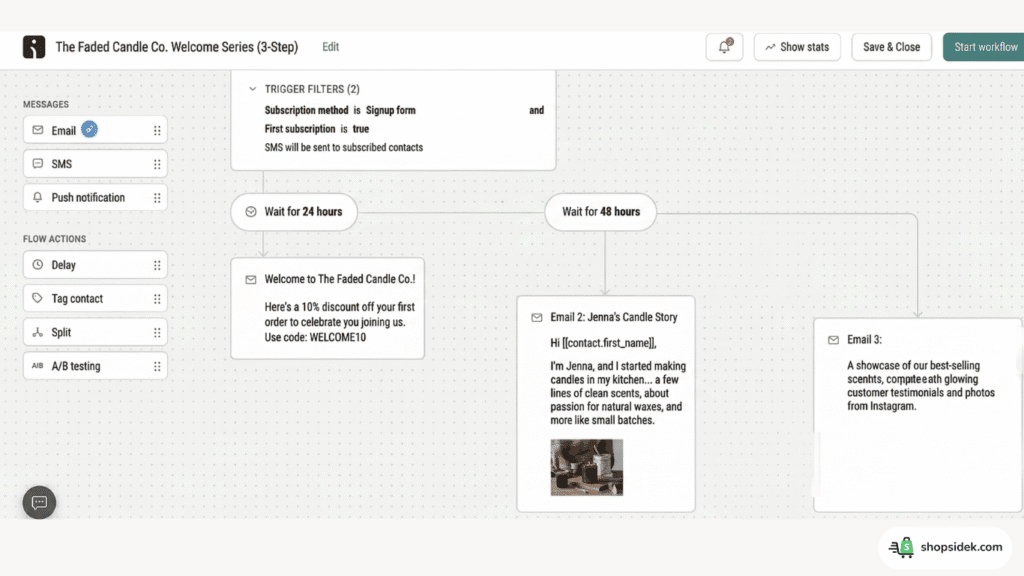
- Email 1 (Immediate): A warm welcome offering 10% off their first order.
- Email 2 (24 Hours Later): A personal note from Jenna sharing the story of how she started making candles in her kitchen.
- Email 3 (48 Hours Later): A showcase of her best-selling scents, complete with glowing customer testimonials and photos from Instagram.
The results were immediate and impactful. By focusing on brand storytelling and social proof, the new sequence resonated with her audience on a deeper level.
Within the first two months of launching the new series, The Faded Candle Co. saw a 12% increase in total orders directly attributable to the welcome flow. This simple automation turned passive “window shoppers” into paying customers by building trust and demonstrating the passion behind the brand.
Your Final Choice & Starting Your Store
We’ve covered everything from strategy to cost, and by now, you should have a clear idea of where you are in your business journey. The key isn’t to find the single “best” app, but to choose the best email marketing app for Shopify that fits your needs right now.
Let’s quickly recap our 3-stage framework to make your final choice simple:
- If you’re launching your store or are in Stage 1, your choice is clear: start with Shopify Messaging. It’s built right into your dashboard, covers all the essentials, and is the most effective way to get started without adding costs.
- If you’re entering Stage 2 and ready for automation, your best bet is Omnisend for its incredible all-in-one email and SMS platform. Choose Sequenzy if you want an AI-native platform that can help build campaigns and lifecycle automations while giving you unlimited subscribers without per-contact pricing. If your primary focus is converting traffic and growing your list as fast as possible, choose Privy.
- If you’re scaling into Stage 3 and need pro-level data, it’s time to invest in a powerhouse. Choose Klaviyo to leverage deep customer analytics and predictive insights to maximize revenue.
You have the strategy and the tool recommendations. The only thing left to do is build the business that will put them to work. The most powerful automation in the world needs a great platform to run on.
Sign up for Shopify today and turn your business idea into a revenue-generating machine.

FAQs About Best Email Marketing App For Shopify
Why isn’t Mailchimp on the main list?
Mailchimp is a powerful email marketing tool, but its history with Shopify has been complex. For a period, their direct integration was removed from the Shopify App Store. While it has since returned, the tools on our list—like Klaviyo, Omnisend, and Privy—have been built from the ground up with a “Shopify-first” focus.
This results in deeper, more reliable data syncing and features that deliver the best Shopify email marketing experience, which is why we recommend them for new store owners.
Can I switch email marketing apps later on?
Yes, you can absolutely switch apps as your business grows. Your customer email list is your asset, and you can almost always export it as a CSV file from one provider and import it into another.
However, be aware that you typically cannot migrate your automation flows, campaign history, or performance data. This is why our “3 Stages” guide is so important—it helps you choose the right app for your next 12-18 months of growth, so you won’t have to switch too frequently.
What is the single most important automation to set up first?
While the Welcome Series is crucial for building relationships, the Abandoned Cart automation is the single fastest way to see a direct return on investment. It’s an automated sales recovery machine that works in the background.
Nearly 70% of shopping carts are abandoned, and a timely email reminder (or a two-part series) can recover a significant portion of that lost revenue. Set this up the day you choose a Stage 2 or Stage 3 app.
Do these apps do more than just send emails?
Yes, many are evolving into all-in-one marketing platforms. For example, Omnisend has excellent SMS marketing features fully integrated into their platforms, allowing you to create workflows that use both email and text messages.
It’s also a master of on-site conversion tools like pop-ups, banners, and spin-to-win wheels. This is a key trend: combining multiple channels under one roof for a more cohesive customer experience.
Is it really okay to just start with a free app?
Yes, in fact, I strongly recommend it. Starting with Shopify Messaging for Stage 1 allows you to learn the fundamentals without any financial pressure. The key is to know when to upgrade.
Here’s a simple rule: the moment you think, “I wish I could automatically send a series of welcome emails,” you’ll know you’ve outgrown the free tool and are ready to graduate to a Stage 2 app like Omnisend.