⚡ ShopSideK Verdict
To start Shopify dropshipping, you realistically need $500 to $1,000 for an Accelerator setup, which covers custom domain registration, sample ordering, essential apps, and basic Facebook/Google ad testing. Bootstrapping on a Barebones budget (under $100) is possible using organic TikTok/Pinterest marketing. A scalable, high-growth Pro-Launch budget requires $1,500+. Sourcing from quality-controlled partners like FFOrder is highly recommended to protect your margins.
- 1 Barebones Path (Under $100) — Uses Shopify’s extended $1 trial, a custom domain ($15/yr), and 100% organic social media marketing (TikTok Reels, Pinterest Pins) to acquire your first customers.
- 2 Accelerator Path ($500–$1,000) — The most recommended path. Dedicated budget of $200–$500 for testing paid Meta/Google ads, ordering product samples ($50–$100), and installing critical conversion apps.
- 3 Pro-Launch Path ($1,500+) — For rapid scaling. Aggressive paid ad campaigns ($800+ budget), premium theme customization, and advanced app integrations for reviews and email automations from day one.
Dropshipping is never 100% free. Even on a bootstrap budget, you need working capital. You must pay your supplier for customer orders before Shopify processes and releases your payouts. Always keep a backup fund of at least $150–$250.
Exclusive Partner Offer · Extended 3-Month Trial at $1/Month
If you’re asking, “how much money do you need to start Shopify dropshipping,” you’ve likely seen a wide range of answers. One article might tell you it’s possible with $0, while the next claims you need over $2,000 for your first month. This conflicting advice often leads to analysis paralysis, stopping a great business idea before it even starts.
Forget the confusing numbers. We’re here to provide the most transparent financial roadmap for 2026. Instead of a single, vague estimate, we’ve developed three distinct and actionable budget plans tailored to your specific goals: the Barebones Budget for bootstrapping your first sale, the Accelerator Budget for achieving faster growth, and the Pro-Launch Budget for scaling from day one.
This guide breaks down every potential cost, so you can launch with absolute confidence. While you map out your financial plan, you can explore the platform completely free. Start a free Shopify trial here and follow along.
Quick Answer: How Much Money do You need to start Shopify Dropshipping
Your ideal dropshipping budget depends entirely on your goals. Are you looking to test a product idea with minimal financial risk, or are you ready to build a scalable brand from day one? To give you a clear answer, we’ve broken down the startup costs into three distinct, realistic tiers.
Find the path that best matches your ambition and resources. This table provides a quick overview of what you can expect to invest in your first month.
The 3 Realistic Startup Budgets for Dropshipping
| Budget Tier | Total Month 1 Cost | Platform | Initial Ad Spend | Key Focus |
|---|---|---|---|---|
| Barebones | Under $100 | Shopify Trial ($1) | $0 – $50 | Organic Marketing (TikTok) |
| Accelerator | $500 – $1,000 | Basic Shopify ($25) | $200 – $500 | Paid Ads Testing, Essential Apps |
| Pro-Launch | $1,500+ | Grow Shopify ($65) | $800+ | Scaling Ads, Premium Theme & Apps |
The Barebones Budget is designed for maximum efficiency, relying on free trials and organic marketing—often called “sweat equity”—to generate your first sales. It’s a low-risk way to validate your niche.
The Accelerator Budget is, in my opinion, the most common and recommended starting point. This investment allows you to properly test products with paid advertising, gather valuable customer data, and install essential apps to improve your store’s functionality.
💡Not sure which apps are worth the spend? Our phase-by-phase guide to the best dropshipping apps for your stage breaks down exactly what to install—and what to skip—at the Barebones, Accelerator, and Pro-Launch budget levels.
The Pro-Launch Budget is for entrepreneurs who are serious about scaling quickly. This budget supports a more aggressive advertising strategy, premium themes, and advanced apps, setting the stage for significant growth from the very beginning.
Core Costs: An Itemized Breakdown of Your Initial Investment
Regardless of which budget you choose, every dropshipping store shares a set of foundational costs. These are the non-negotiable investments that form the backbone of your business. Here’s a detailed look at where your initial capital will go.
(While this guide focuses strictly on the dropshipping model, you can also review our breakdown of the real Shopify website cost to see how these expenses compare to a traditional inventory-based store.)
1. Your eCommerce Platform: Choosing the Right Shopify Plan
When considering what Shopify plan is best for dropshipping, the choice for a new entrepreneur is straightforward. While Shopify offers several pricing tiers, your focus should be on keeping initial overhead low while still getting all the essential features.
For 99% of beginners, the Basic Shopify plan is the clear winner. At $25 per month after your trial period, it provides every essential feature you need to launch and grow, including a fully functional website, unlimited product listings, and secure payment processing.
To understand why this is the best choice for your budget, let’s compare it to the next tier up:
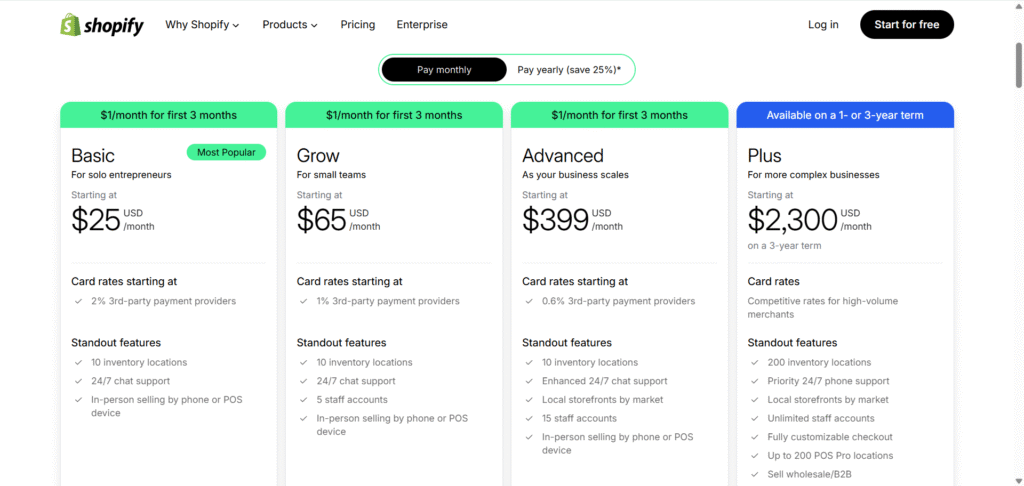
The primary reason to upgrade to the Grow plan is for the lower transaction fees. However, this only makes financial sense once your store is generating significant volume. The “tipping point” is around $16,667 in monthly sales. Until you reach that revenue level, the Basic plan is actually cheaper to run.
Starting with the Basic plan keeps your overhead low while you focus on finding winning products. You can activate your extended trial for $1 / 3 month to lock in the lowest rate.
Note: I’m a Shopify Media Partner, which means I might earn a small commission if you sign up through my link. It doesn’t cost you anything extra and helps keep this blog running.
2. Your Digital Address: Domain Name
A custom domain name (e.g., yourbrand.com) is one of the most important small investments you can make. While Shopify provides a default URL (your-store.myshopify.com), using it makes your business look unprofessional and can erode customer trust.
Purchasing a custom domain from registrars like Namecheap is simple and affordable, typically costing around $15 per year. This small fee secures your brand identity, improves your search engine visibility, and gives customers the confidence they need to make a purchase.
3. Business & Legal Setup
While it’s tempting to skip the administrative steps, remember that you are building a real business. At a minimum, you’ll need to decide on a business structure. A Sole Proprietorship is often the simplest and cheapest to start, but forming a Limited Liability Company (LLC) can protect your personal assets.
The cost to register an LLC varies by state but, as the Shopify blog notes, generally falls between $50 and $500. This is an investment in your business’s long-term health and legitimacy. You may also need to apply for local business licenses or a resale certificate to purchase inventory tax-free, so be sure to check your local requirements.
4. Product Validation: Ordering Samples
To me, this is the step that separates amateur dropshippers from serious entrepreneurs. Before you list a single product, you must order samples to validate their quality. Skipping this step is a recipe for customer complaints, costly refunds, and negative reviews.
Budgeting $50 to $100 for product samples, as Shopify recommends, is crucial. This allows you to assess the product’s look and feel, check for defects, gauge shipping times and take unique photos and videos for your marketing. Think of this not as a cost, but as an essential quality control investment.
Sourcing from a platform like FFOrder Dropshipping (free to use + exclusive $15 signup coupon) is highly recommended. It offers manual quality control checks on all items before they leave the warehouse, fast shipping to the US/EU in 7-9 business days (10–15 business days globally) with tracking numbers automatically synced within 24 hours.
5. Essential Store Apps: Your Functionality Stack
Shopify apps are powerful tools that add critical features to your store, from sourcing products to building customer trust. I know it’s easy to get carried away, but a lean “starter stack” is all you need. Most of the best apps offer robust free plans that are perfect for new stores.
Here are the three core functions you should cover from day one:
- Product Sourcing: FFOrder is the primary Shopify app for finding and syncing products. Its free plan is sufficient for getting started.
- Product Reviews: Social proof is essential for conversions. Apps like Loox (30 day free trial) or Rivyo AI Reviews allow you to easily import product reviews, and both offer free or low-cost plans.
- Email Marketing: Building an email list is a long-term asset. Platforms like Omnisend have powerful free plans that let you capture customer emails and send automated campaigns.
Marketing & Advertising: Your Biggest Variable Expense
Once your store is built, your single biggest ongoing investment will be getting customers through the door. This is also your most flexible expense, as you can start with a budget of zero and scale up as you grow. Your approach to marketing will directly align with the budget tier you chose.
(If you haven’t reached the marketing phase yet and need help building your store from scratch, our complete tutorial on how to dropship on Shopify covers the entire setup process.)
The “Sweat Equity” Route: Organic Marketing (TikTok, Instagram, Pinterest)
If you’re launching on the Barebones Budget, your marketing strategy will be fueled by time and effort, not money. This “sweat equity” approach is powerful for testing ideas and building an initial audience without financial risk. Instead of paying for ads, you’ll create content that attracts customers naturally.
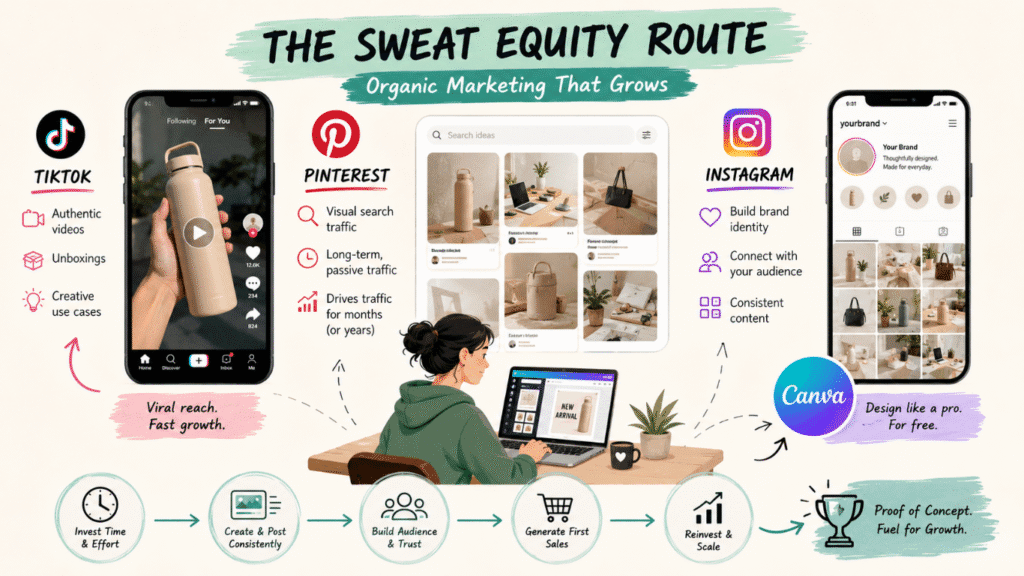
TikTok is the top platform for this strategy. Its algorithm can make a video go viral overnight, even from a brand-new account. Focus on creating authentic, low-fi videos showcasing your product in action, unboxings, or creative use cases. You don’t need a professional camera; your smartphone is your best tool here.
Pinterest acts as a visual search engine, making it a fantastic source of long-term, passive traffic. Create high-quality pins and graphics that link back to your product pages. Unlike a TikTok video that has a short lifespan, a popular pin can drive traffic for months or even years.
You can use free tools like Canva to design professional-looking pins and social media posts for Instagram, which helps build your brand’s visual identity. The key to organic marketing is consistency. By posting regularly, you build momentum that can lead to your first sales and provide the proof of concept needed to reinvest in paid ads later.
The Paid Traffic Route: Budgeting for Facebook & Google Ads
For those using the Accelerator or Pro-Launch budgets, paid advertising is your path to faster growth and scalable results. While organic marketing is about building momentum slowly, paid ads are about buying data and speed.
It’s crucial to approach your initial ad spend with the right mindset. In practice, your first $100 to $200 in ad spend is not designed to generate a profit; it’s an investment in market research. You are paying to learn:
- Which products get the most clicks?
- Which ad copy and images resonate with your audience?
- Who is your ideal customer?
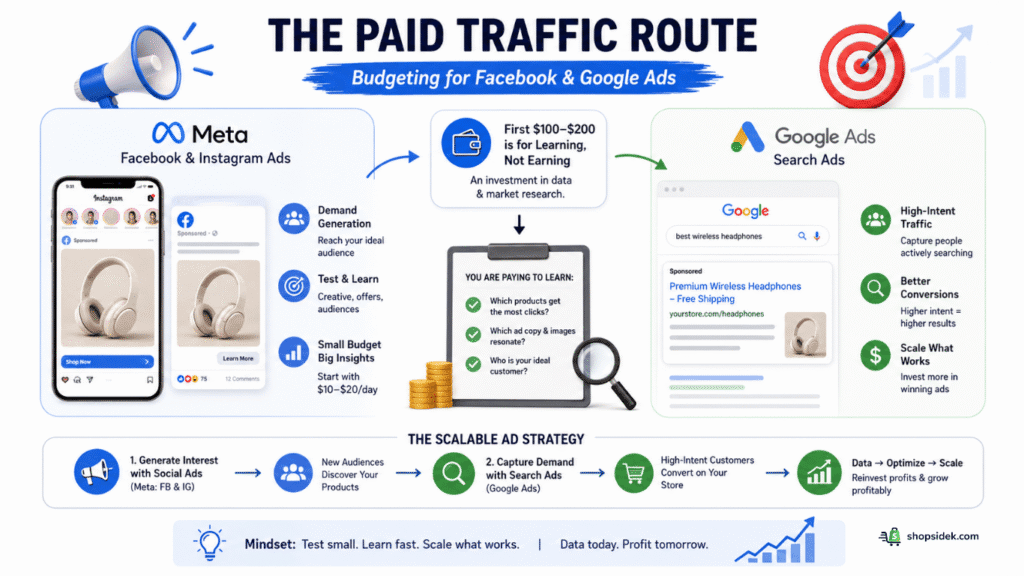
Starting with a small daily budget of 10-20 on platforms like Facebook and Instagram (Meta) allows you to test different product ads and audiences without breaking the bank. These platforms are excellent for demand generation—placing your product in front of people who fit your target customer profile.
As you gather data, you can also allocate a budget for Google Ads. This allows you to capture high-intent customers who are actively searching for products like yours. This two-pronged approach—generating new interest on social media and capturing existing demand on search—is the foundation of a scalable advertising strategy.
The “Hidden” Costs Most Guides Forget
Your Shopify plan and marketing budget are the big-ticket items, but several smaller, recurring costs can catch new entrepreneurs by surprise. My advice is to budget for these from the start; it’s key to protecting your profit margins and avoiding financial headaches down the road.
Here are the three “hidden” costs every dropshipper needs to anticipate:
1. Payment Processor Fees: Every time you make a sale, a small percentage is deducted to process the payment. Whether you use Shopify Payments, Stripe, or PayPal, the standard fee in the United States is 2.9% + 30¢ per transaction. This might seem small, but it adds up quickly as your sales volume grows. Be sure to factor this into your product pricing to ensure each sale is profitable.
💡To quickly forecast how these transaction fees will impact your bottom line alongside your monthly subscription, we recommend plugging your projected numbers into a Shopify pricing calculator.
2. Returns & Refunds: In eCommerce, returns are an unavoidable part of doing business. When a customer wants a refund, you are responsible for returning their money. However, your dropshipping supplier may not accept the returned product, meaning you absorb the cost of the original item. It’s wise to set aside a small cash reserve—I suggest 5-10% of your monthly sales—to cover the cost of refunds and maintain excellent customer service.
3. Taxes & Compliance: As your business grows, so does your responsibility to collect and remit sales tax. Sales tax laws are complex and vary between states and countries. While you may not need a sophisticated system on day one, be prepared to eventually invest in a compliance tool. Services like TaxJar or Avalara can integrate with your Shopify store to automate tax collection, saving you from a significant administrative burden.
Putting It All Together: A Real-World Profit Calculation
All these individual costs can feel abstract. Let’s translate them into a tangible, real-world scenario to see how a single sale generates profit. This calculation is the foundation of your business model, showing you exactly how much money you make from each transaction before accounting for marketing.
Let’s use a common dropshipping product as an example: a piece of jewelry.
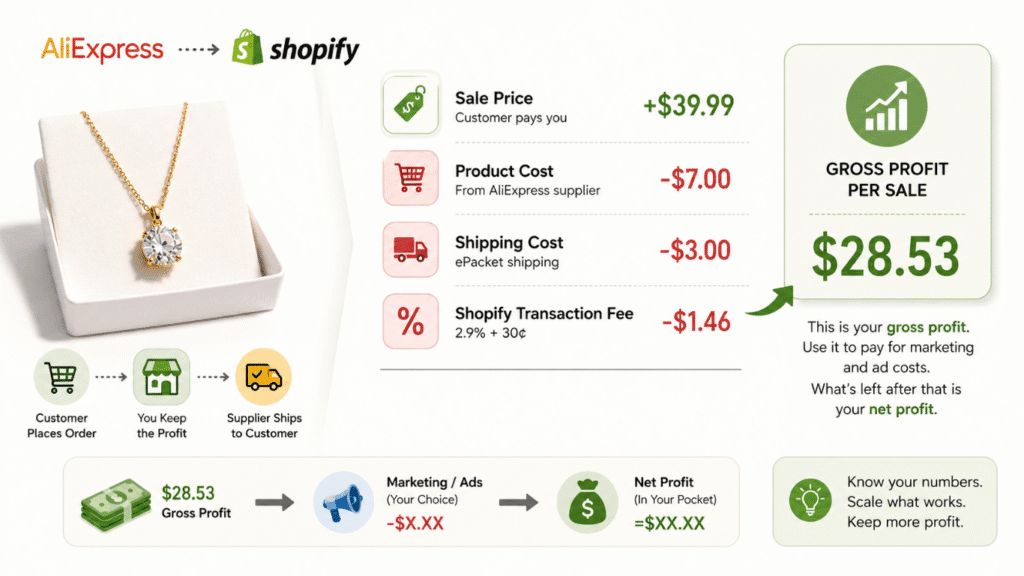
Imagine you find a necklace on AliExpress and decide to sell it on your Shopify store for $39.99. Here’s how the math breaks down on a typical order:
- Sale Price: +$39.99
This is the total amount the customer pays you. - Product Cost (from Supplier): -$7.00
This is the wholesale price you pay your AliExpress supplier for the necklace. - Shipping Cost (ePacket): -$3.00
This is the cost to have the supplier ship the item directly to your customer. - Shopify Transaction Fee (2.9% + 30¢): -$1.46
This is the standard fee for processing the customer’s payment.
- Gross Profit per Sale: $28.53
This $28.53 is your gross profit. It’s the money left over from a sale after paying for the product and fulfillment. This is the critical number you’ll use to pay for your marketing and advertising costs.
Anything left after that is your net profit—the money that goes into your pocket. Knowing this margin helps you make smart decisions, like how much you can afford to spend on ads to acquire a new customer.
FAQ: How Much Money do You need to start Shopify Dropshipping
Can you really start dropshipping with no money?
While some guides claim you can start for $0, it’s more nuanced. You can get incredibly close by leveraging Shopify’s free trial, using free apps like FFOrder, and focusing entirely on organic marketing.
However, this isn’t a long-term strategy. You will still need capital to pay your supplier for customer orders before the funds from that sale are deposited into your bank account. So, while you can build your store for next to nothing, you need some working capital to actually fulfill orders and operate sustainably.
Is $500 enough to start dropshipping?
Yes, $500 is an excellent starting budget. This question appears frequently in places like the Shopify Community forums, and for good reason—it’s a realistic and substantial amount for a new entrepreneur.
This figure aligns perfectly with our Accelerator Budget, allowing you to cover all your core costs (Shopify plan, domain, samples) and dedicate 200-300 to a proper advertising test. This is enough capital to gather real customer data and find your first winning product.
How much do successful dropshippers make?
Profitability in dropshipping varies dramatically and depends on niche selection, marketing skill, and operational efficiency. It is not a get-rich-quick model. After accounting for product costs, fees, and advertising, a healthy net profit margin is typically between 15% and 20%.
For some, this means an extra few hundred dollars a month. For others who successfully scale their brands, it can grow into a six or even seven-figure business. I’ve learned that success is directly tied to your commitment to testing, learning, and treating it like a real business.