Last updated: November 15, 2026. Both pages are live demos you can open and click through for free, without an account.
A hair care product page has a problem most product pages don’t: the same product is not right for every head of hair, and the shopper has usually bought the wrong one before. The two Shopify examples below solve it for two products. Coilwort, a curl cream, sells the jar inside its routine (cream, gel and mist, ticked together), helps the shopper choose one of three weights with a three-question finder, and swaps a wrong weight for free. Calltime, a tinted dry shampoo powder, puts a tint on every bottle, shows on a swatch card that the right tint leaves no grey line, and sells the subscription first.
Key takeaways: 7 rules for a hair care product page
- Help them choose the variant before they see a total. A short finder or a swatch test by hair level beats a dropdown the buyer has to guess.
- Make the wrong choice cheap. A free swap to the right weight or tint, with the first one kept, removes the fear that stops most hair buyers.
- Sell the set the product lives in. Coilwort ticks the gel and the mist; Calltime preselects two bottles, a tint for each person.
- Count in uses, then time the subscription from them. “About eighteen wash days in a jar” or “38 mornings a bottle” becomes an interval the shopper can check.
- Say when your product is not the answer. “If you like the pot, keep the pot” and “wash on day five” make the rest believable.
- Publish an ingredient list for every formula and every tint. US rules give hair products no shared list across shades.
- Claim only what the bottle and the label can show. “No aerosol can” and “no talc” can be checked; “natural” and “benzene-free” need proof.
The two examples at a glance
| Coilwort | Calltime | |
|---|---|---|
| Product | Flaxseed leave-in curl cream, 8 oz jar, $28 | Tinted dry shampoo powder, 1.7 oz squeeze bottle, $26 |
| Variants | Three weights (Light, Medium, Rich), one price | Four tints by hair level (Fair, Honey, Chestnut, Espresso), one per bottle |
| Kaching offer type | Frequently Bought Together on a Bundle Upsell: the cream locked in, a gel and a mist ticked | Quantity Break, subscription first: 1, 2 or 3 bottles |
| Selected on load | All three ticked: $56, crossed-out $68 | 2 bottles on Subscribe & save 20%: $38.40, crossed-out $48 |
| Subscription | 15% off, every 6, 8 or 10 weeks | 20% off, every 6, 8 or 12 weeks |
| Free gifts | None in the widget | A travel puffer with 2 bottles; a puffer and a root brush with 3 |
| Cart reward | A satin scrunchie from $60 | Free shipping at $35, a scrunchie trio at $55 |
| Order in the walkthrough | $56 → $60 | $38.40 → $57.40 |
| Live example | Coilwort template (T12) | Calltime template (T29) |
Example 1: Coilwort, a curl cream page that sells the routine
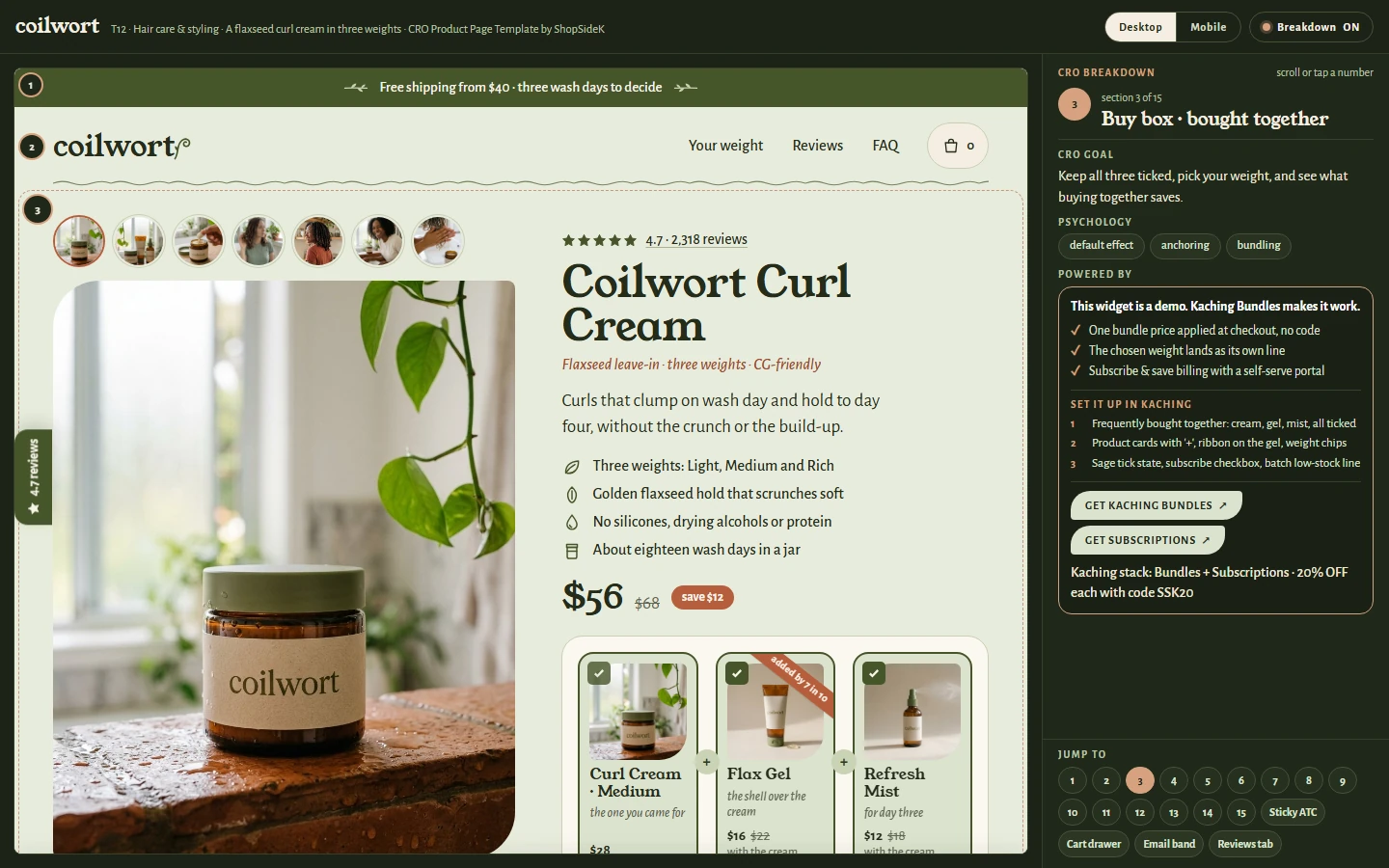
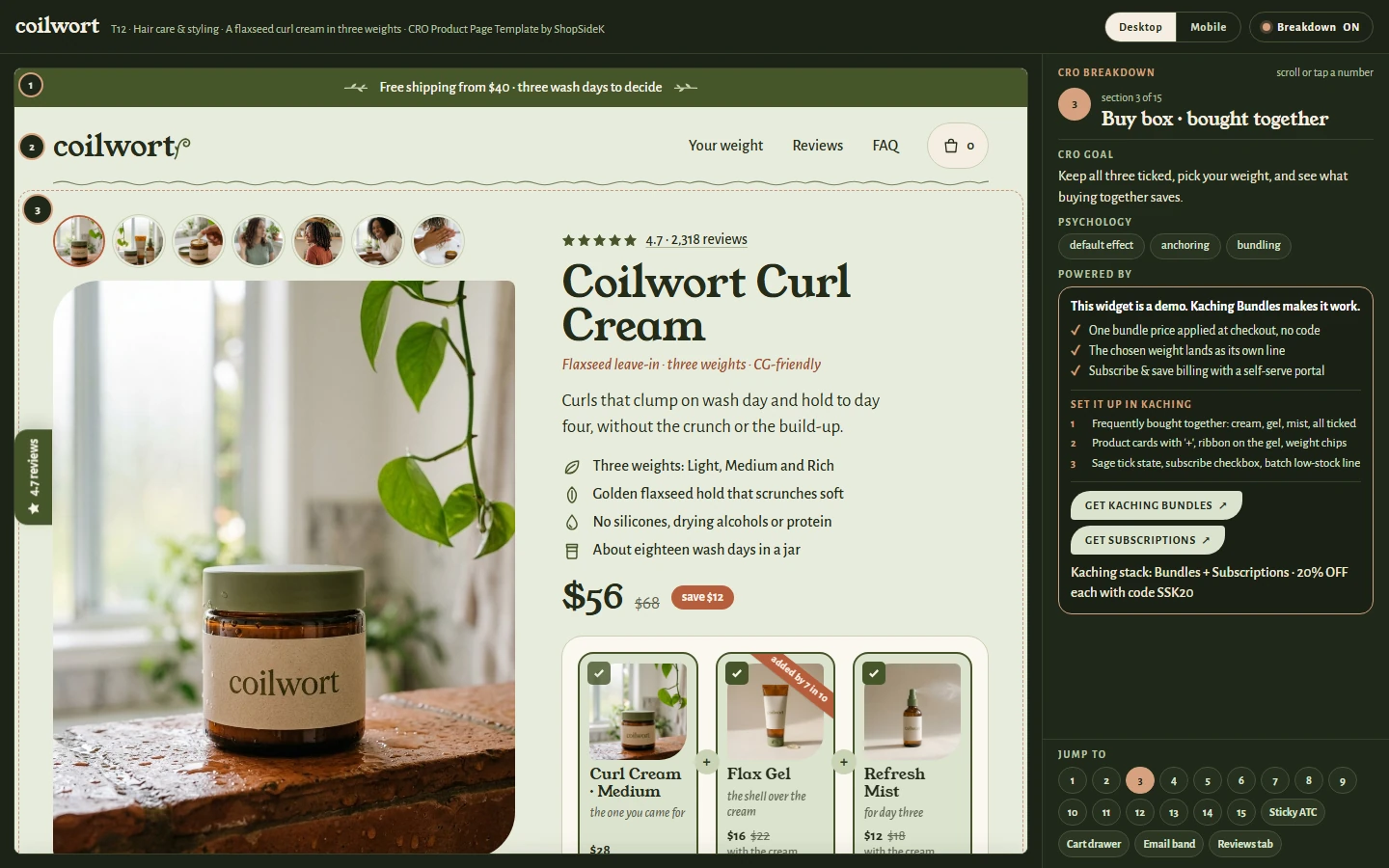
Coilwort sells one product in three weights: a flaxseed leave-in curl cream at $28 a jar. Light suits waves, fine hair and hair that floats in water; Medium suits curls; Rich suits coils, thick hair and hair that sinks. The weight changes the formula, never the price. Two partners ride along: a Flax Gel ($22 on its own, $16 with the cream) that dries into a soft shell over the cream, and a Refresh Mist ($18 on its own, $12 with the cream) that revives the curls on day three without a rewash.
The offer: the cream, ticked with what it’s used with
The bundle is a frequently-bought-together row: three product cards joined by “+” signs, each with a checkbox. The cream’s box is ticked and locked, captioned “the one you came for”. The gel and the mist load ticked, and either can be unticked.
| What’s ticked | One-time price | Crossed-out price | One-time saving | Subscribe & save price | Subscribe saving |
|---|---|---|---|---|---|
| The cream only | $28 | none | none | $23.80 | $4.20 |
| Cream + gel | $44 | $50 | $6 | $37.40 | $12.60 |
| Cream + mist | $40 | $46 | $6 | $34.00 | $12.00 |
| All three (on load) | $56 | $68 | $12 | $47.60 | $20.40 |
The crossed-out price is the items’ own prices added up, which is what Kaching computes for a Bundle Upsell. The cream on its own carries no strike, so it works as an honest full-price anchor. Free shipping starts at $40 on one-time orders, and every subscription box ships free.
On the demo’s assumed costs, the weakest order is the cream alone on subscribe & save with the 10% welcome code on the first box: $21.42 of revenue against $8.60 of cost (the jar, packing and the shipping the shop pays), a 59.9% gross margin, held up by add-ons that drop by a set dollar amount instead of a deep percent. Test your own costs in the Shopify discount break-even calculator, and read how Shopify bundle discounts stack before letting a welcome code combine with bundle and subscription prices.
The sections that do the persuading
- One row for the weight. A row of chips under the cream card (“waves · curls · coils”) changes the label and the stock line, never the price or the photos, so nothing on the page jumps.
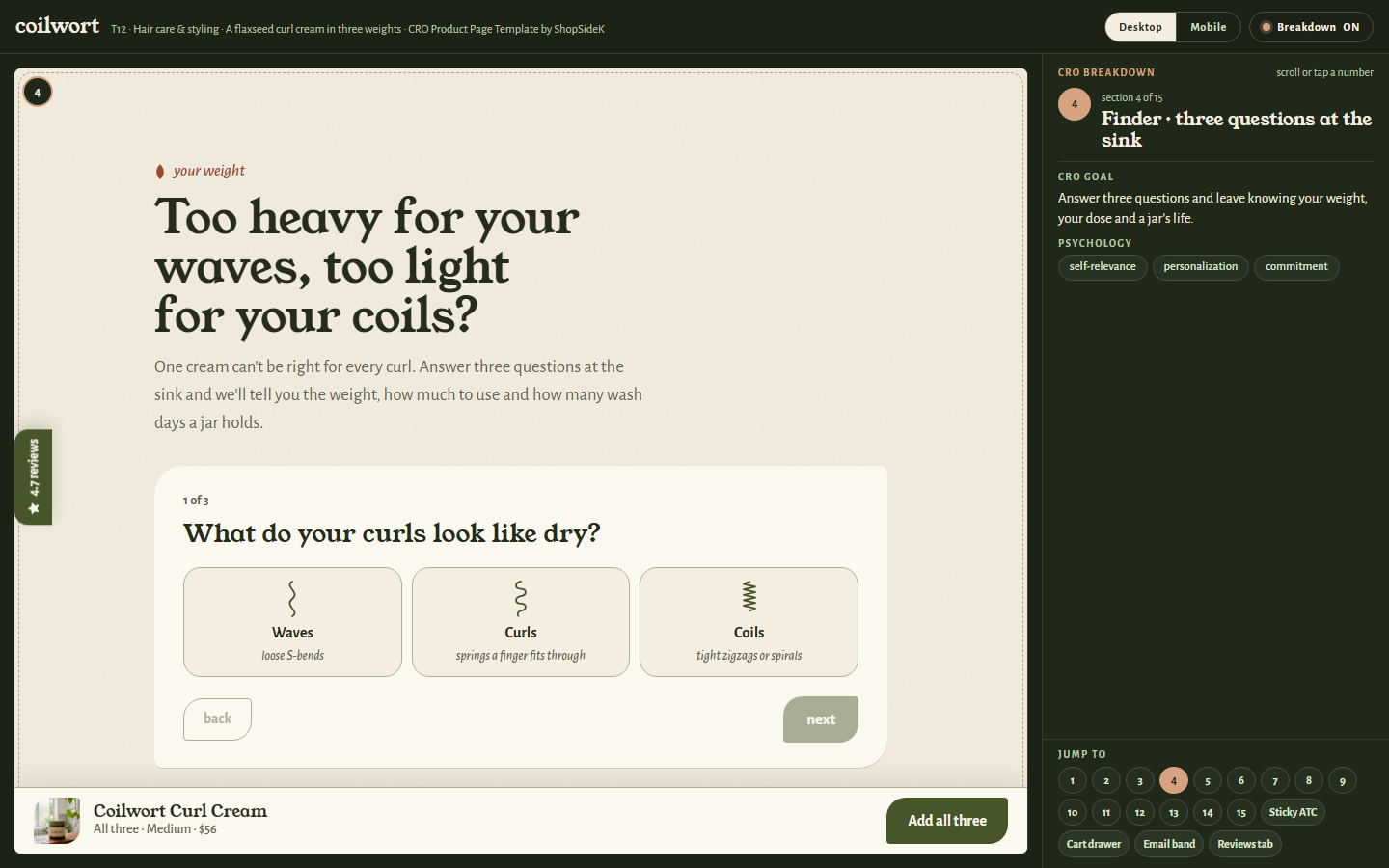
- Three questions at the sink. The whole page leans on this finder. The curl pattern sets the starting weight; whether a clean strand floats, drifts or sinks in a glass of water moves it one step lighter or richer (the page calls it “a rough home test, not a lab one”); length sets the dose. The result names the weight and how many wash days a jar holds. Its button only scrolls back to the bundle and leaves the chip for the shopper to tap, so the choice stays theirs.
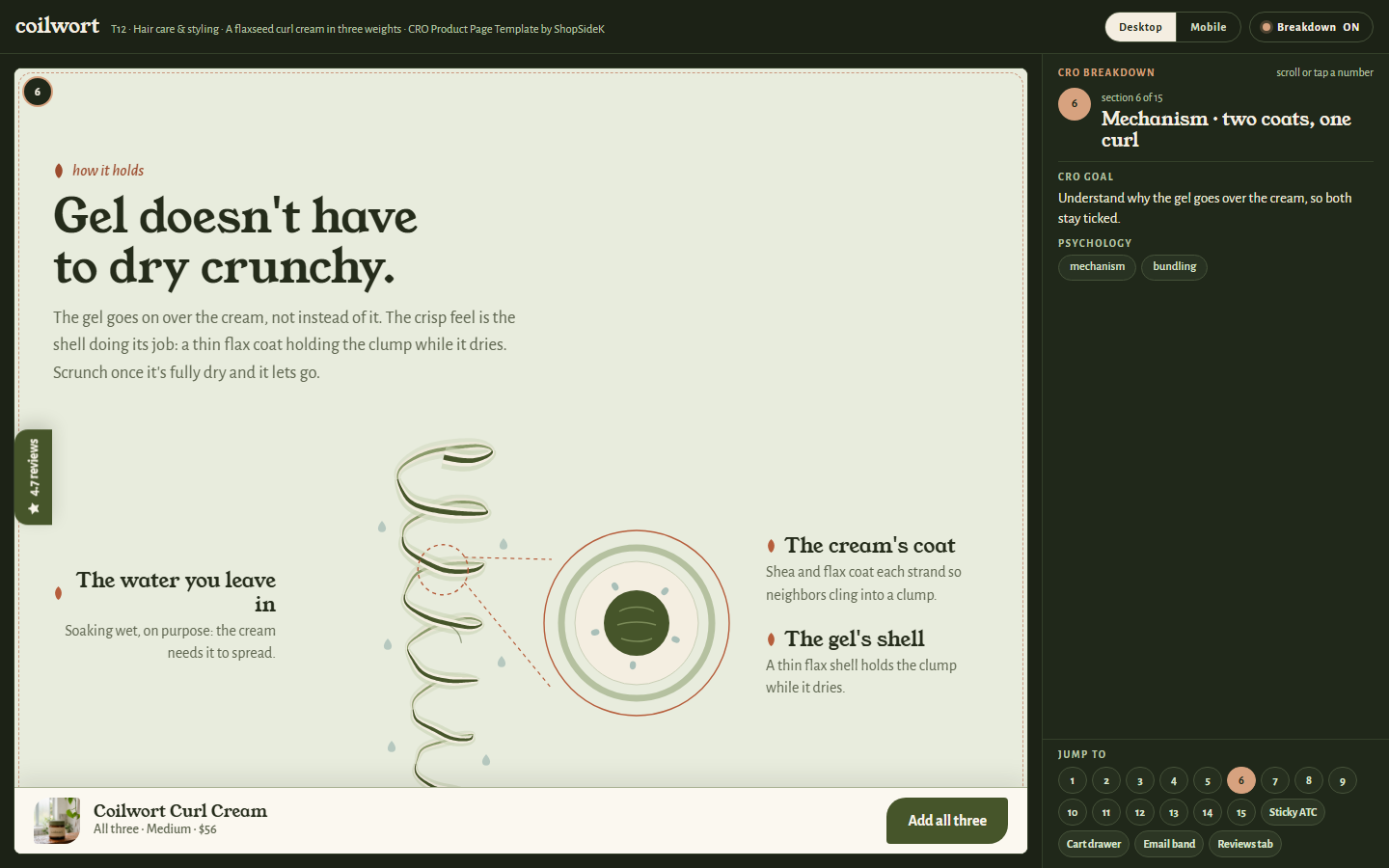
- What the plants stand in for, and two coats on one curl. One section turns “CG-friendly” into four plants with jobs, such as golden flaxseed for hold instead of a gel’s polymers. The next draws a single curl: the cream coats strands so they clump, and the gel’s thin shell holds the clump while it dries. Its real job is to keep the gel ticked.
- Reviews you can read by curl type. Each review (Loox) carries a line such as “2B waves · Light · low porosity”, so a shopper can see which weight someone with their hair kept.
- Guess the day, and the stove or the jar. A photo asks “Which day of the wash is this?” and reveals day four. The next section admits that flaxseed gel is a well-known home recipe and ends with “If you like the pot, keep the pot.” Being generous about the free alternative makes the paid one easier to believe.
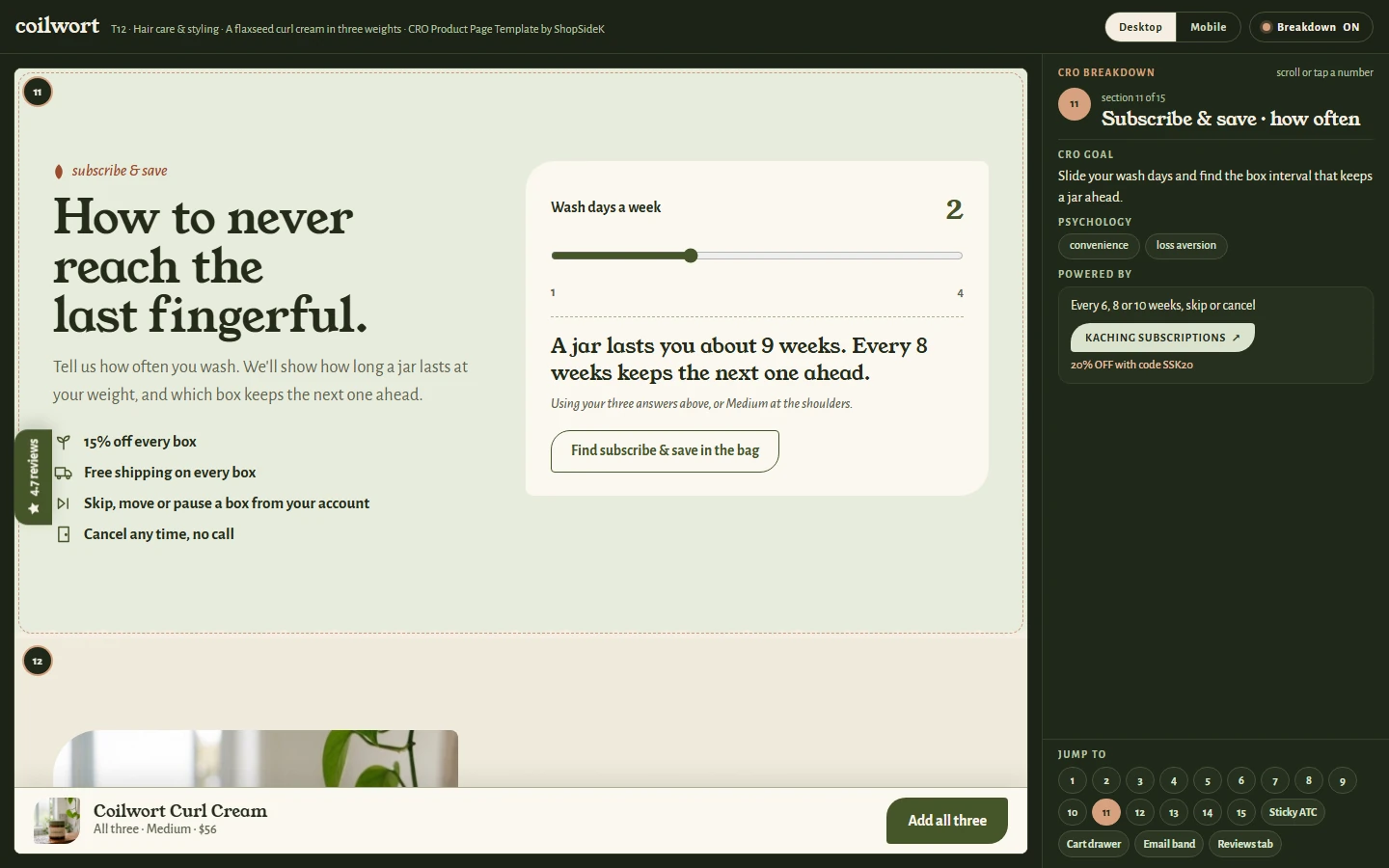
- Subscribe & save from wash days. A slider divides the jar’s wash days by wash days a week and suggests the longest box interval that doesn’t run past it. Medium at shoulder length lasts 18 wash days; at two a week that’s nine weeks, so the page suggests every 8 weeks. Its button scrolls to the bundle and never ticks the subscription box.
- The guarantee. “Opened jars come back too”: what’s left of a jar, even half, comes back within 30 days for a full refund. The wrong weight gets the other one free, and the first jar stays.
The cart: from $56 to $60, and a scrunchie
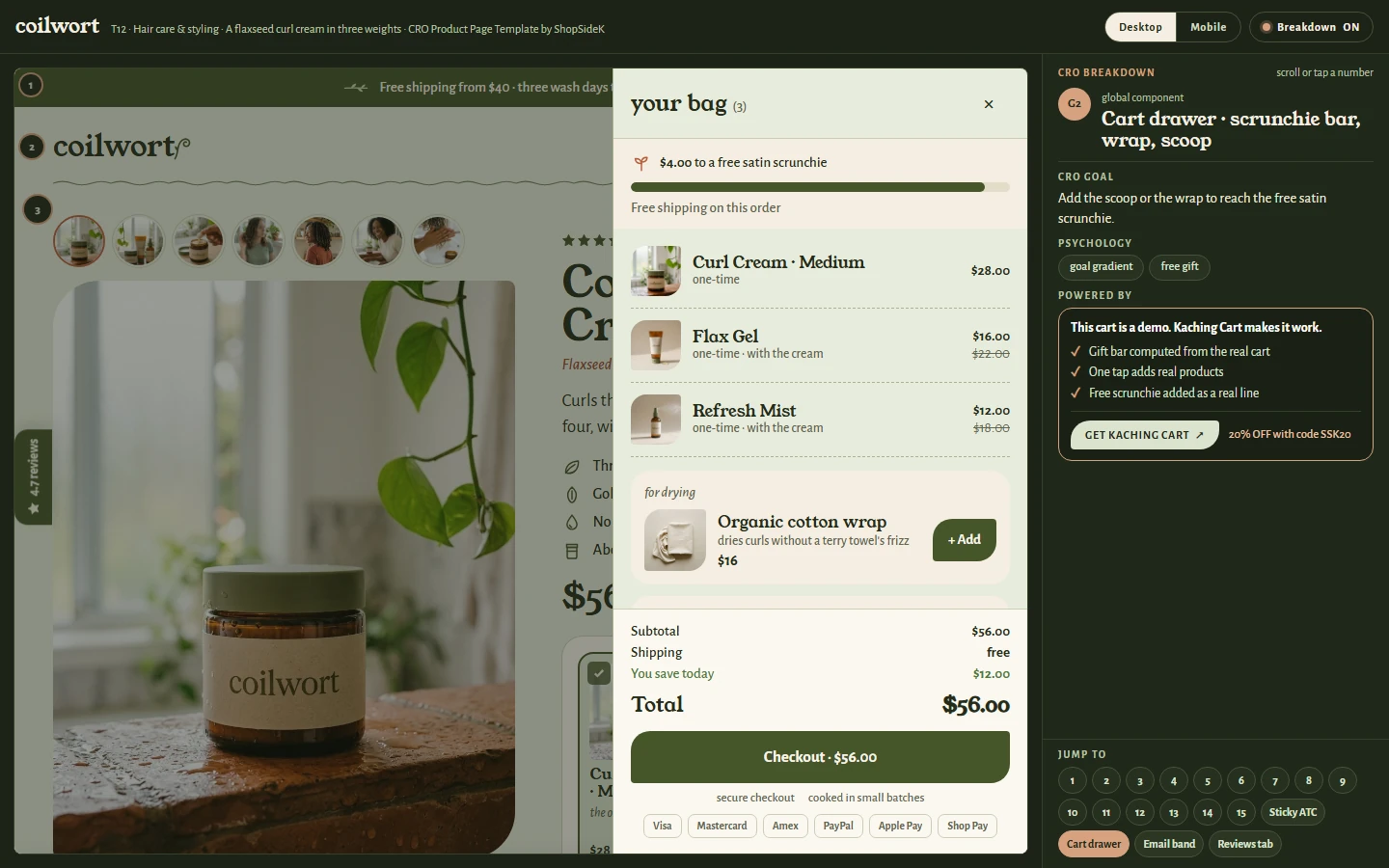
The cart drawer (Kaching Cart) opens straight onto a free-gift bar: a satin scrunchie ($8 value) from $60 of products after discounts. The preselected routine is $56, so the bar reads “$4.00 to a free satin scrunchie”. A beechwood scoop toggle at $4 (“keeps fingers out of the jar”) lands the order on exactly $60, and an organic cotton wrap at $16 takes it to $72. On subscribe & save the routine is $47.60, $12.40 short, and the wrap clears it.
One thing not to copy
The vote bars in Guess the day. After a vote, the section shows “how earlier visitors guessed”: 58% day one, 27% day two, 11% day three, 4% day four. In the demo those are fixed numbers, written to make the reveal land. On a live store, count real votes or drop the bars and keep the reveal. The same goes for the “added by 7 in 10” ribbon on the gel, the “Nine in ten stayed with the first weight they picked” heading and the jars-left lines: sample text, to show only when your own order data produces it.
Rebuild the offer in Kaching
- A Bundle Upsell deal on the cream with the gel at $16 and the mist at $12 when bought with it, both selected by default.
- Product cards joined by “+”, one Weight row for the cream, a corner badge on the gel card.
- Subscriptions on with plans every 6, 8 or 10 weeks at 15% off, and a free-shipping label from $40.
Kaching lists “Frequently bought together” among its bundle types (Kaching Bundles on the Shopify App Store), documents per-item discounts on product-page bundle upsells (Kaching help: upsell bundles on the product page) and explains adding subscriptions to a bundle (Kaching help: sell subscriptions for bundles). Three details are not in Kaching’s public docs: a checkbox per card with the main product locked, the weight as text pills, and a badge on a single upsell card. Check them in your own editor, with the variant dropdown as the fallback.
Example 2: Calltime, a tinted dry shampoo page that sells the subscription first
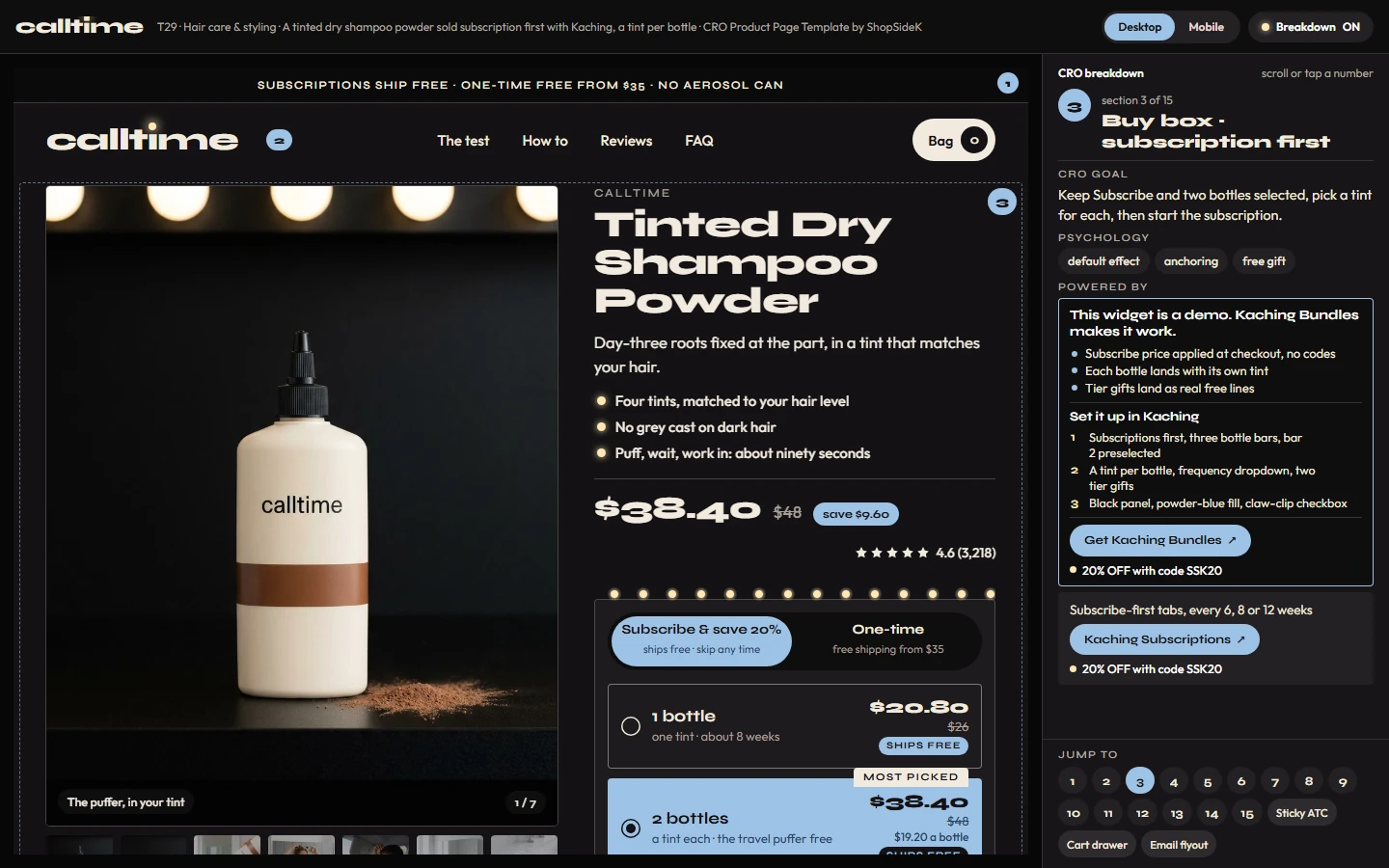
Calltime sells a tinted dry shampoo powder: 1.7 oz of rice starch, kaolin and silica in a squeeze bottle with a narrow nozzle, no aerosol can. It comes in four tints by hair level, Fair (levels 8–10), Honey (6–7), Chestnut (4–5) and Espresso (1–3), at $26 a bottle. The buyer fears the grey line a white powder leaves on dark hair, then running out on a day-three morning. The page answers with a tint per bottle and a subscription that is already selected.
The offer: bottles per box, a tint for every bottle
| Bottles | Subscribe & save 20% (selected tab) | One-time | Per bottle, subscribed / one-time | Free with it |
|---|---|---|---|---|
| 1 bottle | $20.80, struck $26 | $26, plus $4.95 shipping | $20.80 / $26 | Nothing |
| 2 bottles (preselected) | $38.40, struck $48 | $48, struck $52 | $19.20 / $24 | Travel puffer, 0.4 oz ($9) |
| 3 bottles | $52.80, struck $66 | $66, struck $78 | $17.60 / $22 | Travel puffer and soft root brush ($21) |
“Deliver every” loads at 8 weeks (6 and 12 are the others). On the subscription tab the struck price is the same bar’s one-time price, so the only saving it claims is the 20%. Choosing a bar opens one tint dropdown per bottle, Chestnut by default, so one box can hold a Fair and an Espresso; a “Which tint?” link scrolls to the cast test and picks nothing. On a subscription the gifts come with the first box only, as the strip under the bar says. A checkbox adds two claw clips for $8.
On the demo’s assumed costs, the weakest order is one bottle on subscription: $20.80 of revenue against $9.44 of cost (the bottle, packing, shipping, payment fees and reserves for tint swaps and refunds), a 54.6% gross margin. The welcome code, CALLTIME10, works on a first one-time order only, so nothing stacks on the subscriber price. For whether each bottle count should get the same subscription rate, see subscription plans per quantity tier on Shopify.
The sections that do the persuading
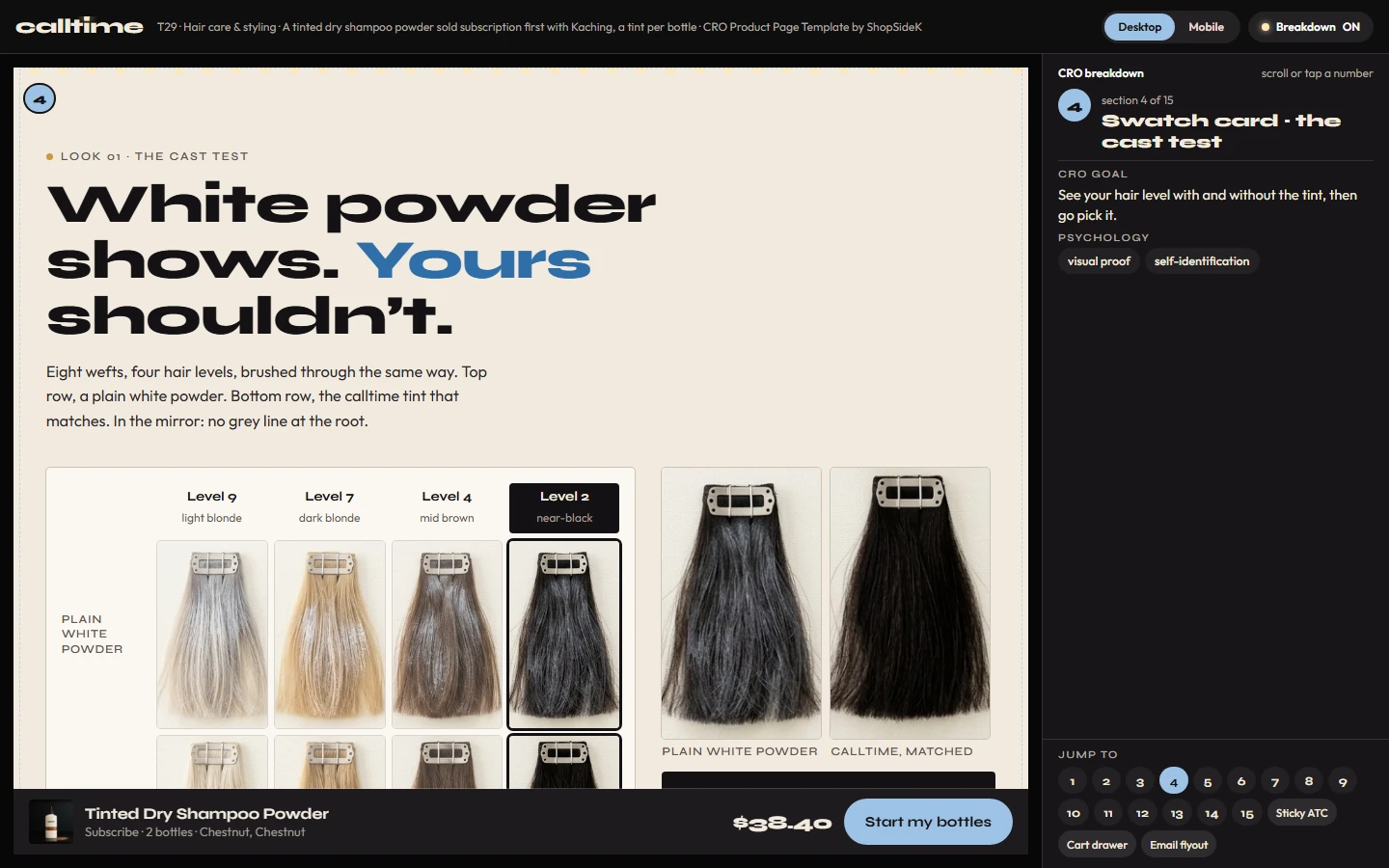
- The cast test. A salon swatch card holds eight wefts at four hair levels: the top row brushed with a plain white powder that goes grey on the darker wefts, the bottom row with the matching tint, which doesn’t show. Its label, “Our own swatch test, photographed in daylight. Not a study.”, is worth copying.
- Day three, 7:40. A split-flap departures board lists mornings by role, from a night-shift nurse to a flight attendant, and ends on the shopper’s own: “You · 07:40 · bathroom → door”.
- Where the powder goes, and when to stop. A photo of a part marks five spots with their puffs. A wash cycle follows, ending on day five with a wash, because “Powder builds up if it never meets shampoo.”
- What’s in a puff. Four powders with their shares (rice starch 58%, kaolin 24%, silica 6%, the tint up to 12%), each with what it replaces: talc, a volume product, propellant, a white cast.
- One mirror, two tints. A floor plan sends “Theirs · Fair · 7:20” and “Yours · Espresso · 7:40” to one bathroom: the case for two bottles, made without a deeper discount.
- How often should it come? Three chips (3, 4 to 5, or 6 to 7 mornings a week) turn a bottle’s 38 mornings into about 12, 8 or 6 weeks. As on Coilwort, the button only scrolls and never changes the widget’s interval.
- Reviews by hair color, and a swap for the wrong tint. Loox chips filter the gallery by hair color, with a buyer who swapped Chestnut for Honey and a three-star complaint about a clogged nozzle. The guarantee gives 60 days with half a bottle used and sends the right tint free.
The cart: from $38.40 to $57.40, and a scrunchie trio
The drawer (Kaching Cart) runs a two-step bar on the products before codes: free shipping at $35, already reached on a subscription, then a satin scrunchie trio ($10 value) at $55. The preselected box opens at “$16.60 to a free scrunchie trio”, above a “Goes in the bag” slider with a root brush ($12) and a wide-tooth comb ($7); the travel puffer stays hidden because the box already brings one. The brush and the comb take the order to $57.40 and add the trio free. Two one-time bottles at $48 sit $7 short, so the comb lands them on exactly $55. Shipping protection ($2.95) starts switched off.
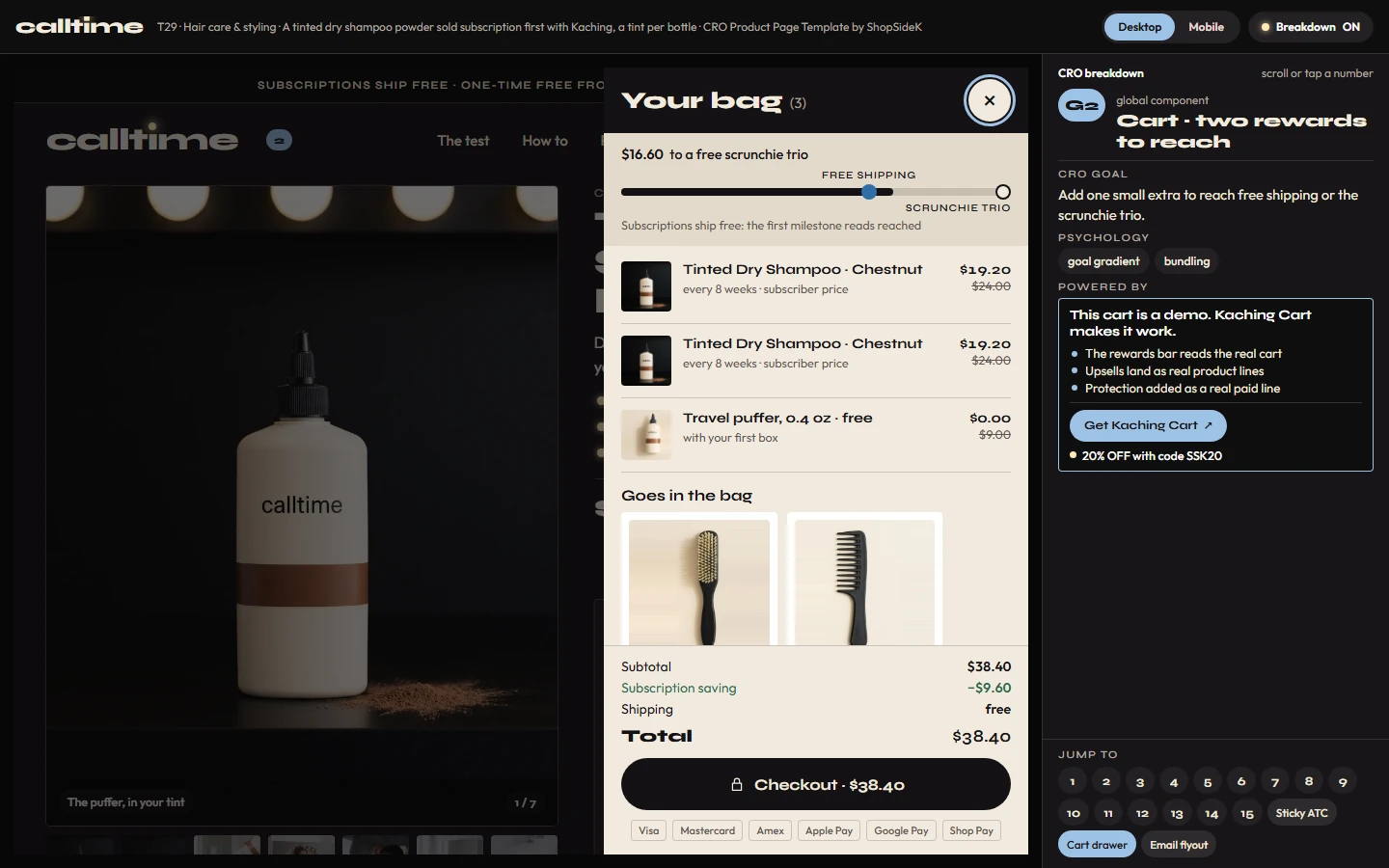
One line to change if you copy the drawer: “Subscription saving −$9.60” sits between a $38.40 subtotal that already includes it and a $38.40 total, so the column doesn’t add up. Start from the $48 subtotal, or make the saving a note.
One thing not to copy
The cocoa in the tint. The demo’s ingredient copy colors Honey, Chestnut and Espresso with cocoa powder and iron oxides. Iron oxides are on FDA’s list of colors for cosmetics; cocoa powder is not, and FDA requires every color additive, plant-derived ones included, to be listed for its use (see the label section below). If your tint relies on a pantry powder for color, have a regulatory specialist check it, or color with listed pigments. As with Coilwort’s ribbon, the “most picked” tab is sample text.
Rebuild the offer in Kaching
- A Quantity Break on 1, 2 and 3 bottles at $26, $48 and $66, bar 2 preselected, with “Let customers choose different variants for each item” on for the Tint.
- The Subscriptions toggle on, with Kaching Subscriptions plans every 6, 8 or 12 weeks at 20% off.
- The travel puffer as a free gift on bar 2, the puffer and the brush on bar 3, the claw clips as an upsell, a “most picked” badge.
Kaching documents a custom total price per quantity and free gifts on every deal type (Kaching help: bundle types), a different variant for each item with colors in the dropdown (Kaching help: variant dropdowns), an upsell inside a deal bar that can be offered to subscribers (Kaching help: add an upsell to a deal bar), and skip, pause or cancel from the customer’s account (Kaching help: Kaching Subscriptions explained). Three details are not in Kaching’s public docs: the Subscribe tab selected on load, gifts with the first box only, and the cart removing a paid add-on the box already includes. Check them in your own editor, or browse the Kaching subscription-first templates.
What a hair care page can say: ingredient lists, colors and “free of” claims
A curl cream and a dry shampoo are cosmetics, and the FDA notes that it “does not have a list of approved or accepted claims for cosmetics” (FDA: cosmetics labeling claims), so the brand owns every word it prints. Cosmetics and their ingredients also need no FDA approval before sale, except color additives (FDA: talc). Six points shape pages like these. This is general information, not legal advice.
- One ingredient list per formula, and per tint. On the package label, a cosmetic declares each ingredient in descending order of predominance; ingredients at 1% or less may follow in any order, with color additives at the end (21 CFR 701.3). The rule’s shared list for shades, with colors marked “may contain”, covers eye makeup, other makeup and nail polish (21 CFR 720.4(c)), not hair products. Coilwort’s weights differ in their butters and Calltime’s tints in their colors and starch, so each jar and each tint needs its own list, and a live store would show every one.
- Every color needs FDA approval for its use, plant-derived ones included. Coal-tar hair dyes aside, FDA says all color additives used in cosmetics must be approved, by a regulation that addresses the substance’s use as a color. Colors from mineral, plant or animal sources skip batch certification but must still meet their listing, and a cosmetic that fails the color rules is adulterated (FDA: color additives and cosmetics fact sheet). Iron oxides are listed for coloring cosmetics generally (21 CFR 73.2250); cocoa powder is not in FDA’s table of color additives permitted in cosmetics.
- “No aerosol” describes the bottle; “benzene-free” needs test results. In December 2021, P&G recalled aerosol dry shampoo and dry conditioner sprays after finding benzene that came “from the propellant that sprays the product out of the can” (P&G recall notice on FDA.gov). In October 2022, Unilever’s aerosol dry shampoo recall followed an investigation that “identified the propellant as the source” (Unilever recall notice on FDA.gov). Calltime’s page says only what its squeeze bottle shows, “no aerosol can” and “no propellant”, and never “benzene-free”, which would be a claim about test results.
- “No talc” is a powder brand’s easiest true line. Under MoCRA, FDA proposed asbestos testing rules for talc-containing cosmetics in December 2024, then withdrew the proposal on November 28, 2025 to weigh the comments; its talc page lists no newer action as of November 15, 2026. Calltime’s list has no talc to test.
- “Natural” and “unscented” are promises shoppers read literally. FDA’s claims page doesn’t define “natural” and points to the FTC. On April 12, 2016, the FTC announced settlements with four personal-care marketers over “all natural” and “100% natural” claims, including a haircare brand whose products contained synthetic ingredients such as phenoxyethanol, and said such claims mean no artificial ingredients or chemicals (FTC press release). Neither demo uses the word; Calltime’s iron oxides are, by their FDA listing, synthetically prepared. The FDA also warns that some products labeled “unscented” may contain fragrance ingredients (FDA: fragrances in cosmetics); Calltime pairs “unscented” with “no fragrance”.
- Shelf life is optional, and still worth printing. No US law or regulation requires an expiration date on cosmetics, and the FDA notes that dipping fingers into a product adds microorganisms such as bacteria and fungi (FDA: shelf life and expiration dating of cosmetics). Coilwort states “twelve months closed, six months open” and sells a $4 scoop that “keeps fingers out of the jar”.
Hair care product page checklist
- The product shown with what it’s used with, or a bottle count that fits the household.
- One row for the variant (weight, tint or scent), the price unchanged by it, and a picker per unit when one box serves two people.
- A short finder or a side-by-side test, with an honest note on how rough it is.
- A free swap for the wrong variant, and a refund that covers an opened jar or a half-used bottle.
- A subscription interval worked out from use, and gifts that say whether they come once.
- Reviews labeled with hair type or color and the variant the reviewer kept.
- An ingredient list for each formula and each tint, every color on FDA’s list, and no “natural” or “benzene-free” you can’t back.
- Shopper numbers (vote shares, “most picked” badges, stock counts) only when your own data produces them.
FAQ
What should a hair care product page include?
A clear choice of variant (weight, tint or scent) with help choosing it, what the product is used with, how long it lasts in uses, the ingredient list for each formula, reviews labeled by hair type or color, and a guarantee that covers opened products and swaps the wrong variant free.
How do I help shoppers choose the right curl cream weight?
Ask a few questions they can answer at home: what their curls look like dry, whether a clean strand floats or sinks in water, and how long their hair is. In the example, the curl pattern sets the starting weight, the float test moves it one step lighter or richer, and length sets the dose.
Should a dry shampoo product page default to a subscription?
It can, when the product runs out on a rhythm. Calltime preselects Subscribe & save 20% on two bottles and works out the interval from use: 38 mornings a bottle at four or five mornings a week is about 8 weeks. Show the price, the interval and how to skip or cancel before checkout.
Do I have to list ingredients on a hair care product page?
US rules require the ingredient declaration on the package label, in descending order of predominance, under 21 CFR 701.3. We found no federal rule that requires it on the product page, but hair buyers look for it there. Each formula and each tint needs its own list.
Do the colors in a tinted dry shampoo need FDA approval?
Yes. Outside coal-tar hair dyes, FDA requires every color additive in a cosmetic to be approved for that use, including colors from plant or mineral sources. Iron oxides are listed for cosmetics; check every coloring ingredient against FDA’s list before launch.
Can I call my hair care product natural?
The FDA hasn’t defined “natural” for cosmetics, and the FTC has treated “all natural” and “100% natural” as meaning no artificial or synthetic ingredients. If your formula contains synthetic preservatives, emulsifiers or pigments, describe what each ingredient does instead.
Can I use these templates on my store?
Both pages are free, interactive demos with a breakdown of every section and the Kaching settings behind the offer. Each is a design reference, not an installable theme: you rebuild the offer in Kaching and the sections in your own theme.
More product page examples
Coilwort and Calltime are part of the ShopSideK library of Shopify product page templates, each with a free section-by-section CRO breakdown. Browse the hair care and styling templates, or every page built on a Kaching frequently bought together offer.
For more on cosmetic claims, see skincare product page examples and supplement product page examples. For another page that defaults to the subscription, see pet product page examples.
Sources
- FDA: Cosmetics labeling claims
- 21 CFR 701.3, Designation of ingredients (Cornell LII)
- 21 CFR 720.4, Information requested about cosmetic products (Cornell LII)
- FDA: Color additives and cosmetics, fact sheet
- FDA: Color additives permitted for use in cosmetics
- 21 CFR 73.2250, Iron oxides (Cornell LII)
- P&G recall of aerosol dry shampoo and dry conditioner sprays, December 17, 2021 (FDA.gov)
- Unilever recall of select aerosol dry shampoos, October 18, 2022 (FDA.gov)
- FDA: Talc
- FTC: Four companies agree to stop falsely promoting their personal-care products as “all natural” or “100% natural” (April 12, 2016)
- FDA: Fragrances in cosmetics
- FDA: Shelf life and expiration dating of cosmetics
- Kaching help: different bundle types
- Kaching help: how to upsell bundles in your Shopify product page
- Kaching help: how to sell subscriptions for bundles in Shopify
- Kaching help: customize your bundle variant dropdowns
- Kaching help: how to add an upsell to your deal bar
- Kaching help: Kaching Subscriptions explained