Last updated: October 30, 2026. Both pages are live demos you can click through for free, no account required.
A pet product page sells to someone who can’t ask the real customer: the owner has to guess whether the dog will eat it, which size fits, and whether it does what the bag says. The two Shopify examples below settle those doubts in a different order. Snaggle, a daily dental chew, leads with proof and makes the subscription the default, because a chew only helps if the dog gets one every day. Crumbwell, a freeze-dried food topper, leads with the deal: buy two pouches, get the third free, with a protein picked for every pouch.
After the two breakdowns comes the part most pet store roundups skip: what a US treat, chew or topper page may say about teeth, breath and nutrition, according to AAFCO, the Veterinary Oral Health Council and the FTC.
Key takeaways: 7 rules for a pet product page
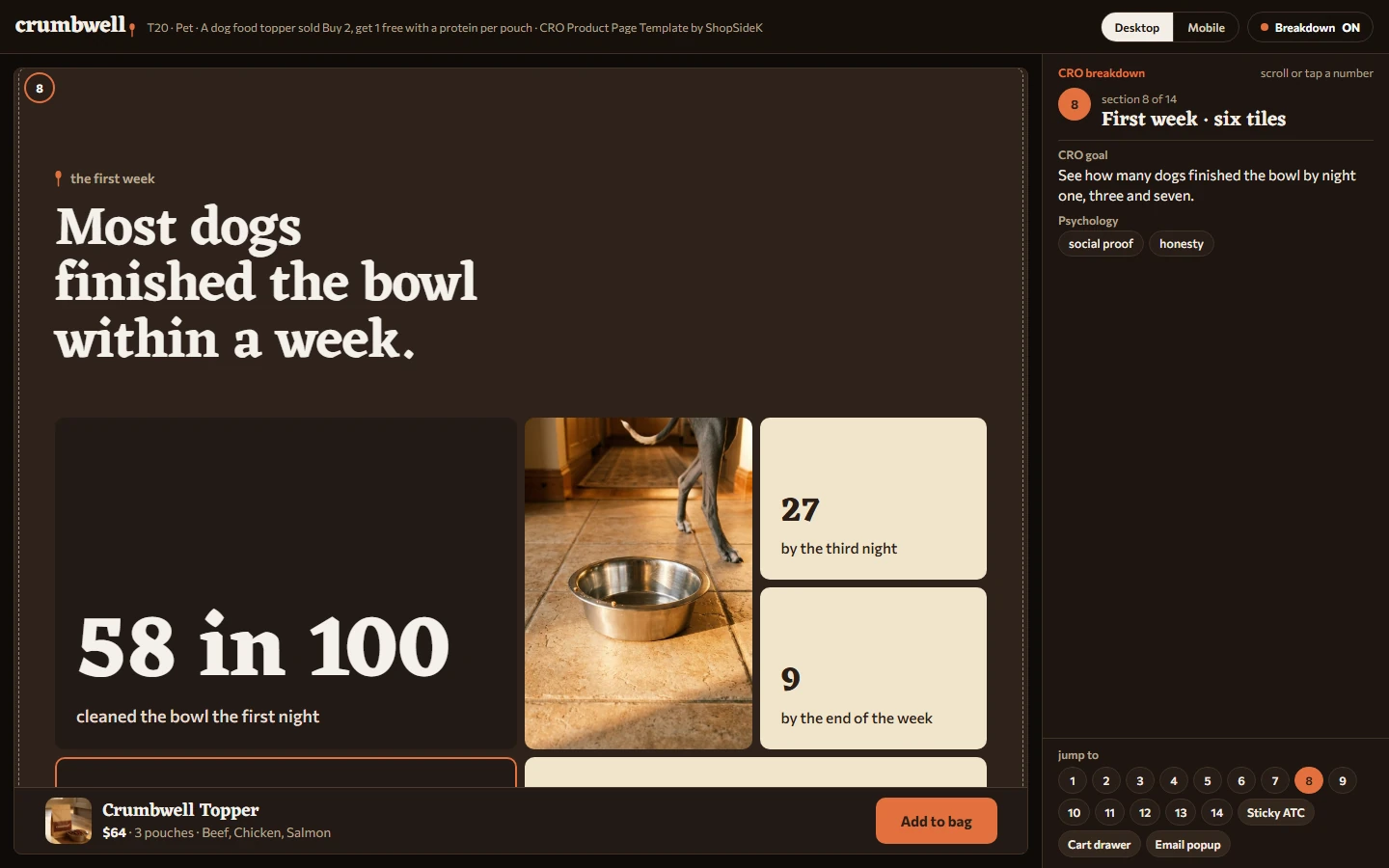
- Answer “will my dog eat it?” before any claim. Snaggle opens its proof with five owner clips; Crumbwell prints how many dogs finished the bowl by night one, three and seven, and how many never did.
- Size it to the dog, then write the answer into the bundle. A size finder or serving table by weight replaces a guess the owner would otherwise make alone at checkout.
- Match the default to how fast the product runs out. A chew given daily defaults to a subscription; a topper bought by flavor defaults to a three-protein rotation.
- Let each unit in a multi-pack be different. Two dogs need two sizes and a picky eater needs more than one protein, so every bag or pouch gets its own picker.
- Say what the product is not. “A topper, not a complete meal” and “between vet visits, not instead of them” keep the page believable.
- Describe the mechanism, never a disease. Ridges that scrape and peppermint that masks odor are food claims; gum disease and tooth loss belong to drugs.
- Refund the bag the dog walked away from. A guarantee that covers an opened bag removes the risk every owner of a picky dog has already paid for once.
The two examples at a glance
| Snaggle | Crumbwell | |
|---|---|---|
| Product | Daily dental chews, 30 a bag, three sizes by dog weight | Freeze-dried single-protein topper, 8 oz pouch, three proteins |
| Leads with | Proof: owner clips, day-1 and day-28 photos, an owner panel | The deal: buy 2, get 1 free |
| Kaching offer type | Subscription first on 1, 2 or 3 bags, a size per bag | Buy X Get Y on 1, 3 or 5 pouches, a protein per pouch |
| Selected on load | 2 bags, subscribe and save 25%, every 30 days | Buy 2, get 1 free: Beef, Chicken, Salmon |
| Prices | One-time $34 · $62 · $84; subscribed $25.50 · $46.50 · $63 | $32 · $64 · $96 |
| Free gifts | Rope toy ($14) with 2 bags; rope toy and bandana ($26) with 3 | Clip scoop ($9) with 5 pouches |
| Reorder | A subscription inside the bundle widget | An auto-refill switch in the cart, 10% off refills |
| Signup offer | A spin-to-win wheel: up to 15% off, or a free item | $5 off a first order, plus an optional reorder text |
| Guarantee | 60 days, even if every bag is empty | 30 days, even on an open pouch |
| Order in the walkthrough | $46.50 → $78.50, with a free lick mat | $32 → $54, now shipping free |
| Live example | Snaggle template (T03) | Crumbwell template (T20) |
Example 1: Snaggle, a dental chew page that sells a daily habit
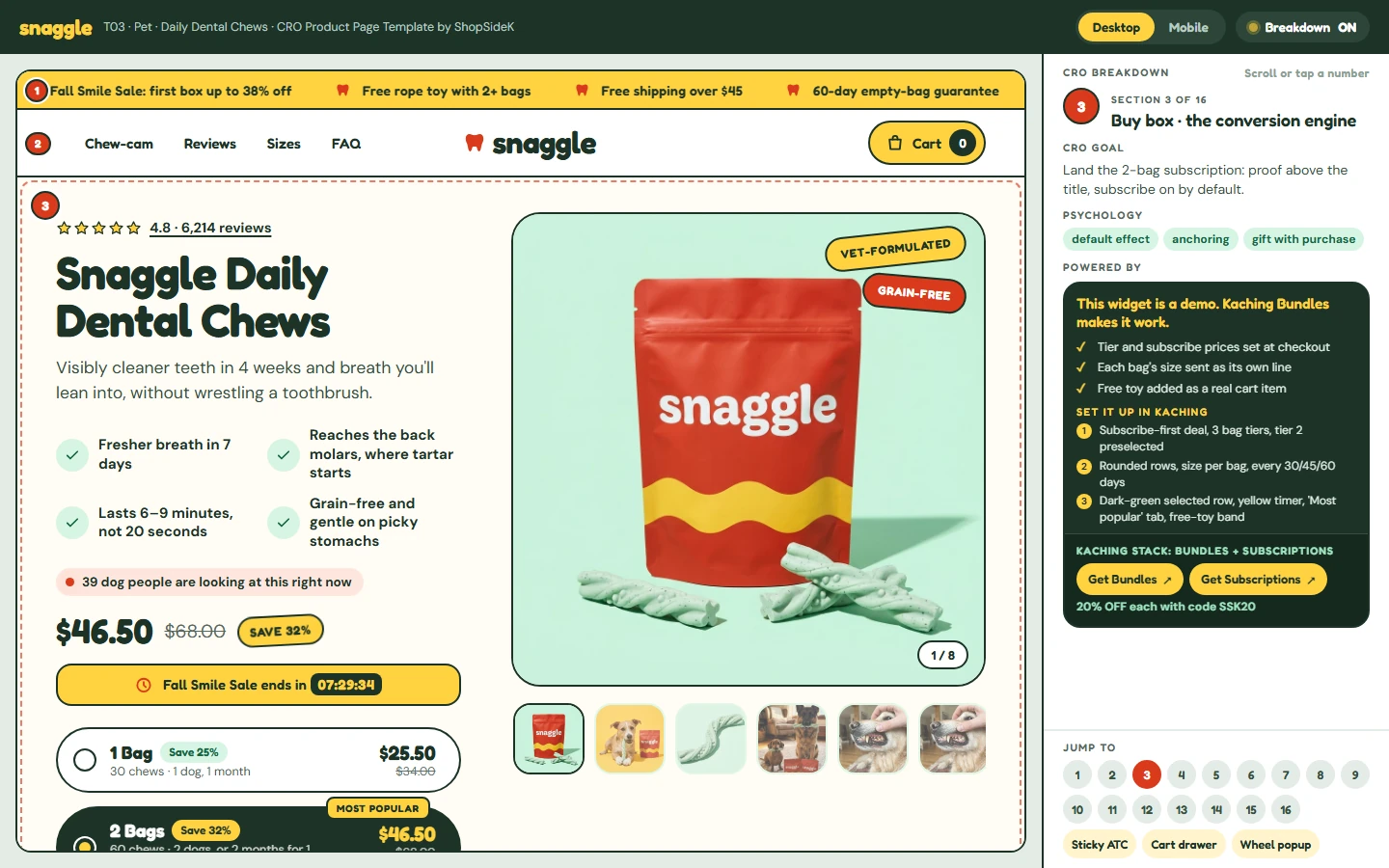
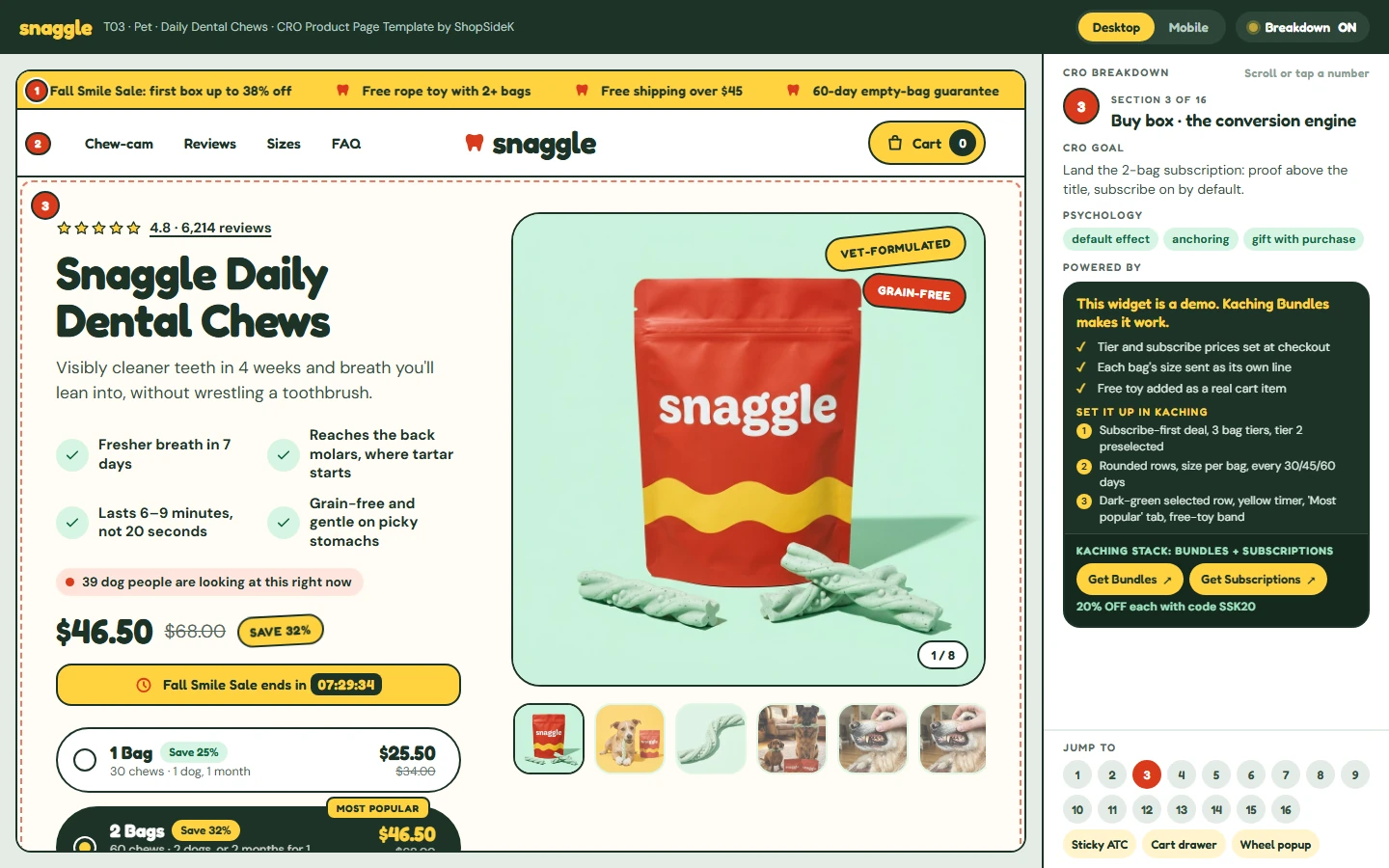
Snaggle sells soft, ridged dental chews, one a day and 30 to a bag, in Small (5–20 lb), Medium (20–50 lb) and Large (50+ lb). The chew works only if it’s given every day, so the page treats the subscription as the product and the one-time purchase as the exception.
The offer: bags per delivery, a size for every bag
| Bundle bar | One-time | Subscribe and save 25% | Per bag, subscribed | Free gift |
|---|---|---|---|---|
| 1 bag: 1 dog, 1 month | $34 | $25.50 | $25.50 | none |
| 2 bags: 2 dogs, or 2 months for 1 (preselected) | $62, struck $68 | $46.50 | $23.25 | Floss rope toy ($14) |
| 3 bags: 3 dogs, or 3 months for 1 | $84, struck $102 | $63 | $21.00 | Rope toy and bandana ($26) |
Each bar counts bags per delivery and says who they’re for. Selecting a bar opens one size row per bag at the same price, so a house with a beagle and a Lab can put a Medium and a Large in one box. Subscribe is on when the page loads, every 30 days by default or every 45 or 60, with the perks underneath: the price locked in, skip, pause or cancel in two clicks. The two larger bars ship free over the $45 line.
The sections that do the persuading
- Chew-cam. Five short owner clips answer “will my dog eat it?” before the page claims anything.
- Smile check. Pick a dog your size and flip its day-1 photo to day 28; each card keeps the owner’s caveat, such as front teeth “still a touch yellow.”
- Text the vet. A chat answers three questions that stall a purchase: does a chew do anything, is it safe to swallow, can it replace brushing. Her answer to the last is no, and her credential line names her as the brand’s formulation advisor.
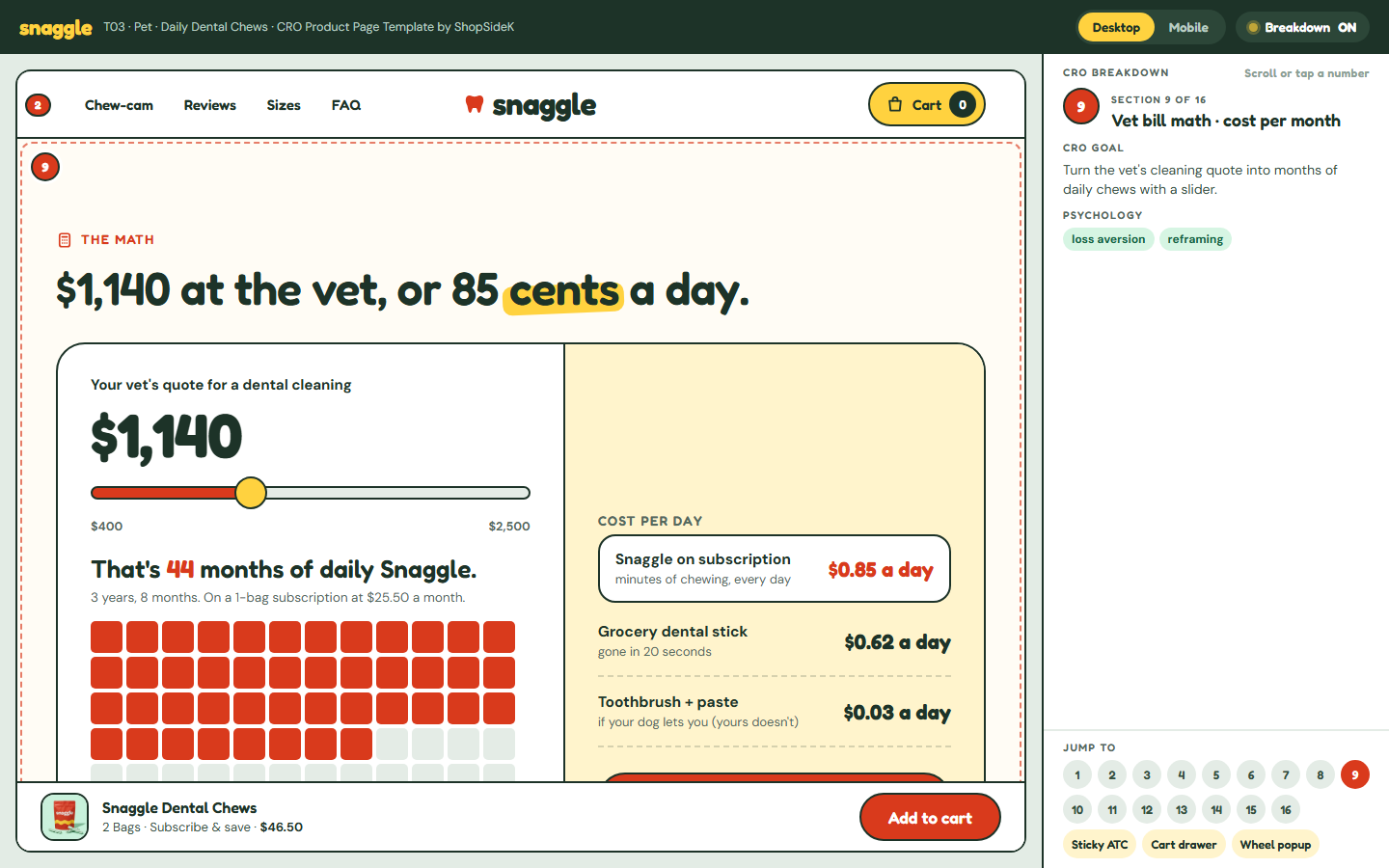
- Vet bill math. A slider turns a dental-cleaning quote into months of chews: the default $1,140 buys 44 months of a $25.50 box, $0.85 a day, and the fine print says a chew helps between vet visits, not instead of them.
- Size finder. Tap the dog’s weight and the size, with 22, 34 or 58 calories per chew, drops into the bag picker.
- The guarantee as a receipt. Sixty days, a full refund even if every bag is empty, and the first bag refunded if the dog won’t touch it.
The cart: a second reward within reach
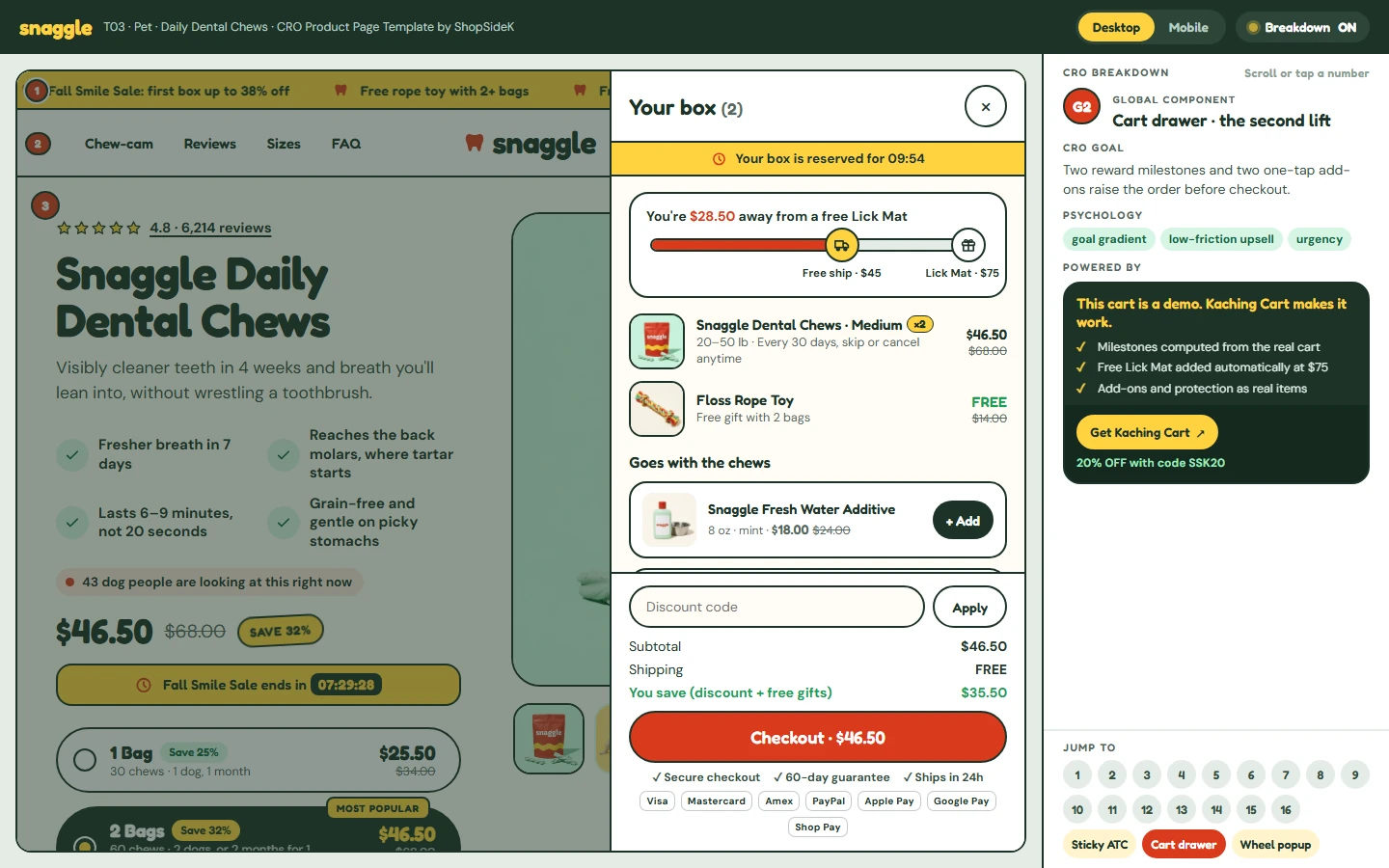
The preselected box ($46.50) clears free shipping by itself. The drawer then points to a free lick mat ($15 value) at $75 and lists two things for the same mouth: a water additive ($18) and finger wipes ($14). Adding both takes the order from $46.50 to $78.50, past the lick mat line.
One thing not to copy
The owner-panel report card: “54% less visible tartar at day 28” across 112 dogs, graded like a school report and signed by the brand’s vet. It reads like a study, yet its footnote says owners supplied the photos. A tartar percentage needs controlled trials (see the claims section below); an owner panel can honestly report fresher breath or a dog that ate the first chew, not a measured reduction. The demo also runs a “Fall Smile Sale” countdown, a live viewer chip and a 10-minute cart hold to show where those modules sit; on a live store, keep each only if the sale, the count and the hold are real.
Rebuild the offer in Kaching
- A Quantity Break on 1, 2 and 3 bags, bar 2 preselected, the Subscriptions toggle on: 25% off every 30, 45 or 60 days.
- Rounded pill rows, a size dropdown for each bag, a “Most popular” tab on bar 2.
- A free rope toy on bars 2 and 3, the bandana added on bar 3, free-shipping labels on both.
For whether every bag count deserves the same subscription discount, see subscription plans per quantity tier on Shopify.
Example 2: Crumbwell, a food topper page built on buy 2, get 1 free
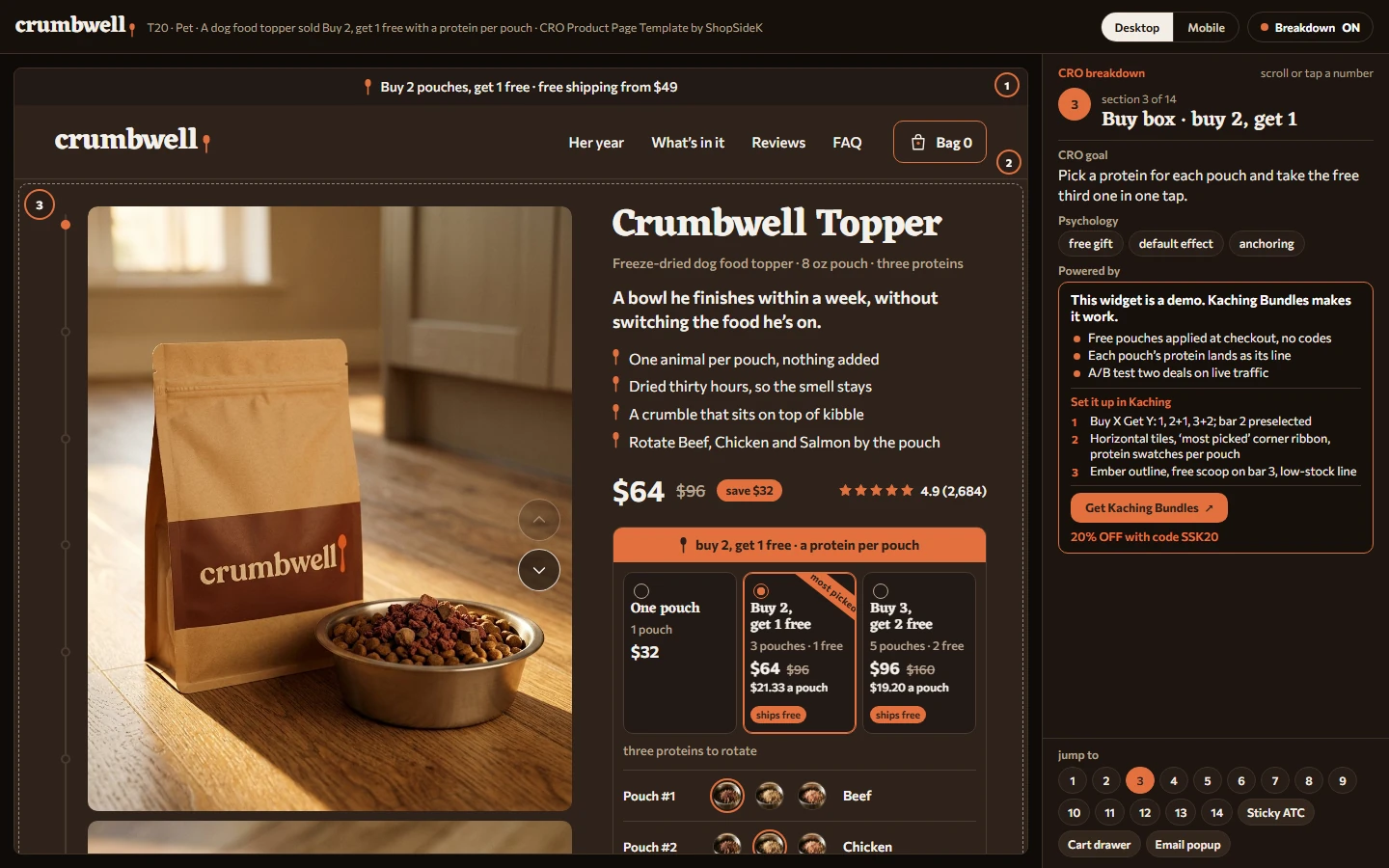
Crumbwell sells a freeze-dried topper with one animal per pouch: beef with its heart and liver, chicken thigh with its heart and liver, or salmon with its skin, cooked to 165°F, dried about thirty hours and crumbled to sit on kibble. The dose is a level tablespoon per meal for every 20 lb, on top of the dog’s usual food, and the page is written for the owner whose dog walks away from dinner.
The offer: buy X, get Y, a protein for every pouch
| Bundle bar | Pouches | Price | Crossed-out price | Per pouch | Extras |
|---|---|---|---|---|---|
| One pouch | 1 | $32 | none | $32 | Pays $4.95 shipping |
| Buy 2, get 1 free (preselected) | 3, one free | $64 | $96 | $21.33 | Ships free |
| Buy 3, get 2 free | 5, two free | $96 | $160 | $19.20 | Ships free, free clip scoop ($9) |
The middle bar loads with Beef, Chicken and Salmon, so the default is already a rotation. Every pouch gets its own protein row, the free ones too, and the saving shows in dollars (“save $32”, “save $64”), never as a percent. A low-stock line appears only while a Salmon pouch is selected; in the demo its count is a fixed sample value, and the page has no timer, so there is one scarcity cue.
The sections that do the persuading
- Is it the food, or is it him? One paragraph sorts three dogs: bored of the same bowl (a topper helps), particular since puppyhood, or off everything and drinking more, which it sends to the vet before any food change.
- Pot to pouch. Four stacked cards follow one batch from stockpot to crumble and end on the label: beef, beef heart, beef liver, nothing else.
- The first week, in one grid. From 2,684 reviews: 58 in 100 dogs cleaned the bowl the first night, 27 more by the third, 9 by the end of the week, and 6 never did, linked to the refund.
- Hold to pour and the specials board. Hold a button to turn the crumble into gravy with warm water; open each protein’s note for its smell, the dogs it suits and its calories (about 21, 19 or 22 a tablespoon).
- A vet’s limit beside the buy button. A veterinary nutritionist’s line: keep anything added on top under a tenth of the day’s calories. Two tablespoons for a 40-lb dog come to about 4% of a 1,000-calorie day.
- The promise. A switch between “He walked away” (a full refund within 30 days, even on an open pouch) and “He finished it” (another protein next time, or auto-refill).
The cart: add-ons sized to the gap, reorders as a switch
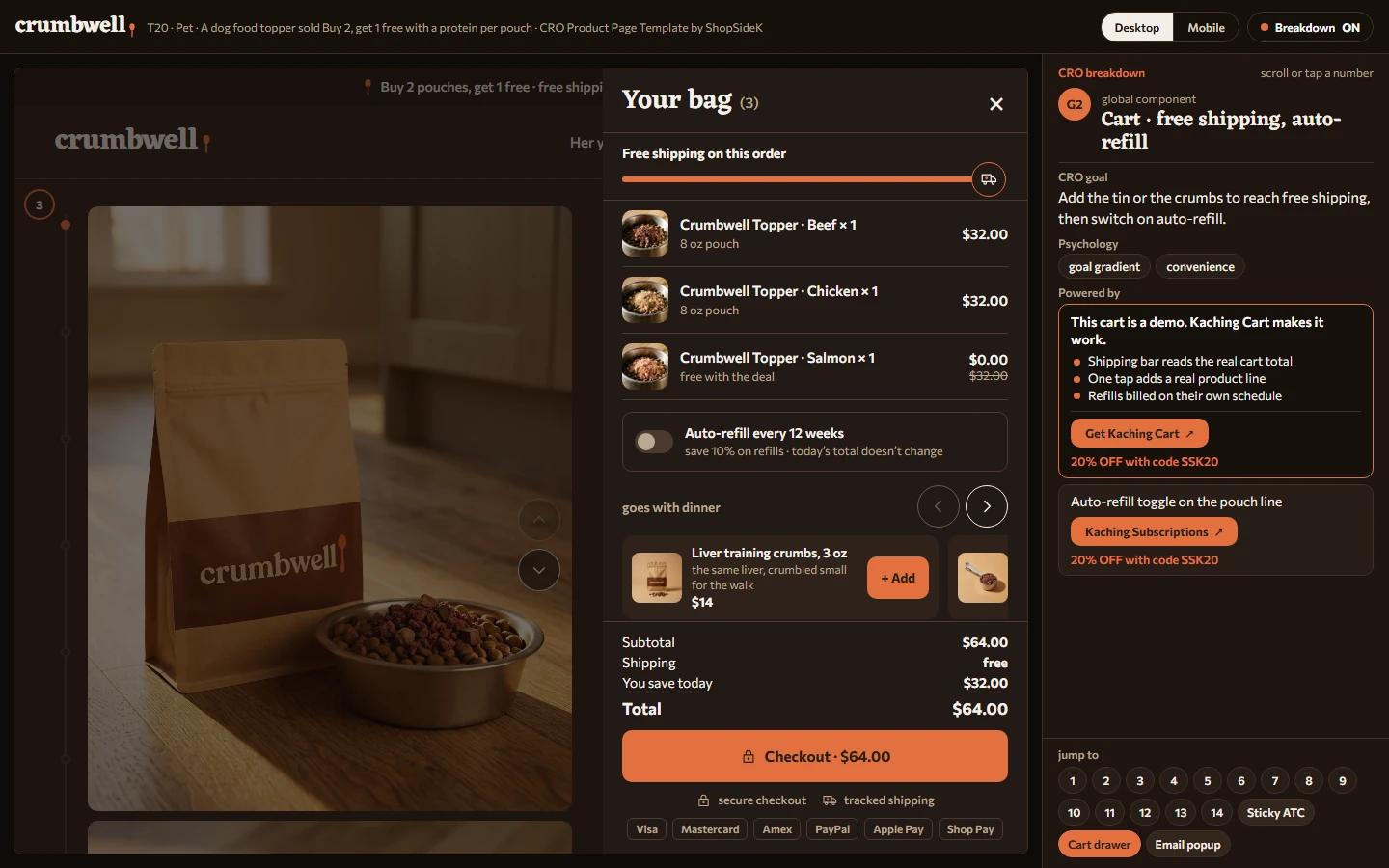
Bars 2 and 3 clear the $49 free-shipping line before the cart opens. A single pouch opens it at “$17.00 to free shipping”, with a “goes with dinner” slider of liver training crumbs ($14), the clip scoop ($9) and a stoneware bowl ($26), plus a pantry tin ($8) as a one-tap add-on. The tin and the crumbs take $32 to $54, over the line. Under the topper line, an auto-refill switch books the same bar and proteins every 4, 8 or 12 weeks at 10% off ($28.80, $57.60 or $86.40 a refill), without changing today’s total. The widget stays a plain deal; the reorder question waits until the shopper has chosen.
One thing not to copy
The founder story. “Her year” tells, in four phone-story frames, how a former line cook’s old greyhound came back to her bowl. It works because it is one cook, one dog and one kitchen. If your brand has no story like it, don’t write one: an invented founder is easy to spot and hard to recover from. Open with “Is it the food, or is it him?” instead.
Rebuild the offer in Kaching
- A Buy X Get Y deal: buy 1, buy 2 get 1 free, buy 3 get 2 free, bar 2 preselected.
- Horizontal tiles, a protein swatch row per pouch, a “most picked” ribbon on bar 2.
- The clip scoop as a free gift on bar 3, a savings line in dollars, low stock limited to the Salmon variant.
For when a free unit pays better than a percent off, see the economics of BOGO offers on Shopify.
What a dog treat, chew or topper page can claim in the US
FDA and the states enforce pet food rules. AAFCO writes model language that states can adopt, and it does not test, approve or certify products (AAFCO: understanding pet food). This is general information, not legal advice.
Treat, topper or complete food
A product that isn’t complete and balanced carries the statement “This product is intended for intermittent or supplementary feeding only.” Treats don’t have to meet nutritional adequacy requirements if “snack” or “treat” appears clearly on the front panel (AAFCO: reading labels), and AAFCO advises feeding them sparingly (AAFCO: treats and chews). Say the same thing near the buy box: Crumbwell prints “A topper, not a complete meal” in its FAQ and footer, with calorie math so owners can take a little kibble out.
The name sets a percentage
Under AAFCO’s naming rules, a product named for an ingredient (“Beef for Dogs”) must be at least 95% that ingredient by weight not counting added water, and 70% counting it. “Dinner”, “entrée” or “platter” drops that to 25% (10% of the total), “with” needs 3%, and “flavor” needs an ingredient that provides the flavor (AAFCO: reading labels). Use the exact name from the bag on the product page, since a word like “dinner” changes what’s inside.
Dental claims: the mechanism is fine, a disease is not
AAFCO’s Guidelines for Dental Related Claims, sent for adoption by its Pet Food Committee in 2017 to replace the older tartar-control guidelines, cover foods, treats, rawhides and chews (AAFCO Pet Food Committee report, 2017):
- Chewing action. Claims to clean or whiten teeth or freshen breath through abrasive or mechanical action are not objectionable.
- Plaque, tartar, bad breath. These claims may misbrand a food, but enforcement is a low priority when they rest only on abrasion or a masking flavor.
- Any other mechanism. If the effect comes even partly from something else, the product needs an approved New Animal Drug Application or a favorable FDA review letter before it’s sold.
- Disease. Claims to prevent or treat gingivitis, gum problems or tooth loss need an approved drug application.
- Name the mechanism. The label must say how it works, in the spirit of “with ridges to help scrape teeth.”
Snaggle’s ridges, rubbery nubs, six to nine minutes of chewing and parsley and peppermint sit on the mechanical and flavor side. Its chew clock goes further: an enzyme coating that keeps working on plaque after the last bite is a chemical mechanism, so a real chew saying that needs FDA review first, or copy limited to what the ridges do.
The VOHC seal is earned with trials
The Veterinary Oral Health Council awards its seal for “Helps Control Plaque” and “Helps Control Tartar.” The company funds the trials, two are required to show the result repeats, a cross-over design runs at least 28 days per leg, and VOHC reviews the results against its minimum standard (VOHC: protocols and submissions). The seal is a registered mark, and VOHC decides who may use it (VOHC: earn the seal). Snaggle claims no seal, which is why its 54% figure has nothing behind it but owners’ photos.
Averages, not “up to”
In a January 9, 2015 closing letter on Pedigree Dentastix, FTC staff said an “up to 80%” tartar-reduction claim suggested a result typical owners wouldn’t get: the company’s own studies put 80% as an outlier and the mean at 47%, and a fine-print average far from the headline didn’t fix it. The inquiry also covered how expert endorsers and influencers were engaged (FTC closing letter). Lead with the average, keep it next to the claim, and disclose any paid tie to a vet.
How to set up a pet bundle in Kaching
- Choose the deal by how the product runs out. A daily chew suits a Quantity Break with subscriptions; food sold by flavor suits Buy X Get Y (Kaching help: bundle types).
- Give every unit its own picker. Different variants for each item gives every bag a size and every pouch a protein, free pouches included (Kaching help: variant dropdowns).
- Put the subscription where it fits. Snaggle offers it inside the deal; Crumbwell asks about auto-refill in the cart (Kaching help: subscriptions for bundles).
- Gift what goes with the habit. A rope toy for a chewer, a measuring scoop for a topper; see free gift vs discount on Shopify.
- Size the signup offer to the margin. Crumbwell gives a flat $5 because a 10% code would have dropped its five-pouch bar just under 50% margin on the demo’s costs; Snaggle’s wheel stops at 15% because a 20% slice would have pushed its worst order to about 48%. See how Shopify bundle discounts stack.
- Price the worst order. On the demos’ assumed costs, both pages’ worst orders keep about 51% gross margin: three subscribed Snaggle bags with a 15% code, and a five-pouch Crumbwell refill. Check yours in the Shopify discount break-even calculator.
Pet product page checklist
- Proof that answers “will my dog eat it?” before any benefit claim.
- Size or serving guidance by weight, wired into the bundle picker.
- A picker per unit: a size per bag, a protein or flavor per pouch.
- A preselected bar that matches how fast the product gets used up.
- The product’s role in plain words: a treat, a topper or a complete food.
- Dental copy that names the mechanism and never a disease.
- Customer numbers labeled as customer-reported, with the “never did” share shown.
- A vet on the page only if real, with any paid tie disclosed.
- A refund that covers an opened bag or pouch.
- At most one scarcity cue, and only a real one.
FAQ
What should a pet product page include?
Proof that dogs eat it, sizing or serving guidance by weight, the full ingredient list, calories per serving, what the product is (treat, topper or complete food), a refund that covers an opened bag, and a bundle where each unit can have its own size or flavor.
Should a dog treat page default to a subscription?
Yes when the product only works with daily use, as with a dental chew, and show skip, pause and cancel right beside it. For food bought by taste, a multi-pack default with a reorder offer in the cart can fit better.
Can a dog chew page claim it reduces tartar?
Under AAFCO’s dental guidelines, cleaning teeth or freshening breath by chewing action is not objectionable, and plaque or tartar claims are a low enforcement priority when they rest only on abrasion or a masking flavor. Other mechanisms need FDA review, and gum disease claims need an approved drug application.
What does the VOHC seal mean?
The Veterinary Oral Health Council accepted the product’s trial data for “Helps Control Plaque”, “Helps Control Tartar” or both. The company funds two trials run to VOHC’s protocol, and VOHC reviews the results before authorizing the seal.
Does a dog food topper need to say it isn’t a complete meal?
If it isn’t complete and balanced, AAFCO’s model label statement says it is intended for intermittent or supplementary feeding only. On the page, say it in plain words too, as Crumbwell does with “A topper, not a complete meal.”
Is buy 2, get 1 free a good offer for pet food?
It suits food sold in flavors or proteins, because the free pouch completes a rotation. Show the saving in dollars, let each pouch pick its own flavor, and check that the deepest bar keeps its margin after any signup code.
Can I use these templates on my store?
Snaggle and Crumbwell are free demos to study, each with a breakdown of every section and the Kaching settings behind its widget. Nothing installs: you set up the offer in Kaching and build the sections in your own Shopify theme.
More product page examples
Snaggle and Crumbwell both come from the ShopSideK library of Shopify product page templates, where every page opens with a free CRO breakdown. Browse more pet product page templates, or compare offers on the Kaching subscription-first templates and the Kaching Buy X Get Y templates.
If you sell on subscription or make claims, see also supplement product page examples and skincare product page examples.
Sources
- AAFCO: understanding pet food
- AAFCO: reading labels
- AAFCO: treats and chews
- AAFCO Pet Food Committee report, April 2017, with the Guidelines for Dental Related Claims (PDF)
- Veterinary Oral Health Council: protocols and submissions
- Veterinary Oral Health Council: earn the VOHC seal
- FTC staff closing letter on Pedigree Dentastix, January 9, 2015 (PDF)
- Kaching help: different bundle types
- Kaching help: customize your bundle variant dropdowns
- Kaching help: sell subscriptions for bundles