⚡ ShopSideK Verdict
A Shopify website costs $25–$399/month for the platform subscription, plus $50–$150+/month in essential apps and transaction fees. With a DIY setup, most new merchants can launch a professional store for under $100/month total. The biggest hidden costs are credit card processing fees (2.4%–2.9% per sale), premium themes ($180–$350 one-time), and third-party app subscriptions.
- 1 Launch a professional store for ~$90–$110/month with DIY setup + Basic plan + essential apps
- 2 Upgrading from Basic to Grow saves money once you exceed $22K/month in sales (lower CC processing fees)
- 3 Use Shopify Payments to completely avoid the extra 0.5%–2% transaction fee on every sale
- 4 A premium theme ($180–$350) replaces multiple paid app subscriptions and saves money long-term
- 5 Your biggest variable cost will be marketing & advertising — not Shopify’s platform fees
Just $1/month for 3 months · No credit card required to start
You’ve seen the ads and heard the success stories, but you’re asking the right question: what is the real bottom line for a Shopify website? While you can get started for the price of a few coffees a month, the true shopify website cost goes beyond the subscription fee.
To plan effectively, my advice is to think in terms of Total Cost of Ownership (TCO). This includes your one-time setup investments, like a theme and design, plus all the ongoing monthly expenses that actually help you grow.
This guide provides a complete, transparent breakdown of every cost. We’ll cover platform fees, design, essential apps, and transaction fees. More importantly, we’ll walk through real-world budget scenarios to give you a clear and realistic financial picture for your new business.
The 30-Second Summary: Shopify Website Cost at a Glance
For those who need the bottom line fast, here’s a realistic look at what you can expect to invest in a Shopify store.
- Upfront Cost (One-Time): $250 – $5,000+. This wide range covers purchasing a premium theme and potentially hiring a professional for design and setup. A typical DIY launch with a great theme lands on the lower end of this spectrum.
- Ongoing Cost (Monthly): $100 – $500+. This includes your monthly Shopify plan, essential app subscriptions for marketing and reviews, and payment processing fees.
- Shopify’s Main Plans: The core of your cost is the subscription. The main plans are Basic ($25/month), Grow ($65/month), and Advanced ($399/month) when billed monthly
- Key “Hidden” Costs: The expenses that surprise most new owners are credit card transaction fees, the one-time cost of a premium theme, and recurring subscriptions for third-party apps.
The Shopify Pricing Calculator: Find Your True Cost
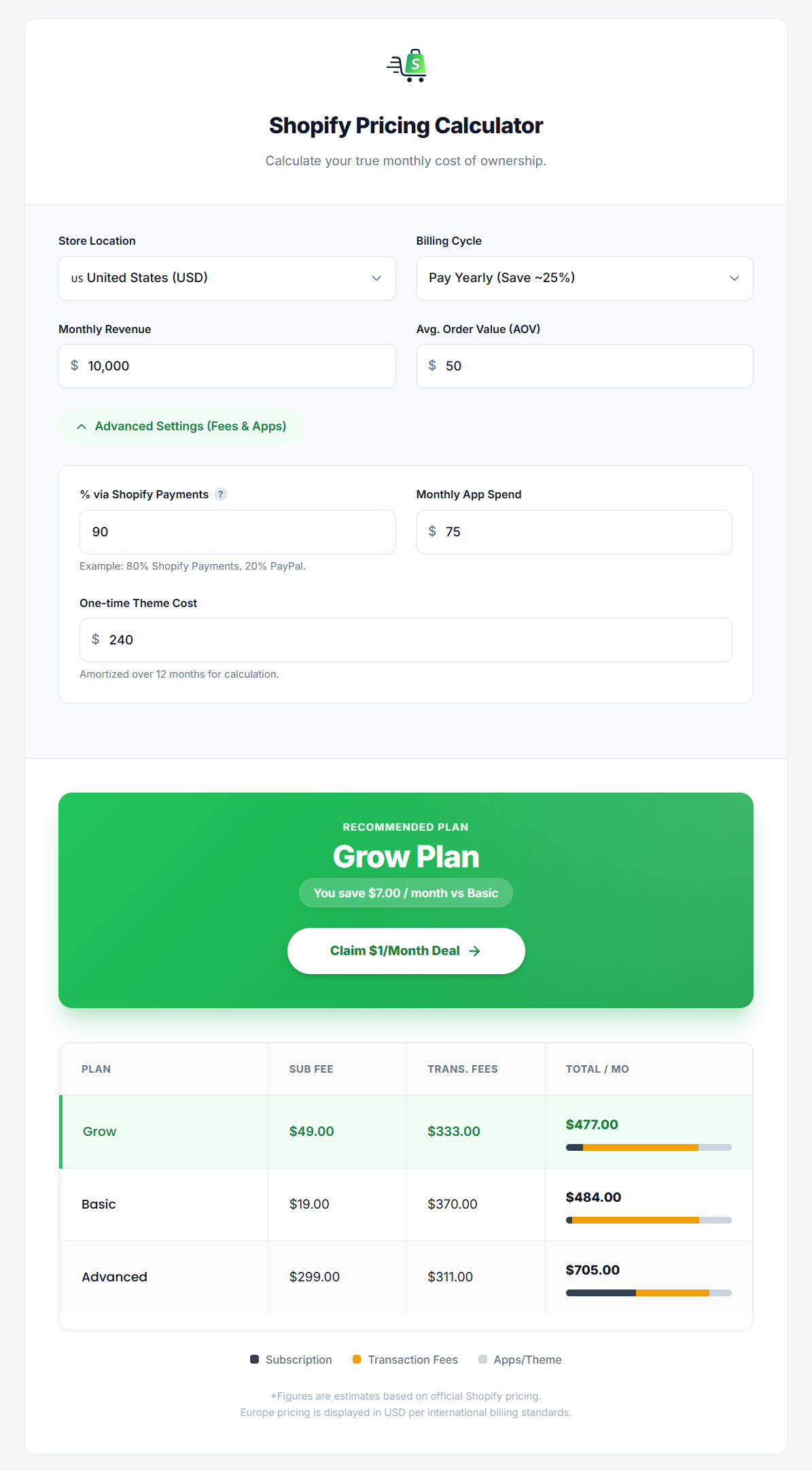
While the numbers above provide a strong framework, your exact monthly bill depends on your sales volume and the apps you choose. To eliminate the guesswork and create a precise budget, we built a free interactive tool.
Our calculator factors in your expected revenue, plan choice, and essential app costs to give you an accurate estimate of your total monthly investment. It even recommends the most cost-effective plan based on your numbers, helping you start your business on solid financial ground.
Part 1: Your Core Investment — Understanding the Shopify Website Cost Foundation
Your Shopify subscription is the foundation of your e-commerce budget. Choosing the right plan depends on your current sales volume and growth ambitions, as each tier is designed to offer more value as your business expands.
Which Shopify Plan Is Right for Your Business?
Shopify offers three main plans tailored to different stages of business growth. For the largest retailers, Shopify Plus provides an enterprise-level solution with extensive customization and support.
- Basic: Perfect for new businesses, entrepreneurs testing a product idea, or stores with low monthly sales volume. It gives you everything you need to launch a fully functional online store.
- Grow: The ideal choice for growing businesses. This plan introduces better reporting and, most importantly, lower credit card processing fees, which can save you significant money as your sales increase.
- Advanced: Built for scaling businesses that require advanced reporting tools, third-party calculated shipping rates, and the lowest transaction fees available outside of Shopify Plus.
Here’s how the core features of each plan compare:
| Feature | Basic | Grow | Advanced |
|---|---|---|---|
| Monthly Price | $25/month | $65/month | $399/month |
| Best For | New businesses | Growing businesses | Scaling brands |
| Online CC Rates | 2.9% + 30¢ | 2.6% + 30¢ | 2.4% + 30¢ |
| Staff Accounts | 0 | 5 | 15 |
| Reporting | Basic | Standard | Advanced |
To hit the ground running risk-free, follow our detailed roadmap on how to maximize your Shopify free trial and launch a profitable store.
Understanding Shopify’s Transaction & Payment Processing Fees
I know this can be one of the most misunderstood parts of the total shopify website cost. There are two potential fees on every sale, but you can easily avoid one of them.
- Credit Card Processing Fee: This is a standard, unavoidable fee charged on every online transaction made with a credit card. The rate is determined by your Shopify plan and is collected by the payment processor (like Shopify Payments or PayPal).
- Shopify Transaction Fee: This is an additional fee Shopify charges only if you choose not to use their in-house processor, Shopify Payments. If you use Shopify Payments, this fee is waived, and you only pay the standard credit card processing fee. For this reason, the vast majority of merchants use Shopify Payments.
The most important takeaway is that upgrading your plan lowers your credit card processing rate. This creates a clear financial “breakpoint” where moving to a higher-tier plan actually saves you money.
Here’s the simple math: The difference in processing fees between the Basic and Shopify plans is 0.3%. Once you sell over $22,000 per month, the money you save on fees is greater than the monthly cost increase between the two plans. At that point, upgrading becomes the more profitable decision.
💡To see exactly how these transaction fees—along with your app costs and goods—impact your take-home pay, plug your daily numbers into our interactive Shopify profit margin calculator.
Part 2: One-Time Setup Costs to Launch Your Store
Before you can make your first sale, you’ll need to invest in the foundational elements of your store. These are typically one-time costs that establish your brand’s presence and create the customer experience.
Domain Name: Your Digital Address
Your domain name is your store’s address on the internet (e.g., yourbrand.com). This is a non-negotiable part of creating a professional brand identity. You can purchase your domain directly through Shopify or from a third-party registrar like Namecheap. Expect this to be a small but essential annual expense.
- Typical Cost: $10 – $20 per year.
Shopify Themes: The Look and Feel of Your Store (Free vs. Premium)
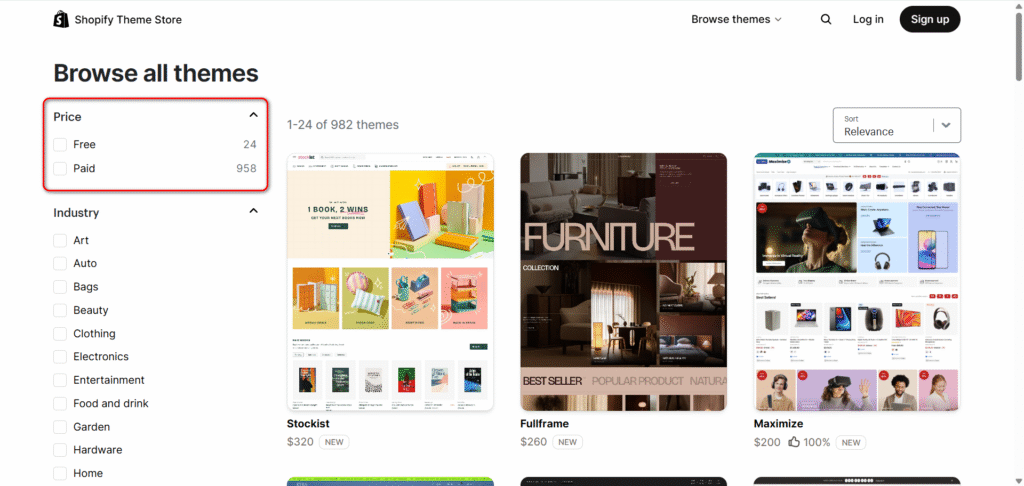
Your theme dictates your store’s design, layout, and user experience. It’s a critical component of the upfront shopify website cost. The Shopify Theme Store offers a curated selection of both free and paid options.
Free Themes are excellent for getting started. They are professionally designed, mobile-friendly, and fully supported by Shopify. However, they offer limited customization and features, which may require you to add more apps later on to fill the gaps.
Premium Themes are a one-time investment that can significantly elevate your brand. For a cost of around $180 to $350, you get access to more advanced design features, better technical support from the theme’s developers, and built-in functionalities like advanced filtering or promotional banners that might otherwise require a paid monthly app.
Personally, I think for most serious businesses, investing in a premium theme is one of the smartest upfront decisions you can make. It provides a more unique and robust foundation that you can grow with, ultimately saving you money on apps and custom development down the line.
To see what a top-tier design can look like in practice, explore our analysis of the 50+ best Shopify store examples and what makes them successful.
Shopify Development & Setup: DIY vs. Hiring a Professional
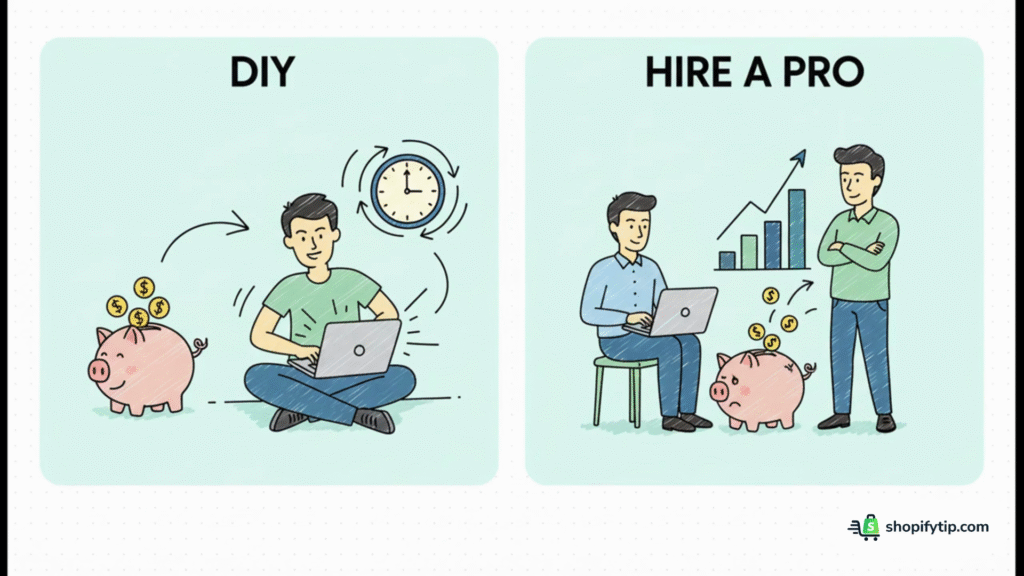
How you choose to build your store is the single biggest variable in your upfront cost. Your decision depends on a trade-off between your budget, technical comfort, and timeline.
Do-It-Yourself (DIY): $0
This is the most popular path for new entrepreneurs. Shopify’s platform is designed to be intuitive, allowing anyone to set up a professional store without writing code. The only cost is your time, making it the best route for those on a tight budget who are willing to learn.
Hire a Freelancer: $25 – $150/hour
A flexible and popular middle ground, hiring a freelancer can save you time and handle technical tasks you can’t. Costs vary significantly by the expert’s location, allowing for a smart strategy called “geographic arbitrage.” By hiring skilled talent from lower-cost regions via platforms like Upwork, Fiverr, or Toptal, startups can access high-quality development at a fraction of the price.
Here are typical hourly rates by region:
- North America (US/Canada): $75 – $150/hour
- Western Europe (UK/Germany): $60 – $120/hour
- Eastern Europe (Poland/Ukraine): $40 – $70/hour
- Asia (India/Vietnam): $25 – $50/hour
Hire an Agency: $5,000 – $20,000+
This is the ideal choice for established businesses that need a comprehensive, strategy-driven solution. As cited by agencies like OuterBox, this investment gets you a dedicated team for custom design, development, and a fully managed launch, ensuring a scalable and professionally polished final product.
💡Read our guide on how to choose the best Shopify digital marketing agency.
Part 3: Ongoing Monthly Shopify Website Costs Beyond Your Subscription
Once your store is live, your financial focus shifts from one-time setup costs to recurring investments. Your Shopify subscription is the baseline, but the real engine for growth comes from leveraging the Shopify App Store and budgeting for the operational realities of running a business.
Essential Shopify App Subscriptions: Building Your Tech Stack
Think of apps not as optional extras, but as specialized employees who work 24/7 to grow your business. A well-chosen “tech stack” is a necessary investment that can pay for itself many times over. While there are thousands of apps, most successful stores start with a few key categories.
- Email Marketing: This is your most profitable marketing channel. Tools like Omnisend allow you to automate welcome emails, recover abandoned carts, and build direct relationships with customers. Omnisend often starts with a generous free plan and scales as your contact list grows.
- Typical Cost: $0 – $60+/month

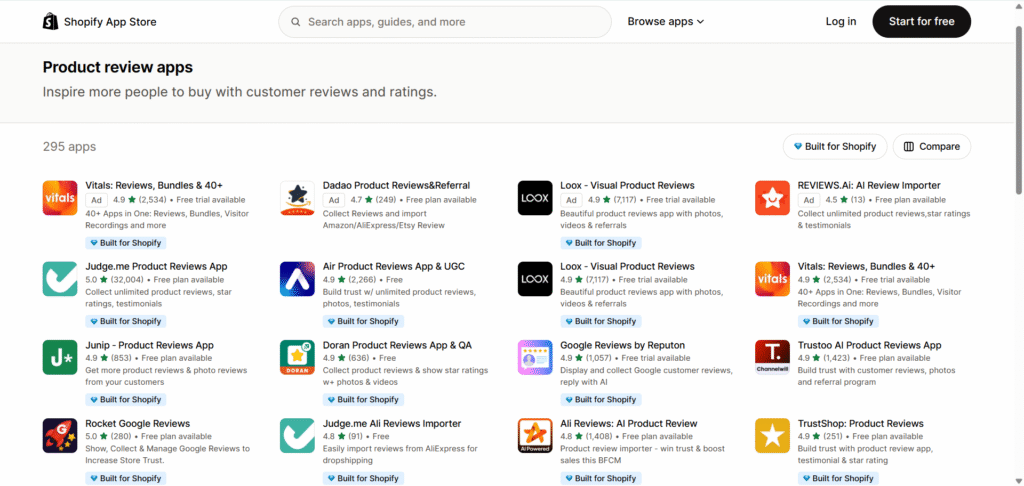
- Reviews & User-Generated Content (UGC): I’ve found that social proof is essential for building trust. Apps like Loox (30 day free trial) or Judge.me automatically request and display customer reviews and photos, which dramatically increases conversion rates.
- Typical Cost: $10 – $30/month
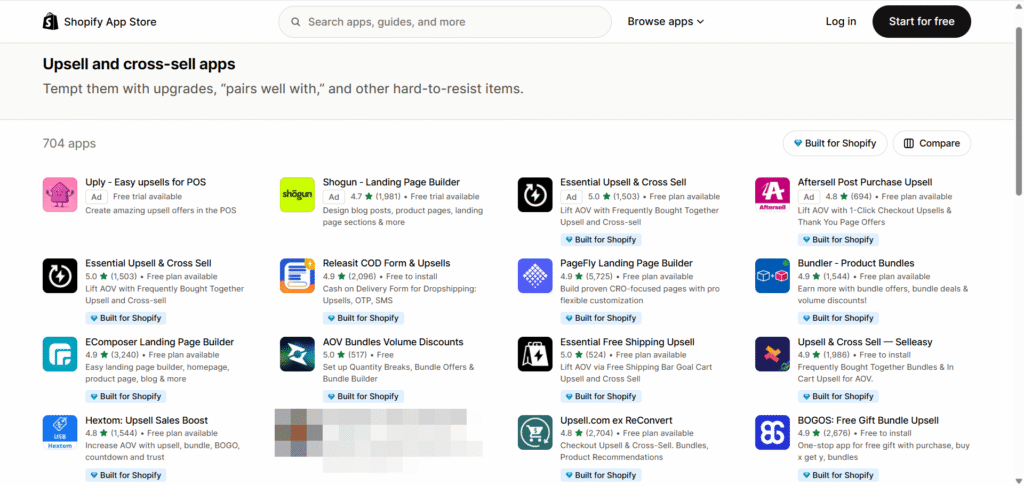
- Upselling & Cross-selling: The easiest way to increase revenue is to sell more to the customers you already have. An app like ReConvert helps you add post-purchase offers and thank you page promotions, boosting your average order value.
- Typical Cost: $5 – $25/month
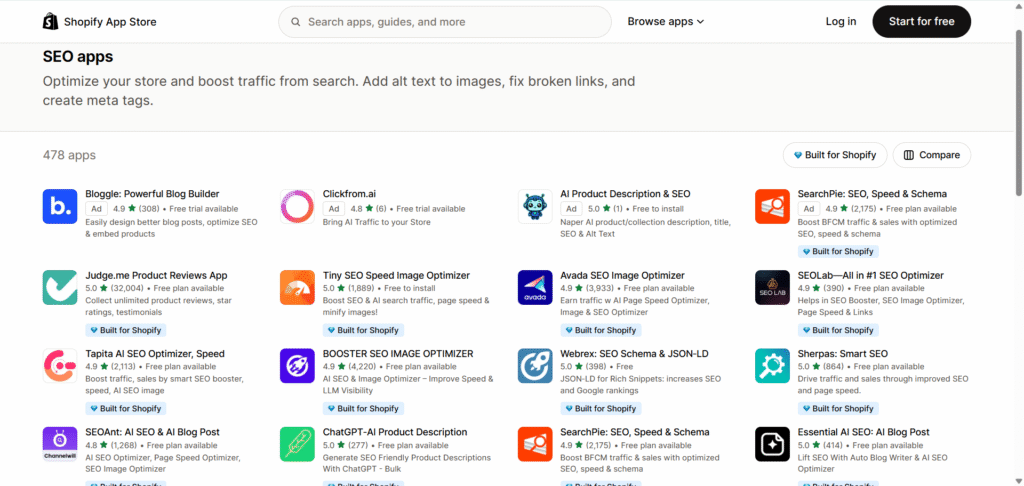
- SEO & Site Speed: To rank on Google, your site needs to be fast and technically sound. Apps like Tapita SEO or Tiny SEO can help with image compression, fixing broken links, and adding the structured data needed to stand out in search results.
- Typical Cost: $20 – $50/month
Upgrading Your Design: A Comparison of Top Shopify Page Builders
What if you want to create a stunning landing page for a new product launch or a highly customized “About Us” story without hiring a developer? That’s where page builders come in.
These powerful Shopify apps provide an intuitive drag-and-drop editor, giving you complete creative control over your store’s layout. For a modest monthly fee, they offer a level of design flexibility that could otherwise cost thousands in freelance development fees, making them a strategic investment for any brand focused on creating unique customer experiences.
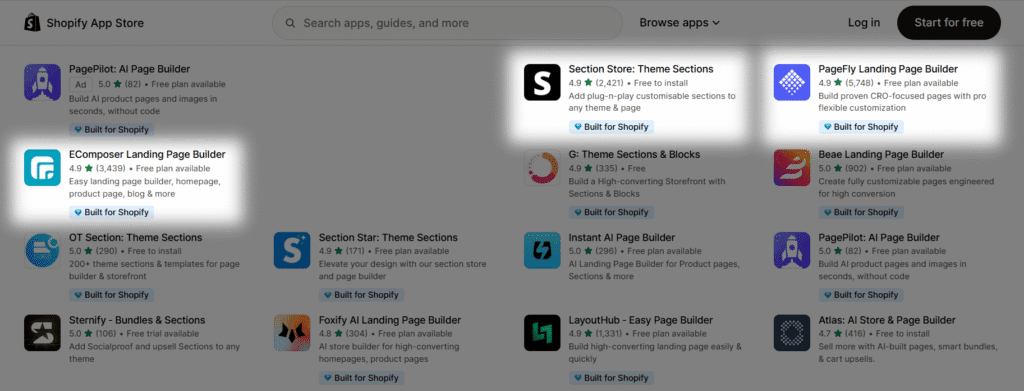
Here’s how three of the top contenders stack up:
| Tool Name | Best For | Starting Price (Monthly) | Key Feature |
|---|---|---|---|
| Section Store | Beginners & Value | $0 (Free to install) | Built for Shopify, plug-and-play customizable sections for most themes, strong page-speed focus, and optional one-time premium sections instead of committing to a full page builder |
| PageFly | Design Flexibility | $0 (Free plan available) | Generous free plan, huge element library, drag-and-drop builder, and strong responsive design controls for custom landing pages and product pages |
| EComposer | Ease of Use & Speed | $0 (Free plan available) | Very user-friendly interface, optimized for fast page load speeds, plus AI-powered layout/content tools and 28+ built-in sales extensions |
While all three are strong options, the best choice depends on what you need right now. For most Shopify merchants, Section Store is the best overall recommendation — especially if you want a simpler, faster, and more cost-efficient way to upgrade your storefront without paying for a full page builder.
Other Business Operating Costs to Budget For
Finally, it’s crucial to remember that your Shopify store is the center of a real business, which has real-world operating costs. From my experience, a realistic budget must also account for:
- Marketing & Advertising: This will likely be your largest variable expense. Whether it’s running ads on Facebook and Google, paying for influencer collaborations, or content marketing, you need a dedicated budget to attract new customers.
- Inventory Costs:
- If you are not dropshipping, the cost of purchasing and storing your products is a major ongoing expense that directly impacts your cash flow.
- If you are utilizing an inventory-free model, review our exact breakdown of how much money you need to start Shopify dropshipping to set realistic expectations.
- Business Licenses & Taxes: Depending on your location, you may have fees for business registration. You also need to plan for collecting and remitting sales tax.
The Shopify Budgeting Worksheet: 3 Real-World Cost Scenarios
“It depends” is the most accurate answer, but it’s also the least helpful when calculating a shopify website cost. To give you a concrete starting point, we’ve modeled three realistic budget scenarios based on actual merchant data.
Whether you are testing a new product idea or migrating an established brand, one of these profiles likely fits your situation.
Scenario 1: The Bootstrapped Startup
Best For: Solopreneurs, dropshippers, or creators launching their first store.
The Strategy: Keep overhead low. You do the setup work yourself (DIY), invest in a high-quality theme to look professional, and stick to the Basic plan until sales pick up.
| Cost Category | Item | Estimated Cost |
|---|---|---|
| One-Time Setup | Total Upfront | ~$350 |
| Domain Name | $15 | |
| Premium Theme | $335 | |
| DIY Setup | $0 (Your Time) | |
| Monthly Recurring | Total Monthly | ~$90 – $110 |
| Shopify Basic Plan | $39 | |
| Email Marketing (Starter) | $0 – $20 | |
| Reviews App (Basic) | $10 | |
| Upsell App | $20 |
Scenario 2: The Small Business Launch
Best For: Established small businesses moving online or funded startups.
The Strategy: You have a budget to save time. You hire a freelancer to handle the technical setup and design customization, ensuring a polished launch. You choose the “Shopify” plan early to save on transaction fees as you expect immediate sales volume.
| Cost Category | Item | Estimated Cost |
|---|---|---|
| One-Time Setup | Total Upfront | ~$1,500 |
| Domain Name | $15 | |
| Premium Theme | $350 | |
| Freelancer (Setup/Design) | $1,135 (approx. 10-15 hrs) | |
| Monthly Recurring | Total Monthly | ~$250 |
| Shopify Plan | $105 | |
| Email Marketing (Growth) | $45 | |
| Reviews App (Pro) | $30 | |
| SEO/Page Builder App | $30 | |
| Accounting Integration | $40 |
Scenario 3: The Scaling Brand
Best For: High-volume sellers ($20k+/month revenue) or brands requiring custom functionality.
The Strategy: Efficiency and automation are key. You invest in the Advanced plan for the lowest transaction fees and better reporting. You likely hire an agency or developer for custom coding to tailor the theme perfectly to your brand.
| Cost Category | Item | Estimated Cost |
|---|---|---|
| One-Time Setup | Total Upfront | ~$5,000+ |
| Domain Name | $15 | |
| Premium Theme | $350 | |
| Agency/Developer Retainer | $4,500+ (Custom Dev) | |
| Professional Photography | $500+ | |
| Monthly Recurring | Total Monthly | ~$500+ |
| Shopify Advanced Plan | $399 | |
| Email & SMS Marketing | $100+ | |
| Full Tech Stack (Loyalty, UGC) | $150+ | |
| Advanced Analytics/Reporting | $50+ |
Conclusion: Is Shopify Worth the Investment?
As we’ve seen, the total Shopify website cost is more than the sticker price on a subscription plan. It’s a dynamic figure that includes your platform fee, one-time design choices, and the ongoing app subscriptions that power your growth. Each of these components is a direct investment in your business’s functionality, customer experience, and marketing muscle.
While the numbers can seem daunting—and I know they often are—Shopify’s true value lies in its scalability and robust ecosystem. You aren’t just paying for a website; you’re gaining access to a secure, world-class commerce platform that can grow with you from your first sale to your millionth. The ability to add powerful features through the app store means you can build a tech stack that rivals enterprise brands, all for a predictable monthly cost.
For serious entrepreneurs ready to build a lasting business, the combination of power, security, and scalability provides an unmatched return on investment. But what does that return actually look like? To understand the potential upside, it’s helpful to see our data-backed analysis of how much the average Shopify store makes per month.
Ready to build your business? Click the button below to start Shopify’s 3-day free trial & enjoy $1/month for 3 months. Launch your store today.


Disclosure: As an official Shopify Media Partner, I may earn a small commission if you choose to sign up—at no additional cost to you. This support helps me keep creating valuable, free content for you.
FAQs About Shopify Website Costs
Here are straightforward answers to some of the specific questions new merchants have when budgeting for their shopify website cost.
Can I start using Shopify for free?
Yes, you can start with a 3-day free trial to build your store and explore all the core features without any commitment. This gives you full access to the dashboard to see how it works. After the trial, you can take advantage of Shopify’s introductory offer, which is often “$1/month for 3 months,” giving you a very low-risk way to officially launch and start selling.
Is Shopify cheaper than building a WooCommerce store?
This depends on how you measure cost. While WooCommerce is a free plugin, you must pay separately for web hosting, security (SSL certificates), premium themes, and paid extensions to match Shopify’s out-of-the-box functionality. When you consider the TCO, Shopify’s all-inclusive monthly fee—which covers hosting, security, and support—often proves more predictable and cost-effective, especially for those who are not technically experienced.
Does Shopify take a percentage of my sales?
This is a common point of confusion. Shopify only charges a transaction fee (from 0.5% to 2%) if you do not use their in-house payment processor, Shopify Payments. If you use Shopify Payments, this fee is waived. The only per-sale fee you’ll pay is the standard credit card processing rate (e.g., 2.6% + 30¢), which is a mandatory fee for any online store, on any platform.